







In this blog post, you will see:
- The definition of an AI agent.
- How AI agents work and what their main components are.
- The primary types of AI agents based on intelligence and behavior.
- All the steps required to build an AI agent.
- The best tech stack for developing AI agents.
- Real-world examples of agents.
Let’s dive in!
What Is an AI Agent?
An AI agent is a software system that can perform tasks autonomously, using tools and making decisions to achieve a goal with little or no human intervention (except in human-in-the-loop scenarios).
To reach their objectives, AI agents commonly plan, reason, and adapt their actions by orchestrating multiple processing steps, leveraging memory, and integrating with external tools such as APIs, databases, or third-party solutions.
How AI Agents Work and What Elements They Consist Of
AI agents operate by executing an autonomous cycle aimed at achieving a goal, which is generally complex and involves multiple steps. To do that, they need to perceive their environment, reason about the information they have access to or have retrieved, take action, and learn from the outcomes, continuing this cycle until they determine the objective has been reached.
Unlike traditional calls to LLMs, which usually perform a single task, AI agents can engage in multi-step problem-solving while adapting their strategies and learning from their mistakes.
An AI agent’s behavior depends on various factors, especially the conceptual architecture it relies on. Broadly, its workflow consists of a loop of phases like perception, reasoning, action, learning, etc. Together, these phases enable the agent to pursue its objectives autonomously.
From a technical perspective, an agent can be implemented as simply as a while True loop with an exit condition based on goal verification. For example, this is how Hugging Face recently implemented its Agent class. Learn more about how to build a Hugging Face AI agent.
The Core Components of an AI Agent
An AI agent typically consists of several key components that enable autonomous and adaptive behavior. These are:
- Large language model (LLM): Often referred to as the “brain” or “engine” of the agent, the AI model provides the foundational reasoning and natural language processing capabilities. It gives the agent the ability to interpret user inputs, generate responses, and formulate plans. Note that a single agent can use multiple LLM modules (e.g., one for reasoning, another for planning, and a third for goal verification). Also, the AI model can be either remote or hosted locally.
- Memory: Essential for maintaining context and learning over time, an agent’s memory is usually organized into two systems:
- Short-term memory: Handles the immediate context of a current task or conversation, storing recent information necessary for ongoing coherence. In most cases, this is implemented using in-memory data structures or databases, such as temporary caches, session-based storage, or Redis, as fast access and low latency are pivotal here.
- Long-term memory: Stores factual knowledge, past experiences, user preferences, and skills accumulated over multiple sessions. This component allows the agent to maintain continuity and provide more personalized, context-aware responses. Common technologies for long-term memory include vector databases (e.g., Pinecone, Weaviate, FAISS) for storing embeddings, SQL/NoSQL databases and document stores or knowledge bases (e.g., MySQL, PostgreSQL, MongoDB, etc.).
- Tools: LLMs have limited knowledge and cannot perform every task on their own. AI agents extend their capabilities by integrating external tools, which allow the underlying LLM to interact with the environment and the external world (e.g., accessing the file system, browsing the web, or interfacing with business infrastructure). These tools support the agent in performing specific tasks such as web scraping, interacting with websites, creating files, and more. To manage tool usage, agents rely on various AI protocols, with MCP (Multi-Tool Control Protocol) being the most popular (at the moment, at least).
- Execution runtime: This orchestration layer manages the agent’s overall workflow. It checks that plans are followed, sequences tool calls correctly, and coordinates all moving parts. Additionally, it can facilitate the deployment and management of the AI agent’s architecture. Examples of execution runtimes include LangChain, LlamaIndex, CrewAI, AutoGen, and others.
Further reading:
- Inside the AI Agent Tech Stack
- Best AI Web Scraping Tools: Complete Comparison
- Building AI-Ready Vector Datasets for LLMs: A Guide with Bright Data, Google Gemini, and Pinecone
Types of AI Agents
In this section, we will focus on the different types of AI agents. These will be classified according to their level of decision-making and how they interact with their environment to reach desired outcomes.
Note: There are many ways to categorize AI agents, but this classification is among the most relevant. That is because it clearly defines how an agent behaves and makes decisions. Other possible classifications include those based on the reasoning paradigm, such as ReAct, ReWOO, and others.
Further reading:
Simple Reflex Agents
The simple reflex agent is the most basic type of AI agent. It relies solely on the current environmental input and a set of predefined condition-action rules to make decisions. It does not maintain any internal state, memory of past experiences, or consider future consequences. Actions are immediate and reactive.
Model-Based Reflex Agents
A model-based reflex agent is an improvement over the simple reflex agent. It incorporates an internal model of the world, which helps the agent track the current state and understand how past interactions or actions have impacted the environment. That means it can function even in partially observable settings.
While still using condition-action rules, the decision is based on both the current percept and the reasoned internal state. This memory and reasoning about the environment’s dynamics allows for more informed and effective decisions than its simpler counterpart.
Goal-Based Agents
Goal-based agents are proactive and have a specific goal or objective. They use planning and reasoning to evaluate different possible actions and select the sequence of steps that will lead them closer to achieving that goal. These AI agents can look ahead to the desired future state, making their decisions based on a logical assessment of outcomes relative to the objective.
Utility-Based Agents
Utility-based agents go beyond simple goal achievement by using a utility function to maximize overall benefit or happiness. They evaluate a range of possible outcomes and assign a numerical utility value to each, enabling them to make nuanced decisions that balance competing objectives or tradeoffs (e.g., speed vs. safety).
Learning Agents
A learning agent improves its performance over time by adapting to new experiences and data based on feedback from its environment. It continuously updates its behavior through a learning component. A common mechanism used to implement learning agents is reinforcement learning, where the agent learns which actions maximize its reward through continuous trial and error.
Further reading:
Multi-Agent Systems
Multi-agent systems involve multiple interacting agents working together to handle complex problems. Higher-level agents may focus on overarching goals, while lower-level agents handle specific subtasks. The core concept is AI orchestration, where a system integrates these diverse agents to manage complex tasks across multiple domains. One of the most popular libraries to implement multi-agent systems is CrewAI.
Further reading:
- Building a Real Estate Agent with CrewAI & Bright Data
- Building a Multi-Source Review Intelligence Agent with CrewAI and Bright Data
- Content Optimization for GEO with CrewAI and Bright Data
Building an AI Agent: From Ideation to Deployment
The steps below illustrate everything you need to do to go from zero to having an AI agent online. Let’s go through them!
1. Define the Purpose
Think about the tasks the agent should handle at a high level and the scenarios it should be able to cover. Agents should be specialized enough to solve specific problems. Still, sometimes, you want to build agents to perform a wide range of tasks and cover multiple use cases.
No matter what, you must have a clear understanding of the purpose behind your AI agent. You might even realize that you do not actually need a full agent, and a simple AI workflow is sufficient.
2. Design Agent Workflow
Represent the agent visually as a map of nodes, with each node corresponding to a component, as in the example below: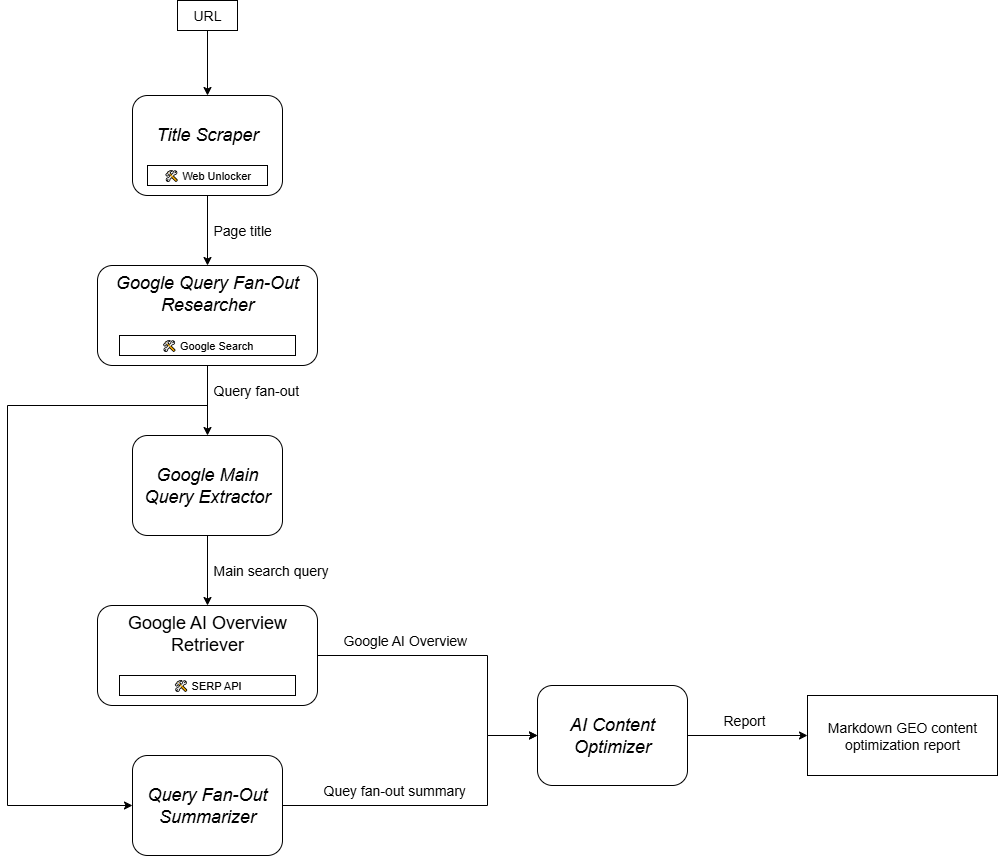
In some cases, it is better to think in terms of steps rather than components. This process helps you clearly define the workflow and establish the expected input and output for each node/step.
3. Select Data Sources
An AI agent is only as powerful as the data and information it can access. Therefore, you need to identify and provide the data your AI models require to achieve their goals. This can include APIs, web data, datasets, databases, or other data sources. Keep in mind that not all data formats are ideal for AI ingestion, as empirical benchmarks have shown.
In this regard, Bright Data offers a rich AI-ready infrastructure of products, which includes:
- Web Unlocker API: Bypasses anti-bot protections on websites, allowing you to retrieve any web page in HTML or Markdown format.
- SERP API: Unlocks search engine results and extracts SERP data from major search engines to power web search scenarios.
- Web Scraper APIs: Pre-configured APIs for structured data retrieval in AI-optimized formats from over 100 major domains.
- Browser API: Cloud-controllable browser instances that integrate with AI for programmatic web interactions, with built-in unlocking capabilities.
- Crawl API: Automates content extraction from any domain, retrieving full website content as Markdown, text, HTML, or JSON.
- Training data: AI-ready public web data and multi-modal datasets from popular platforms, with several billion entries available.
4. Select the AI Model(s)
Platforms like OpenRouter and Hugging Face list several thousand AI models. Some are general-purpose, like OpenAI or Gemini models, while others are fine-tuned for niche applications. Based on your agent’s visual workflow and high-level architecture, select the AI models that will power each node requiring LLM integration.
Further reading:
- Fine-Tuning GPT-OSS: A Step-by-Step Guide Using Unsloth
- Fine-Tuning Llama 4 with Fresh Web Data for Better Results
- Fine-Tuning Gemma 3: A Step-by-Step Guide with Custom Q&A Dataset
- How To Fine-Tune GPT-4o With a Web Scraper API Using n8n
5. Integrate with Tools
LLMs are great for content generation but limited in other functionalities and by their training data. To extend your agent’s capabilities, identify the tools your LLM-powered nodes need. These tools can be custom-built (e.g., by calling external APIs), rely on local task runners, or come from ready-to-use services like MCP servers.
Note: Bright Data MCP enables LLMs and AI agents to access the web effectively, allowing them to search, extract, and navigate online content without getting blocked, thanks to over 60 integrated tools. Remember that it also offers a free tier for usage without a charge.
Further reading:
- How to Integrate Bright Data MCP with smolagents
- Connect LangChain Agents to Bright Data MCP Easily
- CrewAI & Bright Data MCP: Advanced Web Scraping Guide
- AutoGen AgentChat Integration with Bright Data MCP
- Integrate Pydantic AI with Bright Data MCP
- Build AI Agents Using AWS Strands SDK + Bright Data MCP
- Bright Data MCP integrations
6. Implement Logic
Using a chosen AI agent framework or low-code/no-code solution, implement your agent by translating your design into a functional system. This includes connecting AI models, tools, and other components.
The AI agent implementation may involve writing scripts, creating configuration files, and defining prompts to guide LLM-powered nodes in performing their specific tasks. In the case of multiple AI agents, you can also leverage protocols like A2A (Agent-to-Agent) for inter-agent communication.
Further reading:
- Build AI Agents with Pica and Bright Data
- Use Dify to Build AI Agents with Data Retrieval Capabilities
- Build AI Agents With Web Data Using LlamaIndex
- – Build AI Agents with Scraping Capabilities in xpander.ai
- How to Build an AI Scraper Powered by Hugging Face and Bright Data
7. Test and Iterate
Once the agent is runnable, test it against both simple and intricate scenarios. Verify that each step produces the expected input and output. Testing also helps refine the agent’s infrastructure, such as identifying the need for additional tools, different models, or better prompts. Edge-case testing is especially important for accuracy and reliability. Additionally, you will likely encounter some errors and may realize that you require a more robust error-handling process.
8. Deploy and Monitor
Finally, deploy your agent, either on the cloud or on-premises. Implement monitoring tools to track the agent’s behavior in real-world conditions. Feedback from monitoring helps you iterate and improve the agent. Keep in mind that new models, tools, or capabilities may become available, so continuously update your agent to leverage the latest AI advancements.
Further reading:
Best Tech Stacks for AI Agent Development
Now, as is often the case in software development, there is no single “best” tech stack for building AI agents. Instead, success depends on making the right choices for each component involved in the AI agent development process (e.g., as AI providers, LLMs, databases, prompt versioning tools, etc.).
Here, we will focus on the most important aspect of the stack: the framework or solution used to actually build the AI agent!
Below, you will find a table with more than 15 of the most popular open-source options, sorted by GitHub stars:
| AI Agent Framework | Programming Languages | GitHub Stars |
|---|---|---|
| AutoGPT | — (low code/no code) | 179k+ |
| Langflow | Python, TypeScript/JavaScript | 134k+ |
| LangChain | Python, JavaScript/TypeScript | 118k+ |
| Dify | — (low code/no code) | 117k+ |
| AutoGen | Python, .NET | 51k+ |
| Flowise | — (low code/no code) | 46k+ |
| LlamaIndex | Python, JavaScript/TypeScript | 44.9k+ |
| CrewAI | Python | 39.6k+ |
| Agno | Python | 34.5k+ |
| ChatDev | Python | 27.6k+ |
| Semantic Kernel | Python, .NET, Java | 26.5k+ |
| smolagents | Python | 23.5k+ |
| Letta | Python, TypeScript | 18.9k+ |
| OpenAI Agents SDK | Python, TypeScript | 16.8k+ |
| Google Agent Development Kit (ADK) | Python, Java | 13.9k |
| PydanticAI | Python | 13k+ |
Note: Bright Data is officially integrated via MCP with most of the technologies listed above, as well as many others. Explore all 70+ available integrations.
Further reading:
AI Agent Examples
Now that you have a clear understanding of what AI agents are, how they work, what they consist of, and the tools used to build them, the last step is to see them in action.
For that reason, we recommend checking out our AI Agent Showcase, which features a selection of AI agents built with various technologies and designed to cover a wide range of use cases.
Further reading:
- TrendScan: A multi-source company intelligence platform for automated collection and AI-powered analysis of company data from Crunchbase, LinkedIn, Reddit, and Twitter/X.
- Unified Search Agent: A sophisticated multi-modal search agent built with LangGraph that intelligently routes between Google search and web scraping based on query intent classification
- Real Estate AI Agent System: An intelligent Python system that extracts real estate property data as structured JSON using AI agents, Nebius Qwen LLM, and Bright Data MCP.
- GEO AI Crew: An AI-powered tool to audit and optimize website content by crawling URLs, analyzing H1s, and generating actionable GEO recommendations with CrewAI.
- FactFlux: An intelligent multi-agent system for fact-checking social media posts using Agno framework and Bright Data tools.
- AI Travel Planner: An AI Agent automating Travel Planning with n8n and Real-time scrape using Bright Data.
Conclusion
In this article, you learned everything you need to know about building AI agents. By reading this, you now have the information to develop AI agents, as well as plenty of resources for further reading to become even more of an expert in this trending topic.
No matter what your AI agent building goals are, having a reliable web data partner makes all the difference. After all, as highlighted here, agents are only as good as the knowledge they have, which depends entirely on the data they can access.
That is where Bright Data comes in, offering a complete infrastructure of AI solutions to support a wide range of agent scenarios and use cases.
Create a Bright Data account and integrate our web data tools into your AI agents for free today!
FAQ
AI Agents vs. Agentic AI: What Is the Difference?
AI agents carry out entire processes autonomously. In contrast, agentic AI refers to a higher-level system capable of coordinating multiple agents to accomplish more complex objectives. It can plan, reason, and adapt dynamically without ongoing human input. In short, AI agents handle tasks, while agentic AI serves as the intelligent infrastructure that orchestrates them.
AI Agents vs. AI Workflows: What Are the Main Differences?
AI workflows are processes that follow a predefined sequence of steps or logic. They are great for high predictability and are ideal for structured, repetitive tasks. On the other hand, AI agents are non-deterministic systems that possess autonomy and use reasoning to dynamically plan, choose tools, and adapt their actions in real-time. They are ideal for open-ended problems where the solution path is not predefined.
What Are the Best Technologies to Build AI Agents?
Agentic AI focuses on autonomous task execution, such as planning, tool use, state tracking, and decision-making to complete goals. Instead, generative AI (also called GenAI) creates new content like text, images, videos, or code based on prompts. Thus, agentic AI coordinates, and generative AI creates. Dive deeper into our article on agentic AI vs generative AI.
What Are the Best MCP Servers for AI Agent Integration?
Some of the MCP servers for AI agents include Bright Data MCP for real-time web data and structured extraction, GitHub for automating development workflows, Supabase for database and backend management, Playwright MCP for browser automation, and Notion for knowledge management. Other notable servers include Atlassian, Serena, Figma, and Grafana. Discover them all in our article on the best MCP servers for AI agents.
What Is Agentic RAG?
Agentic RAG is an advanced form of RAG (Retrieval-Augmented Generation) that uses autonomous AI agents to intelligently control and adapt the retrieval and response-generation process. See how to build an agentic RAG system with Bright Data.



Technical Writer
 5.5 years experience
Antonello Zanini is a technical writer, editor, and software engineer with 5M+ views. Expert in technical content strategy, web development, and project management.