







In this article, we are going to cover:
- What job API, datasets, and DIY scraping are, and how to choose the right approach for your use case
- The best job data APIs and providers in 2026, with a full breakdown of features, sources, pricing, and limitations
- How to match the right provider to your specific use case, whether you’re building a job board, training an AI model, or running labor market research
💡 Bright Data also provides ready-to-use datasets and managed data services
TLDR: All Providers at a Glance
| Provider | Best For | Sources | Freshness | Free Option | Entry Price |
|---|---|---|---|---|---|
| Bright Data jobs data | Enterprise, AI/ML, full flexibility | LinkedIn, Indeed, Glassdoor + more | Real-time (API); periodic (datasets) | Free tier: 5,000 records/mo | $2.50/1K records (datasets); $0.75/1K records (Scraper API) |
| Coresignal | Professional-network depth + employee enrichment | Job boards, company career pages, ATS platforms, aggregators | Active postings revisited within 24h | 7-day trial (2,000 credits) | $49/mo (API); from $1,000 (datasets) |
| TheirStack | Multi-source coverage, sales intelligence | 315K+ sources + ATS platforms | Near real-time (1 min) | 200 credits/mo free | $59/month |
| Oxylabs | Custom scraping pipelines | Indeed, Glassdoor, StackShare | Configurable | 1-week trial (5K results) | $49/mo (API); $1,000/mo (datasets) |
| SerpApi | Google Jobs data on a budget | Google Jobs (aggregated) | Real-time | 100 searches/mo free | $25/month |
| LinkUp | Clean direct-source, enterprise research | Employer career pages | Daily | None | Custom (demo required) |
| Revelio Labs | Workforce intelligence | Multi-source + career pages | Daily | Demo-gated trial | Custom |
| Techmap | Historical bulk data, budget-conscious | 185 published sources | Regular | Free sample + free API plan | $1/1K jobs (API) |
Whether you are building a job board, powering a sales intelligence tool, or running labor market research, the method you use to collect job data will define your project’s ceiling. Build a scraper from scratch and you inherit every maintenance headache that comes with it: broken parsers when sites restructure, CAPTCHA arms races, deduplication logic you wrote yourself at 2 AM. Use the right API or dataset provider and those problems disappear.
This guide cuts through the noise. Below you will find the top job APIs and data providers in 2026, what they actually deliver, what they cost, where they fall short, and which use case each one fits best.
API vs Dataset vs Scraper: Choose Your Approach First
Before you evaluate providers, you need to be clear on what kind of product you are buying. The three options work very differently.
Job APIs let you query a provider’s database in real time via REST endpoints. You send a request, get structured JSON back. Best for: job boards that need live search, sales tools triggering on fresh postings, and applications where latency matters.
Pre-built datasets are bulk exports of tens or hundreds of millions of records delivered to your cloud storage (S3, GCS, Azure, Snowflake). You download once or subscribe to periodic refreshes. Best for: AI/ML training, bulk historical analysis, and workflows where you process data offline. Cost per record is significantly lower than API calls at scale.
DIY scraping means you build and maintain everything yourself. Tools like Bright Data’s proxies can handle the infrastructure layer, but the parsing logic, deduplication, and schema normalization are still on you. Best for: niche sources no provider covers yet, or when you need maximum control. Ongoing maintenance typically costs 20+ hours per month per scraper target. For a deeper look at what that entails, see the common challenges of building your own web scrapers.
A practical rule of thumb: if you need fewer than 50K records per month and real-time access, an API is usually cheaper and simpler. Above that volume, datasets become more cost-effective. If your target sources do not exist in any provider’s catalog, build with infrastructure tools.
The Best Job APIs and Data Providers in 2026
1. Bright Data: Best Overall for Enterprise-Grade Flexibility
Bright Data does not offer a single job product. It offers an ecosystem. You can buy pre-built datasets, scrape in real time via dedicated Scraper APIs, build custom pipelines using Scraper Studio (a no-code scraper), or pull from the Web Archive for historical snapshots. This flexibility is what separates it from every other provider on this list.
Datasets and scrapers available:
- LinkedIn Scraper API
- Glassdoor Scraper API
- Indeed Scraper API
- LinkedIn job listings: 57M+ records
- Indeed job listings: 46M+ records
- Glassdoor listings: 36M+ records
And a lot more.
Each dataset ships in JSON, CSV, NDJSON, JSON Lines, or Parquet, and can be delivered directly to S3, Snowflake, Google Cloud, Azure, or SFTP. You can subscribe for monthly, quarterly, or biannual refreshes, or purchase a one-time snapshot. The AI filter feature lets you describe your data requirements in plain English and have filters applied automatically, a genuine time saver when you are narrowing 86M records down to what you actually need.
For real-time access, the LinkedIn Jobs Scraper API starts at $1.50/1K records on pay-as-you-go, or $0.75 to $0.98/1K records on monthly subscription plans. Dedicated scrapers exist for Indeed and Glassdoor jobs as well.
What sets Bright Data apart:
- Full GDPR and CCPA compliance with ISO 27001 certification, so the legal risk shifts to Bright Data and not your team
- 70+ integrations including Zapier, n8n, Make, LangChain, LlamaIndex, and CrewAI
- AI-optimized datasets with code examples for ChatGPT and Claude integration out of the box
- Official MCP server for AI agent frameworks
- Free sample datasets in JSON/CSV before you commit to a purchase
- 24/7 support from 80+ data professionals, with dedicated account managers at scale
Pricing: Datasets start at $2.50/1K records ($250 minimum order). Scraper APIs start at $0.75/1K records on subscription. A free tier of 5,000 records per month is available.
Best for: Enterprises, AI/ML teams, and researchers who need multi-source coverage with no infrastructure overhead and full compliance built in.
Not the right fit if: You need fewer than 5K records and want a free tier. TheirStack or SerpApi serve that scenario better.
2. Coresignal: Best for Professional-Network Depth with Employee Context

Coresignal’s main selling point is the depth of its professional-network data. It combines that with employee and company enrichment in one platform. Its jobs data covers 475M+ postings from job boards, company career pages, ATS platforms, and aggregators. Records go back to 2020. The Multi-Source Jobs API returns those postings deduplicated and enriched across 85+ job data fields. Those fields cover recruiter information, seniority, salary, benefits, and company firmographics. Coresignal reports 70M+ active postings, each revisited within 24 hours. For teams evaluating alternatives, a comparison of top Coresignal alternatives can help benchmark where it fits.
The API works on a single monthly credit balance. There is no separate Search and Collect allocation. A job posting costs 1 credit on both the Base and Multi-Source Jobs APIs. So the deduplicated, enriched multi-source records carry no credit premium over single-source ones. They still save you from building deduplication and company-join pipelines yourself. Other record types differ: Base and Clean company or employee records cost 10 credits. Multi-source company or employee records cost 20, and contact enrichment costs 20.
Pricing tiers (API):
- Free trial: 7 days, 2,000 credits, no credit card required
- Mini: $49/month (2,500 credits)
- Starter: $199/month (12,000 credits)
- Pro: $499/month (35,000 credits)
- Growth: $1,000/month (150,000 credits)
- Premium: $1,500/month (1,000,000 credits)
- Scale: $3,000/month (4,000,000 credits)
- Elite: $5,000/month (10,000,000 credits)
- Datasets: from $1,000
Because a job posting costs 1 credit, the per-job price drops sharply as you move up. Ten thousand postings a month fit inside the $199 Starter plan and its 12,000 credits. That works out to roughly $0.017 per job at list price. Pro lands near $0.014 per credit, Growth near $0.007, and Premium near $0.0015. Annual billing takes about 10% off those list prices. Mini through Growth are self-service; Premium and above go through sales.
Run the numbers against your own monthly volume rather than anchoring on one tier. Coresignal’s public pricing page has a calculator that maps an estimated credit count to a plan. Plan names, prices, and credit allocations here were verified against that page on August 19, 2026. Check it before budgeting, since providers on this list revise pricing regularly.
What Coresignal does well:
- Large multi-source job coverage (475M+ job postings, 70M+ of them active)
- 7-day free trial with 2,000 credits and no credit card required
- AI-ready datasets with MCP server integration, plus Zapier and Clay connectors
- Self-service platform with API playgrounds and AI data search for exploring data before writing code
- GDPR and CCPA compliant
- Employee data alongside job data, which is unique among providers on this list
Limitations:
- Entry plans are small: Mini gives 2,500 credits a month, so volume moves you up quickly
- Retrieval is a two-step flow, search then collect, though Bulk Collect cuts the round trips
- The largest plans (Premium and above) are sales-assisted rather than self-service
Best for: Sales intelligence teams that need recruiter contacts alongside job data. Also teams wanting deduplicated multi-source postings with company and employee enrichment resolved for them.
3. TheirStack: Best for Multi-Source Coverage at Low Cost
TheirStack aggregates job postings from 315,000+ sources, including LinkedIn, Indeed, Glassdoor, and 16,000+ ATS platforms including Greenhouse, Lever, and Workable, and deduplicates them automatically. The database updates every minute. What TheirStack uniquely offers is the ability to filter jobs by company attributes: size, funding stage, industry, and tech stack. You can find “Series B fintech companies hiring ML engineers” without building the enrichment pipeline yourself. Understanding the underlying firmographic data that powers these filters helps explain why this capability is so valuable for sales-driven workflows.
Pricing:
- Free: 200 credits/month
- $59/month: 1,500 credits (~1,500 jobs)
- $169/month: 10,000 credits
- $400/month: 50,000 credits
- $1,500/month: 1,000,000 credits
At roughly $0.0015 to $0.039 per job depending on tier, TheirStack is among the cheapest options for multi-source coverage. Unused credits roll over for up to 12 months.
What makes TheirStack stand out:
- Near real-time updates every minute
- Built-in deduplication across all 315K sources
- Webhooks for real-time job alerts
- Filter jobs by company firmographics and tech stack in a single API call
- No-code web app for non-technical users
Limitations:
- No employee data alongside job listings
- Less established than Bright Data or Coresignal for enterprise procurement
Best for: Sales teams, job board builders, and developers who want broad coverage, low cost, and built-in deduplication without stitching together multiple providers.
4. Oxylabs: Best for Teams Building Custom Data Pipelines

Oxylabs sits in the same tier as Bright Data: a large infrastructure provider with dedicated job scraping products. Its datasets cover Indeed, Glassdoor, and StackShare, with delivery options via AWS S3, Google Cloud, Azure, and SFTP. The Jobs Web Scraper API supports custom parsers, a built-in web crawler, and the OxyCopilot assistant that converts natural language instructions into working API code in Python, Node.js, and more.
What Oxylabs offers:
- Standard job posting datasets from major job boards
- Custom datasets built to your specifications
- Dedicated account managers with Slack channel access
- One-week trial with 5K results for the Scraper API
Pricing:
- Standard Job Posting Datasets: from $1,000/month
- Scraper API: from $49/month ($2/1K results)
- Custom datasets: contact sales
Best for: Teams with engineering resources that need raw, unprocessed job data from specific sources, or organizations already using Oxylabs’ proxy infrastructure. If you are not already in the Oxylabs ecosystem, Bright Data offers comparable products with more job-specific coverage options.
5. SerpApi: Best for Google Jobs Data
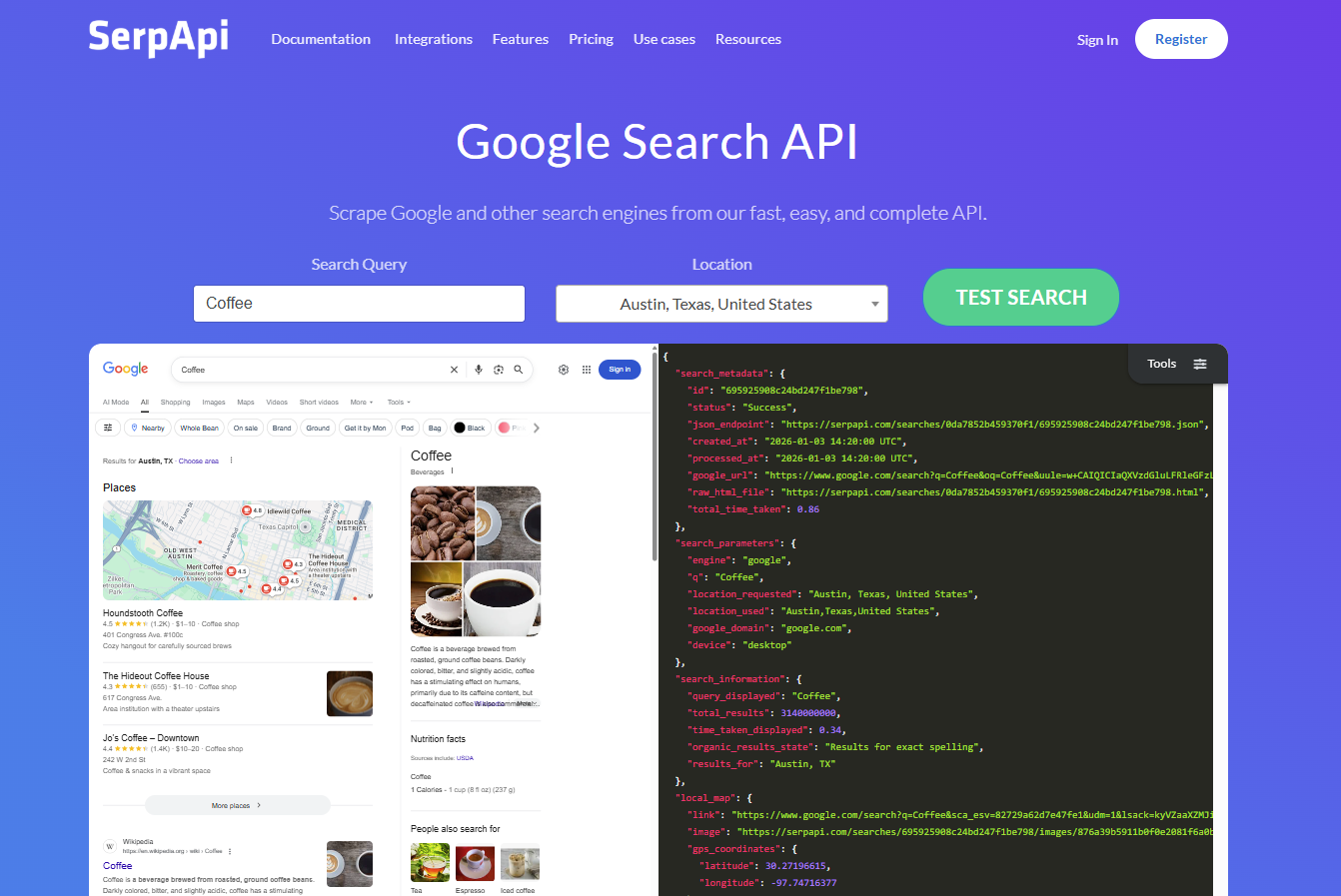
SerpApi is primarily a SERP API provider, but its Google Jobs endpoint is worth calling out specifically. Google Jobs aggregates listings from thousands of sources including Indeed, LinkedIn, ZipRecruiter, and Workday, and SerpApi lets you pull that data programmatically. You get job title, company, location, description, apply links, salary (where Google displays it), and filters for employment type, date posted, and remote work.
Pricing:
- Free plan: 100 searches/month
- Starter: $25/month (500 searches)
- Developer: $75/month (5,000 searches)
- Production: $150/month (15,000 searches)
- Big Data: $275/month (30,000 searches)
What makes SerpApi useful:
- Hits Google’s aggregated job data, giving very broad source coverage by proxy
- Simple REST API with excellent documentation
- 99.977% uptime
- No infrastructure to manage
Limitations: You are limited to what Google Jobs surfaces, with no historical data, no bulk downloads, and no deduplication control. It works great for building job search features that mirror what Google shows. It is not a replacement for a dedicated job data provider if you need scale or custom filters.
Best for: Developers building job search features on a budget who need broad coverage quickly, or any application where “jobs Google knows about” is a sufficient data source. Bright Data’s own Google Search API is worth comparing if you need deeper SERP customization alongside job data.
6. LinkUp: Best for Clean Company-Sourced Enterprise Data
LinkUp has crawled directly from employer career pages since 2007, with no job boards and no LinkedIn scraping. The result is clean data with zero recruiter spam, no reposted jobs, and no duplicates across platforms. Their database holds 315M+ historical job postings across 195 countries, with approximately 5M daily active listings.
For quality-obsessed use cases like economic research, workforce forecasting, or hedge fund signal generation, LinkUp’s direct-source methodology matters. They maintain a “broken scrapes queue” that flags companies whose career pages have changed, typically restoring data within 24 hours for public companies.
Limitations: Enterprise-only with no self-serve option, no public pricing, and no free tier. Acquired by GlobalData in late 2024, which introduces some uncertainty about product direction. You will need to contact sales for a demo and custom quote.
Best for: Large enterprises and research institutions doing labor market analysis that require clean, direct-source data with long historical depth.
7. Revelio Labs: Best for Workforce Intelligence
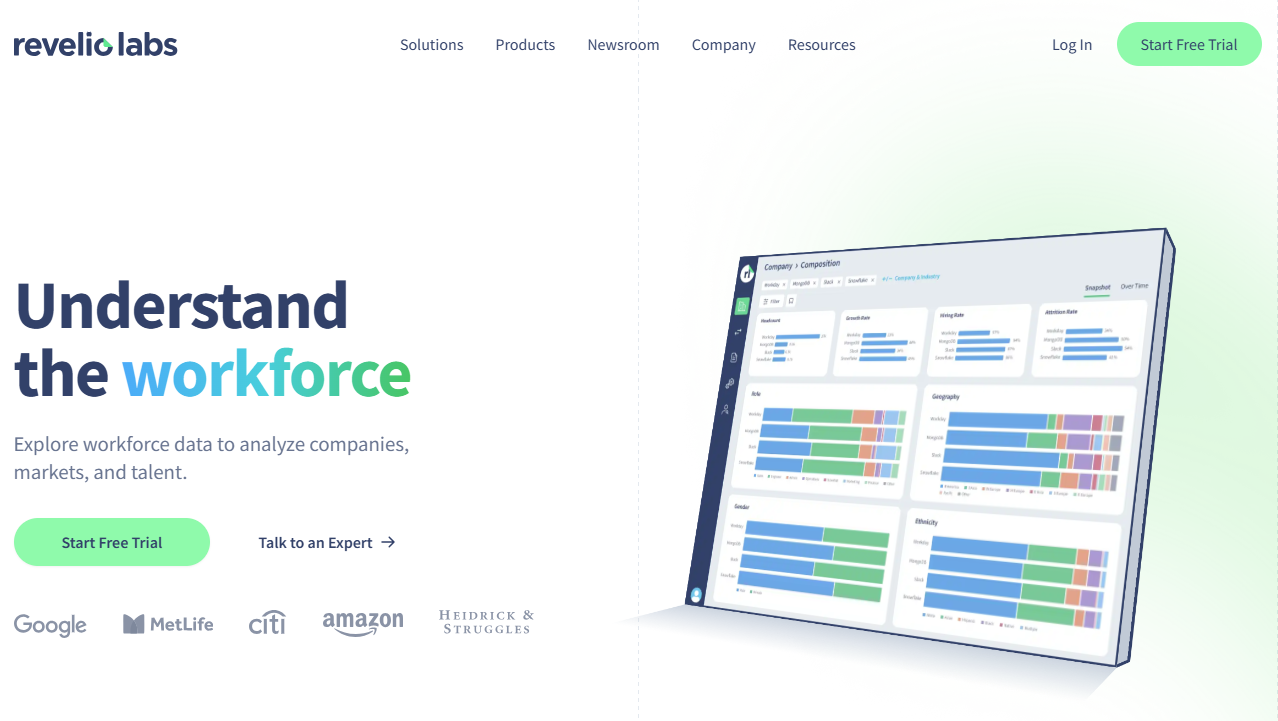
Revelio Labs positions itself as a workforce intelligence platform rather than a job data API. Its COSMOS dataset covers 4.1B+ current and historical job postings from 6.6M companies, deduplicated and normalized with skills taxonomies, occupation classifications, and workforce dynamics data including headcount, hiring rates, and attrition rates by company and department.
This depth of enrichment goes far beyond what any other provider offers, but it is priced and packaged for institutional buyers. No self-serve access, no public pricing, and a demo is required to get started. Those evaluating this category of enriched data alongside employee insights may also find value in reviewing the best employee data providers as a complementary reference.
Best for: HR analytics teams, academic researchers, and corporate strategists who need workforce intelligence, not just raw job listings.
8. Techmap / jobdatafeeds.com: Best Budget Option for Historical Bulk Data
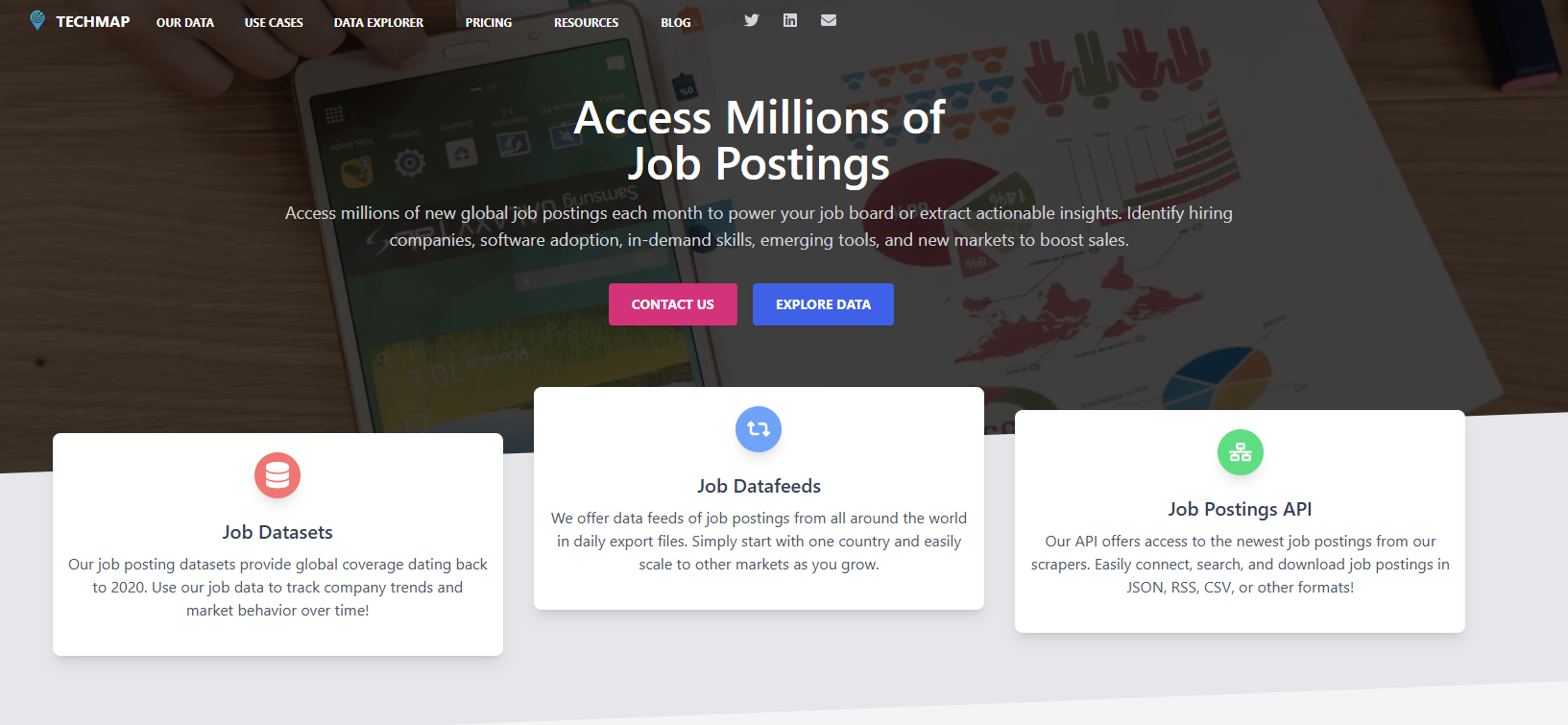
Techmap runs jobdatafeeds.com, providing job data feeds and historical datasets going back to January 2020. Its archive holds 451M+ job postings from 185 sources across 250 countries and territories, including Remote. With approximately 6.7M new global job postings per month and an API priced at $1/1,000 jobs, it is among the most cost-effective options for volume. Data feeds cost $400 per country per month. Historical datasets are a one-time purchase of $2,400 to $4,800 per country.
The API returns JSON, and the RSS API returns RSS feeds. Data feeds and datasets arrive as gzip-compressed JSON Lines files on AWS S3, via AWS Data Exchange. A free API plan and a free dataset sample are available before you commit.
Best for: Budget-conscious developers and researchers who need historical data breadth and are comfortable with a less established provider.
How to Choose the Right Provider
Building a job board or aggregator: Bright Data datasets for the initial bulk load, TheirStack or Bright Data’s dedicated Scraper APIs for ongoing fresh listings. TheirStack’s built-in deduplication saves meaningful engineering time if your board pulls from many sources.
Doing sales intelligence: TheirStack’s company attribute filters (industry, funding, tech stack) are uniquely powerful here. Bright Data works well at scale. Coresignal adds value when recruiter contact data is important to your workflow. For a broader view of this space, see the guide to the best B2B data providers.
Need professional-network data at scale: Coresignal or Bright Data’s LinkedIn datasets and scrapers. Coresignal bundles employee and company enrichment into the job record and resolves entities across sources. Bright Data offers more delivery models (API, scraper, dataset, custom) plus a free tier for validating coverage. Price both against your own monthly volume, since each uses volume-tiered pricing. The top LinkedIn scraping tools guide covers the full spectrum of options here.
Training an AI model: Bright Data’s AI-ready data packages with LLM-optimized formatting and native integrations for LangChain, CrewAI, and LlamaIndex. Coresignal also explicitly supports AI/ML workflows.
Running labor market research: LinkUp for clean direct-source historical data going back to 2007. Revelio Labs if you need workforce dynamics (headcount, attrition) alongside raw job postings. Bright Data’s Web Archive offers 50PB+ of historical data as an alternative source for longitudinal research.
On a tight budget: TheirStack’s free tier (200 credits/month) is genuinely usable for prototyping. SerpApi’s 100 free searches cover small experiments. For paid production use at minimum cost, TheirStack at $59/month offers the best breadth per dollar.
Already using a scraping infrastructure provider: Stick with Bright Data or Oxylabs for job data. You get easier integration, an existing account relationship, and a single vendor for infrastructure and data products.
Final Verdict
No single provider wins for every use case.
Bright Data is the most versatile option. It covers the most sources, offers every delivery model (API, scraper, dataset, custom), integrates with 70+ tools, and provides enterprise-grade compliance with ISO 27001 certification. If you are unsure exactly what you need, Bright Data’s ecosystem lets you start with a dataset and scale to real-time scraping without switching vendors. Start with the free tier to validate coverage before committing.
TheirStack is the best value play for developers and sales teams who want multi-source coverage, built-in deduplication, and near real-time freshness without paying enterprise prices.
Coresignal is the right call when you need professional-network depth with employee and company enrichment together. Its multi-source job records arrive deduplicated and ready to use out of the box.
SerpApi is the fastest path to Google Jobs data if you are building a job search feature and do not need historical access or dataset downloads.
Match the provider to the use case, validate with free samples before committing to scale, and do not underestimate the engineering cost of managing everything yourself.
Frequently Asked Questions
What is the difference between a job API and a job dataset?
APIs let you query job data in real time per request. Datasets are bulk exports of millions of records delivered to your storage. APIs suit dynamic applications; datasets suit bulk processing and deliver lower per-record cost at scale.
How much does a job API cost?
Free tiers exist at TheirStack (200 credits/month) and SerpApi (100 searches/month). Paid access starts at $25/month for SerpApi’s Starter plan. Coresignal’s self-service tiers run from $49/month (Mini) to $1,000/month (Growth), with larger plans sales-assisted. Bright Data’s Scraper APIs start at $0.75/1K records on subscription. Dataset pricing varies by volume.
Can I get historical job data?
Yes. Bright Data’s Web Archive provides 50PB+ of historical data. TheirStack archives go back to 2021. LinkUp goes back to 2007. Revelio Labs to 2008. Techmap to January 2020. The right choice depends on how far back you need to go and whether you need raw listings or enriched workforce data.
How long does integration take?
A basic API integration (auth, first request, parsed response) takes minutes with good documentation. Production-ready integration covering error handling, rate limit management, caching, and schema normalization typically takes one to two weeks. Dataset integration (download to S3, load to database) can often be done in a single day with standard cloud tooling.



Web Data & AI Expert
 6 years experience
Daniel Shashko is a Senior SEO/GEO at Bright Data, specializing in B2B marketing, international SEO, and building AI-powered agents, apps, and web tools.