







In this blog post, you will learn:
- What Crunchbase data is, why it is so relevant, and the main challenges in extracting it.
- Why relying on a Crunchbase data provider helps you streamline the entire process.
- The main considerations to keep in mind when evaluating such a provider.
- A complete comparison of the 7 best Crunchbase data providers.
Let’s dive in!
TL;DR: Quick Comparison of the Top Crunchbase Data Providers
For a quick overview, instantly discover and compare the top Crunchbase datasets providers with this summary table:
| Provider | Data Breadth | Infrastructure | Uptime | Historic Datasets | Scraping Data Options | Compliance | Pay-as-you-go | Pricing |
|---|---|---|---|---|---|---|---|---|
| Bright Data | 4M+ company profiles, funding rounds, investors, M&A, firmographics | Enterprise-grade, fully managed, highly scalable | 99.99% | ✔ | ✔ | GDPR, CCPA, ISO 27001, SOC 2 Type II, CSA STAR | ✔ | $2.50/1k records (datasets), $1.50/1k records (scraped) |
| Piloterr | 3.5M+ records: companies, funding rounds, executives, investors | Cloud-based | — (Undisclosed) | ✔ | ✔ | GDPR, CCPA | ❌ | Starts $3,000, scraping API plans from $49/mo |
| Bardeen | Organizations, investors, funding rounds, employees, person profiles | Cloud-based | — (Undisclosed) | ❌ (but you can access previously scraped data) | ✔ | GDPR, SOC 2 Type II, CASA Tier 2 & 3 | ❌ | Starting at $50/mo |
| WebAutomation | 3M+ companies, funding rounds, teams, key executives | Cloud-based | — (Undisclosed) | ✔ | ✔ | — (Undisclosed) | ❌ | $1/25 rows (~$40/1k rows) |
| HasData | Company profiles, funding rounds, investor data | Cloud-based | 99.9% | ❌ | ✔ | Legality guaranteed in EU & US | ❌ | Starting at $49/mo |
| Apify | Companies, people, investors, funding rounds, acquisitions | Cloud-based | — (Undisclosed) | ❌ | ✔ | GDPR, SOC2 | Depends on Actor | Depends on Actor |
| Rebrowser | Millions of companies, funding rounds, investors, historical patterns | Scalable | — (Undisclosed) | ✔ | ✔ | — (Undisclosed) | ❌ | Custom pricing |
Everything You Need to Know About Crunchbase Data
Time to understand why Crunchbase data is important, what it includes, and how challenging it is to retrieve. This context is essential before diving into the Crunchbase data provider comparison.
What Is Crunchbase Data?
Crunchbase is a known solution for data and intelligence on private and public companies. It provides insights into funding rounds, investors, key people, acquisitions, market trends, and much more.
The platform is trusted by over 80 million users worldwide and has more than 60,000 paying customers. Half of these customers are Fortune 500 companies, along with thousands of small and mid-sized businesses.
Its AI-powered solutions analyze millions of companies to predict trends and major business milestones, delivering nearly 100,000 predictions per month.
Those numbers highlight why Crunchbase is widely regarded as one of the most trusted sources of private market data. Investors, analysts, and dealmakers rely on it to discover, evaluate, and act on high-potential opportunities by analyzing company activity and forward-looking signals.
In detail, access to Crunchbase data enables a wide range of use cases like:
- Identifying investment opportunities, such as startups that match specific investment or acquisition criteria.
- Tracking funding rounds, investors, and deal activity in real time.
- Generating B2B leads based on company growth signals.
- Monitoring competitors and emerging players within an industry.
- Analyzing market trends and sector-level investment patterns.
- Discovering key decision-makers and company leadership changes.
- Supporting due diligence with structured company and funding data.
Types of Crunchbase Data
Crunchbase exposes the following types of data:
- Organizations: Firmographic data on companies, from startups to enterprises, including industry, location, size, operating status, ownership structure, and more. Discover the best firmographic data providers.
- People: Profiles of founders, executives, and board members, useful for tracking career moves and identifying relevant decision-makers.
- Financial and funding data: Details on funding rounds, stages, total capital raised, valuations, investors, M&A (mergers and acquisitions) activity, IPOs, and estimated revenue ranges.
- Investors: Data on venture firms, angel investors, and funds, including portfolios, investment history, deal frequency, and preferred stages or sectors.
- Acquisitions: Information on mergers and acquisitions, including buyers, sellers, timing, and disclosed deal values.
- Company relationships and networks: Connections between companies, investors, accelerators, incubators, and parent or subsidiary entities.
- IPOs and stock prices: Public market data including IPO dates, ticker symbols, initial valuations, and historical stock price performance.
- Events: Records of conferences, meetups, and company milestones, tracking participation, announcements, product launches, leadership changes, and exits.
- Signals and news: Alerts on events like leadership changes, layoffs, funding activity, or growth signals for high-intent opportunity detection. This is high-quality alternative data.
Why Retrieving Data from Crunchbase Is Difficult
Crunchbase sources its data from a vast venture network, including 4,000+ Venture Program members who submit monthly portfolio updates. In particular, over 600,000 executives, entrepreneurs, and investors update 100,000+ profiles each month.
Then, daily data validation is achieved through 400+ AI and ML algorithms, government filings, and coverage of 1,000+ top news publications.
Part of Crunchbase data is accessible via official APIs, but these are expensive and limited to 200 calls per minute. Plus, they only give you access to the three main packages below:
- Fundamentals data: Core historical and firmographic data covering milestones, financials, and market trends for validation and analysis.
- Insights data: AI-powered analyses to reveal market trends, emerging growth patterns, and actionable opportunities.
- Predictions data: AI-driven forecasts on funding rounds, acquisitions, exits, layoffs, and growth, helping anticipate risks and prioritize high-ROI market opportunities.
The main limitation of these APIs is that you are not fully in control. Crunchbase can restrict access, modify endpoints, or change returned content.
When comparing APIs to web scraping—the art of automatically extracting data from public web pages—web scraping usually promises more control, greater scalability, lower cost, and longer-term success.
Data acquisition, validation, and verification are at the core of Crunchbase’s operations. That is why the company is highly protective of its data, securing most of its web pages with anti-scraping mechanisms, including a WAF (Web Application Firewall):
This is why building an effective in-house Crunchbase scraper to fetch that data is quite challenging.
The Need for a Crunchbase Data Provider
Crunchbase data is undoubtedly valuable, but sourcing it reliably and at scale is complex. The most effective approach is to work with a dedicated Crunchbase data provider.
A Crunchbase data provider is a service that collects, organizes, and delivers most or all types of Crunchbase data. These providers handle all technical challenges related to data retrieval, giving you steady access to the information you need, in the format you desire.
Specifically, they make Crunchbase data available in two primary ways:
- Crunchbase datasets: Pre-collected, structured datasets containing historical and regularly updated Crunchbase data. Ideal for large-scale research and training ML and AI models.
- Crunchbase scraping solutions: Tools that retrieve fresh data directly from Crunchbase pages. These are best for scenarios like lead generation, market monitoring, and insights in AI agents.
To maintain comprehensive financial coverage, most organizations combine both approaches:
- Datasets for historical context, analytics, and large-scale reporting.
- Scraping solutions for real-time intelligence and to support automated workflows and pipelines.
Aspects to Consider When Selecting the Best Crunchbase Data Providers
Online, you can find a long list of Crunchbase data providers. Still, not all of them are equally credible or competent. To identify the best options, you should compare providers across the same aspects, such as:
- Data breadth: The types of Crunchbase data available, such as firmographics, funding, acquisitions, people, investor information, etc.
- Infrastructure: Scalability, uptime, success rates, and overall reliability of the provider’s systems.
- Technical requirements: Skills, software, and other technical components needed to access and get the most out of the data.
- Data freshness: Whether data is static through datasets or updated in real time via web scraping solutions.
- Regulatory adherence: Compliance with GDPR, CCPA, and other useful data privacy and security regulations.
- Pricing: The provider’s cost structure, subscription plans, and billing models, including whether a free trial or evaluation option is available.
Top 7 Crunchbase Data Providers
Below is a curated list of the top Crunchbase data providers, hand-picked and ranked based on the criteria established earlier.
1. Bright Data
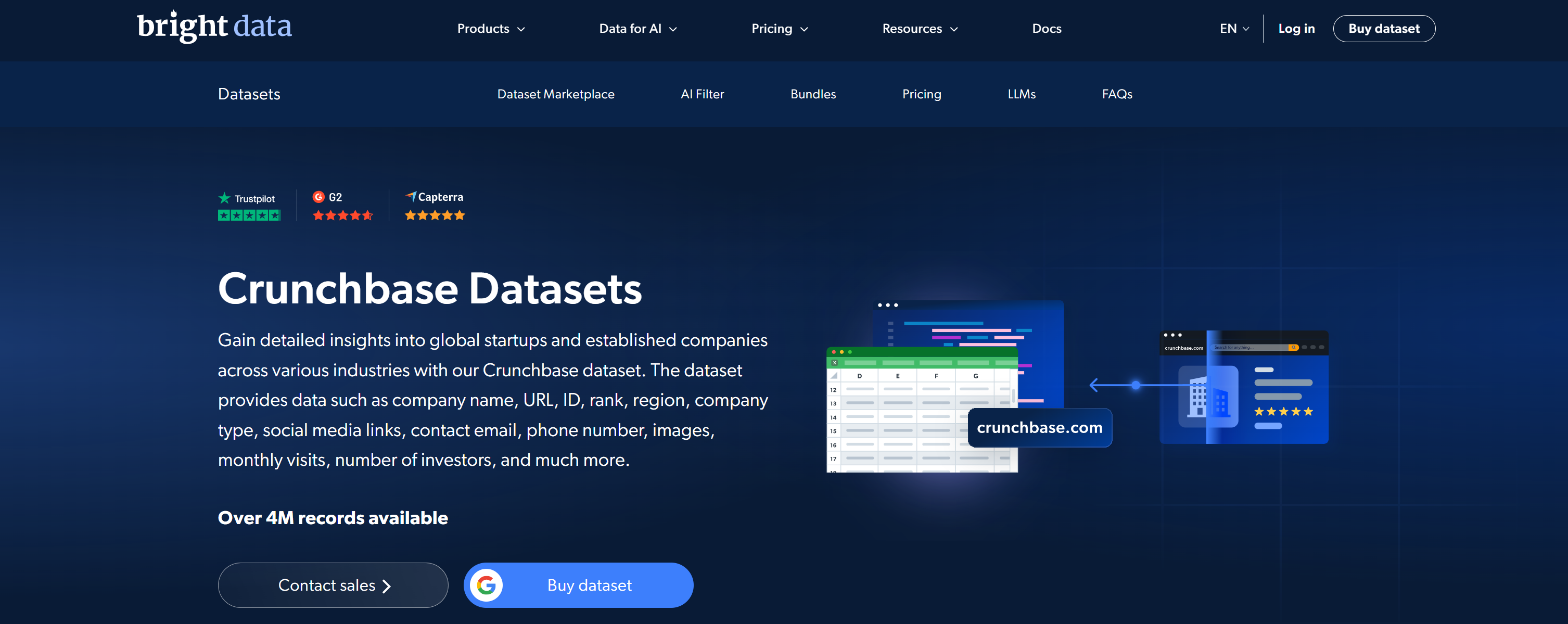
Bright Data began as a proxy provider and has evolved into a leading web scraping and data solutions company. Among Crunchbase data providers, it emerges thanks to its enterprise-ready, highly scalable infrastructure that supports AI integrations and serves 50,000+ clients, including numerous Fortune 500 companies.
Bright Data offers rich Crunchbase datasets in JSON, CSV, and Parquet formats, with record-based pricing and over 4 million entries across multiple industries. The data is clean, validated, continuously updated, and ready for LLM ingestion.
Those datasets cover company name, URL, ID, rank, region, company type, social media links, contact info, monthly visits, number of investors, and more. You can also access and interrogate them via Databricks.
Fresh Crunchbase data can also be collected on demand via Bright Data’s Crunchbase Scraper. This enables you to retrieve company ID, size, type, employees, location, founding date, followers, investors, social media profiles, and more.
The scraper is accessible either through an API for integration into scripts, AI agents, or pipelines, or via a no-code interface suitable for non-technical users.
Bright Data’s Crunchbase data solutions guarantee 99.99% uptime and a 99.99% success rate, supported by a global proxy network of over 150 million IPs and advanced anti-bot tools for CAPTCHAs and scraping prevention.
Together, these features make Bright Data arguably the best Crunchbase data providers on the market!
➡️ Best for: Enterprise-grade analytics, model enrichment, and AI agent integrations.
Data breadth:
- Access to Crunchbase company data including company ID, name, size, type, employees, location, foundation date, social media, followers, investors, and other important firmographics.
- Includes historical funding rounds, M&A activity, and other business indicators.
Infrastructure:
- Flexible Cruchbase dataset delivery in multiple formats (JSON, NDJSON, CSV, and others), with options for compression with Gzip.
- Supports integration with AI applications and CRM enrichment workflows.
- Bulk scraping requests supported (up to 5K URLs per request).
- CAPTCHAs solver, automatic IP rotation, user-agent rotation, and custom headers to avoid blocking.
- 99.99% uptime.
- 99.99% success rate.
- High reliability and scalability with 400M+ residential proxy IPs covering 195 countries, with proven stability for enterprise-grade operations.
- Integrated high-quality validation methods to ensure accurate, structured, and reliable datasets.
- 24/7 global support and dedicated team of data professionals.
Technical requirements:
- Data delivered directly to preferred storage (Amazon S3, Google Cloud, Azure, Snowflake, SFTP).
- No-code scraper available for plug-and-play access via a web platform.
- API-based scraper allows for automation, scheduling, and integration into existing data pipelines.
- Minimal technical effort required for standard scraping, while advanced API usage requires standard API integration knowledge.
Data freshness:
- Delivery on demand with fully automated refresh and scheduler options on a monthly, quarterly, or biannual basis.
- Live data extraction via Crunchbase Scraper API.
Regulatory adherence:
- Fully compliant with GDPR, CCPA, and other privacy regulations.
- Data ethically obtained and collected from publicly available sources only.
- Certified for ISO 27001, SOC 2 Type II, CSA STAR Level 1, and other industry-standard security practices.
Pricing:
- Starting from $2.50 per 1k records for Crunchbase datasets.
- Starting from $1.50 per 1k records for freshly scraped data.
2. Piloterr
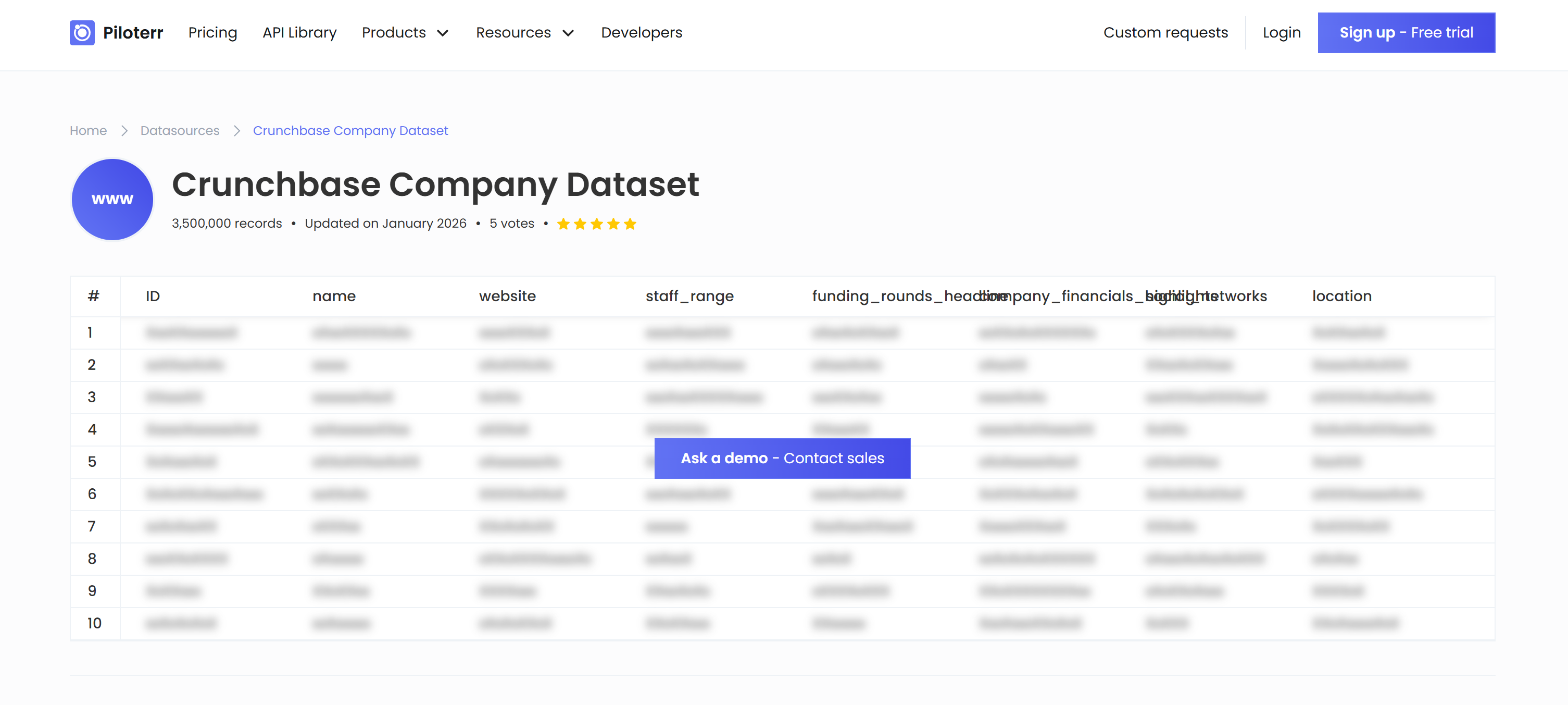
Piloterr is a web scraping and data extraction platform that sells APIs and pre-built crawlers to collect structured data at scale. When it comes to Crunchbase, it also provides both APIs and ready-to-analyze datasets covering companies, funding rounds, executives, and investors. Thus, it supports both historical analysis and continuously refreshed data pipelines.
➡️ Best for: Recurring financial data pipelines.
Data breadth:
- Over 3.5 million records.
- Includes company profiles, funding rounds, team details, key executives, and investor information.
Infrastructure:
- Ready-to-use datasets delivered in CSV, JSON, and other formats.
- Cloud-based API with a standardized data schema for retrieving Crunchbase funding rounds, people information, company information, events, and search data.
Technical requirements:
- Minimal technical skills required to access the datasets.
- More technical knowledge needed to integrate with Piloterr’s cloud scraping API endpoints.
Data freshness:
- Supports both one-time and recurring delivery schedules (daily, weekly, monthly, quarterly, or custom).
- Users can build their own Crunchbase data pipelines using the cloud scraping APIs.
Regulatory adherence:
- GDPR- and CCPA- compliant.
Pricing:
- Crunchbase dataset starts at $3,000.
- Free trial includes 50 scraping API credits.
- Scraping API plans:
- Users:
- Premium: $49/mo for 18k credits.
- Premium+: $99/mo for 40k credits.
- Startup: $249/mo for 110k credits.
- Enterprise:
- Startup+: $499/mo for 230k credits.
- Enterprise: $799/mo for 390k credits.
- Enterprise+: $999/mo for 530k credits.
- Custom: +$2,000/mo for custom credits.
- Users:
3. Bardeen
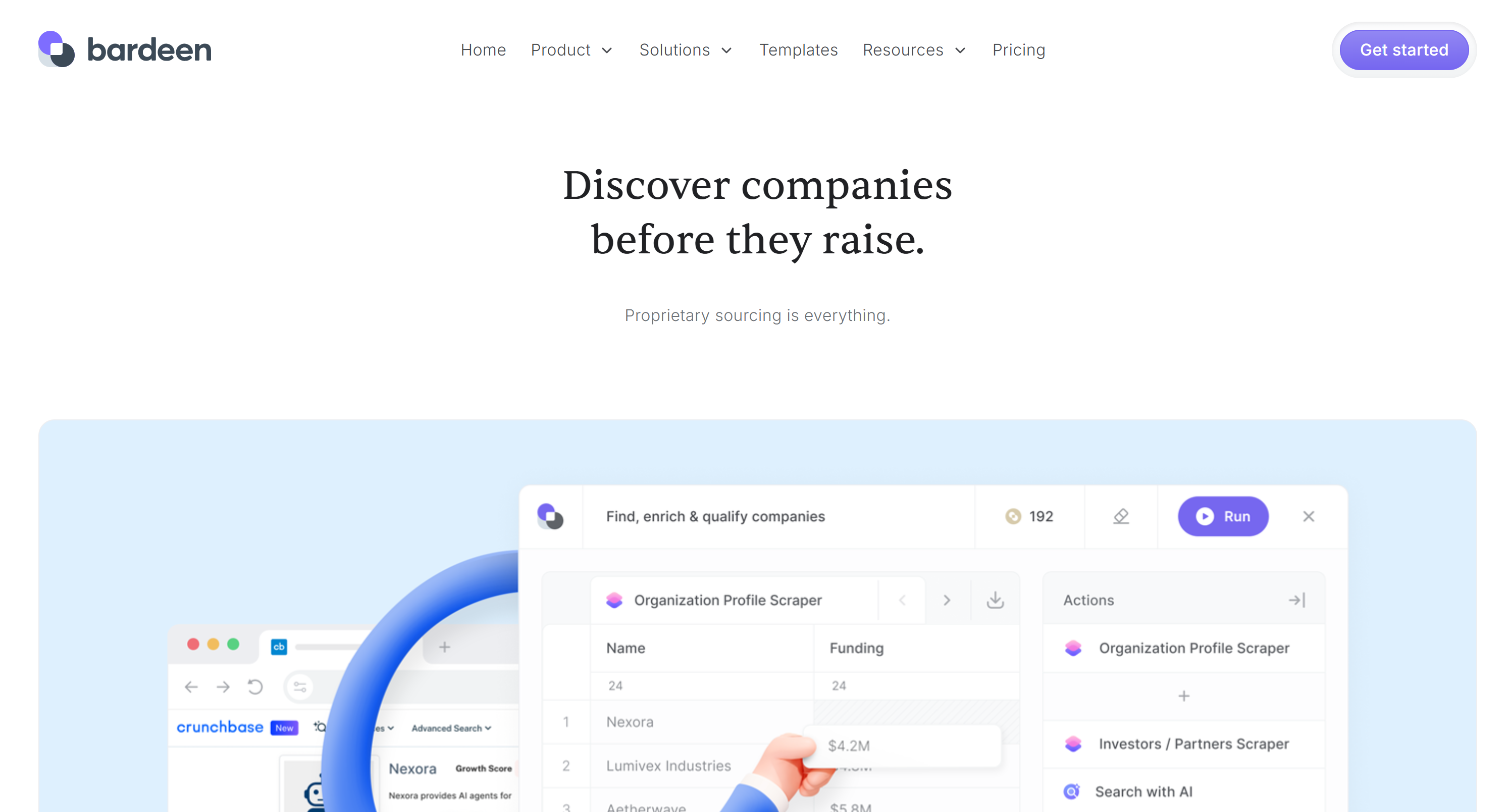
Bardeen is an AI-powered, no-code automation solution that helps automate browser-based workflows for sales, marketing, and operations. It equips you with ready-made Crunchbase scraping templates to extract organization, investor, funding round, and people data on demand. Then, you can enrich and analyze that data directly within the platform.
➡️ Best for: Automation and data analysis.
Data breadth:
- Crunchbase data includes organizations, investors, funding rounds, employee profiles, and individual person profiles.
Infrastructure:
- Scalable platform for automating data extraction from Crunchbase and other sources.
- Offers AI insights, data enrichment, and external integrations.
Technical requirements:
- Pre-built scraping templates that require minimal technical skills.
- Some integration workflows require basic technical knowledge (e.g., API usage, Google Sheets, Airtable, or Notion integrations).
Data freshness:
- On-the-fly data extraction from Crunchbase via Bardeen’s scraping templates.
- Previously scraped data can be scored, enriched, and explored, but there is no direct access to general historical datasets.
Regulatory adherence:
- GDPR-compliant.
- SOC 2 Type II certified, CASA Tier 2 and 3 certified.
Pricing:
- 100 credits provided for free.
- Premium Plan: $50/month to access Crunchbase premium scraping templates and more.
- Enterprise Plan: Custom pricing.
4. WebAutomation
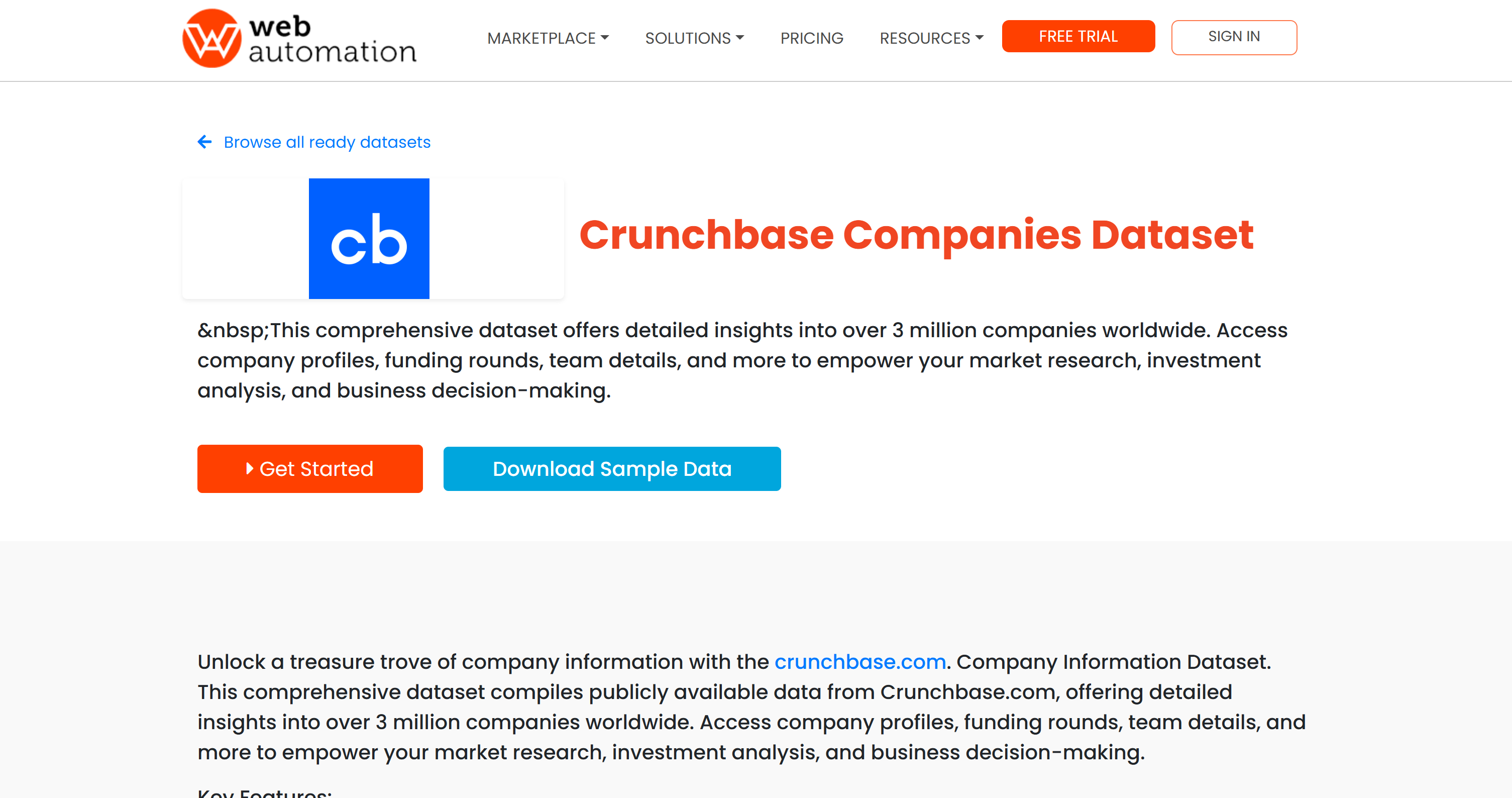
WebAutomation is a cloud-based, no-code web scraping service that lets you extract web data using pre-built scrapers and visual workflows. Its Crunchbase offerings include both a cloud-based scraper and datasets covering over 3 million companies. That also makes it a trusted company data provider.
➡️ Best for: Startup scouting.
Data breadth:
- Over 3 million companies worldwide.
- Includes company profiles, funding rounds, team details, and key executives, covering both established companies and emerging startups across various industries and geographies.
Infrastructure:
- Dedicated no-code Crunchbase company scraper that runs on the cloud.
Technical requirements:
- Minimal technical skills needed to utilize the no-code scraper.
- Data can be exported directly into common formats such as CSV, Excel, and JSON for analysis or integration.
Data freshness:
- Historical company dataset.
- Up-to-date data accessible via the Crunchbase web scraping solution.
Regulatory adherence:
- Undisclosed.
Pricing:
- Sample datasets + free trial for the scraper.
- Full pricing details require contacting sales.
- $1 per 25 company entries for the scraper (equivalent to $40/1k company entries).
5. HasData
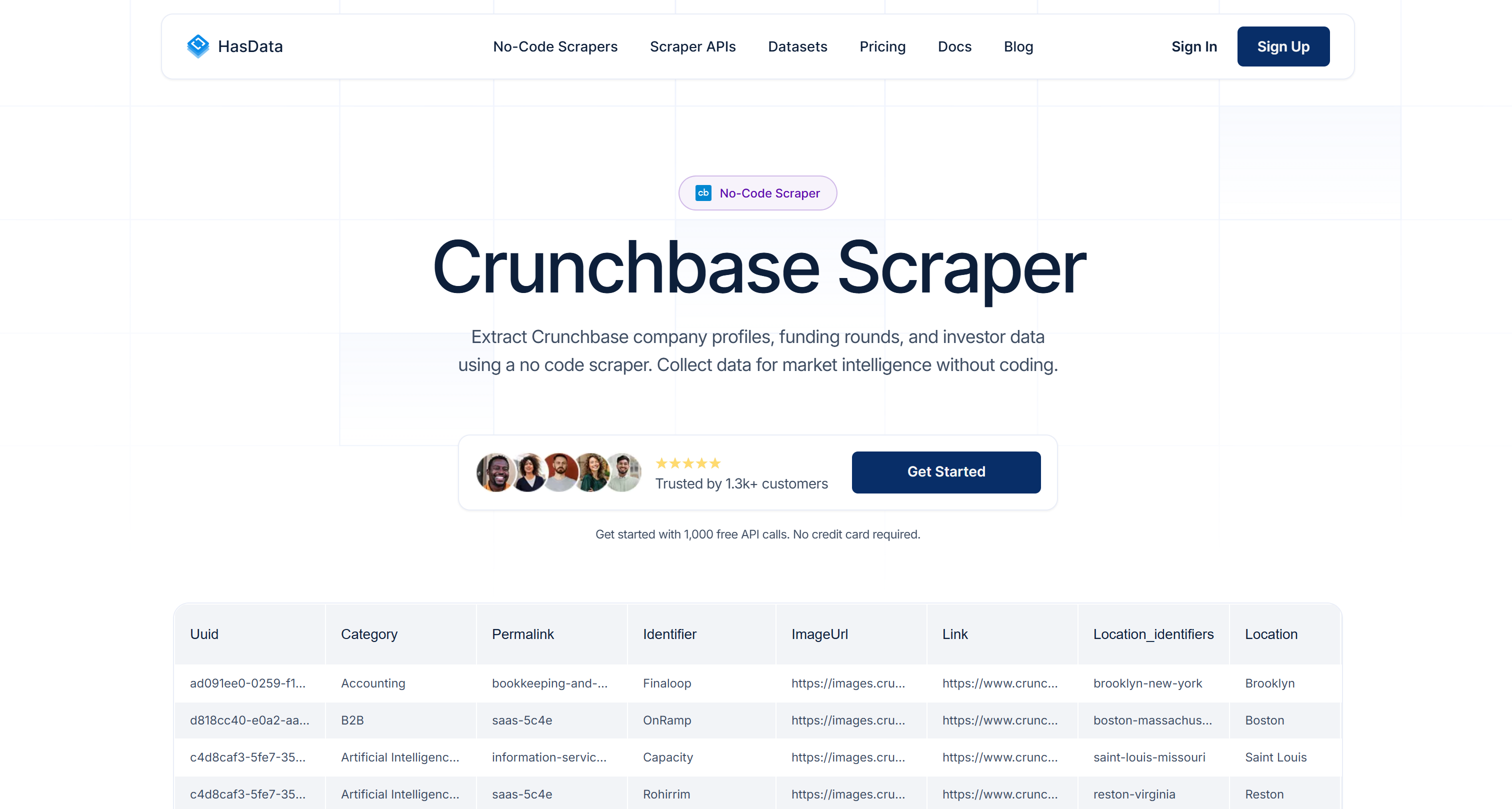
HasData is a cloud-based web scraping platform offering APIs and no-code tools to extract public web data at scale. As a Crunchbase data provider, it opens the door to the collection of company profiles, funding rounds, and investor data through managed infrastructure with built-in proxy handling, anti-bot evasion, and a few pricing plans.
➡️ Best for: Quick access to company data.
Data breadth:
- Company profiles, funding rounds, and investor data.
Infrastructure:
- Cloud-powered scraping service, with no local setup required.
- Support up to millions of requests.
- Proxy management and anti-bot evasion (Cloudflare, DataDome, Akamai, etc.).
- 99.9% uptime.
Technical requirements:
- Minimal technical knowledge required for the no-code scraping interface.
- Simplified API integration via official Python and NodeJS SDKs.
Data freshness:
- Live data extraction.
Regulatory adherence:
- Legality guarantee in the EU and the US.
Pricing:
- Free trial with 1,000 API credits + 30-day free trial on premium plans.
- Paid plans:
- Startup: $49/mo for up to 20k entries.
- Business: $99/mo for up to 100k entries.
- Enterprise: $249/mo for up to 300k entries.
6. Apify
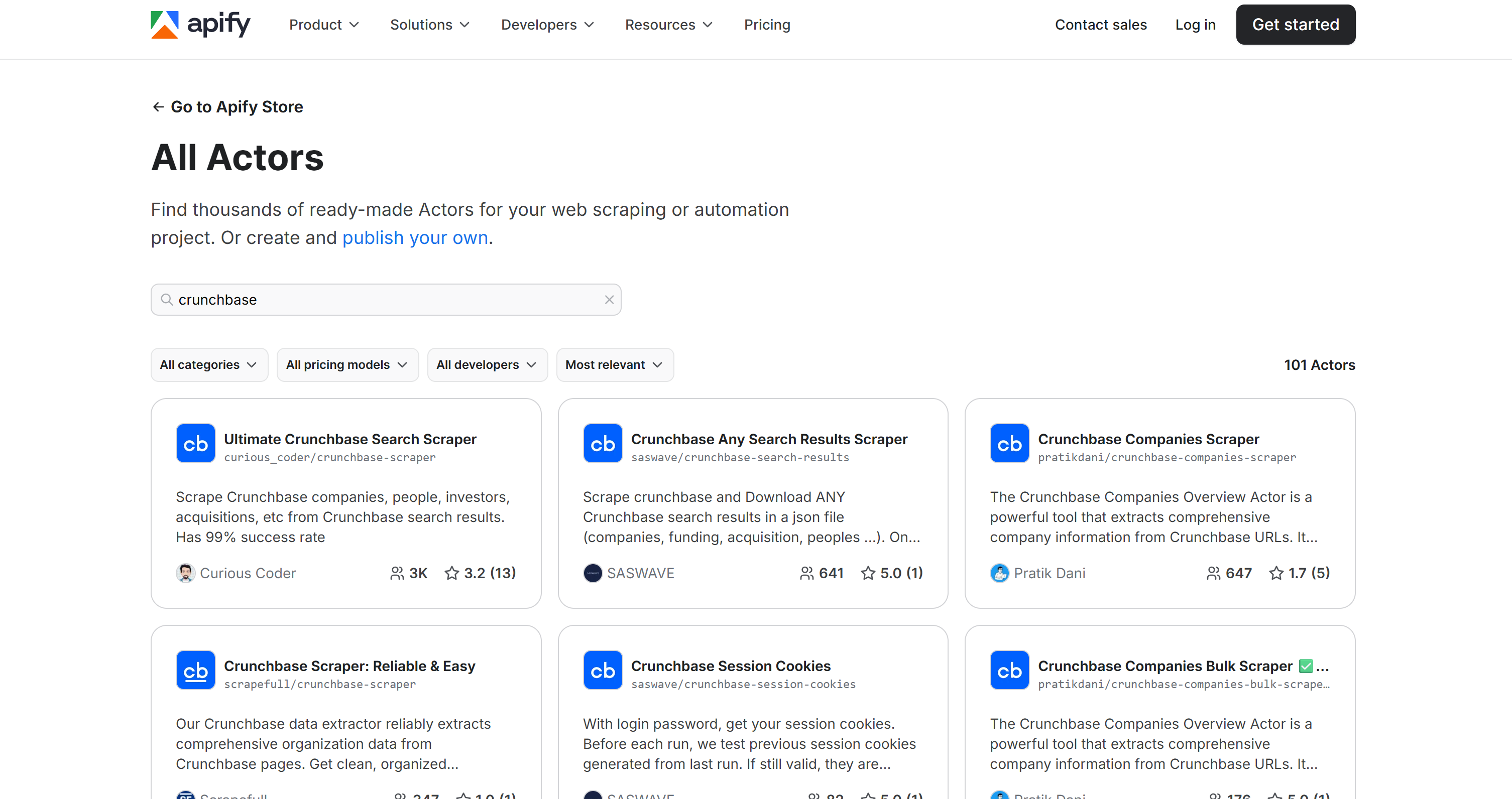
Apify is a cloud-based web scraping and automation platform for extracting and processing web data at scale. In this context, an Actor is Apify’s executable unit that performs a specific task, such as scraping a website or automating a specific workflow. For Crunchbase, Apify exposes 100+ Actors to collect different types of data, including companies, people, investors, funding rounds, and acquisitions.
➡️ Best for: Custom data workflows and enrichment of diverse source datasets.
Data breadth:
- Scraped Crunchbase data covering companies, people, investors, funding rounds, acquisitions, executive profiles, and more.
Infrastructure:
- Cloud-based platform with dozens of ready-made scrapers for Crunchbase.
- Integrated anti-blocking and proxy rotation support.
Technical requirements:
- Actor integration and custom pipelines require technical knowledge (API calls, data processing).
- Minimal effort via the no-code scraping interface on the Apify web application.
Data freshness:
- Real-time extraction from Crunchbase pages.
Regulatory adherence:
- GDPR compliant.
- SOC2 compliant.
Pricing:
- Free plan available.
- Depends on the chosen Crunchbase data scraping Actor.
7. Rebrowser
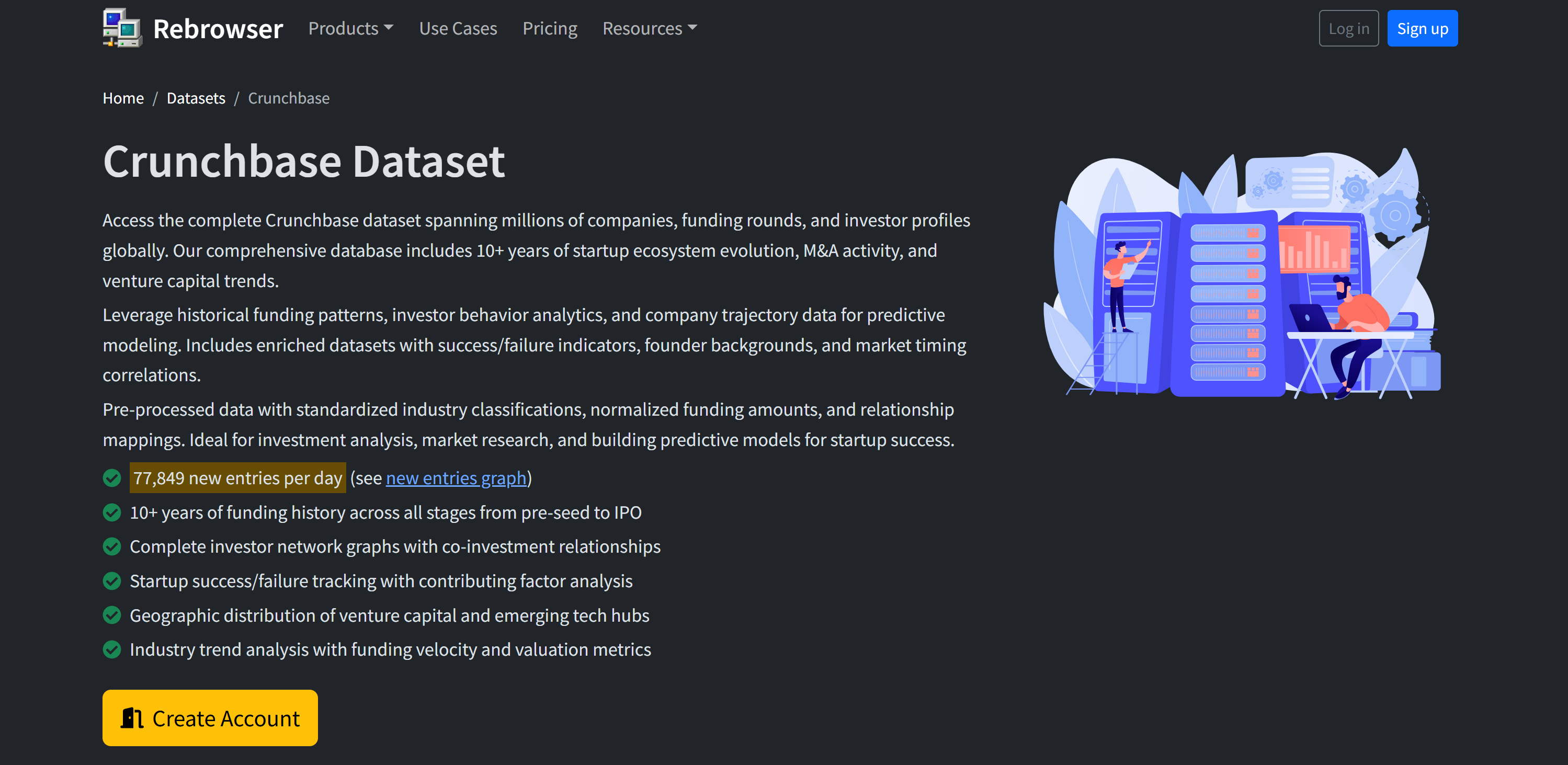
Rebrowser is a headless browser automation framework that mimics real browser environments while avoiding traditional detection vectors. It also operates as a data infrastructure provider for large-scale, hard-to-access web data. For Crunchbase, it comes with both datasets and scraping solutions covering millions of companies, investors, and funding events, with deep historical coverage.
➡️ Best for: Trend analysis and AI training on historical data.
Data breadth:
- Millions of companies, funding rounds, and investor profiles, including historical funding patterns, M&A activity, and startup success/failure indicators.
Infrastructure:
- Scalable infrastructure with anti-bot bypass measures.
- 99.2% accuracy rate for dataset entries.
Technical requirements:
- Minimal technical effort required for datasets, which are delivered ready-to-use, structured, and validated.
- Scraper integration requires technical knowledge for API calls and integration into data pipelines.
Data freshness:
- Historical datasets spanning 10+ years, updated daily with ~75k/80k new entries.
- Fresh data available through a Crunchbase scraper solution.
Regulatory adherence: Undisclosed.
Pricing:
- Custom dataset samples delivered within 7 days.
- Full pricing is undisclosed (you first need to talk with its technical team).
Conclusion
In this article, you learned what Crunchbase data is, why it is valuable, and the obstacles you have to overcome to retrieve it. You also saw how using a Crunchbase data provider can make the data collection process much easier.
These services give you access to a wide range of Crunchbase information, including company profiles, funding rounds, investor details, and more. That information is available either through pre-built datasets or web scraping solutions that let you collect fresh data on demand.
Among the top Crunchbase providers, Bright Data stands out as the leading choice. Its infrastructure is highly robust, and its Crunchbase data services are the most comprehensive, featuring:
- A Crunchbase dataset with over 4 million records.
- A specialized Crunchbase Scraper for real-time data retrieval.
Create a free Bright Data account today to try our Crunchbase data solutions!
FAQ
How to source Crunchbase data?
To collect Crunchbase data, there are two main approaches:
- Using pre-collected Crunchbase datasets: These are structured datasets that providers have gathered or scraped in the past. They include historical data and are ready for immediate use, saving time on live scraping.
- Using a Crunchbase web scraper: You can either build your own scraper or leverage a ready-made Crunchbase scraping service or API. This approach allows you to gather up-to-date information directly from Crunchbase company profiles and other pages.
What is a Crunchbase dataset?
A Crunchbase dataset is a file containing a structured collection of data sourced from Crunchbase. In most cases, it is delivered in formats like CSV, JSON, Parquet, or Excel. It commonly includes company profiles (name, size, location, industry), funding rounds and amounts, M&A records, and more.
How to build a Crunchbase scraper?
A Crunchbase web scraping script follows this roadmap:
- The scraper automates a browser, directing it to visit the target Crunchbase page.
- The page is loaded and rendered using a browser automation tool.
- Data parsing logic is applied to retrieve data points of interest.
- The collected data is returned in your desired format (CSV, JSON, etc.).
Note: Scraping Crunchbase at scale can be challenging due to rate limits, IP restrictions, and other anti-bot measures. Using a managed Crunchbase scraper solution greatly simplifies the process.
How to scrape Crunchbase company data?
When focusing on company data, target Crunchbase company pages and follow the general scraping process outlined earlier. For best results, consider using a professional Crunchbase scraping API, which handles IP rotation, CAPTCHAs, and other web scraping challenges.



Technical Writer
 5.5 years experience
Antonello Zanini is a technical writer, editor, and software engineer with 5M+ views. Expert in technical content strategy, web development, and project management.