







In this blog post, you will learn:
- What Data-as-a-Service is, how it works, and why it matters.
- Why DaaS solutions are more popular than ever, and why counting on a dedicated provider is the right choice.
- The key aspects to consider when evaluating DaaS providers.
- A detailed comparison of the top 10 Data-as-a-Service companies across these criteria.
Let’s dive in!
TL;DR: Summary Table of the Best Data-as-a-Service Companies
| Provider | Infrastructure | Scalability | Main Use Cases | Historical Data | Real-Time Data | GDPR Compliance | Free Demo / Trial | Pricing |
|---|---|---|---|---|---|---|---|---|
| Bright Data | Enterprise-ready, cloud-based, backed by a 400M+ proxy network | Unlimited | Web data pipelines from virtually any site worldwide, covering nearly all industries | ✅ | ✅ | ✅ | ✅ | Both usage-based & subscriptions (from ~$1.50 /1k records) |
| Dun & Bradstreet (D&B) | Enterprise-grade, cloud-based | High | Master data management, risk | ✅ | ❌ | ✅ | ✅ | Tier-based ($15–$50K+) |
| Coresignal | Cloud-based | High | Talent intelligence, jobs data | ✅ | ✅ | ✅ | ✅ | From $49/mo, datasets from $1,000 |
| InfobelPRO | Cloud-based | High | Location & geospatial data | ✅ | ✅ | ✅ | ✅ | Not disclosed (quote-based) |
| Cognism | Cloud-based | High | GTM & CRM enrichment | ✅ | ✅ | ✅ | ✅ | Custom |
| ZoomInfo | Cloud-based | High | Sales & marketing ops | ✅ | ❌ | ✅ | ✅ | Not disclosed (lead-based) |
| RocketSource (Incubeta) | Cloud-based | High | Attribution & analytics | ✅ | ❌ | ✅ | ❌ | Not disclosed |
| Datafiniti | API-first, cloud-based | Unlimited | Property & product data | ✅ | ❌ | ❌ | ✅ | Not disclosed (volume-based) |
| FactSet | Cloud-native | High | Investment & financial data | ✅ | ✅ | ✅ | ✅ | Not disclosed |
| Data Axle | Enterprise cloud | High | Identity & audience activation | ✅ | ❌ | ❌ | ✅ | Not disclosed |
An Introduction to Data-as-a-Service Companies
Before diving into a comparison of the best Data-as-a-Service companies, you need some context. Understand how this data model works, what it covers, and why it matters!
What Does Data-as-a-Service Mean?
Data-as-a-Service (DaaS) is a model in which a company provides on-demand access to high-quality, curated, or raw data through APIs, cloud delivery, subscriptions, or web platforms.
The idea behind it is to enable you to access, integrate, and analyze information. All that without managing complex internal infrastructure, while automating data cleaning, enrichment, and delivery. By centralizing data in a single source, DaaS reduces silos, ensures a single source of truth, and scales with organizational needs.
Common use cases include real-time analytics, business intelligence, market research, and AI model training, empowering data-driven decisions across industries.
Types of DaaS Offerings
Data-as-a-Service offerings can be classified from technical, data, and industry perspectives. From a technical standpoint, data services can be:
- API-based data services: Provide structured data via APIs, facilitating seamless integration into external applications and pipelines.
- Cloud data platforms: Centralized cloud or web-based platforms for data collection, processing, querying, and analytics.
- Dataset sellers: Curated datasets focused on specific industries, markets, or topics, ready for direct analysis or integration into existing systems.
- Managed services: Fully managed data solutions where the provider extracts, processes, maintains, and sends data on behalf of the client. This is tailored to the client’s unique needs and project requirements.
Looking at data types, DaaS companies can provide:
- Raw data feeds: Unprocessed data points directly from the source, typically used to feed internal analytics engines, AI models, or custom processing pipelines.
- Enriched/validated/aggregated Data: Combines multiple sources with added context, cleaned and verified for accuracy.
- Live data: Provides information immediately as it is generated, crucial for applications like high-frequency trading, emergency response, or social media monitoring.
- Historic data: Pre-collected data over past periods, useful for trend analysis, forecasting, benchmarking, machine learning model training, and retrospective studies.
- Insight-based data: Processed data delivered with AI-driven analysis, visualizations, and actionable recommendations.
Finally, from an industry perspective, they can cover:
- Market and financial data: Includes industry trends, competitor activity, pricing, and market dynamics to support strategic decision-making and research.
- B2B data: Company profiles, firmographics, and business contact details for lead generation, sales, and business intelligence.
- Employee and job market data: Information on workforce trends, open positions, roles, salaries, and employee movement across industries.
- Retail data: Consumer behavior, product availability, pricing, and transaction data for merchandising, inventory planning, and marketing.
- Travel data: Flight, hotel, booking, and mobility information for tourism, logistics, and route optimization.
- Social media data: Posts, engagement metrics, and sentiment analysis for brand monitoring, trend detection, and marketing insights.
- Other industry-specific data…
Why Data-as-a-Service Can No Longer Be Ignored
Approximately 402.7 million terabytes of data are created every single day. Plus, the total volume of data created, captured, copied, and consumed worldwide has already reached 149 zettabytes, according to Statista. These numbers are only expected to accelerate with the rapid rise of AI, which is notoriously data-hungry.
Training large language models alone requires enormous datasets. For example, models like the one powering OpenAI’s ChatGPT were trained on hundreds of billions of words, corresponding to tens of terabytes of raw text data (compressed to hundreds of gigabytes) to achieve usable performance.
The same applies to modern RAG pipelines, AI/ML workflows, and data-driven decision systems. They all depend on massive volumes of fresh, well-structured, and continuously updated data to generate reliable insights and accurate outputs. In a data-driven world, relying solely on in-house data and expertise is rarely sufficient.
While some data is open and free, most high-value data is difficult to access. It generally requires advanced techniques like web scraping, or it must be purchased, cleaned, enriched, and aggregated from multiple sources before it becomes useful.
These dynamics explain why Data-as-a-Service companies are gaining rapid traction, becoming one of the fastest-growing segments in the global data economy.
Why You Need a Data-as-a-Service Provider
If you have ever tried to collect data at scale, you know how challenging it can be. Some of the most common obstacles include:
- Anti-scraping measures: Websites deploy CAPTCHAs, IP blocking, rate limits, and fingerprinting techniques that actively prevent automated data collection from web pages.
- Compliance and legal constraints: Data collection must respect privacy laws like GDPR and CCPA, as well as platform terms of service.
- Formats, aggregation, and data quality issues: Raw data often comes in inconsistent formats, contains duplicates or errors, and requires extensive cleaning, normalization, and aggregation to be usable.
- Scalability and infrastructure issues: Collecting large volumes of data reliably requires scalable infrastructure, monitoring, retries, and failure handling, which are costly to build and maintain.
- Maintenance and reliability: Data pipelines frequently break due to changes in external sources, requiring ongoing monitoring, updates, and technical expertise to keep them running.
Most companies, organizations, or individuals simply want access to high-quality data. They often lack the in-house skills, resources, or time to handle those challenges. Thus, they prefer to rely on a Data-as-a-Service provider.
A Data-as-a-Service company delivers ready-to-use data. It handles collection, compliance, infrastructure, data quality, and other operational challenges for you. This helps you focus on using the data for analysis, decision-making, or your specific use case, rather than dealing with the complexity of data acquisition and maintenance.
How to Compare Data-as-a-Service Solutions
DaaS solutions are everywhere, and the market is packed with options. Choosing the right provider can be challenging given such a crowded landscape. Comparison becomes much easier when you have a clear set of criteria to evaluate providers against, such as:
- Data breadth: The types and scope of data offered by the DaaS provider.
- Data sourcing methods: Where and how the provider collects its data, if publicly disclosed.
- Infrastructure: The provider’s ability to scale, maintain uptime, and handle large volumes of data requests.
- Data freshness: Availability of historical, near real-time, continuously updated, or real-time data.
- Data delivery methods: How data is made accessible to clients (via API, cloud integrations, or other methods) and in which formats (JSON, CSV, Excel, etc.).
- Technical requirements: Skills, tools, or infrastructure needed to access, process, and integrate the data.
- Compliance: Adherence to privacy and security frameworks, such as GDPR and CCPA.
- Pricing: Availability of subscription plans, custom packages, or free trials/sample datasets for evaluation.
Top 10 Data-as-a-Service Companies
Discover the best Data-as-a-Service providers, carefully chosen and reviewed according to the criteria presented before.
1. Bright Data
Started as a proxy provider, Bright Data has evolved into a full-scale web data platform. What sets it apart is its enterprise-grade, highly scalable, and AI-ready infrastructure, built to support everything from simple data extraction to complex data pipelines.
Bright Data offers multiple Data-as-a-Service tools that enable direct data ingestion into your pipelines, workflows, and systems. These include:
- Scraper APIs: Extract fresh, structured web data from 120+ websites with built-in compliance, automatic scaling, and pay-per-result pricing. Each site-specific API is accessible programmatically or through a built-in no-code interface.
- Web Unlocker API: Automates the bypassing of blocks, CAPTCHAs, and advanced anti-bot protections to ensure consistent data collection at scale. It manages proxies, anti-bot challenges, and JavaScript-heavy pages, and returns raw HTML, LLM-ready Markdown output, or even AI-structured JSON.
- SERP API: Provides geo-targeted search engine results from Google, Bing, Yandex, and other major search engines. It is ideal for enabling AI data pipelines to verify information and retrieve fresh data from verifiable sources.
If you instead prefer direct access to ready-to-use data, Bright Data also offers:
- Dataset marketplace: Pre-collected, validated, and continuously updated datasets from 120+ popular domains. Data is available in JSON, CSV, and other formats, making it suitable for AI, ML, RAG systems, and business intelligence workflows.
- Fully managed data acquisition services: You define your business goals, and Bright Data handles the full data lifecycle. That involves designing the collection strategy, and then gathering, validating, enriching, and delivering structured data via dashboards, reports, or direct integrations.
These are just a subset of Bright Data’s broader product suite for DaaS scenarios. All services are powered by a global proxy network of over 150 million IPs, delivering unlimited scalability with a 99.99% uptime and success rate. This infrastructure supports organizations of all sizes, from startups to Fortune 500 enterprises.
Taken together, these capabilities make Bright Data one of the most compelling Data-as-a-Service platforms available today for businesses at any scale.
👑 Best for: Businesses of all sizes, including large enterprises, looking for a scalable and highly flexible DaaS experience covering a long list of scenarios.
Data breadth:
- Data from hundreds of popular domains, as well as virtually any public website.
- Supported use cases across e-commerce, competitive intelligence, social media and content platforms, job listings and recruitment, AI and machine learning, market research, retail analytics, real estate, cross-retailer insights, and many other industry-specific scenarios.
- Sources include LinkedIn, Amazon, Instagram, Crunchbase, Zillow, X (Twitter), TikTok, Facebook, YouTube, Indeed, Walmart, Yahoo Finance, Booking.com, Glassdoor, Shein, Airbnb, Yelp, ChatGPT, Google, Perplexity, Grok, Bing, and many others.
Data sourcing methods:
- Ethical, compliant collection of publicly available web data via large-scale web scraping.
Infrastructure:
- 99.99% platform uptime.
- 99.99% success rate on scraping APIs.
- 400M+ residential, mobile, ISP, and datacenter proxy IPs across 195 countries.
- Proprietary technology for CAPTCHA solving, anti-bot bypassing, and structured data extraction across hundreds of domains.
- Support for unlimited concurrency and bulk extraction (up to 5K URLs per request).
- Advanced dataset filtering and segmentation to reduce costs and improve relevance.
- Access to petabytes of cached data via the Web Archive API.
- 24/7 dedicated support from data experts.
Data freshness:
- Historical and trend data available through pre-built datasets with flexible update schedules (daily, weekly, monthly).
- Real-time data collection via API-based and no-code tools.
- Periodically updated datasets to ensure ongoing freshness and new records.
Data delivery methods:
- APIs returning data in JSON, HTML, Markdown, and other formats.
- Dataset delivery via Amazon S3, Google Cloud, Snowflake, Azure, SFTP, Pub/Sub, webhooks, and more.
- Flexible dataset formats including JSON, NDJSON, CSV, and Parquet.
Technical requirements:
- Basic technical knowledge is sufficient to start collecting data via APIs.
- No-code scrapers enable quick, simplified data extraction.
- API familiarity is recommended for advanced automation, custom workflows, and BI integrations.
Compliance:
- GDPR- and CCPA-compliant.
- Data sourced exclusively from publicly available information.
- Certified to ISO 27001, SOC 2 Type II, and CSA STAR Level 1 standards.
Pricing:
- Free trial available.
- Pricing varies by product, with both pay-as-you-go and subscription options:
- Unlocker API: from $1.50 per 1K results.
- Browser API: from $8/GB.
- SERP API: from $1.50 per 1K results.
- Scraper APIs: from $1.50 per 1K records.
- Fully managed data services: From $2,500/month.
- Datasets: from $250 per 100K records.
2. Dun & Bradstreet (D&B)
Dun & Bradstreet (D&B) is a leader in commercial data and analytics, anchored by its massive Data Cloud offering listing over 600M entities. Its services include a Master Data-as-a-Service (MDaaS) product. That is a configurable, API-driven solution that delivers high-quality, pre-mastered commercial data directly into a company’s workflows, CRM, or ERP systems.
👑 Best for: Enterprise master data management.
Data breadth:
- Commercial entity master data, including foundational business data about organizations and decision-makers.
- Insights on business risk, supplier risk, financial risk, compliance risk, and other enterprise-relevant metrics.
- Covers over 600M+ organizations globally, across several industries and sectors.
- Includes analytics, scores, and ratings derived from aggregated data.
Data sourcing methods:
- Data is collected from global registries, verified partners, and real-world business activity.
- Refined through a lot of monthly checks to achieve decision-ready quality.
Infrastructure:
- Cloud-based solutions with scalable delivery through APIs and integrations.
- Integration through MDM and CRM platform partners for seamless workflow connectivity.
Data freshness:
- Centralized, continuously updated master data.
- 15+ years of historical data.
Data delivery methods:
- Access via direct API connections.
- MDM/CRM platform integrations.
- Data streams in desired formats for easy access anytime.
Technical requirements:
- Basic technical skills needed for API integrations.
- Integration into workflows may require configuration within MDM or CRM systems.
Compliance:
- Adheres to GDPR and CCPA.
- ISO 27701, ISO 27001, and Privacy Information Management Systems (PIMS) certifications.
- Supports EU-U.S. and Swiss-U.S. Privacy Shield / Data Privacy Framework, UK extension, APEC CBPR, and TRUSTe Responsible AI Certification.
Pricing:
- Free trial available for some services.
- From ~$15 to $50,000, depending on product tier and pack size.
3. Coresignal
Coresignal is a well-known web data provider with solutions tailored for large-scale B2B, employee, and job posting data. It acts as a Data-as-a-Service solution, providing access to billions of records via REST APIs. The company focuses on converting unstructured web data into standardized, AI-ready datasets for talent intelligence, investment research, lead enrichment, and related use cases.
👑 Best for: Talent intelligence and workforce analytics.
Data breadth:
- 75M+ company records, 500+ data points, data since 2016.
- 839M+ employee records, 250+ data points, data since 2016.
- 425M+ deduplicated active and historical job postings, 85+ data points, data since 2020.
Data sourcing methods:
- Data collected from 15+ public web sources.
Infrastructure:
- Cloud-based, self-service platform that supports custom dataset building and connection via APIs.
Data freshness:
- Data is updated regularly.
- Historical data available (since 2016 for company/employee, 2020 for jobs).
- Supports real-time access via APIs.
Data delivery methods:
- REST APIs for company, employee, and job data.
- Flat files downloadable in JSONL format.
- Self-service platform allows dataset customization and bulk download.
Technical requirements:
- Accessing APIs requires basic technical skills for integration.
- Working with JSONL flat files may require data analysis skills.
- Platform supports search in everyday language for ease of use.
Compliance:
- GDPR- and CCPA-aligned.
- Certified by the Ethical Web Data Collection Initiative.
Pricing:
- Datasets: Starting from $1,000
- Subscription-based plans:
- Free: $0 for 200 Collect credits and 400 Search credits.
- Starter: Starting from $49/month for at least 250 Collect credits and 500 Search credits.
- Pro: Starting from $800/month for at least 10,000 Collect credits and 20,000 Search credits.
- Premium: Starting from $1,500/month for at least 50,000 Collect credits and 150,000 Search credits.
4. InfobelPRO
InfobelPRO is a veteran global data provider for high-volume B2B intelligence and location analytics. It also operates as a DaaS company via on-demand access to a massive database of 375 million companies, 172 million points of interest (POIs), and 1 billion contacts. Its structured data supports CRM enrichment, real-time lead validation, and precise geospatial mapping.
👑 Best for: Location intelligence and geospatial analytics.
Data breadth:
- 172M+ POIs, including places, building footprints, polygons, and location intelligence attributes.
- B2B data covering 375M+ companies, with firmographic, technographic, contact data, and corporate linkage.
- 209M+ B2C consumer data entries, encompassing opt-in names, mobile phones, emails, physical addresses, and income ranges.
Data sourcing methods:
- AI-powered processing leveraging 1,100+ undisclosed data sources.
Infrastructure:
- Cloud-based data platform built for international data integrations.
- Supports high-volume access through APIs, flat files, and DIY applications.
Data freshness:
- Supports live data streams via APIs.
- Includes historical B2B data, up to 8 years.
- Data is continuously processed and updated.
Data delivery methods:
- REST APIs, including company data, location data, POI, enrichment, VAT, and caller ID APIs.
- Flat files designed for plug-and-play integration.
- DIY access to the underlying database through a dedicated search engine.
Technical requirements:
- API integrations require basic web integration skills.
- Flat files need data analysis capabilities to operationalize at scale.
- Technical documentation and hands-on customer support are available.
Compliance:
- Emphasis on GDPR compliance and privacy standards.
Pricing:
- Possibility to test the data API for free.
- Pricing is quote-based and use-case dependent.
- Custom datasets and flexible delivery methods are available following consultation with data experts.
5. Cognism
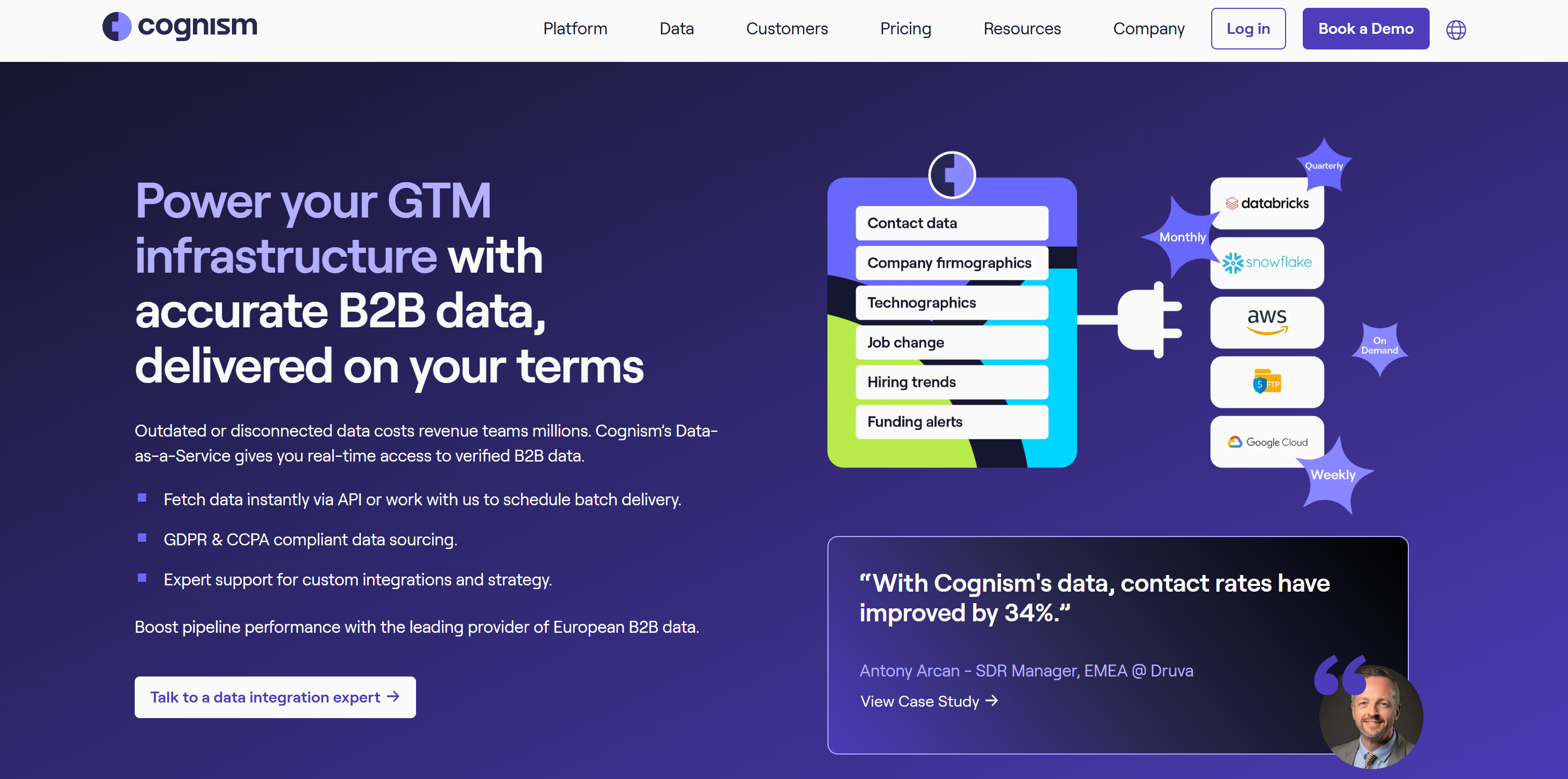
Cognism is a sales intelligence platform that provides premium B2B sales data. Its DaaS experience is built around giving teams access to verified, compliant contact and firmographic data directly within their GTM (Go-to-Market) stacks via APIs or cloud integrations such as Snowflake. The end goal os this provider is to help sales and marketing teams accelerate prospecting and improve data-driven outreach.
👑 Best for: CRM and GTM stack enrichment.
Data breadth:
- B2B data, including contacts, firmographics, technographics, intent, hiring signals, job-related attributes, and more.
- Strong coverage of European markets.
Data sourcing methods:
- Data is collected using an AI-powered framework that simulates human web research, extracts public web data, and applies multiple verification and validation layers.
- Popular sources include news articles and press releases, company websites, annual reports, earnings releases, and public registries.
Infrastructure:
- Cloud-based infrastructure for high scalability.
Data freshness:
- Centralized B2B sales intelligence database with both fresh and historical data, regularly updated.
Data delivery methods:
- REST APIs.
- Flat files, with support for Snowflake, AWS S3, Google Cloud, Databricks, and SFTP.
Technical requirements:
- API integrations require basic technical skills for implementation and maintenance.
- Flat files require data analysis or data science skills to extract maximum value from the datasets.
- Professional support for integration, schema design, and custom aggregation for the DaaS option.
Compliance:
- GDPR- and CCPA-aligned data sourcing.
- ISO 27001 and SOC 2–aligned security standards.
Pricing:
- Options for free datasets.
- For the DaaS experience, pricing is bespoke and use-case dependent, based on data type, volume, and delivery method.
6. ZoomInfo
ZoomInfo is a go-to-market intelligence platform equipping you with high-quality B2B data for sales, marketing, and recruiting. As a Data-as-a-Service company, it delivers AI-ready insights (e.g., firmographics, intent signals, and professional profiles) directly into your workflows via APIs and cloud shares like Snowflake or AWS. This integration automates CRM enrichment, replaces manual entry, and fuels data-driven growth strategies.
👑 Best for: Sales and marketing operations needing automated intent-driven targeting.
Data breadth:
- B2B data, including professional profiles, company profiles, firmographics, technographics, contact information, job titles, employment history, and intent signals.
- Global coverage, including North America and expanded international data (34M+ company profiles, 200M+ professional profiles, 45M+ mobile numbers outside North America).
- Advanced insights, such as marketing sophistication, online behavior, and engagement signals.
Data sourcing methods:
- Collected via the FuZion system, which combines AI, machine learning, NLP, human researchers, surveys, third-party providers, and community contributors.
- Sources include company websites, public business information, surveys, niche third-party providers, and internal research teams.
- Multi-layered verification ensures accuracy using both automated systems and manual checks.
Infrastructure:
- Cloud-based DaaS platform with APIs, webhooks, and flat file options.
- Capable of integrating with CRM, marketing automation, sales engagement tools, and major cloud platforms (Snowflake, AWS, Google BigQuery).
Data freshness:
- Continuously updated data.
- Historical, near real-time, and AI-ready data available for predictive analytics.
Data delivery methods:
- REST APIs and webhooks for quick integration.
- Flat files, including support for Snowflake, AWS, Google BigQuery, and CSV/Excel formats.
Technical requirements:
- Basic technical skills required for API integration and workflow automation.
- Data analysis or data science skills needed to leverage flat-file datasets.
- Support available for simplified integration, schema design, custom enrichment, and predictive modeling.
Compliance:
- GDPR- and CCPA-compliant data collection and processing.
- ISO 27001 and ISO 27701 aligned security and privacy standards.
- SOC 2 audits and TRUSTe validations ensure ongoing regulatory adherence.
Pricing:
- Free trial available.
- Pricing is shown upon providing your information.
7. RocketSource by Incubeta
RocketSource (now part of Incubeta) is a behavioral science and data consultancy that transforms data into “humanized” insights. This makes it a uniquely positioned Data-as-a-Service company. It unifies disparate data sources into a cloud-based ecosystem that powers predictive analytics and full-funnel attribution.
👑 Best for: Full-funnel marketing analytics and attribution modeling across complex customer journeys.
Data breadth:
- Primarily marketing, customer, and behavioral data.
- Full-funnel marketing data, customer journey data, qualitative and quantitative insights, and operational data.
Data sourcing methods:
- Data is sourced from existing enterprise systems (e.g., ERP, business applications), marketing platforms, analytics tools, and third-party data sources.
Infrastructure:
- Cloud-based data infrastructure built to unify and process complex, multi-source datasets.
- Supports data pipelines, workflow automation, and AI-driven analytics.
Data freshness:
- Availability of continuously updated data, enabling ongoing analytics, attribution modeling, and predictive insights.
- Supports near-real-time data pipelines.
- Historic data for descriptive analytics.
Data delivery methods:
- Data is delivered through integrated data pipelines and analytics environments rather than standalone dataset downloads.
Technical requirements:
- Requires data and software engineering expertise to integrate systems, design pipelines, and extract insights.
- Advanced use cases involve data modeling, analytics, and AI/ML workflows.
Compliance:
- Explicit support for privacy controls, including “Do Not Sell or Share My Personal Information.”
Pricing:
- Pricing details are not publicly disclosed.
8. Datainfiniti
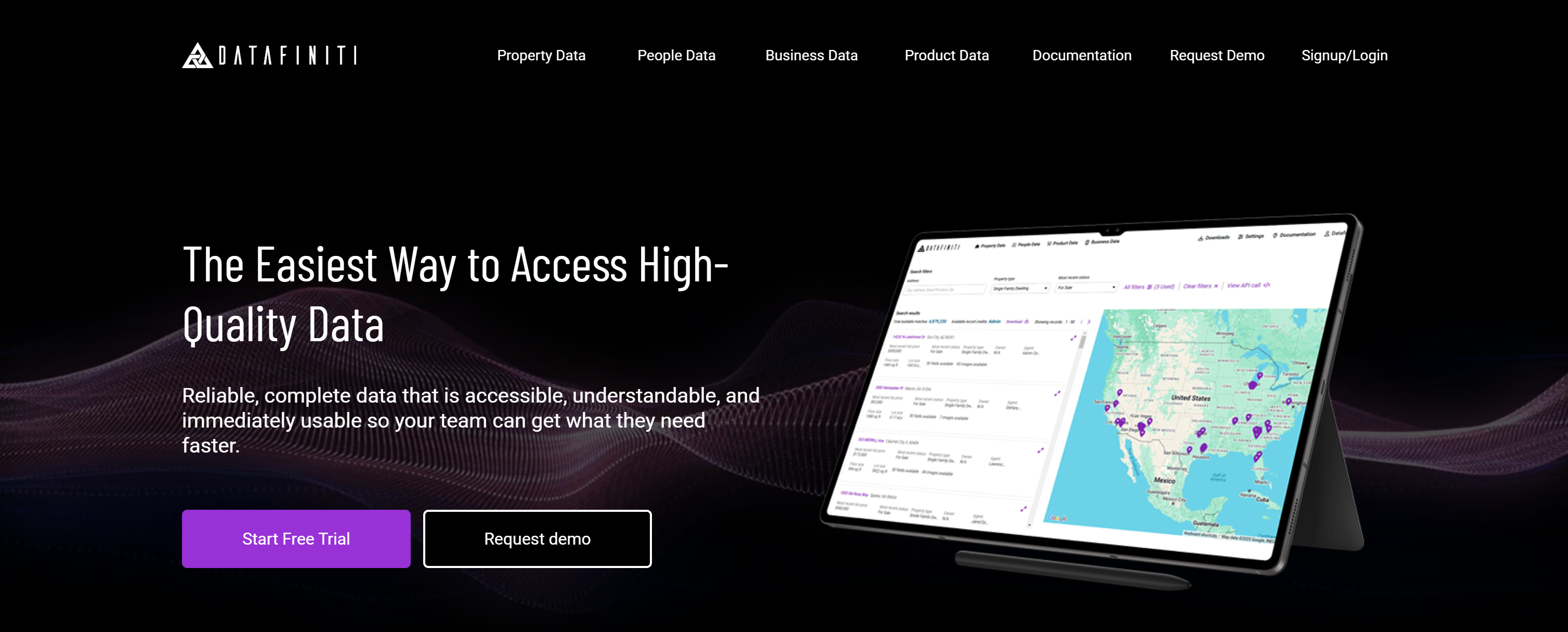
Datafiniti is a data company that operates as a Data-as-a-Service provider. In detail, it offers access to massive, pre-structured datasets across property, product, business, and people verticals. These datasets are exposed through a RESTful API interface. Behind the scenes, the data is collected via web scraping, public sources, and third-party data providers.
👑 Best for: Property and real estate intelligence for valuation, underwriting, and risk analysis.
Data breadth:
- Retail and ecommerce product data with attributes, descriptions, images, and reviews.
- Property data for real estate analysis, valuation, underwriting, address verification, and fraud detection.
- People data for contact and identity verification, enrichment, and risk-related workflows.
- Business and place-of-interest (POI) data for market research, CRM enrichment, and geospatial analysis.
Data sourcing methods:
- Data is collected from the public web, public data, and third-party sources.
- Uses web crawling combined with external trusted sources.
- Data is standardized, deduplicated, and normalized through internal pipelines.
Infrastructure:
- High-performance API without artificial throughput limits beyond plan-defined record caps.
Data freshness:
- Data is continuously collected, cleaned, and refreshed.
- Supports historical property transaction data.
Data delivery methods:
- REST API for integration into applications and workflows.
- Web portal for exploratory search, validation, and evaluation.
- Bulk downloads for offline analysis and data science use cases.
Technical requirements:
- API access requires basic to intermediate engineering skills.
- Data analysis or data science skills are necessary for processing and modeling large datasets.
- Clear documentation and stable schemas reduce implementation and onboarding time.
Compliance: Undisclosed.
Pricing:
- Free trial available, with options for in-depth demos.
- Flexible plans, including month-to-month subscriptions and custom tiers based on record volume.
9. FactSet
FactSet is a financial digital platform that provides integrated data and analytics to the investment community. Specifically, it also acts as a Data-as-a-Service company, supporting complex data pipelines that automate the enrichment and delivery of financial datasets via APIs and cloud integrations. Note that it appears in the list of the best alternative data providers.
👑 Best for: Quantitative and data-driven investment teams.
Data breadth:
- Broad financial and investment-focused data.
- Coverage includes company and security data, market data, alternative data, event-driven data, news, research, estimates, debt, and sustainable investment data.
Data sourcing methods:
- Both proprietary methods and third-party data sources.
- Data comes from exchanges, market contributors, and non-traditional (alternative) sources.
Infrastructure:
- Cloud-native infrastructure that supports both batch and ongoing delivery through managed services and APIs.
- Opens the door to advanced data connectivity and integration across proprietary and third-party datasets.
- Built around a unified security and entity data model to support large-scale linking and governance.
Data freshness:
- Supports real-time streaming, delayed, and historical market data, with coverage backed by 40+ years of data collection.
- Continuously updated datasets for markets, companies, events, and news.
Data delivery methods:
- APIs interface.
- Data feeds accessible through a dedicated marketplace.
- Cloud-based data delivery via Amazon Redshift, Snowflake Data Marketplace, and Databricks
- FactSet-hosted environments and managed data services.
- Supports integration with internal systems, analytics platforms, databases, and statistical tools.
Technical requirements:
- API usage requires developer-level skills for connection.
- Cloud data sharing and marketplace integrations require familiarity with platforms such as Snowflake, Redshift, or Databricks.
- Data management features reduce the need for custom code but still assume data engineering and analytics expertise.
Compliance:
- GDPR compliant.
Pricing:
- Possibility to ask for a free trial.
- Pricing is not publicly disclosed.
10. Data Axle
Data Axle is a long-established data provider specializing in business and consumer intelligence. As a Data-as-a-Service provider, it centralizes billions of data points into a cloud-based delivery layer. Through robust API interfaces, it supports B2B, B2C, and B2B2C use cases across marketing, sales, analytics, and activation. That helps enterprises automate lead enrichment and power AI-driven audience targeting.
👑 Best for: Large-scale identity resolution and audience activation across B2B and B2C.
Data breadth:
- Business data covering 90M+ businesses with 400+ attributes, including firmographic, technographic, intent, specialty, and location-based data.
- Consumer data covering 250M+ consumer profiles with 300+ attributes.
Data sourcing methods:
- Data is sourced from more than 100 public and proprietary undisclosed sources.
- Uses proprietary data compilation processes and machine learning to link and unify identities across datasets.
Infrastructure:
- Enterprise-scale data platform processing over 2 trillion customer records per year.
- Engineered to support large-scale data ingestion, identity resolution, and activation.
- Built to distribute data securely across internal systems, cloud platforms, and external partners.
Data freshness:
- Fresh data, with regularly updated business and consumer datasets.
- Ongoing data refreshes for activation, targeting, and analytics use cases.
- Historical business records available.
Data delivery methods:
- APIs, backed by a Developer Hub with documentation.
- Data delivery via direct integrations, cloud platforms, digital marketplaces (e.g., DMPs, DSPs, data exchanges), and data licensing for full dataset installs within customer environments.
- Pre-built integrations with CRM and marketing platforms.
Technical requirements:
- API access requires developer skills for integration and ongoing usage.
- Pre-built integrations reduce technical effort for common CRM and Martech tools.
Compliance: Undisclosed.
Pricing:
- Offers free trials, demos, and limited access to its data platforms.
- Pricing is undisclosed and requires contacting the sales team.
Conclusion
In this article, you learned what Data-as-a-Service (DaaS) is, how it works, and why it has become essential in today’s data- and AI-driven world.
Among the many Data-as-a-Service providers available, Bright Data stands out as a top choice. Its enterprise-grade data collection services supply reliable web data feeds via APIs and ready-to-use datasets in multiple formats, with advanced filtering options.
Bright Data is backed by a proxy network of 150 million IPs, offers 99.99% uptime, and achieves a 99.99% success rate. Combined with 24/7 priority support, flexible data delivery, and custom JSON outputs, accessing web data at scale has never been easier.
Create a Bright Data account today and start integrating web data solutions for free!
FAQ
What is DaaS (Data-as-a-Service)?
Data-as-a-Service (DaaS) is a data distribution model in which a provider delivers ready-to-use data through channels such as APIs, cloud platforms, or managed services. By treating data as a utility, DaaS removes the need for organizations to build and maintain complex data collection, storage, and processing infrastructure.
What are the right questions to ask when evaluating a Data-as-a-Service company?
These are the main questions you should ask any Data-as-a-Service provider before adopting their solution:
- How do you measure and ensure data accuracy?
- How frequently is the data updated?
- What is the data provenance?
- Is the data compliant with regulations?
- What is your data retention and deletion policy?
- How is the data delivered?
- How easy is integration and usage?
- What security measures are in place?
- What SLAs do you guarantee?
- How does pricing and scalability work?
Which DaaS providers are currently leading the market in AI readiness and RAG integration?
Bright Data is widely regarded as a leader in AI-ready and RAG-optimized data services, thanks to solutions specifically designed for LLMs. Its AI offerings include:
- Web Access: Enables AI inference systems to search, crawl, and interact with the live web seamlessly, without being blocked by anti-bot measures.
- Training Data: Provides custom, high-quality datasets (including text, images, video, and audio) cleaned, curated, and tailored for model training and fine-tuning.
In particular, Bright Data products include AI-specific features such as simplified integration with 70+ AI frameworks, Markdown output (which is ideal for LLM ingestion), data verifiability, and tooling built to support RAG pipelines end to end.



Technical Writer
 5.5 years experience
Antonello Zanini is a technical writer, editor, and software engineer with 5M+ views. Expert in technical content strategy, web development, and project management.