








In this blog post, you will learn:
- The role travel data plays, what it includes, and the main obstacles in sourcing it.
- Why relying on a travel datasets provider is the most effective way to gain valid insights.
- The main factors to consider when choosing such a provider.
- A complete comparison of the six top travel data providers.
Let’s dive in!
TL;DR: Summary Table of the Best Travel Data Providers
Quickly compare the best travel data providers at a glance with this summary table:
| Provider | Infrastructure | Live Data | Historical Data | AI Integration | GDPR Compliance | Free Sample/Trial | Pay-as-You-Go Option | Pricing |
|---|---|---|---|---|---|---|---|---|
| Bright Data | Enterprise-ready, cloud-hosted, massively scalable, 400M+ proxy IPs, with advanced anti-bot protection bypass | ✅ | ✅ | ✅ | ✅ | ✅ | ✅ | $2.50/1k records (datasets), $1.50/1k records (scraper) |
| Travelopro | Cloud-based SaaS | ✅ | ✅ | ✅ | ✅ | ❌ | ❌ | — (Undisclosed) |
| Travel Scrape | Cloud-based, managed scraping | ✅ | ✅ | ❌ | — (Undisclosed) | ✅ | ❌ | — (Undisclosed) |
| WebData Crawler | Cloud-based, SaaS | ✅ | ✅ | ❌ | — (Undisclosed) | ✅ | ❌ | — (Undisclosed) |
| Real Data API | Cloud-based APIs | ✅ | ✅ | ❌ | — (Undisclosed) | ✅ | ❌ | — (Undisclosed) |
| Open Travel Data (OPTD) | Downloadable files | ❌ | ✅ | ❌ | — (Undisclosed) | ✅ | ❌ | Free |
Inside Travel Data: A Practical Overview
Before comparing travel data providers, you need to understand why travel data matters, what it encompasses, and how difficult it is to get.
The Competitive Advantage of Having Access to Travel Data
Between January and September 2025, over 1.1 billion tourists traveled internationally. That represents an increase of more than 50 million compared to the same period in 2024.
The EU remains the most visited region, driven by countries like France, Spain, Italy, Germany, and Greece (all ranking among the top 10 most visited countries globally), and by the fact that around 65% of EU residents took at least one personal tourism trip. France alone welcomes over 100 million tourists annually.
In the United States, the hotel market generated approximately $263 billion in revenue in 2024, with forecasts projecting nearly $396 billion by 2030. As of 2024, there were around 49,800 hotels and motels operating nationwide. That year also marked a milestone since, for the first time ever, more than half of Americans reported taking at least one airline trip.
In short, people are traveling more than ever. The global travel and tourism industry continues to grow, contributing a total of $10.9 trillion to global GDP. That means the travel industry surpasses the GDP of 99% of countries worldwide.
These numbers highlight just how important travel is to understanding the global market. In detail, having access to high-quality travel data supports several use cases, including:
- Optimizing pricing and promotions based on real-time demand for flights, hotels, tours, and packages.
- Monitoring competitors and market positioning by tracking offers, availability, and pricing strategies across regions.
- Timing discounts and campaigns by identifying the best windows for seasonal promotions or targeted sales.
- Improving content effectiveness by understanding which listings, descriptions, or images drive the highest bookings.
- Measuring sentiment and review impact by analyzing customer feedback, ratings, and social media to guide service improvements.
The insights inform strategic planning, demand forecasting, marketing performance, competitive intelligence, and operational efficiency.
Types of Travel Data
Travel data is an umbrella term that covers a wide range of subcategories. The most relevant ones are:
- Flight data: Covers flight schedules, fares, routes, airline performance, and booking trends.
- Hotel data: Includes availability, pricing, occupancy rates, amenities, guest reviews, and more.
- Activity data: Provides information on tickets, schedules, popularity, customer ratings, and more.
- Car rental data: Tracks fleet availability, rental rates, locations, and demand patterns.
- Destination data: Consists of events, attractions, weather, and local insights.
- Behavioral data: Tracks user interactions on websites or apps, including click-through rates, time spent, and abandoned bookings.
- Operational and infrastructure data: Technical details like flight delays, weather conditions, traffic, and public transport schedules.
Once collected, this point-specific data can be aggregated into insight-based data types:
- Customer and booking data: Details traveler preferences, booking behavior, demographics, loyalty information, and more.
- Search and intent data: Shows traveler searches, flight and hotel queries, and budget preferences, revealing planning trends.
- Booking and transactional data: Includes confirmed reservations for flights, hotels, car rentals, and tours.
- Geographic and location data: GPS, roaming, and check-in information reveal movement patterns, tourist hotspots, and popular routes.
- Demographic and psychographic data: Age, nationality, income, and traveler interests (adventure, luxury, family) inform marketing, product development, and personalization.
- Post-trip and sentiment data: Reviews, ratings, and social media mentions provide qualitative feedback on traveler experiences and service quality.
Challenges of Collecting High-Quality Travel Data
If you have ever planned a trip, you know how overwhelmingly rich in options the travel industry is. You can book directly through hotel or airline websites, use aggregator platforms, contact professional travel agents, or rely on travel agencies and similar services.
While these options are great for customers, they contribute to one of the most highly fragmented data markets in the world. Gaining insights in the travel data space is not just about retrieving data from a single portal (as often happens in other industries, like e-commerce with Amazon or short-term rentals with Airbnb).
In travel, collecting data involves sourcing information from multiple websites and aggregating it to extract the most useful insights. This means that the usual challenges of programmatically retrieving web data (i.e., anti-bot protections, IP bans, CAPTCHAs, and so on) are multiplied across dozens of travel data portals. Plus, you need the skills and ability to clean, integrate, enrich, and process that fragmented data.
Why a Travel Data Provider Is the Solution
Travel data is as valuable as it is difficult to collect due to the obstacles mentioned earlier. The process becomes even more challenging when you factor in high scalability needs or the requirement to consider data from multiple sources to avoid bias. To greatly simplify travel data acquisition, the most recommended approach is to use a dedicated travel data provider.
A travel data provider is a service that collects, structures, and delivers various types of travel data, whether as raw data or final insights. These providers handle all the challenges associated with travel data retrieval, from sourcing to aggregation.
These solutions make travel data available in two primary ways:
- Travel datasets: Pre-collected datasets containing historical (and potentially regularly updated) travel data. These can cover general travel information from diverse sources or focus on specific vertical portals. These are ideal for use cases such as market analysis, trend forecasting, competitor benchmarking, and customer behavior studies.
- Travel scraping solutions: Tools to retrieve fresh data directly from travel sites like airlines, hotel booking portals, tour operators, and OTA platforms. Using a travel scraper is best suited for use cases that rely on up-to-date information, such as real-time pricing optimization, dynamic promotions, inventory monitoring, availability checks, and competitive intelligence.
To maintain a complete and accurate view of the complex travel market, most organizations combine both approaches:
- Datasets for historical context and large-scale analysis.
- Scraping solutions for quick intelligence, including integration into AI-powered solutions.
Aspects to Consider When Evaluating the Best Travel Data Providers
You can find a long list of travel data providers online, but not all are worth exploring. To identify the best options, you should compare them across common aspects, such as:
- Market coverage: The types of travel data offered, such as hotel availability, booking trends, flight schedules, supported sources, etc.
- Infrastructure and architecture: The provider’s scalability, including uptime, success rates, and overall reliability.
- Data timeliness: Whether the provider offers static datasets, live data via scraping solutions, or both.
- Technical requirements: The skills, tools, and infrastructure needed to access and use the data effectively.
- Regulatory adherence: Compliance with GDPR, CCPA, and other applicable data privacy and protection regulations.
- Pricing: The provider’s pricing model, including subscription, pay-as-you-go, or custom plans, as well as the availability of a free trial or data sample.
Top 6 Travel Data Providers
Get ready to explore the best travel data providers, carefully chosen, ranked, and reviewed based on the criteria outlined earlier.
1. Bright Data
Bright Data first entered the market as a proxy provider and has grown into a top web scraping and data solution company. Among the best travel data providers, it stands out for its scalability, compliance, and reliability.
It equips you with an enterprise-grade, AI-ready infrastructure for travel data collection that powers OTAs, airlines, hotels, travel tech platforms, and many other use cases. The three complementary travel data solutions Bright Data offers are:
- Travel datasets: Curated and validated travel data ready for analytics, AI models, and BI tools. Available in JSON, CSV, Parquet, and other formats, these datasets cover hotel and flight prices, availability, amenities, ratings, reviews, tours, and much more. Continuous updates and flexible, record-based pricing enable travel businesses to optimize pricing, availability, and market intelligence efficiently.
- Travel scraper: On-demand, large-scale extraction of real-time travel data. Collect current rates, availability, promotions, booking trends, and social insights across hotels, airlines, OTAs, and tours. Anti-bot measures are automatically handled, with API access for automated workflows and a no-code interface for non-technical users. Scrapers are also accessible via MCP for seamless integration with AI agents and through 70+ integrations with popular AI frameworks. Domain coverage spans major travel platforms such as Booking.com, Airbnb, Agoda, Trip.com, Tripadvisor, Expedia, Google Flights, and many more.
- Managed travel data acquisition service: Bright Data handles the entire data journey, from defining sources, schemas, and KPIs, to legal, large-scale collection via a global proxy network. Data is validated, deduplicated, and enriched, then delivered through dashboards and rich insights.
All these travel solutions are powered by a robust infrastructure featuring over 150 million proxy IPs worldwide, advanced anti-bot technologies, and 99.99% uptime with a 99.99% success rate, ensuring reliable, scalable, and LLM-optimized travel data delivery.
With this combination of capabilities, Bright Data is positioned as the most comprehensive and trusted travel data provider!
➡️ Ideal for: Enterprise-grade travel data collection and analytics, AI/ML training, and AI agent integration.
Market coverage:
- Hotels and flights data, including prices, availability, fare/rate calendars, schedules, amenities, and star ratings.
- Activity prices, remaining slots, dates, durations, provider details, photos, ratings for tours and experiences.
- Travel reviews data, such as star ratings, review text, timestamps, management replies, and helpful counts.
- Search-result pages, lowest fares, notices, promo banners, flexible-date grids.
- Competitor prices, special offers, bundle deals, loyalty tiers, promotional countdowns.
- Social travel posts, images, hashtags, location tags, engagement stats.
- Sources include Airbnb, Booking.com, Agoda, Trip.com, Tripadvisor, Expedia, Google Flights, and many others.
Infrastructure and architecture:
- High reliability and scalability with 400M+ proxy IPs across 195 countries for global travel coverage.
- CAPTCHA solving, IP rotation,
User-Agentrotation, custom headers, and other anti-blocking measures for smooth data collection. - 99.99% uptime and 99.99% success rate for live feeds and datasets.
- Bulk scraping supported (up to 5k URLs per request), covering hotels, flights, tours, and destinations.
- Standard SLAs for all users and custom SLAs for enterprises.
- Flexible dataset delivery in multiple formats (JSON, NDJSON, CSV, etc.) with optional Gzip compression.
- Integrated validation and enrichment ensure accurate, structured, and actionable travel data.
- Supports AI applications, revenue management systems, and CRM enrichment workflows.
- Access to historical travel data, including price trends, availability, and reviews, via Archive API.
- 24/7 global support with a dedicated team of travel data professionals.
Data timeliness:
- Live travel data extraction via Bright Data’s API-based and no-code scrapers.
- Datasets with scheduled updates (daily, weekly, monthly, or custom intervals).
- Access to historical travel data on demand for trend analysis and forecasting.
Technical requirements:
- API-based scrapers support automation, scheduled updates, and seamless integration into existing travel data pipelines.
- No-code scraper for instant, plug-and-play access to travel listings directly from Bright Data’s web platform.
- Data can be delivered directly to your preferred storage solution (Amazon S3, Google Cloud, Snowflake, Azure, SFTP, and more).
- Basic technical skills sufficient for standard travel data scraping.
- API and integration knowledge recommended for advanced workflows and custom automation.
Regulatory adherence:
- Aligned with GDPR, CCPA, and other data privacy regulations.
- Data is ethically collected from publicly accessible sources only.
- Certified for SOC 2 Type II, ISO 27001, CSA STAR Level 1, and other leading security standards.
Pricing:
- Free trial + sample datasets available at no cost.
- Starting at $2.50 per 1k records (travel datasets).
- Starting at $1.50 per 1k records (travel scraping solutions).
2. Travelopro
Travelopro is an all-in-one travel technology provider, offering booking engines, white-label portals, and API integration for GDS, airlines, hotels, and more. Beyond its tech solutions, it supplies travel inventory as a wholesaler, powering OTAs and corporate clients. As a travel data platform, it gives access to real-time and historical insights to optimize pricing, bookings, and market strategies.
➡️ Ideal for: Anyone looking for a complete travel ERP solution, where data access and exploration are not the only requirements.
Market coverage:
- Flights, hotels, car rentals, transfers, sightseeing, holiday packages, and tours.
- Integrates multiple GDS (Amadeus, Sabre, Galileo, Travelport) and B2B wholesale suppliers for rates and availability.
- Booking data, accommodation data, transportation data, attraction data, expenditure data, itinerary data, customer data, demographics data, and destinations data.
Infrastructure and architecture:
- SaaS-based travel data platform with cloud-based infrastructure.
- Supports white-label solutions for OTAs, travel agencies, and corporate travel management.
- Connected data centers to deliver data feeds.
- Supports REST API for integrations.
- Capable of integrating with multiple supplier systems, B2B/B2C distribution channels, and third-party apps.
Data timeliness:
- Provides real-time travel data and insights, including live search results for hotels, flights, and car rentals, as well as live insights into customer behavior, market trends, and competitor activity.
- Access to historical data.
Technical requirements:
- Web platform with a user-friendly interface designed for both non-technical users and developers, supporting data unification, customer segmentation, and analytics.
- Requires knowledge of API integration.
- Can integrate into existing booking flows for web or mobile platforms.
Regulatory adherence:
- Full GDPR compliant
Pricing:
- Option to request a demo.
- Multiple plans available with undisclosed pricing, each offering different features.
3. Travel Scrape
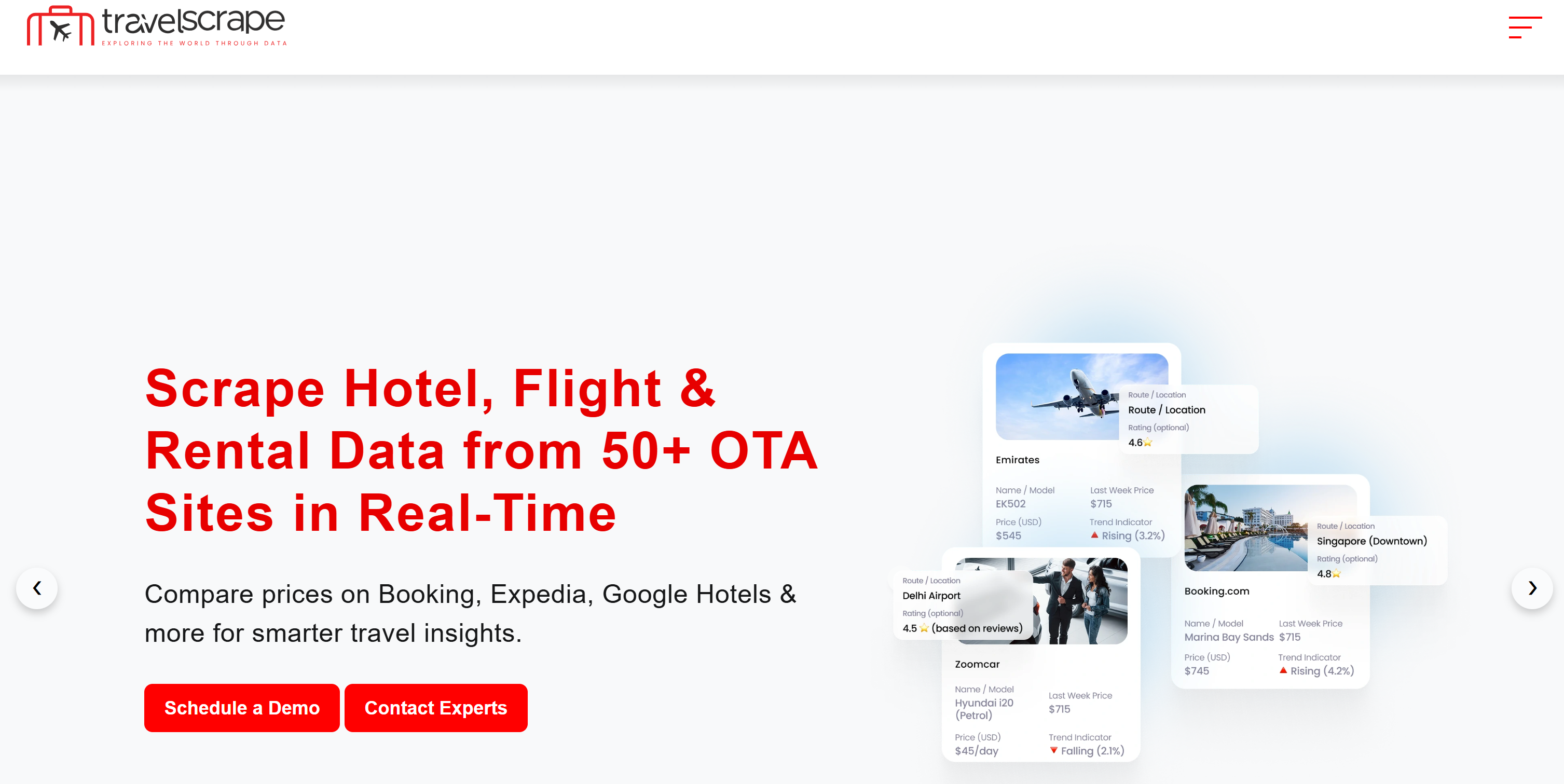
Travel Scrape is a data scraping agency specifically built around retrieving and delivering travel data. Its offerings include:
- A fully managed web scraping solution for the travel industry, equipping you with actionable intelligence from flights, hotels, car rentals, and customer reviews.
- Live scraping services from 50+ travel platforms.
- Curated datasets for accessing structured travel data on market trends, customer feedback, and operational optimization.
➡️ Ideal for: Vertical travel data needs for custom, highly tailored scenarios.
Market coverage:
- Hotels, flights, car rentals, cruises, and vacation rentals, with data fieds including pricing, availability, reviews, operational data, dynamic rates, and booking trends, with 100k+ data points scraped daily.
- 100+ data sources covering 50+ travel platforms, including Airbnb, Booking.com, Expedia, Google Hotels, VRBO, TripAdvisor, MakeMyTrip, IRCTC, Emirates, and more.
Infrastructure and architecture:
- Web scraping services supporting real-time travel data extraction.
- APIs to access hotel, flight, and car rental data.
- Scalable infrastructure with a 99% uptime guarantee.
- End-to-end data management and delivery, including tailored travel data solutions.
Data timeliness:
- Live travel data and intelligence accessible via scraping APIs.
- Historical data available through static datasets, updated frequently.
Technical requirements:
- API integration knowledge required to utilize scraping services.
- No technical knwoledge asked for the fully managed services.
- Data analysis skills needed for visualization, reporting, and insights.
Regulatory adherence: Undisclosed.
Pricing:
- Demo and consultation available to evaluate travel data services.
- Pricing not publicly disclosed (you must contact the sales team for details).
4. WebData Crawler
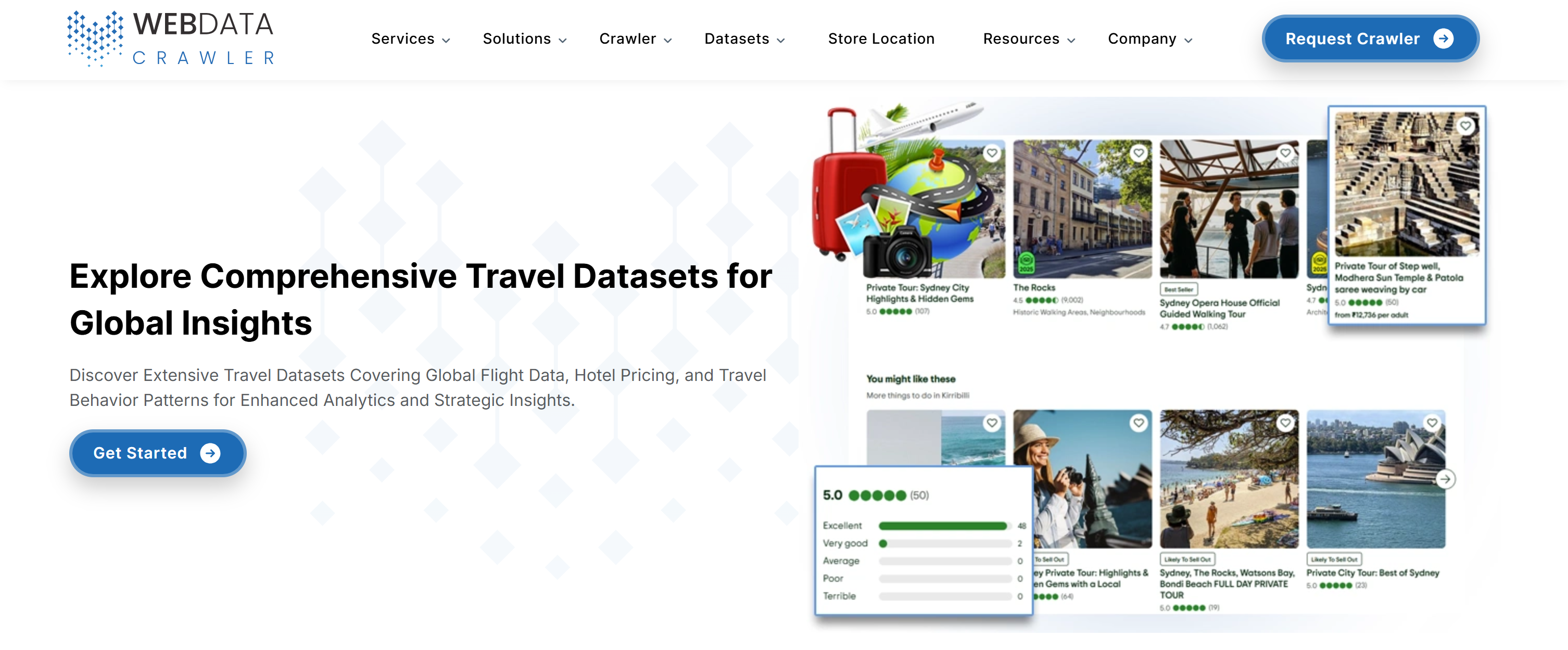
WebData Crawler provisions professional web scraping solutions to help businesses collect, clean, and structure large-scale web data. When it comes to travel data, its services include both comprehensive datasets and scraping APIs covering many travel platforms. In particular, it allows access to multiple types of travel information.
➡️ Ideal for: Travel market analysis.
Market coverage:
- Pricing, availability, trends, destinations, customer preferences, reviews, accommodations, transportation, facilities, trip duration, traveler type, and ratings.
- Source platforms include Agoda, Hopper, Tripcase, Tokopedia, Trivago, Skyscanner, Booking.com, and Airbnb.
Infrastructure and architecture:
- Web scraping and data extraction services via APIs and live crawlers.
- Dataset delivery infrastructure supports CSV, JSON, and XLSX formats, with data sent via API or integrated with cloud solutions such as AWS S3, Google Cloud Storage, Azure, and Oracle Cloud.
Data timeliness:
- Historical travel datasets available with options for one-time, monthly, quarterly, or bi-annual updates.
- Up-to-date travel data access via web scraping solutions.
Technical requirements:
- Datasets are straightforward to access, requiring minimal technical expertise.
- Basic understanding of HTTP APIs is helpful for integrating with web scraping APIs.
- Skills in data integration and aggregation are recommended, as datasets are specific to individual travel platforms.
Regulatory adherence:
- Respect legal regulations and the target site’s policies.
Pricing:
- A sample dataset is provided during the process to assess data quality.
- Pricing details are not publicly listed (you need to contact the sales team for a quote).
5. Real Data API
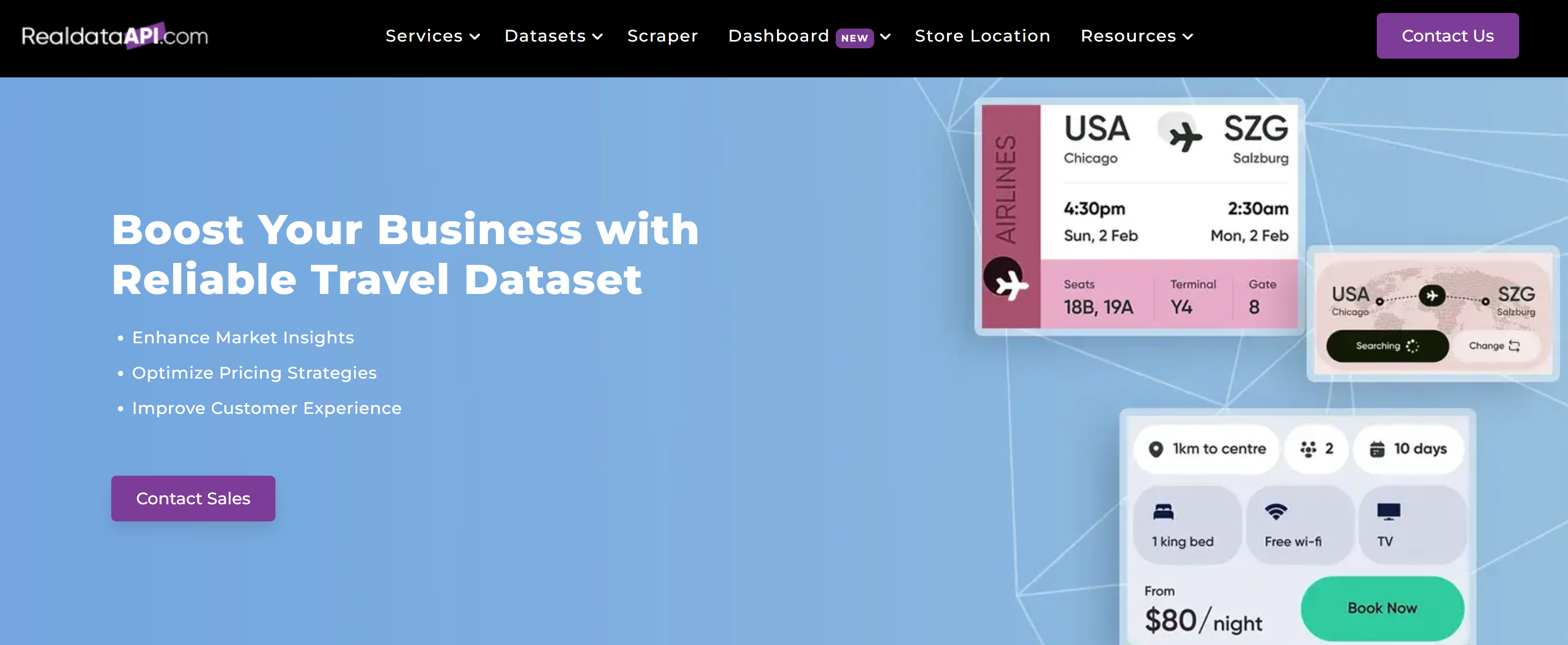
Real Data API is a web scraping platform that automates the extraction of fresh, structured data from websites. Its main goal is to remove the complexity of building and maintaining scrapers in-house. On top of that, it offers ready-to-use datasets containing previously scraped data. Specifically for the travel industry, the provider comes with both datasets and scraping APIs that cover some of the most well-known platforms in the travel and tourism market.
➡️ Ideal for: Competitor benchmarking.
Market coverage:
- Destinations, hotels, flights, car rentals, tours, reviews, availability, booking URLs, and more.
- Supported travel data sources include Airbnb, Booking.com, Expedia, TripAdvisor, Skyscanner, Agoda, Google Flights, Hotels.com, and others.
Infrastructure and architecture:
- Web scraping services for travel data retrieval via APIs and live crawlers.
- Dataset delivery infrastructure supporting CSV, JSON, and other formats, sent to AWS S3, Google Cloud Storage, and other cloud solutions.
Data timeliness:
- Live travel data access via Travel Dataset API and web scraping solutions.
- Pre-collected travel datasets with one-time, monthly, quarterly, or bi-annual updates.
Technical requirements:
- Easy-to-download datasets with no advanced technical knowledge required.
- Basic knowledge of HTTP APIs to integrate with web scraping APIs.
- Data integration and aggregation skills are required, as datasets are vertical to specific platforms.
Regulatory adherence: Undisclosed.
Pricing:
- Sample dataset available to evaluate the output quality.
- Pricing is not publicly available (you must contact the sales team for a quote).
6. Open Travel Data (OTPD)
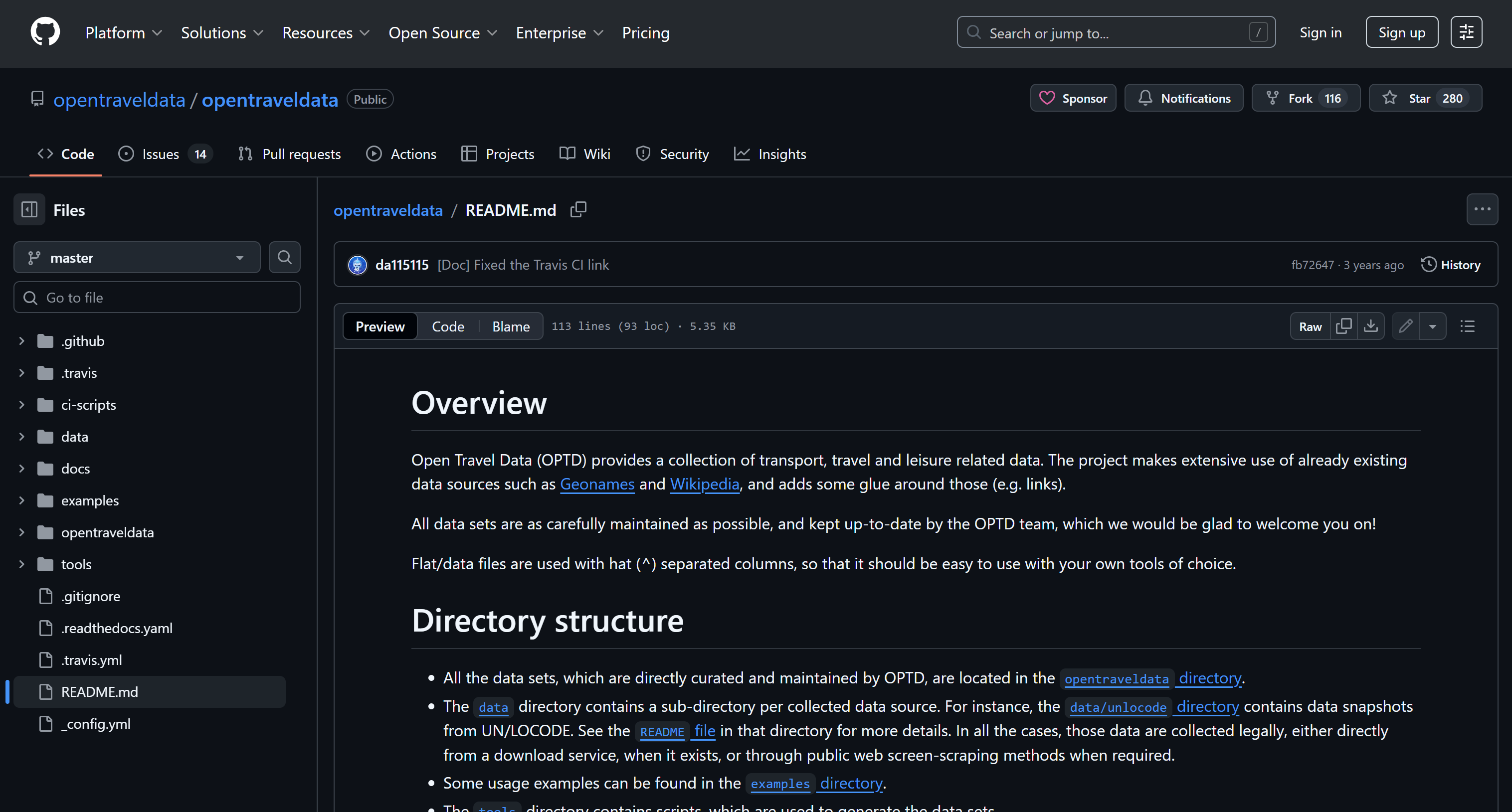
Open Travel Data (OPTD) is an open-source project available as a public GitHub repository. It collects, consolidates, and curates travel data from multiple sources. The project provides free, community-maintained datasets covering airports, airlines, locations, and geographic references. These are delivered as flat files, along with tools and examples to process and integrate this data for travel search, analytics, and research use cases.
➡️ Ideal for: Academic research and AI/ML experimentation.
Market coverage:
- Transport, travel, and leisure data curated from sources like Geonames, Wikipedia, UN/LOCODE, and more.
- Includes geographic, airport, airline, location, and travel reference datasets maintained by the community.
Infrastructure and architecture:
- Downloadable files hosted in the repository.
- Tooling and examples for processing and integration in AWK, Python, Shell, JavaScript, and other programming and CLI languages.
Data timeliness:
- Static datasets, last updated up to three years ago (as of this writing).
Technical requirements:
- Ability to work with flat files and open datasets.
- Optional technical knowledge across multiple programming languages and tools to run the available examples.
Regulatory adherence:
- Data is licensed under CC-BY 4.0, allowing sharing and commercial use with attribution.
Pricing:
- Free and open-source.
Conclusion
In this guide, you learned why travel data is valuable, the main types of data available, and how difficult it can be to access due to the fragmented nature of the market. You also saw how specialized data providers can help overcome these challenges.
Travel data providers offer access to information through datasets, SaaS services, or scraping solutions that collect fresh data. Among the leading providers, Bright Data is recognized for its highly scalable infrastructure.”
In this realm, Bright Data has you covered with travel datasets, scraping APIs, and managed data collection services.
Sign up for a Bright Data account today and start exploring our travel data solutions!
FAQ
Where to source travel data?
Travel data can be sourced from a variety of popular platforms, sites, and online aggregators. Known sources include Airbnb, Booking.com, Expedia, Skyscanner, Tripadvisor, Agoda, Google Travel (Flights, Hotels, etc.), as well as airline-specific and hotel-specific websites.
How to get travel data?
The two main approaches to getting travel data are:
- Using a travel web scraper: You can build it yourself or use a ready-made travel scraping service or API. This method lets you gather up-to-date information directly from travel platforms, such as live pricing for flights and hotel bookings.
- Relying on existing travel datasets: These include historical data that providers have gathered, aggregated, or purchased in the past, ready for immediate analysis.
What is a travel dataset?
A travel dataset is a structured collection of travel-related data, typically in CSV, JSON, Parquet, or Excel formats. It can list hotel availability, pricing, flight schedules, reviews, destination details, and other relevant travel information. These datasets are static and historical, but can receive regular updates.
How to scrape travel data?
To scrape travel data, you must first identify the target travel portal. Once the site is selected, the web scraping process follows this roadmap:
- The scraper connects to the target page.
- The page is rendered using a browser automation tool, or its HTML is parsed with an HTML parser.
- Travel data scraping logic is applied to extract the information of interest.
- The scraped data is returned in the desired format.
For some examples, refer to these guides:



Technical Writer
 5.5 years experience
Antonello Zanini is a technical writer, editor, and software engineer with 5M+ views. Expert in technical content strategy, web development, and project management.