






In this blog post, you will learn:
- What a ChatGPT scraper is and the main scenarios it covers.
- Why you should consider a dedicated solution for scraping ChatGPT instead of calling the OpenAI APIs directly.
- The most important aspects to keep in mind when evaluating ChatGPT scraping tools.
- The best ChatGPT scrapers, presented and ranked according to these criteria.
Let’s dive in!
TL;DR: Quick Comparison of the Top ChatGPT Scrapers
Discover and compare the best ChatGPT scrapers in the summary table below:
| Provider | Type | No-code option | Infrastructure | Concurrency | Fan-out check feature | Shopping data feature | Pay-as-you-go | Free trial | Entry price |
|---|---|---|---|---|---|---|---|---|---|
| Bright Data | API + no-code | ✅ | Enterprise proxy network (400M+ IPs) with automatic unblocking | Unlimited | ✅ | ✅ | ✅ | ✅ | $1.5/1k records |
| ScrapingBee | API | ❌ | Managed scraping API with proxies | 10–200 concurrent requests | ❌ | ❌ | ❌ | ✅ | $49/mo |
| Oxylabs | API | ❌ | Managed scraping infrastructure with proxies | 10–50 req/sec | ❌ | ❌ | ❌ | ✅ | $49/mo |
| A-Parser | Desktop + API | ✅ | Local scraping + external proxies | 100–200 queries/min | ❌ | ❌ | ❌ | ❌ | $179 lifetime |
An Introduction to Scraping Data From ChatGPT
Before reviewing the best ChatGPT scrapers, it is helpful to gain some background knowledge about retrieving data from ChatGPT.
What Is a ChatGPT Scraper?
A ChatGPT scraper is a solution for collecting responses from ChatGPT at scale. It provides an interface (usually via an API or a no-code tool) to send prompts and retrieve structured AI outputs. The responses generally go beyond plain text replies and may also include metadata, citations, links, and more.
Main Use Cases of Scraping ChatGPT
Given the data retrieved from ChatGPT, the main use cases include:
- Synthetic data generation: Collect ChatGPT responses at scale to generate datasets for testing, benchmarking, and training pipelines.
- GEO and fanout analysis: Analyze how ChatGPT surfaces brands, products, or sources across prompts to understand visibility, citation patterns, and competitive positioning in AI-generated answers.
- Model change monitoring over time: Periodically collect responses to the same prompts to detect shifts in wording, sources, accuracy, or behavior as models and ranking logic evolve.
- Augmented web search extraction: Capture ChatGPT responses enriched with web search results to extract summarized information, references, and structured insights without scraping multiple websites directly.
Why a Dedicated ChatGPT Scraper Is Better Than Direct API Integration
You may be wondering why a ChatGPT scraper is even necessary when you can call the OpenAI API directly. In theory, retrieving ChatGPT data is a simple process: you send a prompt and store the response. In practice, building a solid and scalable process is not that straightforward.
Direct API integration requires managing API keys, dealing with rate limits, handling timeouts and transient errors, and normalizing different response formats. You may also need to implement retries, concurrency control, logging, and monitoring. If you want structured outputs, metadata, citations, or web-search–augmented results, the integration becomes even more complex.
A dedicated ChatGPT scraper removes that operational burden. These tools provide a stable interface, typically through an API or a no-code workflow, that handles request orchestration, scaling, and response normalization.
Instead of building and maintaining custom pipelines, a dedicated ChatGPT scraper lets you focus on using the data. For large-scale analysis, monitoring, or automation tasks, this approach is just more reliable.
Factors to Consider When Evaluating Tools to Scrape ChatGPT
The ChatGPT scraper market is evolving rapidly. To avoid wasting time and stay focused on the most relevant options, you need a clear comparison framework based on consistent evaluation criteria, such as:
- Scraping options: The methods provided to extract data from ChatGPT, such as APIs, no-code platforms, desktop applications, or automated workflows.
- Included data: The types of information you can retrieve from ChatGPT responses, such as plain text, citations (when available), hyperlinks, product recommendations, embedded map data, etc.
- Infrastructure: The provider’s ability to scale reliably, maintain uptime, handle large request volumes, and manage challenges such as rate limiting and anti-bot protections.
- Technical requirements: The level of technical expertise or infrastructure needed to use and integrate the ChatGPT scraping solution.
- Compliance: The provider’s adherence to privacy regulations (e.g., GDPR and CCPA) and security standards (e.g., ISO/IEC 27001).
- Free trial: Whether a free trial or testing option is available before committing to a paid plan.
- Pricing: The pricing model offered by the provider and how costs scale with usage.
Top 5 Providers of ChatGPT Scrapers
Let’s explore the best ChatGPT scrapers, carefully selected and ranked according to the criteria outlined above.
1. Bright Data
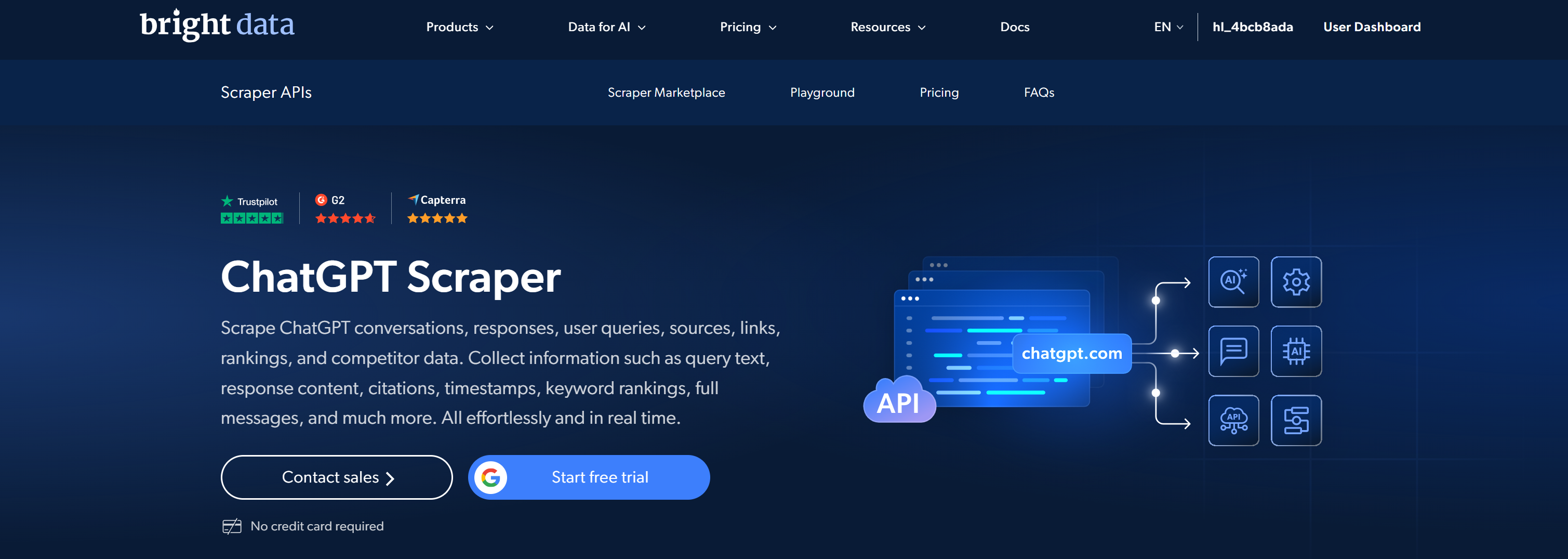
Bright Data offers specialized tools for collecting data from both the web and AI systems. Among its wide range of products and services, it comes with LLM scrapers that extract structured responses and metadata from major AI models, including ChatGPT.
Bright Data’s ChatGPT Scraper helps you collect ChatGPT conversations, responses, user queries, sources, links, rankings, and competitor data. You can retrieve information such as query text, response content, citations, timestamps, keyword rankings, and full messages. All data is delivered in a consistent and scalable way, either via API or through a no-code interface.
That solution supports several key use cases, including:
- AI search visibility: Track how your brand appears in AI-generated results by monitoring mentions, recommendations, and competitor comparisons in real time.
- Real-time AI tracking: Monitor evolving AI-driven search rankings and brand visibility across platforms such as OpenAI GPT and other AI search engines.
- Competitive insights: Analyze how AI systems rank your brand compared to competitors to improve positioning in AI-generated recommendations.
- ChatGPT data analysis: Collect and analyze ChatGPT queries and responses to identify trends, study response quality, and gain research insights.
Two distinctive features further differentiate this ChatGPT Scraper are:
- Query fan-out checks: Captures whether the LLM actually triggered a web search during response generation. It distinguishes between permission to search and real behavior, allowing you to verify if external searches were executed as part of producing the final answer.
- Shopping data: Returns structured information about shopping options provided by the LLM when relevant.
What makes Bright Data stand out is its enterprise-grade infrastructure, powered by a global proxy network with over 150 million IPs, automatic unblocking technology, and 99.99% uptime. This enables reliable, large-scale ChatGPT data collection.
Those features and capabilities position Bright Data as one of the most complete ChatGPT scraping solutions currently available!
📌 Best for: Reliably performing ChatGPT scraping at scale, either via API or a no-code tool, without scalability limitations.
Scraping options:
- API-based ChatGPT scraper.
- No-code interface for scraping ChatGPT in a web-based dashboard.
- Fully managed LLM data collection solution available.
Included data:
- Model responses in text, HTML, or Markdown formats.
- Original query prompt and full response messages.
- Response elements, including:
- Hyperlinks.
- Citations (when available).
- Embedded map data.
- Query fan-out data (see whether ChatGPT performed web searches to answer the prompt).
- Shopping data (structured information about shopping options when available).
Infrastructure:
- Access to 400M+ proxy IPs across 195 countries for geo-located prompts.
- Built-in proxy and unblocking system with automatic IP rotation and CAPTCHA handling.
- 99.95% success rate.
- 99.99% uptime infrastructure.
- Infinite concurrency.
- Supports bulk requests, with up to 5K simultaneous requests.
- Data delivery via API or webhooks.
- Results can be downloaded or sent to storage services such as Amazon S3, Google Cloud Storage, Azure, and many others.
- Data parsing, validation, and structure detection capabilities.
- Supports automated and scheduled runs.
- 70+ AI integrations available.
- 24/7 support from a team of experts.
Technical requirements:
- Basic programming skills required to connect to the ChatGPT scraping API.
- No-code interface available for non-technical users, with options for scheduling and management.
- Technical skills recommended for integrations into AI/ML workflows, pipelines, and applications.
Compliance:
- GDPR compliant.
- CCPA compliant.
- SEC compliant.
- Certified to ISO 27001, SOC 2 Type II, and CSA STAR Level 1 standards.
Free trial:
- Free tier available with no credit card required.
Pricing:
- Pay-as-you-go pricing starting at $1.5 per 1k records with no commitment.
- Monthly plans available:
- 510K records for $499/mo ($0.98 per 1k records).
- 1M records for $999/mo ($0.83 per 1k records).
- 2.5M records for $1,999/mo ($0.75 per 1k records).
- Enterprise plans available with custom pricing.
2. ScrapingBee
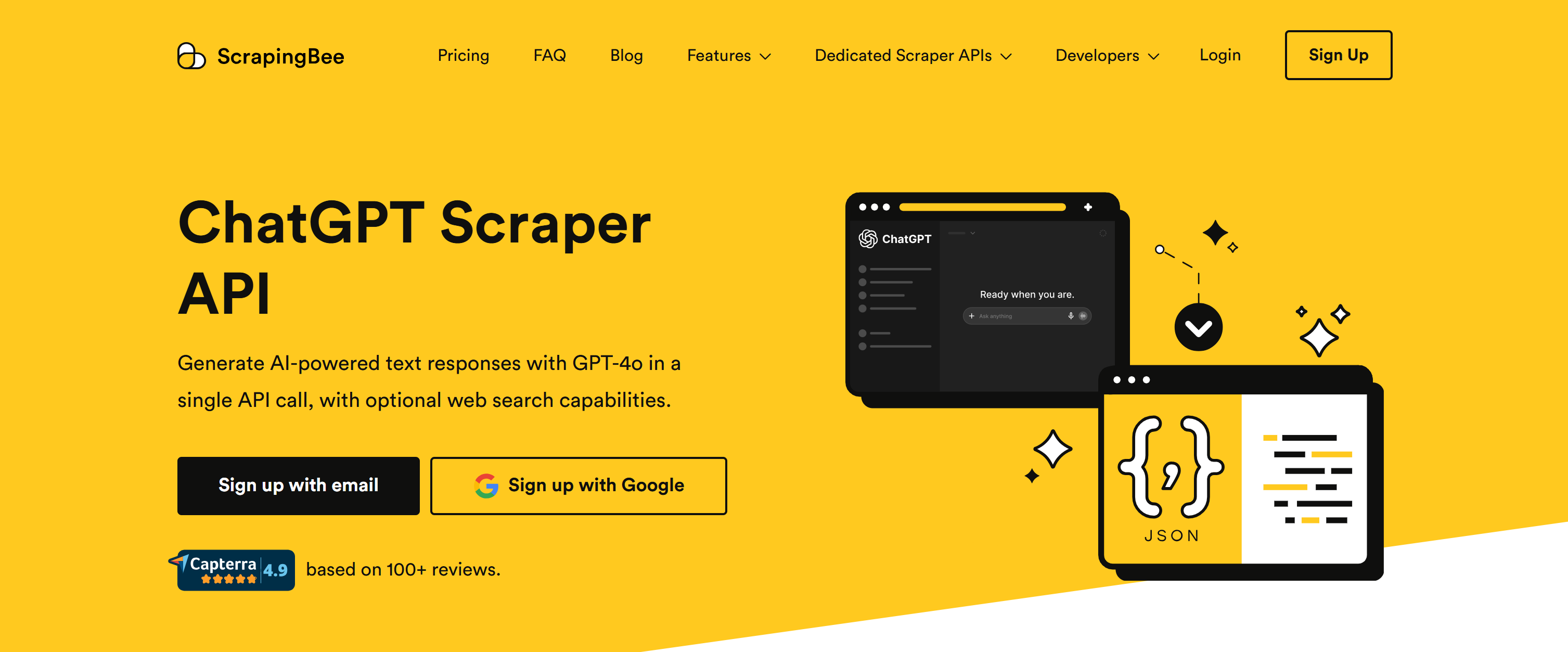
ScrapingBee is a web scraping API designed to extract data while handling IP rotation and anti-bot protections for you. Supported targets include ChatGPT. A dedicated endpoint allows you to retrieve ChatGPT responses in structured formats, with optional web search capabilities and full HTML access.
📌 Best for: Extracting structured responses for keyword research, GEO analysis, and content planning.
Scraping options:
- API-based ChatGPT scraper (GPT-4o model).
Included data:
- Model responses in plain text, Markdown, or structured JSON.
- Prompt and model metadata (e.g., model name).
- Optionally:
- Full HTML responses.
- Web search–augmented responses.
Infrastructure:
- Built-in proxy rotation and CAPTCHA bypass capabilities.
- Automatic handling of anti-bot protections.
- Scalable infrastructure backed by rotating proxies.
- Supports concurrent requests depending on the plan limits (from 10 to 200).
- Response times between 1 and 5 seconds.
Technical requirements:
- Basic programming skills are required to send API requests and process responses.
- Simplified integrations with code snippets available for JavaScript, Python, PHP, curl, and other languages.
- No-code automation supported via Make and n8n.
Compliance:
- GDPR compliant.
- CCPA compliant.
Free trial:
- 1,000 free API credits available, with no credit card required.
Pricing:
- Freelance: $49/mo for 250,000 credits.
- Startup: $99/mo for 1,000,000 credits.
- Business: $249/mo for 3,000,000 credits.
- Business+: $599/mo for 8,000,000 credits.
3. Oxylabs
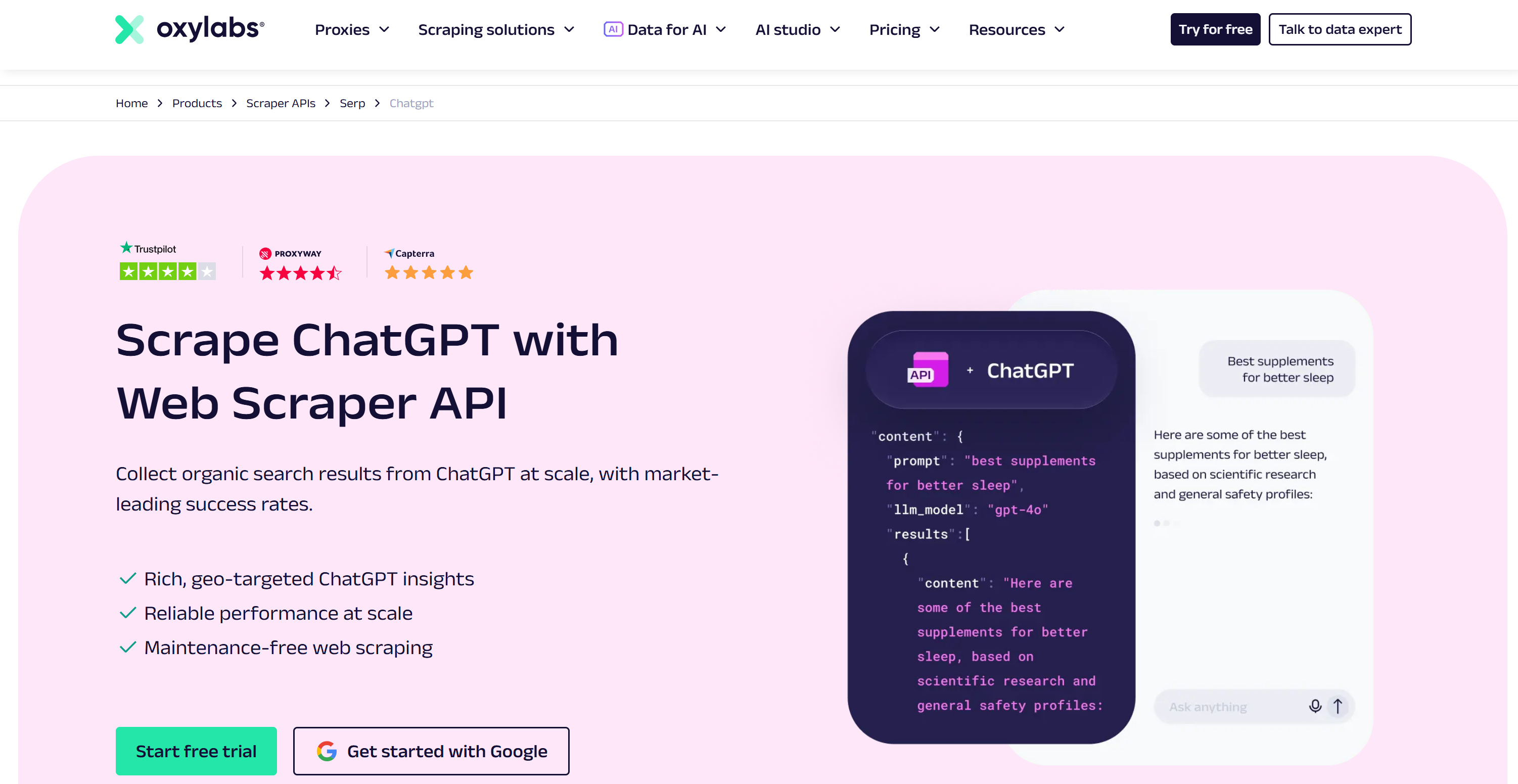
Oxylabs is a global provider of proxy infrastructure and web data collection tools. Its Web Scraper API encompasses several websites, including ChatGPT. This solution opens the door to the automated extraction of ChatGPT responses via API requests. What you get is automated structured outputs with metadata, citations, and optional web-search results.
📌 Best for: Continuous ChatGPT monitoring, benchmarking, or dataset generation.
Scraping options:
- API-based ChatGPT scraper (as part of the Web Scraper API service).
Included data:
- Structured ChatGPT responses in JSON, with full response text in raw text or Markdown.
- Prompt data and model identifier.
- Metadata such as timestamps, search behavior, and geographic origin.
- When available / optionally:
- Citations and links.
- Parsed structured outputs.
- HTML output.
Infrastructure:
- Fully managed, maintenance-free scraping infrastructure.
- Automatic CAPTCHA bypass and anti-bot handling.
- Rate limits from 10 to 50 requests per second, depending on the plan.
- Allows scheduled scraping tasks and automated delivery.
- Supports geo-targeted requests at the country level via built-in proxy integration.
Technical requirements:
- Basic development skills needed to send POST requests and process JSON responses.
- Ability to deal with automated data delivery via callback URLs or cloud storage (e.g., AWS S3, Google Cloud Storage).
Compliance:
- ISO/IEC 27001:2022 certified.
- GDPR compliant.
Free trial:
- Up to 2,000 free results, with no credit card required.
Pricing:
- Micro: $49/mo for up to 98,000 results.
- Starter: $99/mo for up to 220,000 results.
- Advanced: $249/mo for up to 622,500 results.
4. A-Parser
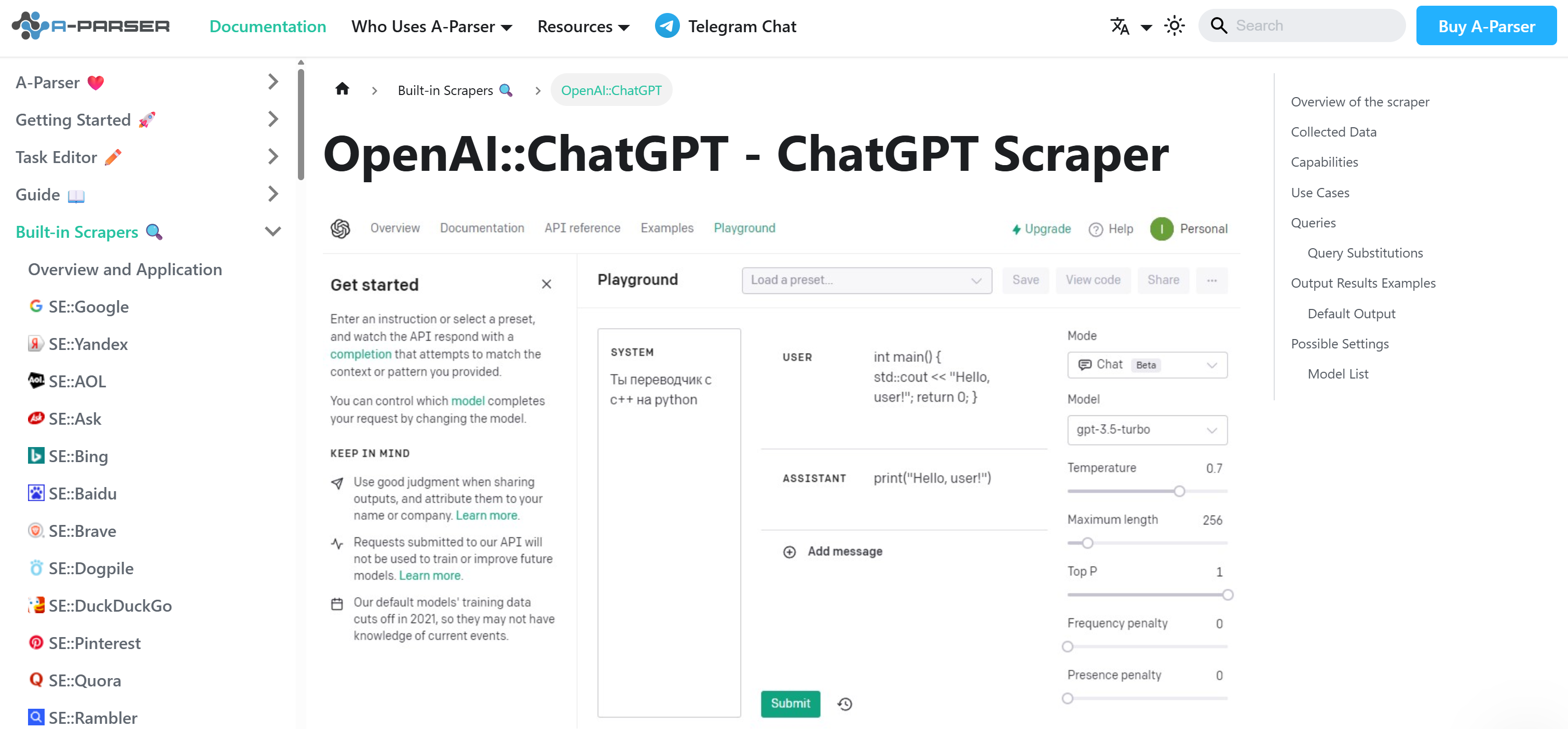
A-Parser is a web-based and desktop application for web scraping and automation. It includes dozens of built-in parsers for extracting data from various platforms, with a focus on search engines and LLM providers. In particular, its ChatGPT scraper retrieves up-to-date, concise, and relevant answers directly from the AI interface.
📌 Best for: Combining ChatGPT data with search engine results.
Scraping options:
- Desktop scraping software available for Windows and Linux, plus macOS support via Docker, along with a browser-based web interface.
- Enables automation and management via API.
Included data:
- Query–response pairs with contextual ChatGPT outputs, with answer text in Markdown format.
- Model information (name of the model used).
- When present / optionally:
- Source links with anchors, snippets, icons, and usage type within the answer.
- Images, including image URLs, previews, source pages, and titles.
Infrastructure:
- Supports up to 100–200 ChatGPT queries per minute.
- Task automation and queue management available via API.
- Supports integration with third-party HTTP and SOCKS4/5 proxies.
- Supports integration with third-party CAPTCHA-solving services.
Technical requirements:
- Basic skills for installation and local setup required.
- No special skills needed to use the tool, which is no-code and provides an intuitive interface.
- Programming skills required for (optional) management via API.
Compliance:
- Undisclosed.
Free trial:
- Not available.
Pricing:
- Lite: $179/lifetime.
- Pro: $299/lifetime.
- Enterprise: $479/lifetime.
- (Paid updates are sold separately.)
Conclusion
In this article, you understood why relying on a ChatGPT scraper instead of calling the OpenAI APIs directly often makes more sense. You saw the importance of a unified interface for retrieving ChatGPT data and explored key use cases, ranging from synthetic data generation to fanout analysis.
Among the available ChatGPT scrapers, Bright Data stands out as the leading option thanks to its enterprise-grade data collection infrastructure. This is backed by a proxy network of over 150 million IPs, delivers high uptime, and achieves high success rates and reliability.
Bright Data offers AI Answer Engine Scrapers that cover several LLM providers, including ChatGPT. In particular, Bright Data’s ChatGPT Scraper allows you to retrieve ChatGPT data either programmatically via API or through no-code integrations.
Create a Bright Data account for free and explore an AI-ready solution for web data scraping!
FAQ
What is the difference between a ChatGPT-powered scraping tool and a ChatGPT scraper?
A ChatGPT-powered scraping tool uses ChatGPT (or OpenAI models, in general) to process or extract data from external websites. Instead, a ChatGPT scraper extracts responses directly from ChatGPT. In short, the first relies on ChatGPT to scrape and structure web data, while the second scrapes ChatGPT itself.
How to use ChatGPT for scraping data from other websites?
The process of using ChatGPT for scraping data from a web page involves these steps:
- Collect raw data: Use a custom scraper or a dedicated scraping solution to retrieve HTML or text/Markdown from target websites.
- Send data to ChatGPT: Provide the scraped content as input via the ChatGPT API or an automation workflow.
- Extract structured information: Ask ChatGPT to convert the raw content into structured formats such as JSON, tables, or specific data fields.
- Store the cleaned data: Use ChatGPT to remove noise and standardize formats, then export the results to a local file, a database, or a cloud service.
For more information, refer to our guide on how to use ChatGPT for web scraping.
Why scrape ChatGPT instead of calling the OpenAI APIs?
Calling the OpenAI APIs may seem straightforward, but building a reliable and scalable pipeline around them can be complex. A dedicated ChatGPT scraper simplifies the process by handling rate limits, retries, scaling, and response normalization, providing a stable interface for collecting ChatGPT data consistently at scale.



Technical Writer
 5.5 years experience
Antonello Zanini is a technical writer, editor, and software engineer with 5M+ views. Expert in technical content strategy, web development, and project management.