








In this article, you will see:
- What market research data is, and the main challenges in retrieving it.
- How a dedicated market research data provider helps overcome these challenges.
- Key factors to consider when comparing these solutions.
- A list of the top six market research datasets providers.
Let’s dive in!
TL;DR: Quick Summary Table of the Best Market Research Data Providers
If you are in a hurry, here is a quick at-a-glance overview of the top market research data providers:
| Provider | Infrastructure | Main source type | Historical dataset | Real-time data | GDPR compliant | Managed service | Free trial/data sample | Pricing |
|---|---|---|---|---|---|---|---|---|
| Bright Data | Enterprise-ready, APIs, 400M+ proxy IPs, unlimited concurrency, 17B+ records | Secondary | ✅ | ✅ | ✅ | ✅ | ✅ | Starting at $1.50 per 1k records. |
| EthosMR | Managed service | Primary | ❌ | ❌ | — (Undisclosed) | ✅ | ❌ | Project-based |
| Crawl Feeds | File download | Secondary | ✅ | ❌ | ✅ | ❌ | ✅ | Dataset-based |
| Travel Scrape | File download + API | Secondary | ✅ | ✅ | — (Undisclosed) | ❌ | ❌ | Dataset-based |
| Memoori | Advisory | Secondary | ✅ | ❌ | — (Undisclosed) | ✅ | ❌ | Project-based |
| Drive Research | Managed service | Primary | ❌ | ❌ | — (Undisclosed) | ✅ | ❌ | Project-based |
An Introduction to Market Research Data
Before diving into the best market research data providers, let’s take a step back and better understand the world of market research.
What Is Market Research Data?
Market research data is all the information collected to study markets, consumers, competitors, and industry dynamics. It is applied specifically to support research, analysis, and decision-making.
At a high level, this data includes quantitative metrics such as demographics, pricing, sales volumes, and market share. It also covers qualitative insights like customer motivations, preferences, and sentiment.
Market research data comes from both primary sources and secondary sources. Primary sources include surveys, interviews, focus groups, and direct observation. Secondary sources are government statistics, industry reports, financial data, and digital platforms.
When analyzed correctly, this type of data helps identify opportunities, validate demand, reduce go-to-market risk, and improve pricing and positioning. Its main areas of focus are consumer behavior, market trends, competitive intelligence, and firmographic and economic indicators.
Types of Market Research Data
Market research data is an umbrella term that spans multiple sectors, industries, and use cases. As a result, it can be categorized in many different ways. At a more concrete, source-based level, the main types of market research data include:
- Financial and stock market data: Company financial statements, stock prices, earnings, ratios, indices, and alternative data used to assess corporate performance and macroeconomic conditions.
- Government statistics: Official datasets covering demographics, employment, inflation, trade, and economic activity.
- Industry reports: Analyst-produced deep dives into specific sectors, including market size, trends, competitive landscapes, and forecasts.
- Trade and customs data: Import and export records detailing shipment volumes, product categories, trade partners, and cross-border market flows.
- E-commerce and retail data: Product pricing, sales volume, rankings, reviews, and seller performance data from online marketplaces and retail platforms.
- Web and search trend data: Data from search engines and digital platforms that reveals what users are actively searching for, browsing, and discovering in real time.
- Web traffic and digital analytics data: Website visits, engagement metrics, referral sources, and conversion behavior collected via analytics and tracking tools.
- Consumer behavior data: Insights into preferences, purchasing patterns, and usage habits, gathered through surveys, panels, loyalty programs, or digital tracking.
- Social media and sentiment data: Public posts, comments, and reactions analyzed to measure brand perception, audience sentiment, and emerging trends.
- Company and firmographic data: Structured information about businesses, including size, revenue, industry classification, location, and organizational structure.
- Sales and transactional data: Records of purchases, pricing, timing, and customers, used to identify revenue drivers and seasonal patterns.
- CRM and customer interaction data: Data from sales notes, support tickets, emails, and feedback that exposes customer needs, objections, and pain points.
Challenges in Sourcing Market Research Data
Sourcing market research data at scale is far from trivial, especially since much of the most valuable information lives on the open web. Most websites have anti-scraping measures in place, such as CAPTCHAs, IP blocking, and browser fingerprinting, to prevent automated data collection. Many sites also change frequently or provide data in inconsistent or unstructured formats.
Even if you manage to collect the data, aggregation is a major challenge. Market signals are scattered across thousands of sites, platforms, and formats. Plus, combining them with internal surveys into a single, consistent dataset requires significant engineering effort.
Enrichment adds another layer of complexity. Raw data often lacks context and must be matched with firmographic, geographic, or behavioral attributes. Data quality issues do not stop there. Deduplication is necessary to remove overlapping records, and cleaning and normalization fix missing fields, inconsistent naming, outdated values, and noisy text.
Maintaining freshness is also difficult. Remember that market data becomes outdated quickly. Thus, data pipelines must run continuously and reliably to get accurate, up-to-date insights.
Why a Dedicated Market Research Data Provider Is the Right Solution
Given the obstacles highlighted earlier, it is clear that without a robust, stable, and scalable infrastructure, sourcing market research data can be slow, fragile, and expensive. That is why most companies seeking reliable market insights turn to a dedicated data provider.
A market research data provider is a service that collects, organizes, and delivers information from a wide range of sources. This can include raw data, ready-to-use enriched datasets, or aggregated insights covering industries, consumers, competitors, and market trends.
In other words, these providers manage the technical and logistical challenges of data collection. They give businesses direct access to data or offer tools that simplify building custom data pipelines, such as:
- Pre-compiled datasets: Structured, ready-to-use files with historical and regularly updated information. Ideal for market analysis, trend studies, and AI training.
- Data collection services: Companies that handle data collection internally on your behalf or provide APIs that retrieve live external market research data from websites, digital platforms, and industry sources.
Keep in mind that most organizations rely on both approaches. They utilize pre-compiled datasets for historical context and scraping tools to capture up-to-date market intelligence.
Aspects to Consider When Comparing Market Research Data Options
By embracing a market research data provider, you can focus on analyzing insights and making business decisions instead of managing the technical complexity of data collection. On the other hand, the number of options available online can feel overwhelming.
To select the most reliable solutions, you should compare them across common factors such as:
- Data coverage: The range and types of market research data offered.
- Sources: Where the provider collects its data, such as websites, government reports, industry publications, or proprietary datasets.
- Infrastructure: The company’s ability to scale, maintain uptime, handle high volumes, and provide accurate, successful data delivery.
- Integration with AI: Support for connecting data to AI models, analytics pipelines, or AI-powered workflows.
- Data freshness: The availability of historical versus real-time data and how frequently it is updated.
- Technical requirements: The skills, tools, or infrastructure needed to access, process, and integrate the data.
- Data governance: Compliance with privacy frameworks like GDPR and CCPA to guarantee ethical and legal data use.
- Pricing: Availability of subscription plans, custom packages, trial access, or sample datasets for evaluation.
Top 6 Market Research Data Providers
Discover the best market research data providers, carefully selected and ranked using the criteria outlined earlier.
1. Bright Data
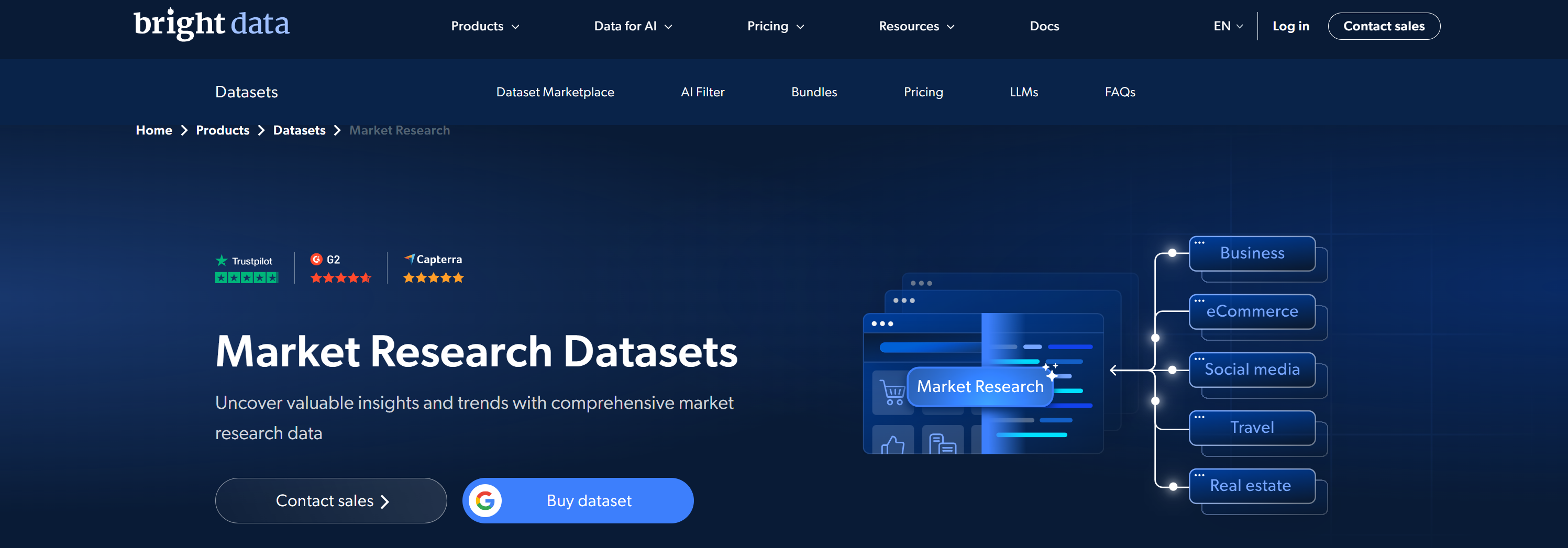
Originally known as just a proxy provider, Bright Data has evolved into the leading web data platform. What makes it stand out is its enterprise-grade infrastructure, which enables highly scalable data collection and delivery across diverse markets and geographies.
That infrastructure supports several use cases, including market research via:
- Market research datasets: Pre-collected, validated, and enriched datasets delivered in JSON, CSV, or Parquet formats. These datasets include billions of records and support historical analysis, competitive benchmarking, and model training.
- Market research web scraping APIs: API endpoints and no-code tools for on-demand data extraction from websites and web platforms. Built-in IP rotation, CAPTCHA handling, and anti-bot mitigation empower consistent data collection at scale across a long list of domains.
- Fully managed data services: End-to-end data acquisition service where Bright Data designs the collection methodology, executes extraction, and delivers structured outputs through reports, dashboards, or direct system integrations.
With a network of over 150 million IPs and a strong focus on compliance and ethical data sourcing, Bright Data provides a robust foundation for market research teams, analysts, and data-driven organizations operating at any scale.
Together, these features position Bright Data as the best market research data provider!
💡 Ideal for: Enterprise-grade market research data collection and analytics from secondary web channels, suitable for internal analysis or integration into AI systems.
Data coverage:
- Over 215 datasets spanning 17+ billion records.
- Covers business, e-commerce, social media, real estate, news, financial, travel, and many other industries.
Sources:
- Data sourced from multiple platforms including social networks (LinkedIn, Instagram, TikTok, X/Twitter, Facebook, YouTube, Reddit, Pinterest), e-commerce marketplaces (Amazon, Walmart, Shopee, Target, Zalando, etc.), real estate portals (Zillow, Zoopla, Metrocuadrado), news outlets (CNN, BBC, Google News), and company databases (Crunchbase, Zoominfo, Pitchbook, Owler).
- Examples: LinkedIn profiles and companies, Amazon products and reviews, Zillow and Airbnb listings, Google Maps business data, TikTok and Instagram profiles and posts, Glassdoor company and job data, financial data from Yahoo Finance, and more.
Infrastructure:
- Globally distributed data collection powered by 400M+ proxy IPs in 195 countries.
- High-throughput infrastructure with support for unlimited parallel requests.
- Enterprise-grade reliability with 99.99% uptime and scraping success rates.
- Built-in anti-bot capabilities, including automatic IP rotation and CAPTCHA solving.
- Large-scale extraction support, handling up to 5,000 URLs per request on the same request.
- Multiple output formats available, including JSON, NDJSON, CSV, and Parquet.
- Flexible data delivery via Amazon S3, Google Cloud, Azure, Snowflake, SFTP, Pub/Sub, webhooks, and similar channels.
- Advanced filtering and segmentation features to isolate only the most relevant records.
- Fully processed datasets that are validated, cleaned, enriched, and optimized for LLM and analytics pipelines.
- Access to petabyte-scale cached data through the Web Archive API.
- 24/7 expert support to assist with setup, scaling, and ongoing data operations.
Integration with AI:
- Compatible with 70+ AI platforms and frameworks, such as LangChain, LlamaIndex, CrewAI, Dify, OpenClaw, AWS Bedrock AI Agents, Microsoft Copilot Studio, IBM watsonx, and others.
- Streamlined integration into AI agents through Bright Data MCP.
- Plain-English query support that lets you describe data requirements in natural language, with AI automatically translating them into accurate filters.
Data freshness:
- Access to historical and trend datasets with configurable refresh cycles (daily, weekly, or monthly).
- Live data acquisition via APIs and no-code scraping solutions.
Technical requirements:
- Basic technical skills are enough to begin collecting market research data through APIs.
- No-code scrapers allow direct data extraction from the Bright Data platform with minimal setup.
- API familiarity is recommended for advanced automation, custom pipelines, or internal system integration.
- No technical expertise required for fully managed services, which are supported end-to-end.
Data governance:
- Full compliance with GDPR and CCPA requirements.
- Data collected exclusively from publicly available web sources using ethical methods.
- Certified under SOC 2 Type II, ISO 27001, CSA STAR Level 1, and additional security standards.
Pricing:
- Free trial access and sample datasets available.
- Market research data collection via API starting at $1.50 per 1k records.
- Market research dataset pricing starting at $2.50 per 1k records, with bundle discounts available.
- Fully managed data services starting from $2,500 per month.
2. EthosMR
EthosMR is a full-service agency delivering end-to-end market research solutions. It offers both quantitative and qualitative services, including large-scale surveys, consumer and B2B panels, focus groups, ethnographies, and in-depth interviews. Its end goal is to help you gather actionable insights across diverse markets and audiences.
💡 Ideal for: Primary consumer and B2B insight generation, such as brand perception, VoC, or product concept testing.
Data coverage:
- Provides both qualitative and quantitative market research data across industries, including finance, automotive, technology, healthcare, retail, food and beverage, travel, and consumer markets.
- Supports surveys, focus groups, ethnography, shopper studies, and retail insights.
Sources:
- Data is collected from several sources, such as recruited panels, hard-to-reach audiences, consumers, business professionals, patients, and ethnically diverse communities across North America.
Infrastructure:
- Managed service covering both quantitative and qualitative research, including large-scale online surveys, tracking studies, focus groups, video ethnographies, and in-depth interviews.
Integration with AI:
- AI-assisted analysis and AI voice agents support enhanced insights and workflow automation.
Data freshness:
- Designed for real-time or recent market studies, with projects tailored to client timelines.
- Emphasis on current consumer, business, and sector insights rather than historical datasets.
Technical requirements:
- Minimal technical requirements for clients, as EthosMR manages survey programming, data collection, and processing.
Data governance: Undisclosed.
Pricing:
- Project-specific quotes.
3. Crawl Feeds
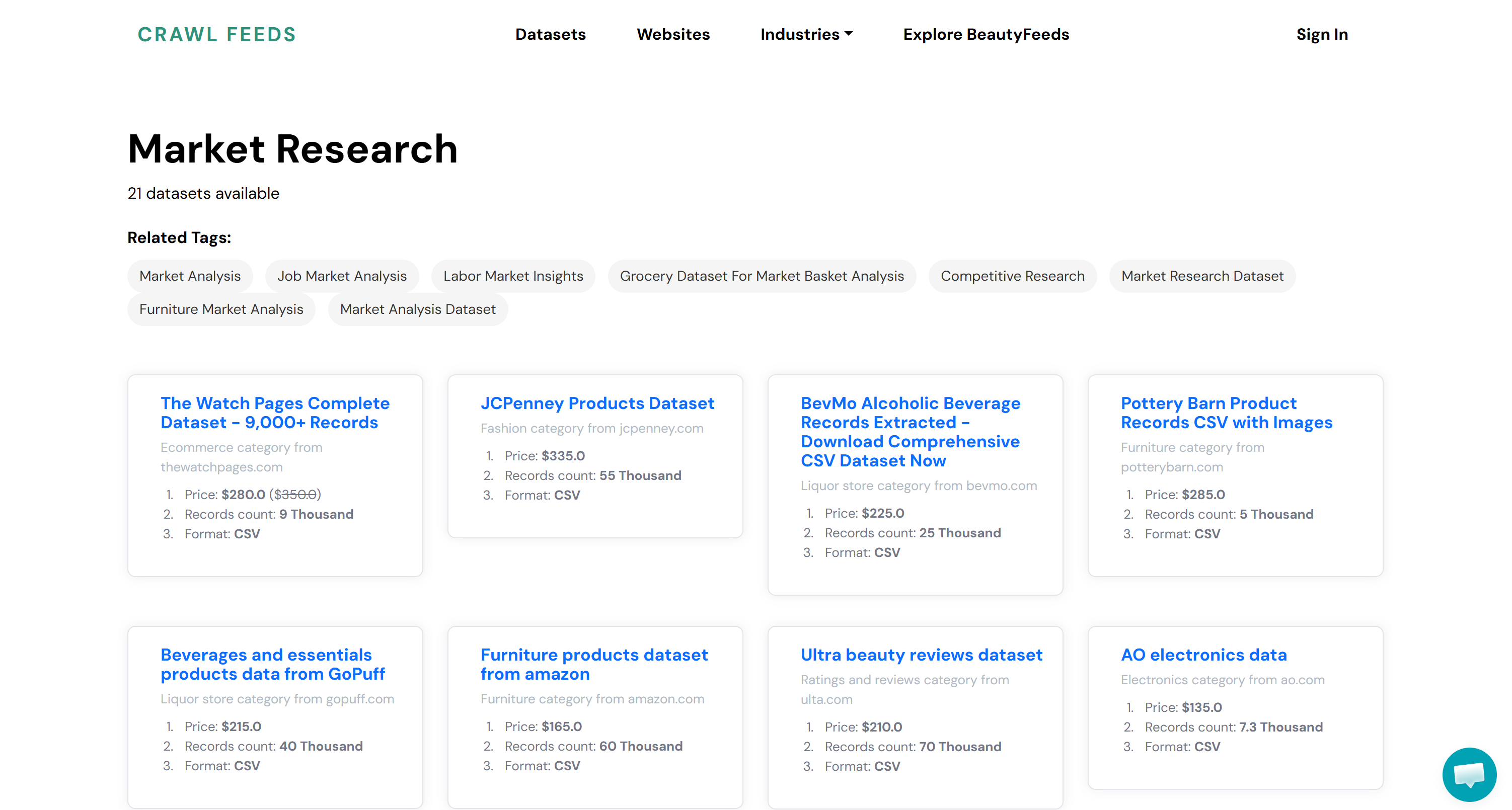
Crawl Feeds is a web data platform that sells structured datasets, as well as custom web scraping services. Covered industries span e-commerce, real estate, and media. In detail, its market research data offerings are built around ready-to-analyze CSV, JSON, and Excel datasets. These enable analysis of consumer behavior, pricing, product listings, and trends.
💡 Ideal for: Academic, internal, or exploratory research where flat-file datasets are sufficient.
Data coverage:
- Offers a wide range of datasets across multiple categories, including e-commerce products, fashion, furniture, electronics, beverages, and ratings/reviews.
- Datasets vary in size from thousands to millions of records.
Sources:
- Data is collected from several websites and digital platforms, such as Amazon, Flipkart, Booking.com, Sephora, JCPenney, and Etsy.
Infrastructure:
- Datasets are available for download in CSV, JSON, and XLSX formats, with no dedicated API infrastructure.
Integration with AI:
- Datasets can be used for AI training.
Data freshness:
- Historical datasets, with options for weekly or monthly updates.
Technical requirements:
- Skills in data analysis, visualization, or machine learning are needed to extract insights from flat-file datasets.
Data governance:
- Data is collected ethically and ensured to be fully compliant with relevant standards.
Pricing:
- Free samples are available for most datasets.
- Dataset prices vary widely, from $35 for smaller datasets to over $6,700 for large-scale datasets.
4. Travel Scrape
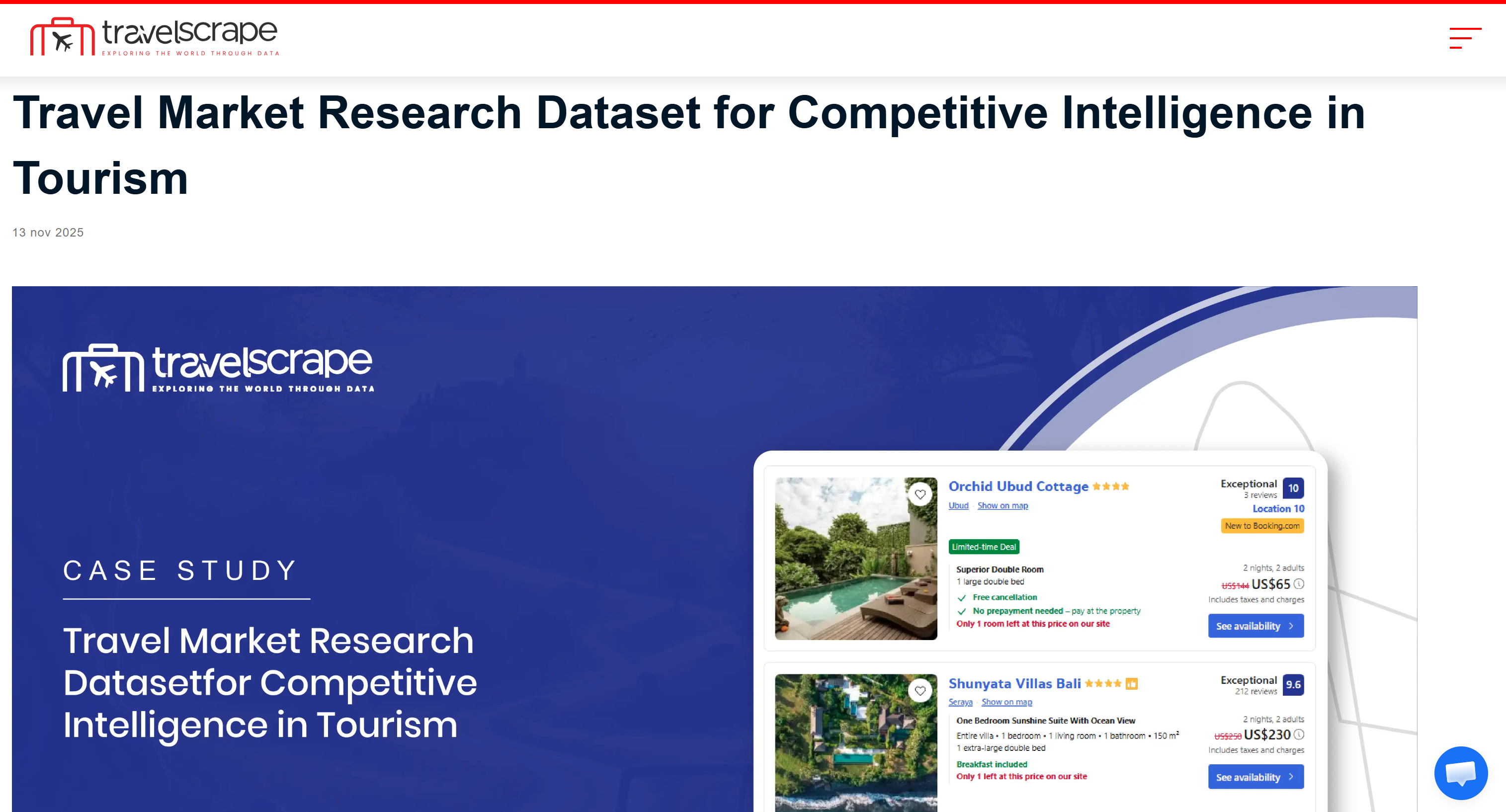
Travel Scrape is a travel data provider that offers automated extraction of publicly available information from airlines, hotels, and OTAs. In particular, it also equips you with travel-focused market research datasets. These support businesses in monitoring competitors, analyzing seasonal trends, forecasting demand, and optimizing pricing.
💡 Ideal for: Market research tasks specialized in the travel industry.
Data coverage:
- Structured market research data on flights, hotels, vacation packages, seasonal demand, pricing fluctuations, consumer behavior, booking trends, competitor offerings, and promotions.
- Predictive analytics datasets supporting forecasting and revenue optimization across travel products and regions.
Sources:
- Aggregated from multiple travel providers, including OTAs, airlines, hotel platforms, and vacation package portals.
- Consolidates fragmented public data to provide unified, analysis-ready insights.
Infrastructure:
- High-frequency automated data pipelines with hourly, daily, or real-time extraction.
- API available for external integrations.
Integration with AI:
- Supports AI-driven recommendation engines, pricing algorithms, and customer segmentation.
- Can be integrated into AI agents via custom tooling.
Data freshness:
- Options for live data scraping.
- Historical data maintained for trend analysis and forecasting, with hourly or daily update frequency depending on your requirements.
Technical requirements:
- Requires technical skills for integration via API.
- Data is delivered in analysis-ready, structured formats suitable for predictive modeling and visualization.
Data governance: Undisclosed.
Pricing:
- Depends on the chosen dataset.
5. Memoori
Memoori is an independent research and consultancy firm focused on the smart building technology market. The company comes with extensive market intelligence, including historical and current datasets, competitive landscape analysis, technology trend evaluations, and vendor ecosystem mapping.
💡 Ideal for: Investment and M&A research, such as market sizing, forecasts, and due diligence support.
Data coverage:
- Market dataset covering technology trends, vendor ecosystems, competitive landscapes, market sizing, and forecasts.
- Data relevant for strategic market intelligence, M&A due diligence, investment opportunity analysis, and technology adoption.
Sources:
- Proprietary research network with global market intelligence.
Infrastructure:
- Managed services designed to provide consistent, structured, and queryable data outputs for analytics.
Integration with AI:
- Support for vector database integrations and AI knowledge pipelines.
Data freshness:
- Historical market research data spanning over ten years, with ongoing updates reflecting market changes.
- Options for recent or real-time data delivery.
Technical requirements:
- Technical aspects are primarily managed by the provider’s advisory team.
Data governance: Undisclosed.
Pricing:
- Varies depending on the scope of the project.
6. Drive Research
Drive Research is a full-service market research firm providing B2B and B2C organizations with tailored, data-driven insights. Its services include online surveys, focus groups, in-depth interviews, VoC studies, UX research, brand tracking, and feasibility studies. In other words, it delivers actionable market research data for strategic decision-making across multiple industries.
💡 Ideal for: Decision-support research for product, marketing, or customer experience strategy.
Data coverage:
- Custom qualitative and quantitative research, including online surveys, customer surveys, employee surveys, phone surveys, intercept surveys, PR surveys, and more.
Sources:
- Primary data collected directly from participants via surveys, interviews, focus groups, in-home usage tests, phone calls, and intercept surveys.
- B2B and B2C audiences, including targeted professionals (e.g., cardiologists, emergency physicians) and consumer households.
- Multilingual and international reach (U.S., U.K., France, Germany, Spain, Italy).
Infrastructure:
- End-to-end project management from planning to final analysis.
- Managed participant recruitment, screening, scheduling, and live support for studies.
- Hybrid research capabilities (online, in-person, and remote methodologies).
Integration with AI: Undisclosed.
Data freshness:
- Relatively fresh data collection through surveys and longitudinal studies (e.g., 6-week follow-ups, quarterly employee surveys).
- Historical comparisons supported via repeated or longitudinal survey designs.
Technical requirements:
- Minimal technical barriers, as the company manages survey administration, data collection, and reporting.
- You require standard analytical skills to interpret reports, infographics, and survey outputs.
Data governance:
- Compliance with privacy and ethical standards via anonymous data collection and careful respondent management.
Pricing:
- Custom quotes based on project scope and research type.
Conclusion
In this blog post, you explored the landscape of market research data and why working with a specialized provider gives you a strategic advantage. Leading market research data providers generally offer curated datasets or services that collect data directly from primary sources.
Among these providers, Bright Data stands out for its enterprise-grade infrastructure and tooling built for modern, AI-driven workflows. Its market research data offerings include:
- Market research datasets: Billions of records collected from a wide range of websites, supporting analysis across multiple industries and use cases.
- Scraper APIs: Scalable scraping endpoints for on-demand extraction of live data from dozens of online domains.
- Managed data acquisition services: End-to-end data collection where Bright Data designs, executes, validates, and delivers the data based on your research requirements.
Create a Bright Data account for free and start exploring its market research data services!
FAQ
Where to find market research data?
You can source market research data from a combination of primary and secondary channels. Primary sources include surveys, focus groups, interviews, and consumer panels. Secondary sources encompass government reports, industry publications, trade associations, academic studies, and online platforms. Depending on your focus, you can also access company filings, social media, review sites, or public datasets to gather insights on consumers, competitors, and market trends.
How to retrieve market research data?
Market research providers typically follow two main delivery approaches:
- Precompiled datasets: Structured collections of historical and current data, including consumer demographics, purchasing habits, product preferences, and market trends. These are useful for benchmarking, trend analysis, or training AI models.
- Custom collection solutions: Managed services or tools that gather data directly from surveys, panels, websites, or digital platforms. This approach provides up-to-date insights on behavior, sentiment, and competitive activity.
What is a market research dataset?
A market research dataset is a structured compilation of insights from primary or secondary sources. It can include survey responses, behavioral metrics, demographics, competitor information, and trend indicators. Depending on the provider, it may be regularly updated or static, serving as either a historical reference or a near-real-time resource for decision-making.



Technical Writer
 5.5 years experience
Antonello Zanini is a technical writer, editor, and software engineer with 5M+ views. Expert in technical content strategy, web development, and project management.