







In this guide, you will learn:
- Why AI agents need search tools to provide more accurate responses.
- The main types of search tools for AI agents.
- The best approaches for connecting search tools to AI agents.
- The top 9 providers of search tools for AI agents, ranked and compared across common criteria.
Let’s dive in!
TL;DR Summary Table: Top Search Tools for AI Agents
Here are the best providers of search tools for AI agents, compared in a simple table at a glance:
| Search tool for AI agents | SERP-based search API | Web search API | Semantic search API | MCP server | Official Agent skills | OpenAPI specs | Integrations | Free option |
|---|---|---|---|---|---|---|---|---|
| Bright Data | ✅ | ✅ | ✅ | ✅ | ✅ | ❌ | OpenClaw, LangChain, LlamaIndex, Agno, CrewAI, and 70+ others | ✅ (via MCP/Agent skills/MCP + free tier) |
| You.com | ❌ | ✅ | ✅ | ✅ | ✅ | ✅ | LangChain, LlamaIndex, Vercel AI SDK, n8n, Zapier, and others | ✅ (initial amount of free credits) |
| Tavily | ❌ | ✅ | ✅ | ✅ | ✅ | ✅ | Vercel AI SDK, LlamaIndex, Google ADK, and others | ✅ (free plan) |
| Agent Reach | ➖ (depends on the configured providers) | ➖ (depends on the configured providers) | ➖ (depends on the configured providers) | ✅ | ✅ | ❌ | Several AI agent libraries | ✅ (open-source) |
| Exa | ❌ | ✅ | ✅ | ✅ | ✅ | ✅ | OpenClaw, LangChain, CrewAI, and others | ✅ (free plan) |
| Linkup | ❌ | ✅ | ✅ | ✅ | ✅ | ❌ | LangChain, LlamaIndex, OpenAI SDK, and others | ✅ (free plan) |
| Parallel | ❌ | ✅ | ✅ | ✅ | ✅ | ✅ | Cursor, LangChain, OpenClaw, and others | ✅ (initial amount of free requests) |
| Firecrawl | ❌ | ✅ | ❌ | ✅ | ✅ | ✅ | n8n, LangChain, CrewAI, OpenClaw, and others | ✅ (free plan) |
| Brave Search API | ✅ | ❌ | ❌ | ✅ | ✅ | ❌ | OpenClaw, LangChain, Cline, and others | ✅ (free plan) |
Why AI Agents Need Search Tools
All AI agents, regardless of the technology stack they are built with, share a common core component: an LLM engine. Now, a fundamental limitation of LLMs is that they are trained on static datasets. That means their knowledge represents a snapshot of the past rather than the current state of the world.
As a result, AI agents powered by vanilla LLMs operate on outdated or incomplete information. Without access to real-time data, they may hallucinate facts, rely on obsolete knowledge, or make decisions based on missing context.
This becomes especially problematic in fast-changing domains and industries where information evolves continuously. Search tools address this limitation by giving AI agents access to contextual, fresh, and verifiable data.
By retrieving up-to-date information from the web or external systems, agents can ground their reasoning in current reality. That leads to more accurate and actionable outputs.
Types of Search Tools for AI Agents
A search tool for AI agents is a system that enables an LLM-powered agent to retrieve external information at runtime. These tools give agents access to data beyond their training knowledge. The retrieved information can be used for grounding, completing specific tasks (e.g., news discovery and summarization), or directly improving the reasoning loop.
The main types of search tools for AI agents include:
- SERP-based search APIs: APIs that extract structured data directly from search engine result pages, typically through web scraping.
- Web search APIs: APIs that provide generalized web search functionality, often aggregating results from multiple sources and exposing them in an LLM-friendly format.
- Semantic search APIs: AI-powered search systems that use embeddings, NLP, and related technologies to retrieve results based on meaning, intent, and context rather than simple keyword matching. See the best semantic search APIs.
- Built-in grounding tools: Native retrieval tools integrated into LLM platforms, such as the Gemini Grounding tool, Claude Web Search tool, or OpenAI Web Search tool. These are usually experimental, limited in customization, or not yet enterprise-grade, as we found out in our benchmark.
Compare the approaches in the summary table below:
| Search tool type | Information verifiability | External integration | Enterprise-ready |
|---|---|---|---|
| SERP-based search APIs | ✅ (results come directly from search engines and can be traced back to specific sources) | Required | Depends on the chosen provider |
| Web search APIs | ⚠️ (data sources tend to be opaque) | Required | Depends on the chosen provider |
| Semantic search APIs | ⚠️ (results are context-driven and may be harder to trace back) | Required | Depends on the chosen provider |
| Built-in grounding tools | ❌ (data sources and retrieval logic are opaque) | Not required, built-in | ❌ |
Explore the list of the best SERP and web search APIs.
How to Connect Search Tools to AI Agents
As shown earlier, apart from built-in grounding tools, all other search tools for AI agents require external integration. This means you must connect your LLM-powered agent to an external search tool.
The main integration approaches are:
- MCP (Model Context Protocol): A standardized protocol that allows agents to access external tools and data sources through a unified interface.
- Agent skills: Reusable capabilities that an agent can invoke to gain additional knowledge. Skills abstract away implementation details and expose clean functions that the LLM can call during execution.
- OpenAPI specs: API definitions that describe endpoints, inputs, and outputs in a standardized format. By loading them, AI agents can understand how to connect to search APIs and use them as tools.
- Custom connectors: Direct, purpose-built integrations such as official plugins. Examples include LangChain integrations, OpenClaw plugins, LlamaIndex integrations, etc.
Top Search Tools for AI Agents: Comparing the 9 Best Providers
Online, you will find several providers of search tools for AI agents. To compare them effectively, evaluate each one using a common set of dimensions:
- Best for: The primary use cases and scenarios the tool is designed to support
- Type: A classification such as SERP-based search API, web search API, and/or semantic search API
- Integrations: Support for MCP, Agent Skills, OpenAPI specs, and custom connectors.
- Pricing: Availability of a free trial or free plan, plus the provider’s pricing model for search usage
Let’s apply these criteria to evaluate, compare, and rank the best search tools for AI agents.
1. Bright Data
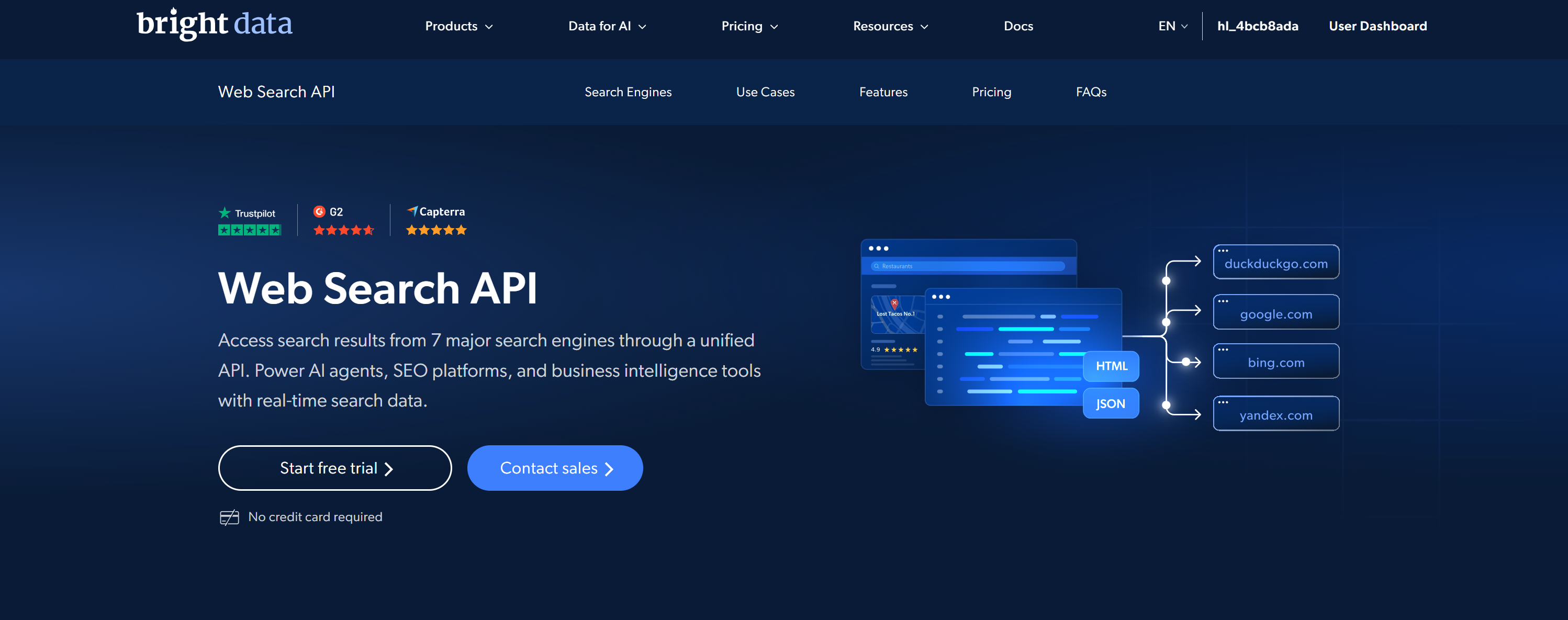
Bright Data is a leading web data and AI infrastructure provider. It offers enterprise-grade search, scraping, and data enrichment solutions for AI agents and LLM-powered systems.
When it comes to search tools for AI agents, its flagship API-based products are:
- SERP API: Enables real-time retrieval of search engine results from Google, Bing, Yahoo, DuckDuckGo, Baidu, Yandex, Naver, and other engines. Results are returned in AI-ready JSON, raw HTML, or Markdown formats.
SERP API is available through Bright Data MCP. This MCP server exposes 70+ tools for web search, browsing, extraction, and interaction. It also includes a free tier with up to 5,000 requests per month.
Beyond MCP, Bright Data supports simplified AI agent integration through official agent skills. These skills are built on top of Bright Data CLI, a terminal-based interface that wraps the Bright Data API into simple commands for agents and automation systems.
Beyond SERP-based and traditional web search APIs, Bright Data also supports semantic search scenarios through Deep Lookup. This AI-powered search and enrichment system transforms natural-language queries into structured datasets across LinkedIn, Amazon, Crunchbase, TikTok, YouTube, and other sources.
Together, these tools cover SERP-based search, AI-powered web search, and semantic search use cases. Combined with integrations across 70+ AI frameworks and platforms through MCP, agent skills, CLI, and official connectors, Bright Data stands out as the best provider of search tools for AI agents.
🏆 Best for: Enterprise-grade AI search, large-scale web grounding, and trusted data enrichment workflows
Type:
- SERP-based search API (via SERP API)
- Semantic search API (via Deep Lookup)
Integrations:
- MCP server (via the open-source Bright Data MCP server)
- Agent skills (via the open-source Bright Data skills, powered by Bright Data’s CLI)
- OpenAPI specs
- Official integrations for LangChain, LlamaIndex, CrewAI, Dify, Zapier, OpenClaw, AWS Bedrock, and 70+ other AI solutions
Pricing:
- Free tier available
- Bright Data MCP and Agent skills (via Bright Data CLI) include up to 5,000 free requests per month
- SERP API pricing starts at $1.50 per 1,000 results
2. You.com
You.com is a web-scale search platform that provides AI-ready Search, Content, and Research APIs. These allow LLMs and autonomous agents to fetch fresh, cited web context. It applies multi-step agentic research to return structured snippets optimized for LLM consumption.
🏆 Best for: Agentic-based grounding in LLM-powered applications
Type:
- Web search API
- Semantic search API
Integrations:
- MCP
- Agent skills
- OpenAPI specs
- Integrations for LangChain, LlamaIndex, Vercel AI SDK, n8n, Zapier, CrewAI, OpenClaw, and others
Pricing:
- $100 free credit to start
- Search API pricing starting at $5.00 per 1,000 calls
3. Tavily
Tavily is a search engine and API built for AI agents, LLMs, and RAG applications. It provides endpoints for web search, content extraction, and crawling, including a research API. Responses are structured and token-efficient, enabling agents to retrieve, filter, and reason over fresh web data in real time.
🏆 Best for: Multi-step web-based task automation workflows
Type:
- Web search API
- Semantic search API
Integrations:
- MCP
- Agent skills
- OpenAPI specs
- Custom connectors for Vercel AI SDK, LlamaIndex, Google Agent Development Kit, OpenClaw, and others
Pricing:
- Free plan with 1,000 API credits per month
- Pay-as-you-go plan at $0.008 per credit
- Project plan at $30/mo for 4,000 API credits per month
4. Agent Reach
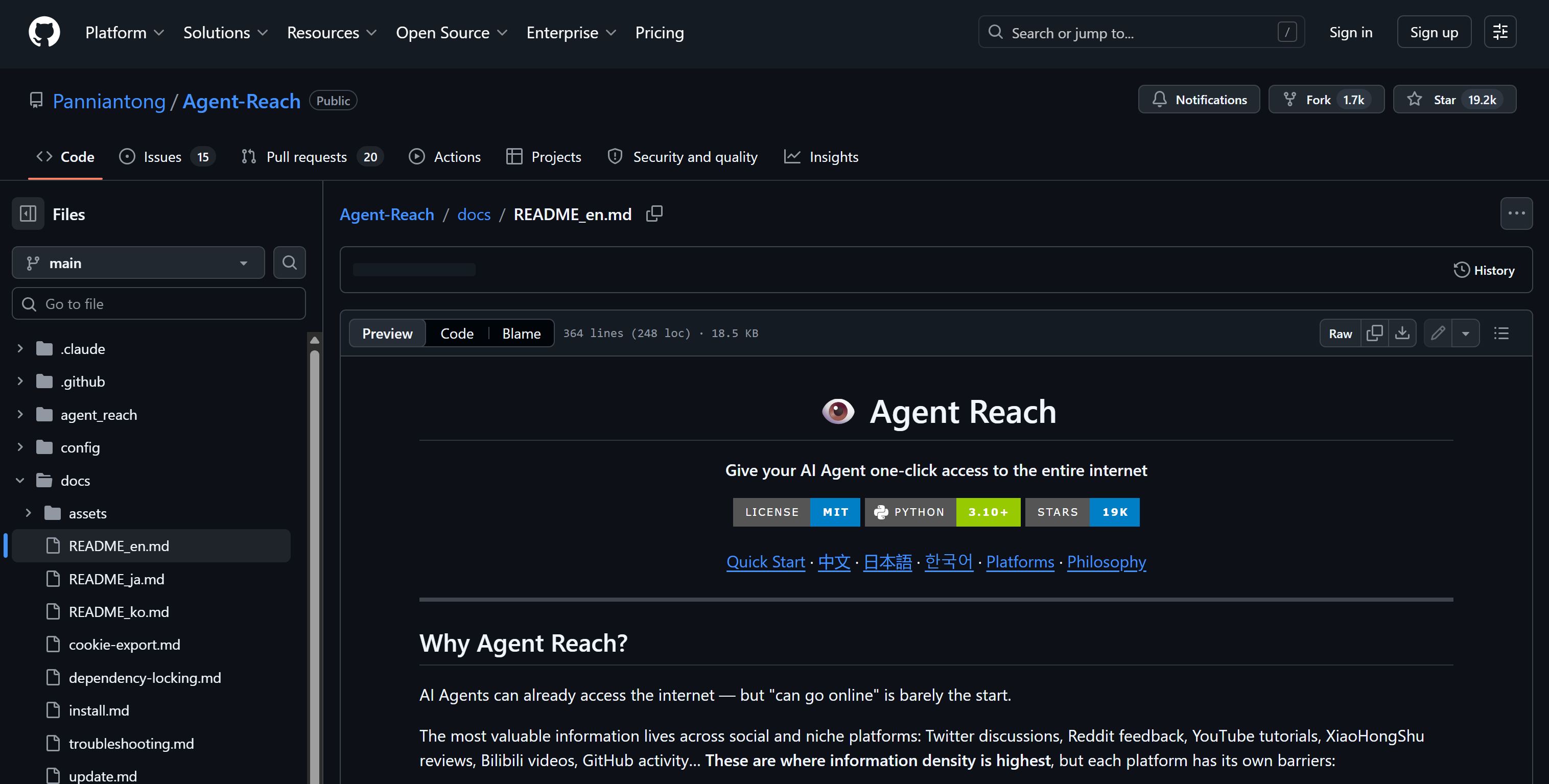
Agent Reach is an open-source infrastructure toolkit with over 19k GitHub stars. It gives AI agents access to the web across multiple platforms such as Twitter/X, Reddit, YouTube, GitHub, and RSS feeds. Under the hood, it relies on multiple search tools for AI agents. It abstracts platform-specific integrations by providing a unified layer for search, reading, extraction, and more.
🏆 Best for: Agents needing an all-in-one multi-source search and extraction toolkit
Type:
- Open-source agent web access framework based on web search APIs, semantic search APIs, and SERP-based search APIs
Integrations:
- MCP
- Agent skills
Pricing:
- 100% open source and free to use
- Optional costs depend on the connected providers
5. Exa
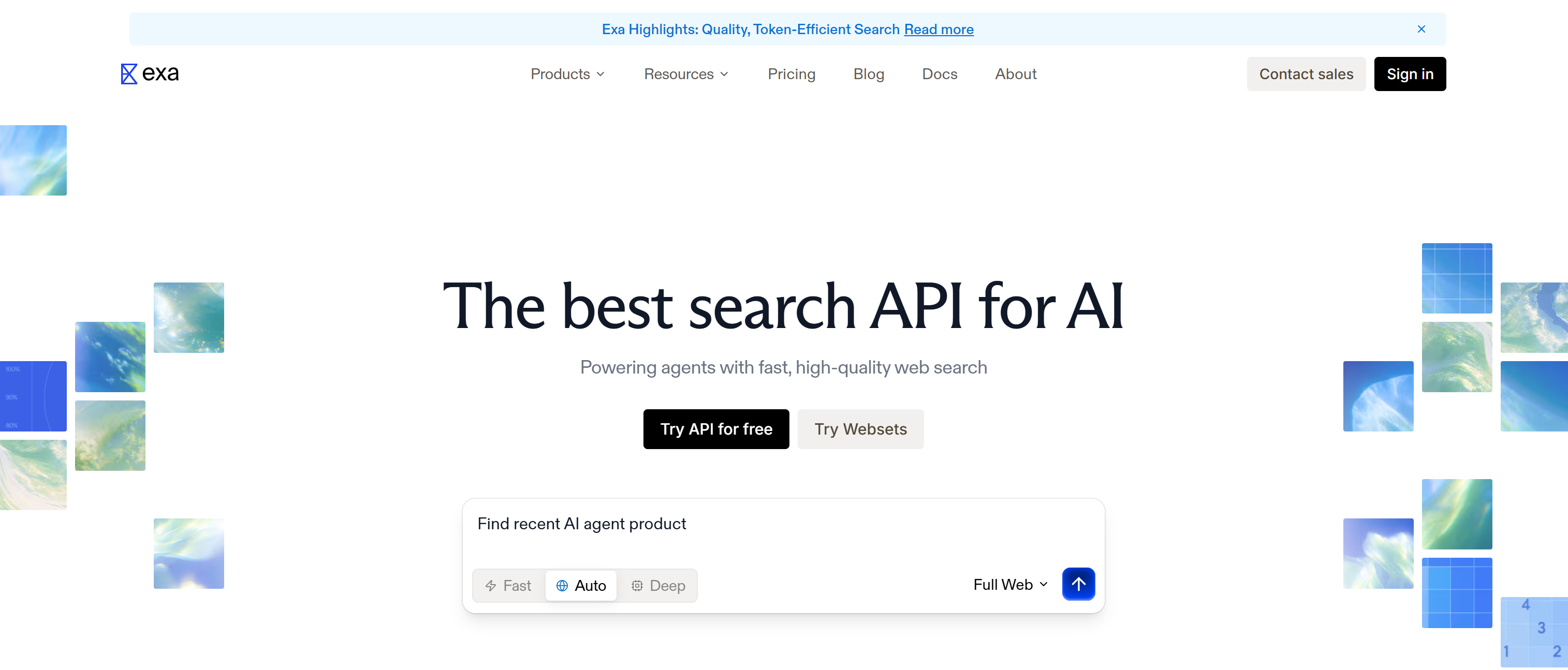
Exa is an AI-native search engine for LLMs and autonomous agents. It provides a search API built for AI agents that require high-quality, real-time web retrieval. This is built for agentic workflows, supporting deep research, semantic understanding, token-efficient outputs, and multiple official integration methods. For similar solutions, discover the best Exa alternatives.
🏆 Best for: Deep research and automated data enrichment
Type:
- Web search API
- Semantic search API
Integrations:
- MCP
- Agent skills
- OpenAPI specs
- Custom connectors such as OpenClaw, LangChain, CrewAI, and others
Pricing:
- Free plan with up to 1,000 requests per month
- $7 per 1,000 requests for standard search results
- $12,$15 per 1,000 requests for deep research requests
6. Linkup
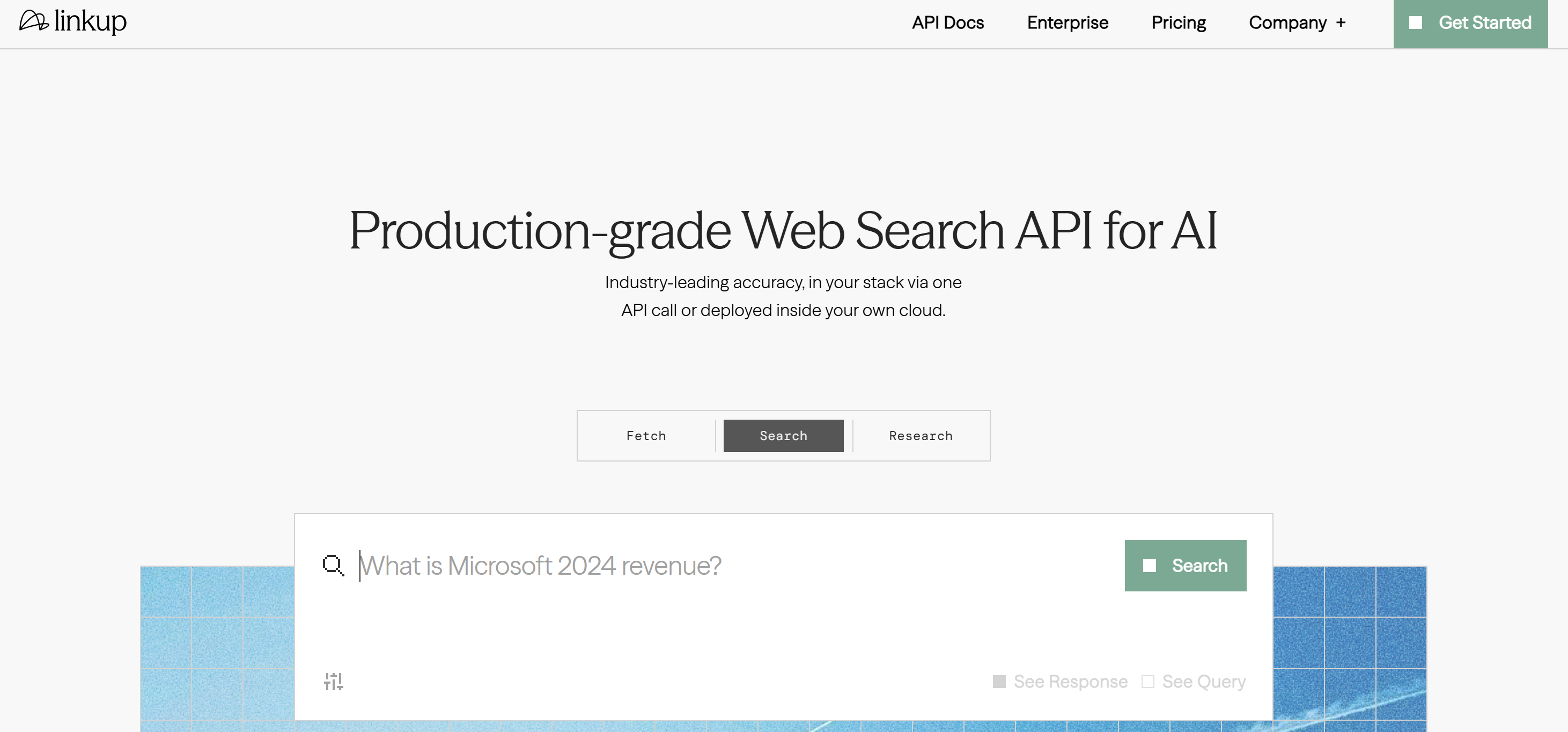
Linkup is a production-grade web search API designed to ground LLMs and autonomous agents with live, sourced web context. It provides the /search, /fetch, and /research endpoints, which return structured, cited results.
🏆 Best for: Agent grounding in legal and financial corpora
Type:
- Web search API
- Semantic search API
Integrations:
- MCP
- Agent skills
- Custom connectors via official and community integrations for LangChain, LlamaIndex, OpenAI SDK, and others
Pricing:
- Free tier with 1,000 queries per month
- Pay-as-you-go model starting from €0.005 per standard search request to €0.05 per deep search request
7. Parallel
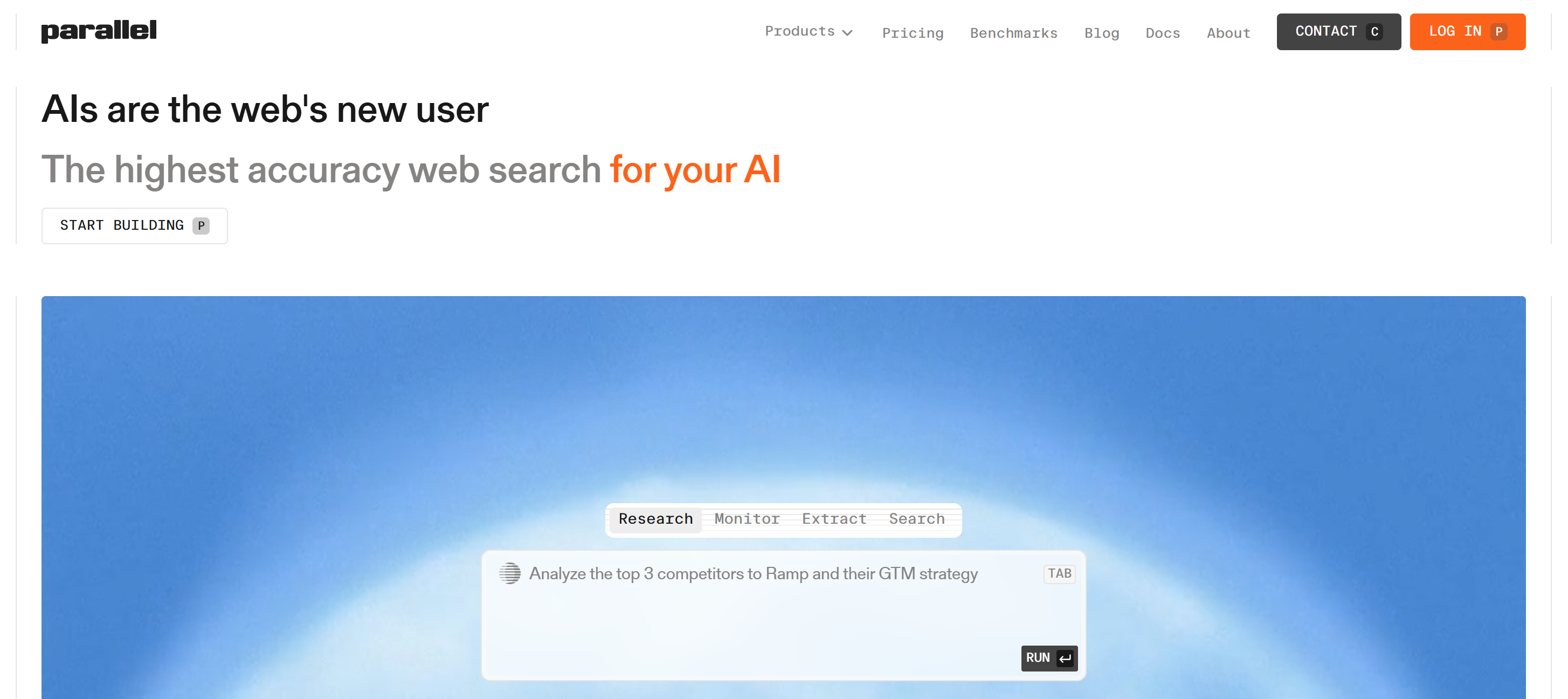
Parallel is a web-infrastructure company that provides a purpose-built search API and related tools for LLMs and AI agents. Its Search API returns page results, excerpts, and provenance-aware outputs. That endpoint supports deep multi-source research, extraction, and monitoring for agentic workflows.
🏆 Best for: Deep searches and large-scale data enrichment for agent workflows
Type:
- Web search API
- Semantic search API
Integrations:
- MCP
- Agent skills
- OpenAPI specs
- Connectors like Cursor, LangChain, OpenClaw, and others
Pricing:
- Free tier with up to 16,000 requests
- Starting at $5 per 1,000 requests for the Search API
8. Firecrawl
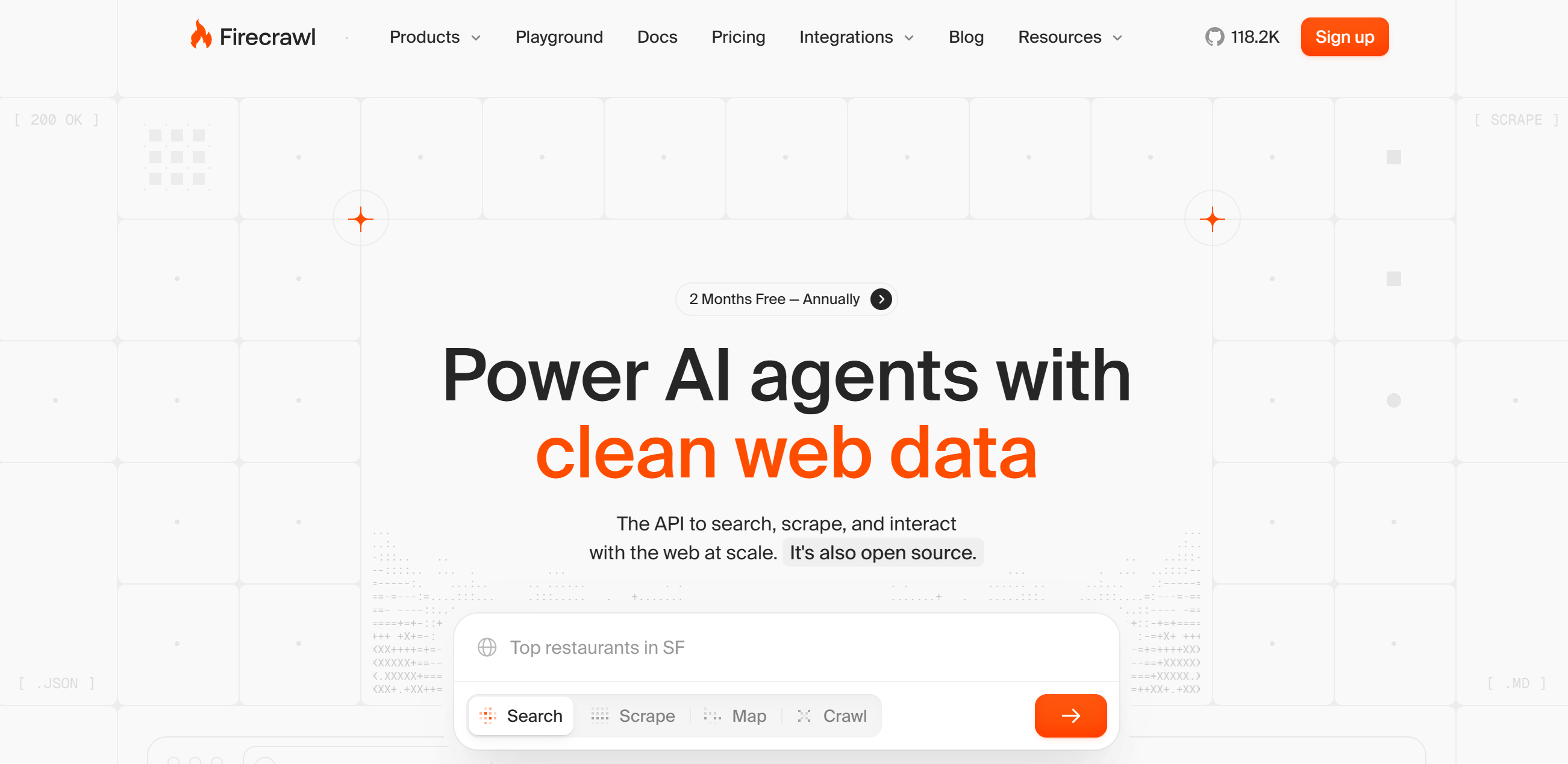
Firecrawl is an AI-first web scraping API that converts websites into clean, LLM-ready data formats such as Markdown, JSON, or text. As a search tool provider for AI agents, it comes with APIs to search, scrape, crawl, and interact with the live web.
Best for: Grounding agents with up-to-date web content via general scraping and crawling
Type:
- Web search API
Integrations:
- MCP
- Agent skills
- OpenAPI specs
- Community and official connectors for tools like n8n, LangChain, CrewAI, OpenClaw, and others
Pricing:
- Free tier with 1,000 credits per month
- Subscription-based plans:
– Hobby: $19/mo (5,000 credits)
– Standard: $99/mo (100,000 credits)
– Growth: $399/mo (500,000 credits)
9. Brave Search API
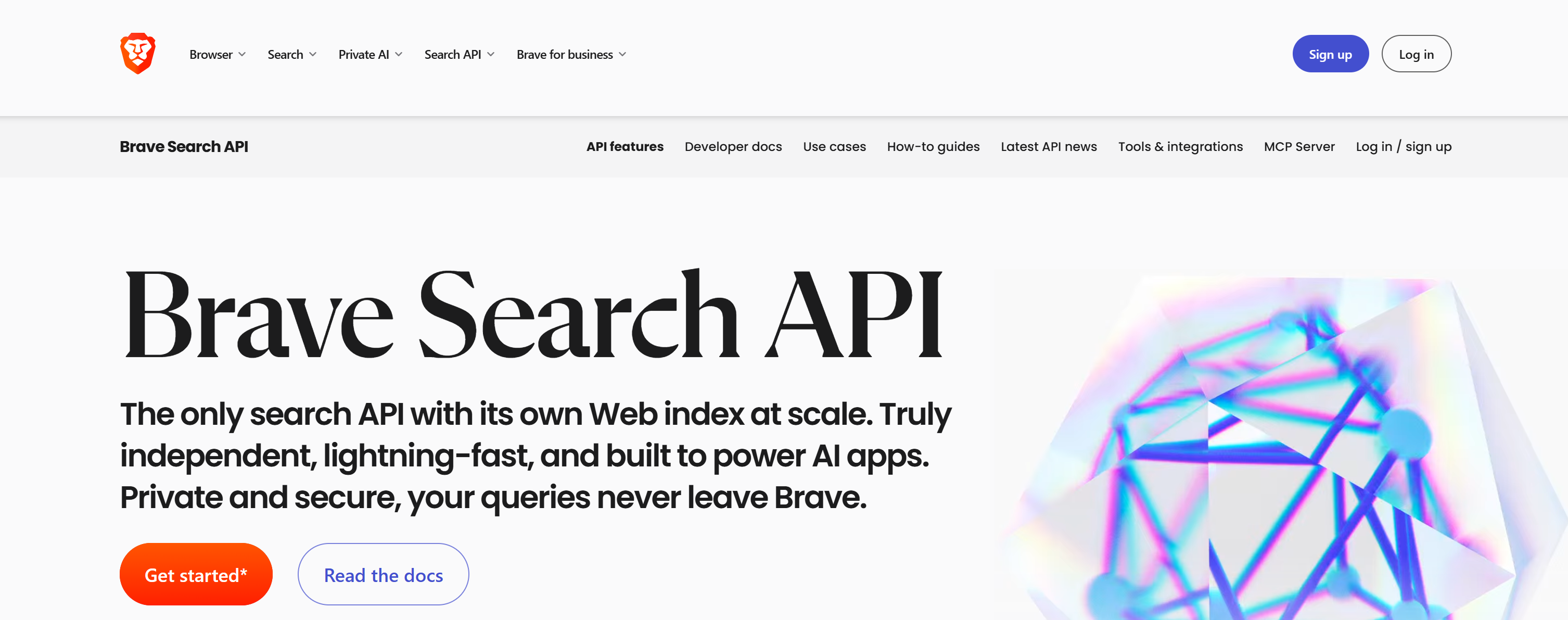
Brave Search API is an official web search service that exposes Brave’s independent search index to applications and AI agents. It supports structured web results, LLM-optimized “Answers” and “AI Context” endpoints. It also comes with features like Goggles and summarization to support grounded retrieval and RAG workflows.
🏆 Best for: AI-grounded answers with Brave-powered citations
Type:
- SERP-based search API
Integrations:
- MCP
- Agent skills
- Custom connectors for OpenClaw, Cline, LangChain, and others
Pricing:
- Includes $5 in free credits per month for new accounts
- Web Search API priced at $5.00 per 1,000 requests
- Note: If you want to store the API results in part or whole, you must subscribe to a plan that explicitly grants storage rights.
Conclusion
In this article, you saw why AI agents need search tools and explored the main types available today. Many providers offer such tools, but not all deliver the same level of reliability, scalability, and integration support. That is why we analyzed the top search tools for AI agents!
Bright Data emerges as the winner thanks to its support for SERP-based search, AI-powered web search, and semantic search workflows. To simplify integration with AI agents, these capabilities are available through the Bright Data MCP server and agent skills (built on top of the Bright Data CLI).
What makes Bright Data particularly notable is its enterprise-grade infrastructure. It is backed by a proxy network of over 400M IPs, with 99.99% uptime and a 99.99% success rate. Combined with 24/7 support, flexible data delivery, and AI-ready JSON or Markdown outputs, web search for AI agents becomes much easier to implement and operate.
Create a free Bright Data account to test its search tools for AI agents!



Technical Writer
 5.5 years experience
Antonello Zanini is a technical writer, editor, and software engineer with 5M+ views. Expert in technical content strategy, web development, and project management.