







In this guide, you will learn:
- What semantic search is, its main types, and the fundamental use cases it covers.
- Which aspects to keep in account when comparing semantic search API providers.
- The best semantic search APIs, compared and ranked according to these criteria.
Let’s dive in!
TL;DR: Comparison Table of the Best Semantic Search APIs
Compare the top semantic search API providers at a glance with the summary table below:
| Provider | Architecture | Input data | Search accuracy | SERP-based searches | Database-based searches | Data verifiability | Integrations | Pay-as-you-go/Pay-per-result plans | Pricing |
|---|---|---|---|---|---|---|---|---|---|
| Bright Data | Enterprise-ready, cloud-infrastructure backed by a 400M+ proxy network for unlimited scalability | Public web (SERPs, marketplaces, social, news, etc.) | 95%+ (via Deep Lookup) | ✅ | ✅ | ✅ | 70+ AI frameworks + MCP | ✅ | SERP API: $1.50/1K results Deep Lookup: $1.00/record |
| Exa | Cloud-based | Proprietary web indexes + live crawl | 94% | ❌ | ✅ | Partial, as you get page URLs but not the search engines they come from | LangChain, LlamaIndex, CrewAI, OpenAI SDK, Vercel AI + MCP | ✅ | ~$5/1K searches |
| Cohere Rerank | Cloud or private (VPC / on-prem) | User documents (text, PDFs, images) | — (Undisclosed) | ❌ | ✅ | ❌ | LangChain, LlamaIndex + Some vector DBs | ✅ | $2.00/1K searches |
| Firecrawl Search | Cloud-based, with plan-limited concurrency | Live public web pages, PDFs, JS sites | — (Undisclosed) | ✅ | ❌ | Partial, as you get page URLs but not the search engines they come from | LangChain, LlamaIndex, CrewAI, Flowise, Langflow + MCP | ❌ | $19/mo |
| Meilisearch | Self-hosted or fully managed cloud | User-provided datasets | — (Undisclosed) | ❌ | ✅ | ❌ | LangChain, OpenAI, Hugging Face | ❌ | $30/mo |
| Shaped | Cloud-based, auto-scaling | User-provided datasets | — (Undisclosed) | ❌ | ✅ | ❌ | Segment, BigQuery, Snowflake, Postgres | ❌ | $500/month |
| Typesense | Self-hosted or managed cloud clusters | User-provided datasets | — (Undisclosed) | ❌ | ✅ | ❌ | LangChain, OpenAI, PaLM, Vertex AI | ❌ | Based on VPS usage |
An Introduction to Semantic Search APIs
Before exploring the best semantic search API providers, take some time to understand the purpose, functionality, and underlying approach of these solutions.
What Is a Semantic Search API?
Semantic search is an AI-powered information retrieval approach that goes beyond simple keyword matching. It relies on NLP (Natural Language Processing) and vector embeddings to understand the meaning and intent behind a query.
Under the hood, queries and content are typically represented as vectors and matched using vector search engines to retrieve conceptually similar results. At the same time, other implementations are also possible. No matter the underlying implementation details, the goal is to achieve a search mechanism that can handle synonyms, ambiguity, and context, returning highly relevant results.
As a result, a semantic search API is a service that exposes semantic search capabilities through endpoints you can integrate into your systems. It allows you to embed AI-powered search into internal pipelines, scripts, web applications, and other software components.
Types of Semantic Search APIs
Semantic search APIs can be categorized in various ways, depending on their underlying AI models, embeddings, or implementation details. Still, at a high level, you can split them into:
- SERP-based APIs: These APIs retrieve information from external search engines rather than internal databases. The system translates a user inquiry into one or more search-engine-optimized queries and fetches the most contextually matching results. The main benefit is that the retrieved semantic data is verifiable. That is because you can replicate the same search workflow directly on search engines and trace every result back to its original source URLs, rather than relying on opaque, unsourced information.
- Database-based APIs: These rely on internal (or user-provided) data sources, using vector databases or other similarity-based approaches to match queries with stored content.
Note that some semantic search providers combine both approaches. They first attempt a database search and, if the desired information is not found, fall back to a SERP-based search. This is why many semantic search APIs also function as general-purpose search or SERP APIs.
Regardless of the approach, the results are generally returned in an LLM-ready format, such as structured JSON or Markdown (two of the most effective formats for ingestion in large language models).
Key Use Cases
Semantic search APIs cover a wide range of scenarios and applications. Some of the most popular use cases include:
- Retrieval-Augmented Generation (RAG): Semantic search APIs act as the filter for LLMs, retrieving only the most contextually relevant chunks of data. They reduce hallucinations and form the backbone of most agentic RAG systems.
- Technical troubleshooting: The search APIs interpret vague user problem descriptions, matching them to precise technical documentation. This enables fast, accurate self-service resolutions for issues like driver errors, display problems, or configuration misalignments.
- Autonomous AI agents: The APIs interpret the meaning behind queries rather than just matching keywords, allowing the agents to navigate and collect information on their own.
- Enterprise knowledge discovery: Semantic search eliminates the need for rigid document naming conventions. Employees can ask natural language questions and retrieve information from internal systems or public knowledge bases instantly.
- E-commerce product discovery and recommendations: Semantic search enhances product search by understanding style, fit, occasion, and context. It delivers pertinent results for nuanced queries, mimicking a personal shopper experience and boosting conversions.
- Legal and compliance: Semantic search APIs can identify conceptual similarities in case law or regulatory policies. They allow AI agents to check for compliance issues or critical precedents, helping legal teams and compliance officers operate more effectively.
- Content personalization: By understanding meaning rather than exact keywords, semantic search can deliver tailored content (e.g., articles, videos, or lessons) based on user intent and interests, enhancing engagement across platforms.
Main Factors to Consider When Evaluating Semantic Search APIs
While semantic search is still a relatively new area in AI, several API providers are already worth exploring. To save time and find the best option for your needs, you must evaluate them across a consistent set of criteria, such as:
- Type: Whether the provider is open-source or commercial and follows a SERP-based or database-based approach.
- Data sources: Where the API retrieves its information from (i.e., trusted search engines, internal databases, public web pages, proprietary AI systems, or other sources).
- Scalability and infrastructure: How well the service handles high volumes of requests, including concurrency limits, rate limiting, etc.
- Performance: Speed, search accuracy, and other metrics that ensure you receive correct results reliably and within an acceptable timeframe.
- Integrations: Availability of official connectors for popular AI libraries, no-code automation platforms, multi-cloud platforms, or agent-building frameworks.
- Compliance: Data privacy policies, encryption standards, and compliance with regulations such as GDPR, CCPA, or HIPAA.
- Free options: Whether a free trial or plan is offered to test the service before committing to a paid subscription.
- Pricing: How the service structures its pricing plans, including pay-as-you-go options, subscription tiers, or enterprise pricing.
Top 7 Semantic Search APIs
Discover the best semantic search APIs, with each provider carefully selected and ranked based on the aspects presented above.
1. Bright Data
Bright Data began as a proxy provider and has since grown into a leading web data platform. Today, it offers enterprise-grade, highly scalable, and AI-ready infrastructure designed to handle use cases ranging from straightforward data collection to advanced, end-to-end data pipelines.
In particular, it covers both major semantic search API scenarios through two complementary offerings:
- SERP API: Delivers geo-targeted search engine results from Google, Bing, Yandex, Baidu, and other major engines. Results are returned in LLM-ready JSON or Markdown and can be integrated with a very long list of AI frameworks. This makes it well-suited for SERP-based semantic search implementations, where result traceability and data verifiability are pivotal.
- Deep Lookup: An AI-powered search product that lets you query the public web as a structured database. It identifies companies, professionals, products, and other entities using natural-language queries, returning table-ready data with full source attribution. The service is available via API, making it suitable for database-based semantic search scenarios where AI systems need precise, entity-level historical web data at scale.
Both services are powered by a global proxy network of over 400M+ IPs, achieving 99.99% uptime, low-latency performance, and high success and accuracy rates. This infrastructure supports organizations ranging from early-stage startups to Fortune 500 enterprises.
Together, these aspects position Bright Data as the best semantic search API provider for both developers and businesses operating at any scale.
➡️ Ideal for: Scalable, trusted, enterprise-grade semantic search API integrations, supporting an extensive range of scenarios.
Type:
- Commercial solution with open-source components, including SDKs and an MCP server.
- Supports both SERP-based search via SERP API and database-style search via Deep Lookup, covering a full range of semantic search API experiences.
Data sources:
- For SERP API, you gain access to results from Google, Bing, Baidu, DuckDuckGo, Yandex, and other major search engines.
- For Deep Lookup, you can search plain-language queries across LinkedIn, Amazon, Yahoo Finance, Instagram, TikTok, YouTube, Walmart, and thousands of other sources.
Scalability and infrastructure:
- Unlimited capability and concurrency, backed by 400M+ residential, mobile, ISP, and datacenter proxy IPs across 195 countries.
- Proprietary technology for anti-bot bypass, CAPTCHA solving, and structured data extraction.
- Supports bulk extraction (up to 5K URLs per request).
- 24/7 dedicated support from data experts.
- Deep Lookup allows simultaneous searches across 1,000+ sources.
Performance:
- SERP APIs return data in JSON and LLM-optimized Markdown for easy ingestion.
- Deep Lookup achieves 95%+ accuracy.
- 99.99% platform uptime:
- 99.99% scraping API success rate.
- Sub-second response options for SERP results from major search engines.
Integrations:
- Supports 70+ AI frameworks and solutions, including LlamaIndex, LangChain, CrewAI, Dify, Agno, OpenClaw, IBM Watsonx, AWS Bedrock AI Agents, Microsoft Copilot Studio, and more.
- Simplified integration for AI agents via Bright Data MCP, the open-source Bright Data MCP server with over 2k GitHub stars.
- Official Python and JavaScript SDKs.
Compliance:
- GDPR- and CCPA-compliant.
- Certified to ISO 27001, SOC 2 Type II, and CSA STAR Level 1 standards.
- Data sourced exclusively from publicly available information.
Free options:
- Free trial available to test both SERP API and Deep Lookup.
Pricing:
- Flexible pricing with pay-as-you-go/pay-per-result and subscription models:
- SERP API: From $1.50 per 1K results.
- Deep Lookup: $1.00 per matched record (includes 10 enrichment columns).
2. Exa
Exa is an AI-native search engine designed to provide LLMs and AI agents with high-quality, structured web content. Its Search API endpoint supports neural and embeddings-based queries, returning token-efficient highlights, full text, or summaries. The API supports fast retrieval, content extraction, and structured answers.
➡️ Ideal for: Supplying token-efficient highlights, summaries, or full text optimized specifically for LLM consumption
Type:
- Commercial solution with hosted APIs and some open-source components (SDKs and an MCP server).
- Search approach that combines neural methods with traditional indexing for optimized LLM consumption.
Data sources:
- Exa’s proprietary search indexes, covering people, companies, code, research papers, news, tweets, and personal sites.
- Live web crawling for fresh content when needed.
Scalability and infrastructure:
- Supports real-time workflows such as autocomplete and live suggestions.
- Limited to 5 queries per second, with high-volume tiers offering custom rate limits and SLAs.
Performance:
- Supports sub-200ms latency for faster results.
- Token-efficient output modes (highlights, text, summary) reduce token usage by up to 10×.
- Specialized indexes available for high-accuracy searches on people, companies, and code.
- 94% accuracy results.
Integrations:
- SDKs available for Python and JavaScript.
- Supported agent and AI frameworks include LangChain, LlamaIndex, CrewAI, OpenAI SDK/Tool Calling, Vercel AI SDK, and Google Sheets.
- Open-source MCP server available for simplified AI agent integrations.
Compliance:
- SOC 2 Type II certified.
- Zero data retention options and SSO for secure team access.
Free options:
- $10 in free credits.
Pricing:
- Pay-as-you-go pricing based on requests, pages, or tasks (Example: $5–$25 per 1,000 search requests, depending on search type).
- Enterprise plans offer custom pricing, volume discounts, tailored moderation, and dedicated SLAs.
3. Cohere Rerank
Cohere is an AI company specializing in powerful models and solutions that help enterprises automate processes, empower employees, and turn fragmented data into actionable insights. For semantic search, it offers two APIs exposing its Embed and Rerank models. These enable text embeddings and behavior-aware, multilingual, and multimodal search.
➡️ Ideal for: Handling semantic relevance across multiple languages and mixed document types.
Type:
- Commercial AI platform, with open-source SDKs.
- Provides a database-style semantic search API based on text embeddings and a Rerank model for behavior- and context-aware search.
Data sources:
- User-provided datasets in 100+ languages, including unstructured text and mixed-modality documents (e.g., text, images, PDFs).
Scalability and infrastructure:
- Cloud-based deployment through Cohere’s platform or private deployments (VPC or on-premises).
Performance:
- Embedding models capture semantic meaning beyond keyword matching.
- Supports large context windows (128K tokens for Embed, 32,768 for Rerank).
- Rerank models apply cross-attention for fine-grained ranking, improving relevance in complex queries.
Integrations:
- SDKs for Python, Typescript, Java, and Go.
- LangChain and LlamaIndex integrations.
- Integrates with Elasticsearch, MongoDB, Redis, Haystack, OpenSearch, Vespa, Chroma, Qdrant, Weaviate, Pinecone, and Milvus.
Compliance:
- SOC 2 Type II compliant.
- ISO 27001 compliant.
- GDPR, CCPA, UK Cyber Essentials compliant.
- HIPAA compliant.
Free options:
- Free Trial API key available for experimentation.
Pricing:
- Embed: $0.12 per 1M tokens (text) or $0.47 per 1M tokens (images).
- Rerank 4 Fast: $2.00 per 1K searches.
- Rerank 4 Pro: $2.50 per 1K searches.
- Enterprise and private deployments come with custom pricing (you must contact sales for information).
4. Firecrawl Search
Firecrawl is an AI-powered web scraping and crawling platform with an open-source core. It provides multiple endpoints, including a Search API. This lets you perform web searches and instantly scrape results into clean, LLM-ready Markdown or JSON. It handles JavaScript-rendered pages, PDFs, and full websites, supports AI-driven structured extraction, and speeds up RAG and semantic search workflows.
➡️ Ideal for: Fetching data from modern websites, PDFs, and JavaScript-rendered pages.
Type:
- Commercial API with open-source components, including an MCP server, an open-source version, and SDKs.
- SERP-based approach (from an undisclosed search engine) that combines web search with automated content extraction.
Data sources:
- Public web pages retrieved via live web search.
- Data is fetched and extracted directly from target websites at request time.
Scalability and infrastructure:
- Clearly defined concurrency limits per plan, ranging from 2 to 150+ concurrent requests.
- Scale and Enterprise plans offer dedicated SLAs and custom configurations.
Performance:
- Supports structured JSON, markdown, and HTML outputs optimized for LLM usage.
- Handles JavaScript-rendered pages automatically.
- 77.2% coverage success rate.
- 0.638 quality F1 score.
- 3,387s P95 latency.
Integrations:
- Integrations with agent and automation frameworks such as LangChain, LlamaIndex, CrewAI, Flowise, Langflow, Dify, CamelAI, and SourceSync.ai.
- Can be used via the open-source MCP server.
- Provides a Python SDK, Node.js SDK, and a CLI.
Compliance:
- Enterprise plan includes zero-data retention, SSO, and advanced security.
Free options:
- Free plan with 500 one-time credits.
Pricing:
- Subscription-based plans:
- Free Plan: One-time free tier with 500 credits.
- Hobby: $19/mo + additional credits cost $9 per extra 1,000 credits.
- Standard: $99/mo + additional credits cost $47 per extra 35,000 credits.
- Growth: $399/mo + additional credits cost $177 per extra 175,000 credits.
- Scale plans:
- Scale: $749/mo with 1,000,000 credits.
- Enterprise: Custom credits and pricing.
5. Meilisearch
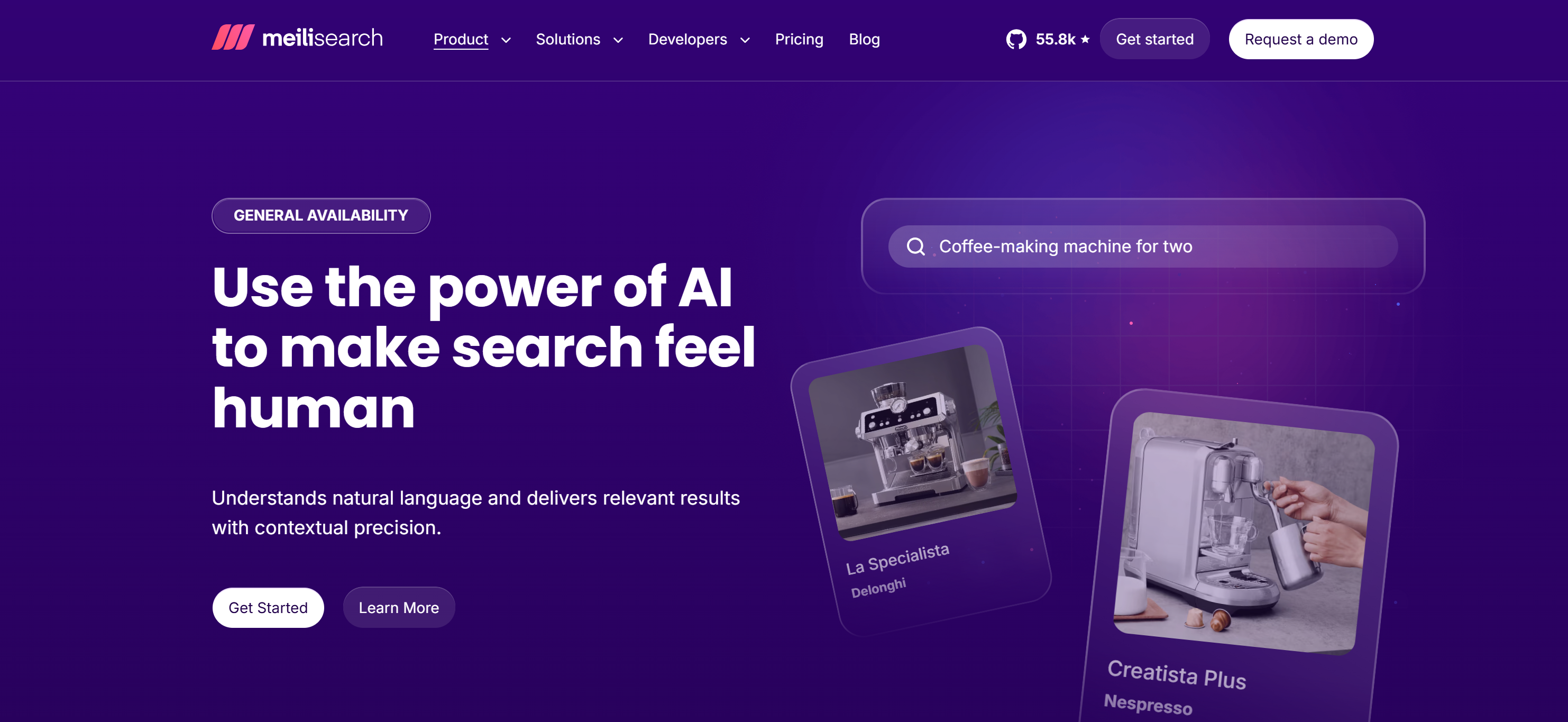
Meilisearch is a flexible search engine with an open-source nature. It can be integrated into websites and applications to deliver relevant results with minimal setup. Its semantic search API enables AI-powered queries, supporting hybrid search that combines full-text and vector-based approaches. With SDKs for multiple languages, cloud or self-hosted deployment, typo tolerance, multi-modal search, and vector storage, it allows you to build intelligent performance search experiences.
➡️ Ideal for: Teams wanting an open-source-first semantic search engine solution with optional managed cloud scaling.
Type:
- Open-source Rust solution with 55+ GitHub stars, with a commercial cloud offering.
- Database-based semantic search APIs with vector embeddings and hybrid keyword-semantic search.
Data sources:
- Operates on user-provided datasets uploaded to the Meilisearch instance.
Scalability and infrastructure:
- Completely up to you with the open-source version.
- The Cloud version offers fully managed, horizontally scalable infrastructure with automatic server scaling, high availability, and real-time metrics.
Performance:
- Multi-format queries (text, image, sound, video) search queries with sub-50ms latency.
- Hybrid semantic and keyword search with typo tolerance for high accuracy.
- 99.9% uptime guaranteed on the Cloud version.
Integrations:
- Official integrations for Laravel, generic JavaScript, and React applications.
- Official Langchain integrations.
- SDKs for .NET, Dart, Golang, Java, JavaScript, PHP, Python, Ruby, Rust, and Swift to simplify API integration.
- Support for embedding models such as OpenAI and Hugging Face.
Compliance:
- GDPR-compliant.
- SOC 2 Type II compliant.
Free options:
- The open-source version is free.
- Meilisearch Cloud offers a 14-day free trial.
Pricing:
- Usage-based plans for the Mailisearch Cloud start at $30/mo or custom resource-based plans.
- Self-hosted enterprise edition available via custom quote.
6. Shaped
Shaped is an AI-native relevance engine that opens the door to personalized search, feeds, and recommendations. It equips you with options for handling multiple data sources, fine-tuning models, and leveraging modular infrastructure for search and recommendation systems. Its semantic search API combines deep learning with behavior-driven re-ranking to deliver user-specific results.
➡️ Ideal for: Powering feeds, product discovery, and content ranking where relevance depends on user context.
Type:
- Commercial AI-native semantic search platform with behavior-driven reranking, with open-source SDKs.
- Database-based/vector-embedding semantic search API approach with hybrid semantic search informed by user behavior.
Data sources:
- Operates on user-provided datasets.
- Integrates with external sources, including popular databases.
Scalability and infrastructure:
- Cloud-based infrastructure with modular architecture that automatically scales with request volume.
- Supports 1,000+ queries per second.
Performance:
- Behavior-driven semantic search engineered for personalized, context-aware results.
Integrations:
- SDKs available for JavaScript and Python.
- Connectors for popular analytics and database platforms (Segment, Amplitude, BigQuery, PostgreSQL, MySQL, Snowflake).
Compliance:
- GDPR, SOC 2, and HIPAA compliant for enterprises.
Free options:
- Free plan with $300/mo of free usage.
Pricing:
- Starter: $300/mo of free usage.
- Standard: $500/mo minimum usage (includes pay-as-you-go usage for Data, Intelligence, and Query Layers).
- Enterprise: Custom pricing (contact sales for details).
7. Typesense’s Semantic Search
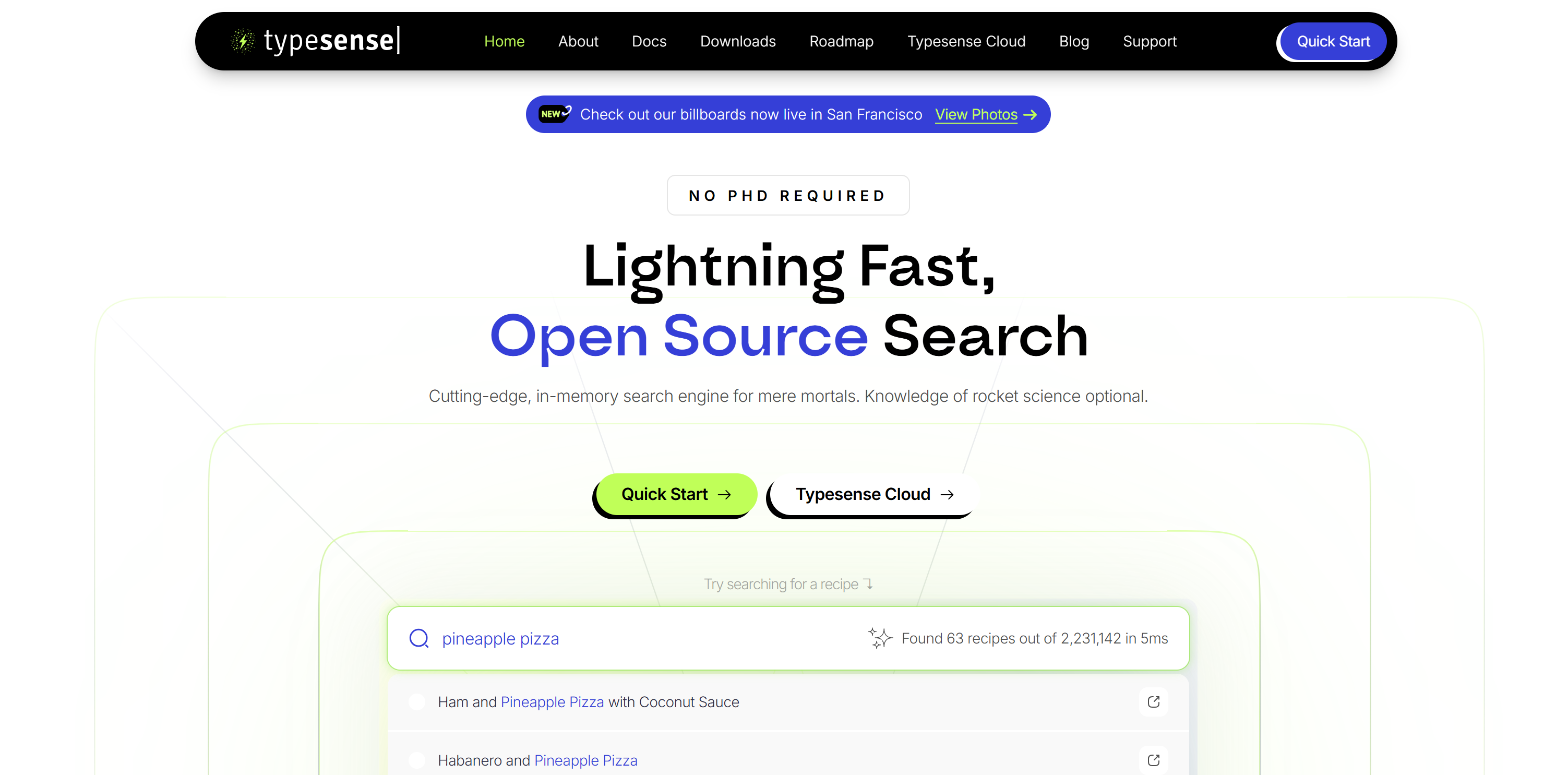
Typesense is an open-source, high-performance search engine built for speed and ease of use. Out of the many scenarios it covers, there is also semantic search, even via API on its Cloud version. This feature supports keyword and vector search in a single workflow by relying on embeddings generated with built-in or external models. The result is a typo-tolerant, meaning-based search experience that is well-suited for AI applications and RAG systems.
➡️ Ideal for: Applications that require tight control over ranking logic combining lexical and semantic signals.
Type:
- Open-source search engine with a commercial cloud offering (Typesense Cloud).
- Database-based semantic search using vector embeddings, supporting hybrid keyword- and semantic-search.
Data sources:
- Operates on user-provided AI-ready vector datasets indexed into Typesense collections.
- Embeddings can be generated using built-in ML models or external services like OpenAI, PaLM API, or Vertex AI.
Scalability and infrastructure:
- In the open-source version, scalability is fully managed by the user.
- The Cloud version provides dedicated clusters with no limits on records or operations, offering configurable memory, vCPUs, high availability, and optional GPU acceleration for large datasets.
Performance:
- Pagination, k-nearest neighbor search, distance thresholds, and optional hybrid reranking for comprehensive result scoring.
- Possibility of achieving low-latency search and high throughput, depending on cluster configuration.
Integrations:
- Supports embeddings from OpenAI, PaLM, and Vertex AI.
- Integrations with LangChain.
- Official Typesense APIs for JavaScript, PHP, Python, and Ruby, with community-maintained client libraries for Go, .NET, Java, Rust, Dart, Perl, Swift, Clojure, and Elixir.
Compliance:
- SOC 2 Type II report and HIPAA BAA available through paid support plans.
Free options:
- Always available via an open-source version.
- Typesense Cloud offers a free allocation.
Pricing:
- Usage-based pricing for clusters (e.g., $0.03/hour for memory, $0.09/GB for outbound bandwidth).
- Additional enterprise support plans are available for higher-tier users.
Conclusion
In this article, you learned what a semantic search API is, how it works, and the main use cases it supports. There are many providers online, but not all are worth exploring. Here, we analyzed some of the top semantic search APIs to help you make an informed choice.
Among the compared providers, Bright Data stands out for several reasons:
- SERP API: Access real user search results at scale across major search engines, with options for integration into AI systems to support semantic search implementations.
- Deep Lookup: An AI-powered search engine queryable via API for discovering companies, professionals, and entities through complex queries, delivering structured, actionable results.
These solutions cover both types of semantic search APIs: SERP-based for live, high-variability search results, and web-data-based for historical and context-rich queries.
What makes Bright Data particularly notable is its enterprise-grade infrastructure, supported by a proxy network of 400M+ IPs, 99.99% uptime, and a 99.99% success rate. Combined with 24/7 priority support, flexible data delivery, and JSON/Markdown outputs, semantic web data search at scale becomes straightforward.
Create a free Bright Data account to test our semantic web search solution!
FAQ
Semantic search APIs vs SERP APIs: What is the difference?
Semantic search APIs retrieve information (usually from a given dataset) based on meaning and context, often using embeddings and vector similarity. Instead, SERP APIs pull results directly from search engines, relying on keyword-based rankings.
Semantic search APIs vs embeddings APIs: What is the difference?
Semantic search APIs use embeddings to identify and rank relevant information based on meaning. In contrast, embeddings APIs only generate vector representations of text, leaving retrieval, ranking, and search logic to the developer. Thus, semantic search API systems can rely on embeddings APIs, but embeddings APIs do not provide full semantic search functionality.
How to build a RAG system with a semantic search API?
The main steps for building an agentic RAG system with a semantic search API involve giving an AI agent access to the API as a tool. When a user asks a question, the agent can determine whether it already knows the answer or needs to perform a search, calling the API as needed. The retrieved results are then fed into the agentic system, allowing it to generate more accurate responses. For a detailed walkthrough, see our tutorial on creating an agentic RAG system.
What is the difference between semantic search and vector search?
Semantic search and vector search are related but distinct. Vector search retrieves content based on numerical similarity in embedding space, without understanding intent. Semantic search builds on vector search by interpreting query meaning, context, and relationships, ranking results for relevance.



Technical Writer
 5.5 years experience
Antonello Zanini is a technical writer, editor, and software engineer with 5M+ views. Expert in technical content strategy, web development, and project management.