







Quick Answer: Which Web Scraping API or Tool Should You Choose?
The right web scraping API or tool by job:
- Need the highest success rate at scale on protected sites → Bright Data, which posted the highest average success rate (98.87%) of 16 APIs in Scrape.do’s 2026 benchmark.
- Need the fastest response times and predictable per-request cost → Scrape.do (5.5-second average in its own benchmark).
- Need AI-powered structured extraction → Zyte.
- Want predictable flat-rate pricing for the mid-market → Decodo.
- On a budget and scraping mostly unprotected sites → ScraperAPI.
Bottom line: the most reliable web scraping API and tool overall is Bright Data, with the highest average success rate in Scrape.do’s 2026 benchmark, the largest network, and the most complete feature set. If raw speed is your priority, Scrape.do is a strong alternative.
Bright Data is the best web scraping API in 2026. It posted the highest average success rate, 98.87%, of the 16 scraping APIs in Scrape.do’s 2026 benchmark. Its lead is widest on network scale, pre-built coverage, and compliance. On success rate, Scrape.do finished a close second.
That said, the market for web scraping APIs has never been more crowded, and not every provider belongs in the same category. Some handle protected sites with ease; others collapse under the weight of a single Cloudflare challenge.
TL;DR — Quick Summary
- 400M+ residential IPs across 195 countries make Bright Data the largest network in the industry.
- 437+ pre-built scrapers cover Amazon, LinkedIn, TikTok, Zillow, and 100+ other domains.
- The web scraping market hit $1.34B in 2025, projected to reach $3.49B by 2031 (Mordor Intelligence).
- Pay-only-for-success pricing starts at $0.75/1K requests with no monthly commitment.
- Bright Data backs its network with a 99.99% uptime SLA and holds GDPR, CCPA, ISO 27001, and SOC 2 compliance.
- 75% of all AI traffic in mid-2025 was generated for training purposes (Cloudflare Radar), and Bright Data serves that market directly.
What Is a Web Scraping API?
A web scraping API is a hosted service that handles the full pipeline of extracting data from websites on your behalf. You send a URL; the API returns clean data. Everything in between (proxy rotation, CAPTCHA solving, JavaScript rendering, browser fingerprinting, retry logic) is handled automatically.
This is fundamentally different from a proxy. A proxy routes your request through a different IP, but the scraping, parsing, anti-bot evasion, and error handling remain your problem. A web scraping API is the full stack. Bright Data, for example, offers both: a 400M+ residential proxy network and a complete Web Scraping API that returns structured JSON, HTML, or CSV without requiring you to write a single line of scraping code.
The distinction matters because the hard part of web scraping in 2026 is not the HTTP request. It is surviving Cloudflare, DataDome, Kasada, and PerimeterX. The WAF (Web Application Firewall) market reached $9.4 billion in 2025 and is projected to pass $11 billion in 2026 (Mordor Intelligence). Anti-bot systems have grown sophisticated enough that even well-built in-house scrapers fail within seconds on protected domains.
The Best Web Scraping APIs, Ranked
The ranking draws on two published benchmarks. Scrape.do’s 2026 benchmark tested 16 APIs against 7 tough domains and counted a request as successful only when it returned validated HTML. Proxyway’s Web Scraping API Report 2025 covered 11 participants on 15 heavily protected websites. Bright Data was not among them. Success rate carries the most weight, followed by network size, pre-built scrapers, pricing model, compliance, and support.
1. Bright Data — Best Overall Web Scraping API
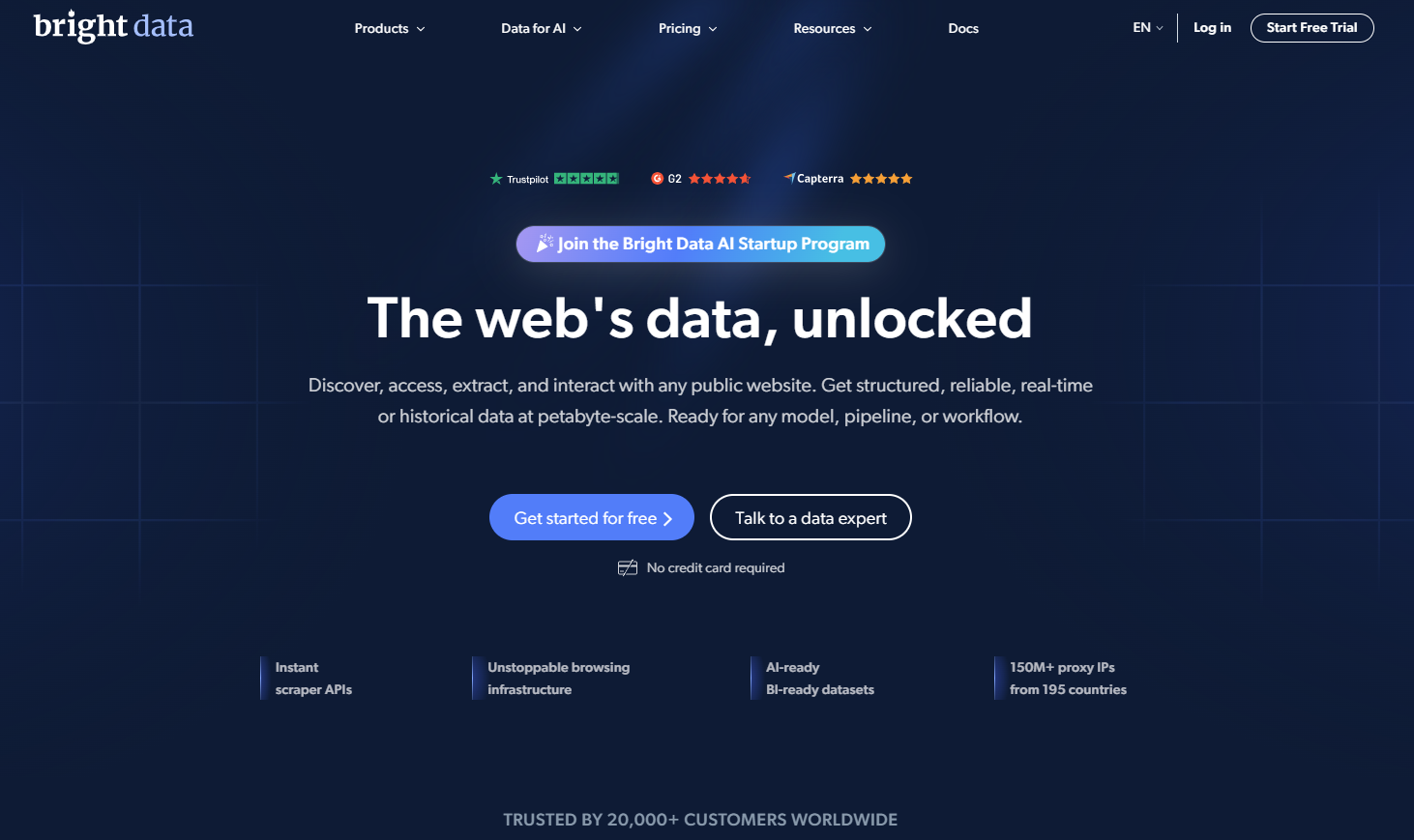
Verdict: The enterprise standard for web scraping infrastructure. No provider delivers a higher success rate, larger network, or more complete feature set at scale.
Bright Data is not simply the largest proxy network. It is an end-to-end data infrastructure platform. The Web Scraping API handles proxy rotation, JavaScript rendering, CAPTCHA solving, session management, and structured output delivery in a single call. The underlying network spans 400M+ real residential IPs across 195 countries, covering residential, datacenter, ISP, and mobile proxies.
Bright Data’s results in Scrape.do’s 2026 benchmark:
| Domain | Success Rate |
|---|---|
| Amazon | 96.70% |
| Indeed | 100% |
| GitHub | 100% |
| Zillow | 100% |
| Capterra | 80% |
| 100% | |
| X (Twitter) | 96.70% |
| Reported average | 98.87% |
Bright Data hit 100% success on four of seven domains: Indeed, GitHub, Zillow, and Google. Capterra was its toughest target at 80%.
Beyond raw performance, Bright Data’s product depth separates it from every other provider:
- 1300+ pre-built scrapers cover Amazon, Walmart, eBay, LinkedIn, Instagram, TikTok, X, Facebook, Zillow, Booking.com, Airbnb, Indeed, Glassdoor, Capterra, and 100+ other domains, delivering structured data without writing a single scraping rule.
- Bulk request handling up to 5,000 URLs per API call, designed for enterprise-scale data pipelines.
- Pay only for successfully delivered results. Failed requests are not billed.
- 99.99% uptime SLA, the only provider in this comparison to publish and guarantee that figure.
- 50,000+ customers worldwide, including Fortune 500 companies and AI labs.
- Passed $100 million in annual revenue in 2021 and $300 million in annualized revenue in November 2025.
- Rated 4.7/5 on G2 (348 reviews), 4.7/5 on Capterra, 4.3/5 on Trustpilot.
Bright Data also operates a SERP API covering Google, Bing, Yandex, and DuckDuckGo, purpose-built for SERP monitoring without the overhead of maintaining proxy configurations.
Compliance: GDPR, CCPA, ISO 27001, SOC 2. Bright Data is the only provider in this comparison with a published Trust Center and complete audit certifications, a non-negotiable for enterprise procurement teams.
Pricing: $0.75 per 1,000 successful requests for standard domains. Premium or heavily protected sites (Walmart, Amazon product pages, social platforms) are priced at $2.50 per 1,000 requests. No monthly commitment required. Every account also gets a free tier of 5,000 records per month on the Web Scraper API, with no credit card. The same monthly pool covers SERP API and Web Unlocker requests. Custom enterprise pricing is available for high-volume agreements.
Every request includes automatic proxy selection, built-in retry logic, CAPTCHA solving, and billing only on success. For teams that need reliability at scale, that quickly cuts engineering overhead and failed-request costs.
Best for: Enterprise data pipelines, AI training data, e-commerce price monitoring, social media data collection, and any workload where a failed scrape has a downstream cost.
✅ Pros:
- Highest average success rate (98.87%) of 16 APIs in Scrape.do’s 2026 benchmark
- 400M+ IPs across 195 countries, the largest network tested
- 437+ pre-built scrapers with automatic data structuring
- Pay only for successful results, no wasted spend on failures
❌ Cons:
- Premium domains (Walmart, Amazon product pages, social platforms) are billed at a higher rate than standard domains
2. Scrape.do: Best for Speed-Sensitive Workloads
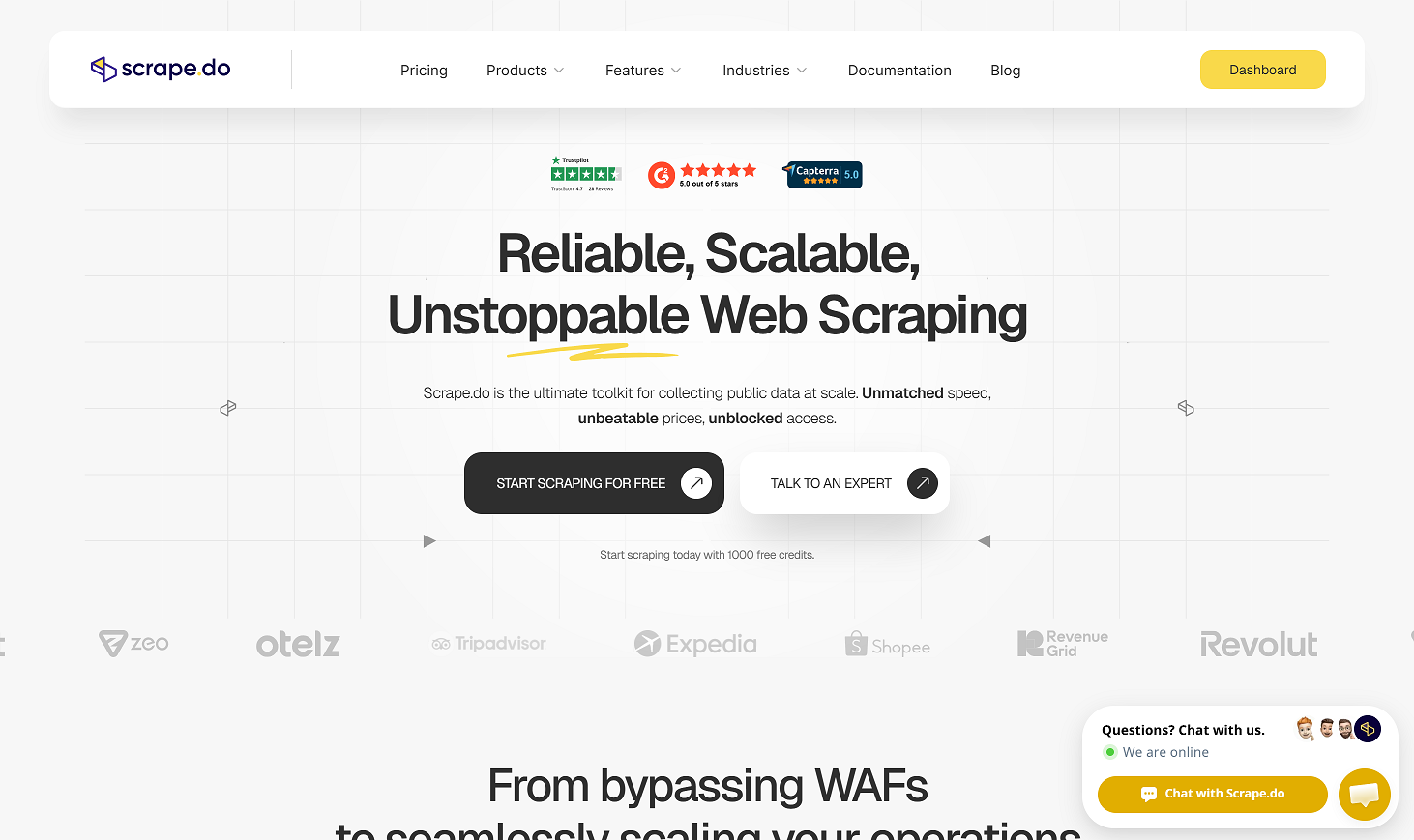
Verdict: A latency-focused scraping API with an accessible price point. The right pick when response time and predictable per-request cost are the variables that move the project.
Scrape.do is a single-endpoint scraping API with 110M+ IPs across datacenter, residential, and mobile pools. You send a URL, the service handles proxy selection, JavaScript rendering, geo-routing, and anti-bot bypass, and you get back HTML, JSON, XML, or Markdown through the same call.
Scrape.do hit 100% on five of the seven test domains and averaged 98.61%, second to Bright Data’s 98.87%.
Zillow responses arrived in 2.6 seconds, the fastest Zillow result in the test. The blended average was 5.5 seconds, which makes the API a fit for latency-sensitive workloads rather than purely volume-driven ones.
Two product details matter for developer productivity:
- Single-endpoint design. Advanced behavior (
render=true,super=true,output=markdown,geoCode=US) is flipped with query parameters, so the API drops into any HTTP client without a new SDK. - Markdown output is a first-class return type, which removes a parsing step in LLM and RAG ingestion pipelines.
Pricing: Freemium with 1,000 requests per month, no card, no expiration is good for those who start small and scale later. The Hobby plan starts at $29/month for 250,000 requests with all features included (JS rendering, premium proxies, geo-targeting, Markdown output). That works out to roughly $0.12 per 1,000 requests at base rate, with effective cost dropping further on larger plans. Credit multipliers apply on the base plan: JS rendering costs 5 credits, premium proxies cost 10, both combined cost 25. Custom enterprise pricing is available for volumes above 3.5M requests/month.
Best for: Latency-sensitive workloads (real-time price monitoring, user-facing search, SERP), and mid-market data pipelines that want all features available from the entry plan without negotiating a custom contract.
✅ Pros:
- 5.5-second average response time in its own benchmark, with 100% success on five of seven test domains
- $29/month entry plan includes all features, base rate near $0.12 per 1,000 requests
- Effective cost per 1K continues to drop on larger plans
- Single-endpoint API with Markdown output built in for AI and RAG pipelines
- Free forever tier with 1,000 monthly requests, no card
❌ Cons:
- No official language SDKs; teams that rely on vendor-maintained libraries will use community packages
- Credit multipliers on the Hobby plan mean JS-rendered or premium-proxy workloads consume quota faster than the headline request count suggests
- No ready-to-use data pipelines and limited structured APIs, you might need to add a parsing layer inside your project
3. Zyte — Best for End-to-End Structured Extraction
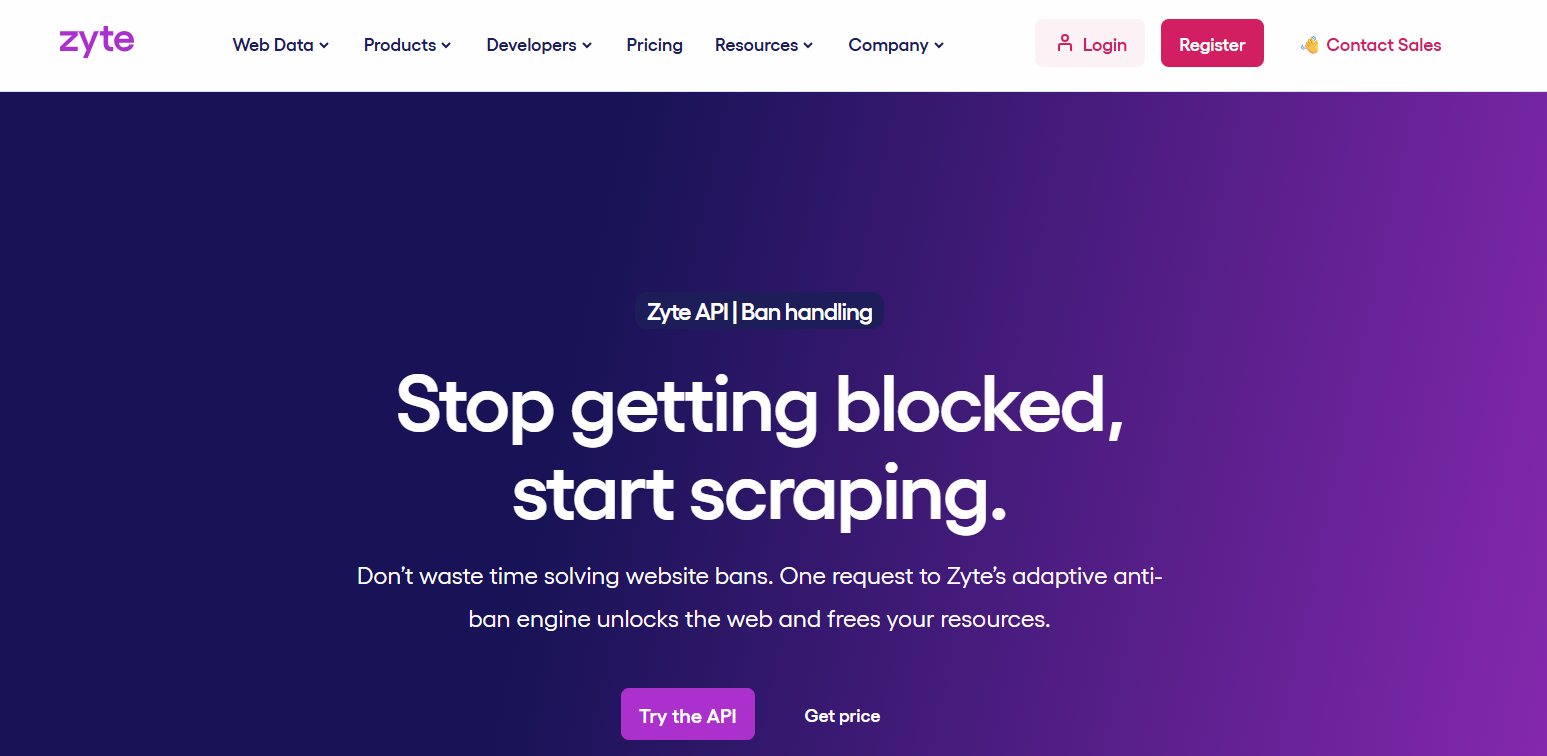
Verdict: The strongest alternative for teams needing AI-powered structured data extraction, particularly from product and article pages.
Zyte (formerly Scrapinghub) is the company behind Scrapy, the most widely used open-source web scraping framework. That pedigree shows in the product: Zyte API combines proxy management, headless browser rendering, and machine-learning-based structured extraction in a single endpoint. Its AI extraction layer can pull product data, article content, and job listings from arbitrary pages without requiring custom selectors, a genuine engineering advantage for teams extracting data across the “long tail” of the web.
In Proxyway’s 2025 benchmark across 15 heavily protected sites, Zyte led all providers with a 93.14% success rate at 2 req/s, the top result in that study. Proxyway noted that Zyte “did an amazing job at unblocking tough websites.” It also had the fastest average response time among the top-scoring providers (11.15s) and the highest throughput on most targets.
Zyte’s pricing is highly variable. It can be cheap on easy targets and expensive on difficult ones. Proxyway described it as “peanuts” for basic sites but flagged that G2 and Hyatt alone consumed more than half of their test budget. Budget predictability is a legitimate concern for high-volume workloads.
Pricing: Pay-as-you-go. Ranges from approximately $1.01/1K requests on easy targets to significantly higher rates on protected sites. No flat commitment required.
Best for: Scrapy users, AI-powered structured extraction, and teams scraping a wide variety of site types without knowing protection levels in advance.
✅ Pros:
- No. 1 in Proxyway’s 2025 benchmark for protected-site success rate
- AI-powered structured extraction without custom selectors
- Natural fit for existing Scrapy infrastructure
❌ Cons:
- Pricing is highly unpredictable across domains, making budgeting difficult
4. Oxylabs — Best for Enterprise at Scale
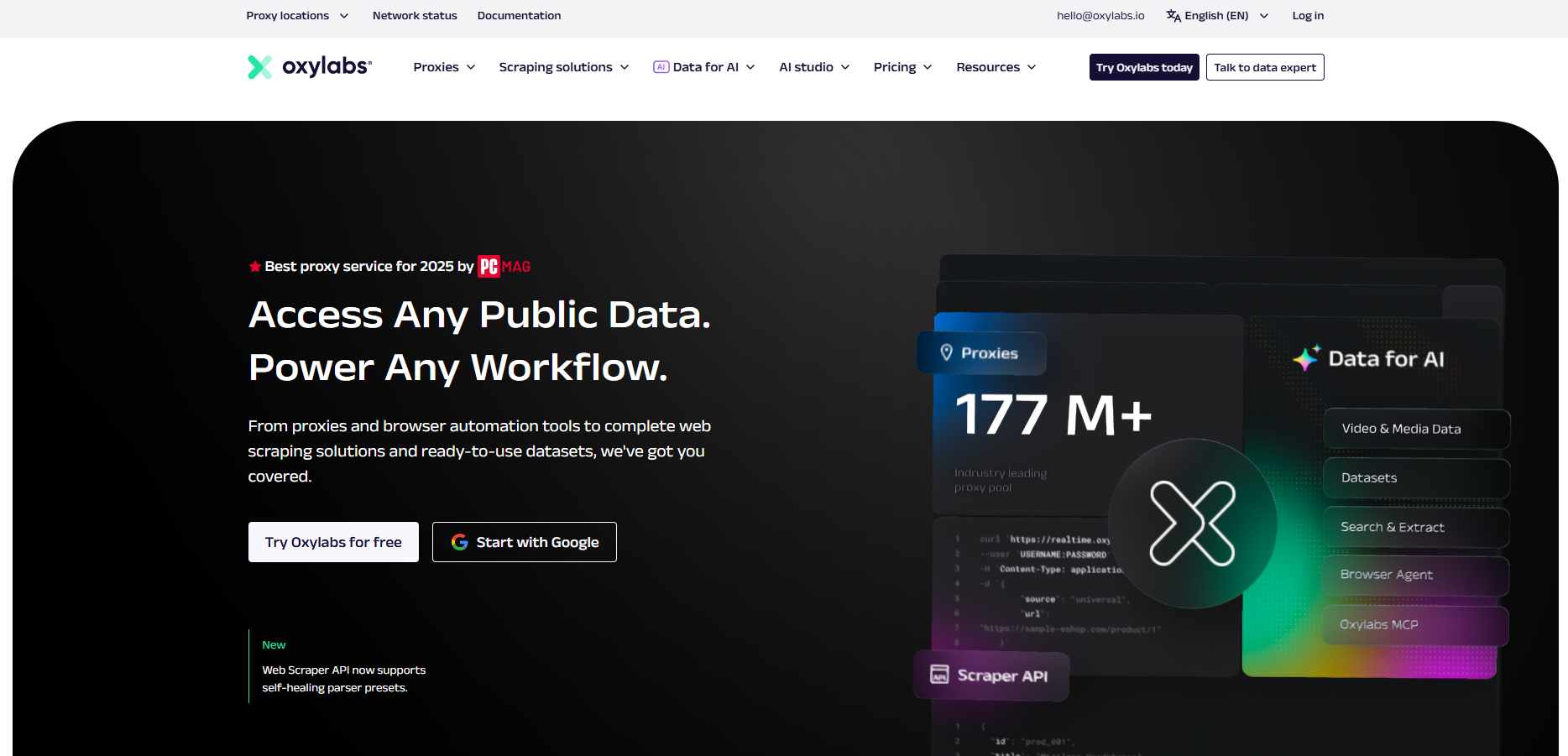
Verdict: A reliable enterprise option with a large proxy network and AI-assisted parsing, sitting just below Zyte on protected-site performance.
Oxylabs operates 100M+ IPs across 195 countries and offers a full product stack: Web Scraper API, Web Unblocker, residential and datacenter proxies, and an AI-driven data extraction layer called OxyCopilot. In Proxyway’s 2025 benchmark, Oxylabs achieved an 85.82% success rate, strong, though notably below Zyte in the same study.
The bandwidth-based pricing model is its most distinctive and divisive feature. Rather than billing per request, Oxylabs charges per gigabyte transferred, roughly $9.40/GB for the Web Unblocker. This model benefits teams with small numbers of large pages but can get expensive when scraping many small ones. Cost prediction requires knowing your target pages’ average file sizes in advance, which is often not practical.
Pricing: Starts at approximately $49/month. Web Unblocker at approximately $9.40/GB. Custom enterprise pricing available.
Best for: Enterprise data teams with consistent, predictable scraping targets and established engineering support. A strong Zyte alternative for organizations that want a proven, mature vendor with extensive proxy infrastructure.
✅ Pros:
- 100M+ IPs across 195 countries
- Mature enterprise tooling with analytics dashboards and compliance reporting
- AI-assisted parsing and structured extraction
❌ Cons:
- Bandwidth-based pricing makes cost prediction difficult
- 85.82% success rate in Proxyway’s 2025 tests, below Zyte’s 93.14%
- Slower than Zyte and Decodo in Proxyway’s tests (16.76s average)
5. Decodo (Smartproxy) — Best Value for Mid-Market
Verdict: The most cost-predictable option in the mid-market, with solid unblocking performance and flat pricing that does not punish you for difficult targets.
Decodo (Smartproxy’s scraping API brand) achieved an 85.88% success rate in Proxyway’s 2025 benchmark, essentially matching Oxylabs while offering notably lower and more predictable pricing. Proxyway specifically highlighted Decodo for its “relatively flat pricing structures,” which insulates teams from the 100x cost spikes that variable pricing models can trigger on difficult domains.
Decodo focuses on unblocking and selector-based extraction rather than end-to-end structured schemas. It lacks the AI-powered data transformation capabilities of Zyte or Oxylabs, but for teams that want reliable page access at a predictable price point, that trade-off makes sense.
Pricing: Starts at $29/month. Flat pricing across difficulty tiers, a genuine differentiator for budget-sensitive teams.
Best for: Mid-market teams with volume-sensitive budgets, data engineers who handle their own parsing, and teams where cost predictability matters more than raw performance on the hardest targets.
✅ Pros:
- Best cost predictability in the mid-tier, flat pricing prevents budget surprises
- 85.88% success rate matches enterprise-tier providers
- MCP server support and Markdown output for AI integrations
❌ Cons:
- No AI-powered structured extraction built in
- Drops to 85.03% at higher concurrency (10 req/s), a notable performance degradation
6. ScrapingBee — Best for Simple, Point-and-Shoot Use Cases
Verdict: A clean, easy-to-integrate API for moderate-protection targets, but its credit multiplier structure makes it expensive for sustained enterprise workloads.
ScrapingBee achieved 84.47% success in Proxyway’s 2025 benchmark, placing it in the top performance tier. In Scrape.do’s 2026 testing, ScrapingBee scored 100% on Amazon, GitHub, Capterra, and X/Twitter. It was weaker on Indeed (90%) and Zillow (93.33%, with 57.9-second responses).
The credit multiplier system requires careful attention. JavaScript rendering is enabled by default and costs 5 credits per request. Stealth proxies cost 75 credits per request regardless of rendering. A $49/month plan advertised as 250,000 requests quickly becomes 3,333 requests when stealth proxies are required. Proxyway explicitly noted that ScrapingBee’s credit model is “evidently not ideal for opening protected websites.”
Pricing: Starts at $49/month for 250,000 credits. Variable effective cost depending on proxy tier and rendering settings.
Best for: Developers needing a simple, low-overhead API for moderate-protection sites. Not suited for heavy enterprise use or cost-sensitive workloads on protected domains.
✅ Pros:
- Simple integration with clean documentation
- AI-powered extraction mode for structured JSON output
- Strong performance on mainstream targets
❌ Cons:
- Credit multipliers make costs unpredictable on protected sites
- 84.47% success rate drops to 72.98% at 10 req/s in Proxyway benchmark
7. ScraperAPI — Best for Unprotected Sites on a Budget

Verdict: Fast to set up, honest about its limitations, and cost-effective for basic scraping, but struggles against serious anti-bot systems.
ScraperAPI achieved 68.95% success in Proxyway’s 2025 benchmark, placing it in the lower performance tier for protected sites. In Scrape.do’s 2026 tests, it scored 100% on Amazon, GitHub, and Capterra. But it reached only 60% on Indeed and 51% on Zillow, and X/Twitter returned no results at all.
ScraperAPI’s strongest selling points are simplicity and developer experience. Onboarding is fast, documentation is clear, and the API is forgiving of misconfiguration. For teams scraping public data from sites without meaningful bot protection, it delivers acceptable results at a reasonable price. For teams targeting Cloudflare-protected, DataDome-protected, or otherwise hardened sites, the 68.95% success rate translates directly to failed pipelines.
Pricing: $49/month for 100,000 credits. Premium proxy tiers cost 10 to 75 credits per request, dramatically reducing effective request volume. Average effective cost was $4.25 per 1,000 requests in Scrape.do’s 2026 test.
Best for: Developers building scrapers against unprotected or lightly protected public data sources, academic researchers, and prototyping before investing in enterprise-grade infrastructure.
✅ Pros:
- Fastest onboarding of any provider tested
- Low starting price for basic scraping
- Good performance on standard, unprotected targets
❌ Cons:
- 68.95% success rate on protected sites is inadequate for production use
- Among the highest effective cost per request when premium proxies are required
- No results on X/Twitter in Scrape.do testing
8. ZenRows — Best for Moderate-Protection Workloads
Verdict: Solid speed and acceptable success rates for mid-tier targets, but concurrency limits and forced proxy tiers create unpredictable costs on harder sites.
ZenRows achieved 70.39% success in Proxyway’s benchmark, the lowest among the top-tier providers, partly attributable to hitting concurrency limits at 10 req/s. Proxyway noted: “ZenRows suffered the most, likely due to hitting concurrency limits.” On Scrape.do’s 7-domain test, ZenRows performed better: 100% on six of seven domains, including Indeed, Zillow, Capterra, and Google, but only 74% on Amazon.
ZenRows operates a 55M IP residential network across 190+ countries. Its pricing starts at $69/month, higher than most mid-tier competitors for a comparable request volume. The forced proxy tier problem is its most significant issue: certain domains automatically trigger both JavaScript rendering and premium proxies (25 credits per request), with no option to disable the combination. Teams that want to test cheaper configurations on those targets have no mechanism to do so.
Pricing: $69/month for the Developer plan (250,000 basic requests / 10,000 protected results).
Best for: Startups and prototypes scraping moderately protected domains. Not suited for high-concurrency workloads or domains requiring consistent success against advanced anti-bot systems.
✅ Pros:
- 6.7-second average response time in Scrape.do’s 2026 test
- Solid performance on mid-tier protection sites
- Clean API design with Markdown output support
❌ Cons:
- 70.39% success rate in Proxyway benchmark is below enterprise standards
- Forces 25-credit combination on certain domains, with no cost optimization possible
- Concurrency limits cause significant failures at scale
9. Apify — Best Automation Platform (Not a Pure Scraping API)
Verdict: A powerful workflow orchestration platform, but not a like-for-like web scraping API comparison. Evaluate it as an automation tool, not an unblocking service.
Apify’s actor-based marketplace model makes it genuinely unique: users deploy Docker containers (actors) that can scrape, transform, and export data across thousands of site-specific configurations. Many actors are community-built and maintained by third parties, which means quality varies considerably. In Proxyway’s benchmark, Apify achieved highly variable results depending on which actor was used. Some performed excellently (G2, Instagram), while others failed entirely (Hyatt, Shein) or ran for 14+ hours at near-zero throughput (Walmart).
Apify is not the right comparison for teams choosing between Bright Data, Zyte, or Oxylabs for unblocking-first use cases. It is, however, an excellent orchestration layer for teams building complex multi-step data pipelines that combine scraping, transformation, scheduling, and delivery, particularly where flexibility and actor customization matter more than raw throughput.
Pricing: Variable. Actors have different pricing models (per compute unit, per result, per GB). Some specialized actors carry additional monthly subscription fees on top of platform usage.
Best for: Data engineers building complex automation pipelines, teams that need actor-level customization, and use cases requiring scraping, processing, and scheduling in a single managed platform.
✅ Pros:
- Extremely flexible actor-based architecture
- Large marketplace of pre-built scrapers for specific targets
- MCP server support and excellent scheduling capabilities
❌ Cons:
- Not a standardized scraping API; performance is actor-dependent
- Highly variable runtime and throughput (Walmart actor ran for 14 hours in Proxyway testing)
- Actor marketplace quality is inconsistent; some actors are abandoned
Side-by-Side Web Scraping API Comparison Table
| Provider | Success Rate | Proxy Network | JS Rendering | Pre-built Scrapers | Starting Price | Compliance |
|---|---|---|---|---|---|---|
| Bright Data | 98.87% | 400M+ IPs | ✅ | 437+ | $0.75/1K req | GDPR, CCPA, ISO 27001, SOC 2 |
| Scrape.do | 98.61% | 110M+ IPs | ✅ | None | $29/mo | GDPR |
| Zyte | 93.14% | Variable | ✅ | Limited | ~$1.01/1K req | GDPR, ISO 27001 |
| Oxylabs | 85.82% | 100M+ IPs | ✅ | Some | $49/mo | GDPR, ISO 27001 |
| Decodo | 85.88% | Variable | ✅ (Advanced) | Some | $29/mo | GDPR |
| ScrapingBee | 84.47% | Variable | ✅ | Limited | $49/mo | GDPR |
| ScraperAPI | 68.95% | Own infra | ✅ | Some | $49/mo | GDPR |
| ZenRows | 70.39% | 55M IPs | ✅ | None | $69/mo | GDPR |
| Apify | Variable | Third-party | ✅ | Marketplace | Usage-based | GDPR |
Bright Data and Scrape.do figures come from Scrape.do’s 2026 benchmark. The others come from Proxyway’s Web Scraping API Report 2025, which did not test Bright Data. The two use different sites and are not directly comparable.
How to Choose the Right Web Scraping API
Consider Your Target Websites
The most important variable is not price. It is where you are scraping. A provider with a 99% success rate on Amazon may drop to 50% on Shein, G2, or Hyatt. In Proxyway’s 2025 benchmark, Shein averaged just 21.88% success across all providers, and G2 averaged 36.63%. If your targets sit behind Kasada, DataDome, or PerimeterX, you need a provider whose network can consistently generate peer-level trust signals: real residential IPs, browser fingerprint management, and automatic retry logic. That narrows the field to Bright Data, Zyte, and Oxylabs.
If your targets are mostly unprotected or protected only by basic Cloudflare challenges, ScrapingBee, Decodo, or ScraperAPI may serve your needs at a lower price point.
Consider Volume and Scale
Volume changes the economics significantly. At 100K requests per month, nearly any provider is affordable. At 10M+ requests, the difference between a 98% and an 85% success rate translates to 1.3 million additional failed requests, each one consuming engineering time, retry infrastructure, or downstream data gaps.
Bright Data’s bulk request handling (up to 5,000 URLs per API call) and cloud-native infrastructure are specifically engineered for this scale. Its pay-only-for-success model also means high-volume teams are not billed for infrastructure failures.
Consider Compliance Requirements
Enterprise procurement typically requires documented compliance certifications. Bright Data holds GDPR, CCPA, ISO 27001, and SOC 2 certifications, the most complete compliance posture of any provider in this comparison. Zyte and Oxylabs hold ISO 27001 and GDPR certification. ScraperAPI, ZenRows, and ScrapingBee publish GDPR compliance statements but have not published independent audit certifications.
If your team operates in financial services, healthcare, or any regulated industry, compliance is not optional.
Consider Pricing Models
Web scraping API pricing falls into three structures:
- Per-request flat rate (Bright Data): Predictable. You know the cost per 1,000 requests before you send them. No multipliers.
- Credit-based with multipliers (Scrape.do, ScrapingBee, ScraperAPI, ZenRows, Decodo): Low headline price, but JavaScript rendering and premium proxies can multiply per-request costs by 5x to 75x. Budget carefully.
- Bandwidth-based (Oxylabs): Cost depends on page file sizes, which vary unpredictably. Acceptable for teams with consistent targets; difficult to budget for exploratory scraping.
Zyte’s hybrid model (pay-as-you-go with difficulty tiers) offers the best base rates for easy sites and becomes expensive on hard ones, which mirrors the actual cost of unblocking but makes planning difficult.
Common Use Cases for Web Scraping APIs
E-Commerce Price Monitoring
Retailers, brands, and data vendors monitor competitor pricing across Amazon, Walmart, eBay, Etsy, and thousands of regional marketplaces. Bright Data’s 437+ pre-built scrapers include structured extractors for all major e-commerce platforms, returning price, availability, reviews, seller data, and product metadata in clean JSON without any selector maintenance. Teams can also access pre-collected e-commerce datasets to skip scraping altogether for standard use cases.
Social Media Data Collection
Social media scraping involves some of the most aggressively protected endpoints on the web. LinkedIn, Instagram, TikTok, X, and Facebook all deploy in-house bot detection. Bright Data’s Social Media Scraper API handles LinkedIn profiles, company pages, Instagram posts, TikTok creator data, X/Twitter timelines, and Facebook public pages, with the 400M+ residential IP network providing the peer-level trust required to avoid detection at scale. For LinkedIn specifically, see the best LinkedIn scrapers.
Real Estate Data Extraction
Real estate analytics requires data from Zillow, Redfin, Realtor.com, Booking.com, Airbnb, and hundreds of regional portals. In Scrape.do’s 2026 test, Bright Data hit 100% success on Zillow. Its Real Estate Dataset delivers structured listing data without any scraping infrastructure to maintain.
AI and LLM Training Data
AI companies are the fastest-growing segment of the web scraping market. Bright Data passed $100 million in annual revenue in 2021 and $300 million in annualized revenue in November 2025. AI demand drove much of that growth. According to Cloudflare Radar, 75% of all AI-related web traffic in mid-2025 was generated for training purposes, not inference or RAG. Bright Data serves AI labs, model developers, and research organizations directly, with its infrastructure built to handle the throughput required for continuous training pipelines. Every 15 minutes, Bright Data customers collectively scrape enough data to train a large language model from scratch.
SERP Monitoring
Search rankings change daily. Brands, SEO agencies, and competitive intelligence teams need real-time access to Google, Bing, and Yandex SERPs across multiple geographies. Bright Data’s SERP API delivers structured search result data (including ads, featured snippets, local packs, and organic results) across all major search engines without triggering geo-based filtering. For a broader comparison of SERP solutions available, see this roundup of the top SERP APIs.
Job Market Research
HR technology companies, labor market researchers, and job aggregators depend on data from Indeed, LinkedIn Jobs, Glassdoor, Monster, and regional job boards. Bright Data has purpose-built scrapers for each of these platforms. The combination of pre-built extractors and a 400M+ residential IP network makes it the most reliable option for job market data at scale.
Financial Data
Financial data requires high reliability and legal clarity. Bright Data’s compliance posture makes it the defensible choice for enterprise financial applications. Zyte and Oxylabs are also strong options here, particularly for structured extraction from financial news sources or SEC filings at smaller scale.
Academic and Research Scraping
Researchers and academics typically operate at lower volume with tighter budgets. ScraperAPI’s $49/month entry point and straightforward API make it accessible for students and smaller institutions. Zyte offers a free tier well-suited for exploratory research scraping. Bright Data’s free tier, with 5,000 records every month and no credit card, covers exploratory projects too. For larger academic datasets, pre-collected datasets from Bright Data’s dataset marketplace can replace scraping entirely, allowing teams to purchase structured data directly rather than building a pipeline.
Key Technical Challenges and How to Solve Them
Anti-Bot Systems
Modern anti-bot platforms (Cloudflare, DataDome, Kasada, PerimeterX) operate at the browser fingerprint level. They detect headless browsers, data center IP ranges, and behavioral patterns within milliseconds. In Proxyway’s 2025 benchmark, Shein had an average success rate of 21.88% across all providers. The solution is not smarter scraping logic. It is IP diversity and fingerprint authenticity. Bright Data’s 400M+ residential IPs provide genuine peer-level trust signals that datacenter proxies cannot replicate.
CAPTCHA Solving
CAPTCHA challenges are designed to scale manual resolution costs to zero for machines. A scraping API without CAPTCHA bypass capability fails every time a challenge is served. Bright Data’s built-in CAPTCHA solver handles standard, image-based, and behavioral challenges automatically, with no third-party CAPTCHA service required and no manual intervention. Teams evaluating standalone tools can also consult this comparison of the top CAPTCHA solvers on the market.
JavaScript-Heavy Sites
Single-page applications built on React, Vue, or Angular return empty HTML to standard HTTP requests. The actual content is injected by JavaScript after page load. Any web scraping API without full JavaScript rendering cannot extract meaningful data from these sites. All providers in this comparison support JS rendering, but the mechanism matters. Bright Data’s JS rendering runs via the Browser API in a genuine browser context with authentic fingerprinting, not a detectable headless browser signature.
IP Blocking and Rate Limiting
Data center IPs share ASN ranges that anti-bot systems recognize and block at the network level. Rotating data center proxies can exhaust their usable IP pool within minutes on aggressive targets. Residential IPs (assigned to real consumer devices by ISPs) carry legitimate usage histories that anti-bot systems treat as trusted. Bright Data’s 400M+ residential IPs are sourced from real devices with genuine usage patterns, providing the trust signals required to bypass carrier-grade blocking.
Scale and Concurrency
In-house scraping infrastructure breaks at scale. Concurrency limits, retry infrastructure, IP pool management, and session handling become engineering projects in their own right. Bright Data’s cloud-native infrastructure handles bulk requests up to 5,000 URLs per call, manages concurrency automatically, and scales to enterprise volumes without requiring any infrastructure provisioning on the client side.
Data Parsing
Raw HTML is not data. Transforming scraped HTML into structured JSON, CSV, or database-ready records requires parsing logic that breaks every time a site redesigns. Bright Data’s 437+ pre-built scrapers handle parsing automatically, with sites monitored and updated by Bright Data’s engineering team when layouts change. Teams using pre-built scrapers receive structured data without maintaining a single parser.
Compliance
Legal data collection requires documented processes, not just good intentions. GDPR Article 6 requires a lawful basis for processing; CCPA requires disclosure and opt-out mechanisms; enterprise procurement teams require ISO 27001 or SOC 2 certifications before signing contracts. Bright Data’s Trust Center documents its compliance posture across all major frameworks, the most complete compliance package available from any provider in this comparison.
Scraper Maintenance
Websites change their layouts, HTML structures, and loading behavior constantly. Every change can break a custom scraper silently, producing no data or incorrect data until someone notices. Bright Data monitors its 437+ pre-built scrapers automatically and pushes updates when target sites change, eliminating the maintenance burden entirely from the customer’s side. Teams that prefer fully managed data acquisition with zero infrastructure ownership can explore Bright Data’s Managed Service for a hands-off alternative.
Frequently Asked Questions
What is the best web scraping API in 2026?
Bright Data is the best web scraping API in 2026. It posted the highest average success rate, 98.87%, of the 16 scraping APIs in Scrape.do’s 2026 benchmark. It also achieved 100% success on Indeed, GitHub, Zillow, and Google individually.
How do web scraping APIs work?
You send a request to the API endpoint with a target URL. The API routes the request through a managed proxy network, handles any CAPTCHA challenges, renders JavaScript if needed, validates the response, and returns the page content, typically as HTML, JSON, or CSV. All proxy rotation, session management, fingerprinting, and retry logic happen automatically inside the API. You receive clean data; the API absorbs the infrastructure complexity.
What is the difference between a proxy and a web scraping API?
A proxy routes your request through a different IP address, but scraping, parsing, CAPTCHA handling, JavaScript rendering, and retry logic remain entirely your responsibility. A web scraping API handles all of it: proxy rotation, anti-bot bypass, rendering, parsing, and structured data delivery. Bright Data offers both: a 400M+ residential proxy network for teams that want direct infrastructure access, and a full Web Scraping API for teams that want the full stack managed for them.
How much does a web scraping API cost?
Pricing varies significantly by provider and feature tier. Bright Data starts at $0.75 per 1,000 successful requests with no monthly commitment, and its free tier includes 5,000 records every month with no credit card. Zyte starts at approximately $1.01 per 1,000 requests for easy targets but scales up substantially for protected sites. ScrapingBee, Oxylabs, and ScraperAPI start at $49/month. Decodo starts at $29/month. ZenRows starts at $69/month. For all credit-based providers, effective per-request cost increases when JavaScript rendering or premium proxies are required, sometimes by 5 to 75 times.
Which web scraping API has the highest success rate?
Bright Data, with a 98.87% average success rate, the highest of the 16 scraping APIs in Scrape.do’s 2026 benchmark. It achieved 100% success on Indeed, GitHub, Zillow, and Google. In Proxyway’s 2025 benchmark, Zyte led that study’s field with a 93.14% success rate across 15 heavily protected sites.
Can web scraping APIs bypass Cloudflare?
Yes. The best web scraping APIs use residential IP rotation and browser fingerprint management to bypass Cloudflare’s bot detection systems. Bright Data led Scrape.do’s benchmark, while Zyte and Oxylabs placed in the top three of Proxyway’s, which did not test Bright Data. Providers relying on data center proxies or small IP pools are more likely to be blocked, particularly on sites where Cloudflare is configured aggressively.
Is Bright Data the best web scraping API?
Based on published benchmark data, yes. Bright Data’s average success rate is the highest recorded in Scrape.do’s 16-API test, and its network (400M+ IPs), pre-built scraper coverage (437+ sites), compliance posture (GDPR, CCPA, ISO 27001, SOC 2), and reliability guarantees (99.99% uptime SLA) are unmatched by any competitor in this comparison. For small or budget-constrained projects, the free tier of 5,000 records per month, with no credit card, is the easiest place to start.
What is the web scraping market worth in 2026?
According to Mordor Intelligence, the global web scraping market was valued at $1.34 billion in 2025 and is projected to reach $3.49 billion by 2031, driven primarily by AI training data demand, e-commerce intelligence, and SERP monitoring. AI-driven web scraping is growing at a compound annual growth rate of 39.4% through 2029 (TechNavio).



Web Data & AI Expert
 6 years experience
Daniel Shashko is a Senior SEO/GEO at Bright Data, specializing in B2B marketing, international SEO, and building AI-powered agents, apps, and web tools.