







This guide explains AI data collection the way a practitioner needs to understand it: what it is, the key concepts that define it, the end-to-end pipeline it runs through, the methods teams use, and the best practices that separate a training set you can trust from one that quietly poisons your model. It also covers where the infrastructure to do this reliably comes from.
In this article:
- What AI data collection is, and why it is different from ordinary data collection
- The core concepts: data types, sources, and the terms that matter
- The end-to-end pipeline, from raw source to model-ready dataset
- The main collection methods and when to use each
- Best practices, common challenges, and the tooling that makes data for AI work
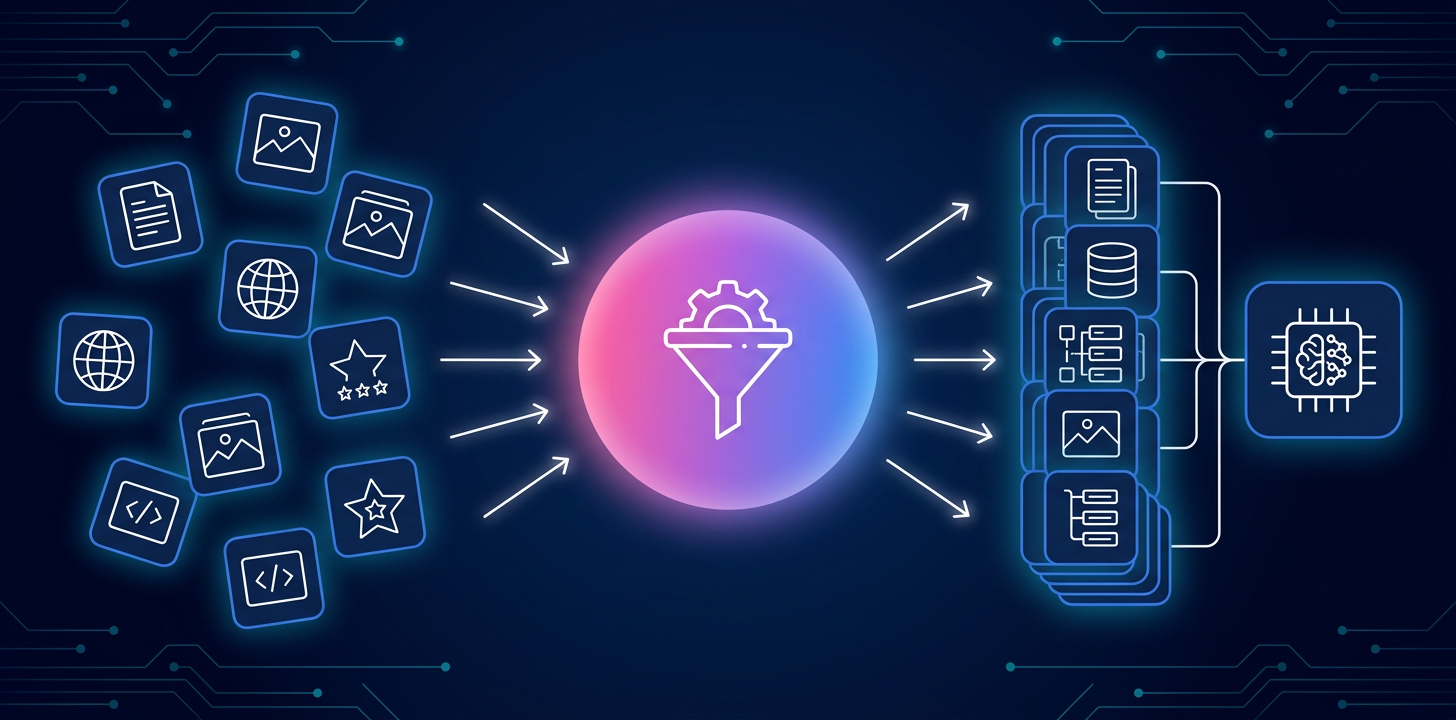
AI data collection turns scattered, messy public data into clean, structured, model-ready datasets.
What is AI data collection?
AI data collection is the process of gathering, structuring, and preparing the large volumes of data used to train, fine-tune, evaluate, and ground artificial intelligence systems. It spans everything from assembling a web-scale text corpus for pretraining a language model, to collecting product images for a computer-vision model, to pulling fresh documents into a retrieval system so an AI agent can answer questions about the current state of the world.
It is worth separating from two neighboring ideas. General data extraction is about pulling information out of a source. Web scraping is one common technique for collecting public web data. AI data collection is the broader discipline that uses those techniques with a specific goal in mind, producing data shaped for machine learning, at the scale and diversity that modern models demand.
Why AI data collection is different
Collecting data for a dashboard and collecting data to train a model are not the same job. Four properties make AI data collection its own discipline.
Scale. Model performance tends to improve with more high-quality data, so AI data collection operates at volumes, millions to billions of records, that would overwhelm a manual or ad-hoc process. The industry-wide shift toward data-hungry models is exactly the trend documented in the Data for AI 2025 report.
Diversity. A model generalizes to situations it saw variations of during training. That makes breadth, many sources, formats, languages, and geographies, as important as raw volume. A narrow dataset produces a narrow, brittle model.
Freshness. A model or retrieval system trained on stale data answers yesterday’s questions. Many AI use cases need recurring collection to stay current, which turns data collection from a one-time task into an ongoing pipeline.
Structure and provenance. Training data must be cleaned, consistently formatted, and traceable back to its source, both for quality and for compliance. Where a business report can tolerate a messy spreadsheet, a training set cannot: errors and duplicates compound across millions of examples.
The core concepts
A handful of building blocks show up in every AI data collection effort.
Data types. Data is usually split into structured and unstructured data. Structured data lives in neat rows and columns, like prices or ratings. Unstructured data, the raw text, images, audio, and video that make up most of the web, is where the majority of AI training value now sits, and it is harder to collect and shape. Understanding the difference between a dataset versus a database matters here too: a dataset is the curated collection you train on, not the live system it may have come from.
Data sources. The main sources are the public web (sites, search results, marketplaces, forums, reviews), APIs and data feeds, first-party data a company already owns, and synthetic data generated to fill gaps. The public web is the largest and most diverse of these, which is why so much AI data collection is, in practice, web data collection.
Key terms. A few concepts recur throughout the pipeline: data parsing turns raw HTML into structured fields; deduplication removes repeated records; annotation or labeling attaches the ground-truth a supervised model learns from; and provenance is the traceable record of where each piece of data came from. If any of these terms is unfamiliar, the primer on what a dataset is is a good foundation.
The AI data collection pipeline
Raw data does not become training data in one step. It moves through a pipeline, and each stage has a distinct job. This is a specialized data pipeline architecture, and it maps closely onto a classic ETL pipeline with an AI-specific twist at the end.
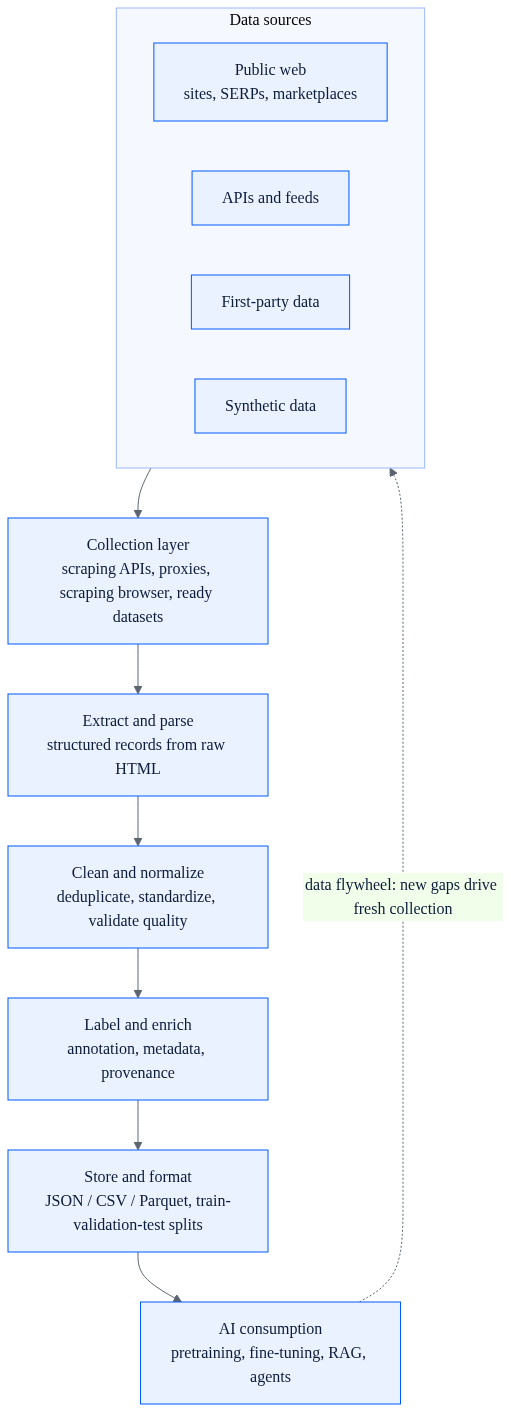
The end-to-end AI data collection pipeline, from raw sources to model consumption, with a feedback loop that drives fresh collection.
- Sources. Identify where the data lives: the specific sites, APIs, internal systems, or generated data that hold what the model needs.
- Collection. Gather the raw data reliably and at scale. For public web data this is where scraping infrastructure, proxies, and managed browsers do the heavy lifting against rate limits and anti-bot defenses.
- Extraction and parsing. Convert raw pages into structured records, pulling the specific fields out of messy HTML.
- Cleaning and normalization. Deduplicate, standardize formats, handle missing values, and validate against quality rules. This is where a dataset earns its trustworthiness.
- Labeling and enrichment. Add annotations, metadata, and data enrichment so the records carry the signal a model can learn from, along with the provenance to audit them later.
- Storage and formatting. Store the result in model-friendly formats like JSON, CSV, or Parquet, and split the data into training, validation, and test sets.
- Consumption. Feed the finished dataset into AI model training, fine-tuning, or a retrieval system.
The loop matters as much as the line. As a model reveals gaps, new failure cases, drifting facts, underrepresented categories, those gaps drive the next round of collection. That is the data flywheel the strongest AI teams build on purpose.
Methods of AI data collection
There is no single right way to collect data. The main methods trade off control, effort, and scale.
- Web scraping. Programmatically collecting public web data is the workhorse of AI data collection, and increasingly it is AI powered web scraping that adapts to page structure automatically. It offers maximum coverage and control, at the cost of handling anti-bot systems and site changes. A closely related discipline is web scraping for machine learning specifically.
- APIs and data feeds. When a source offers a structured API, it is the cleanest path, though APIs often cap volume, rate, or the fields they expose.
- Ready-made datasets. Pre-collected, maintained datasets remove the collection burden entirely and are ideal when someone has already assembled what you need.
- Synthetic data. Generated data fills gaps for rare cases or privacy-sensitive scenarios, but it cannot fully substitute for real-world diversity.
- Crowdsourcing and manual labeling. Human effort remains essential for high-quality annotations and evaluation sets, even as automated labeling improves.
Most serious pipelines combine several of these. For a deeper comparison of the two most common web-data paths, see best AI training data providers.
Best practices for AI data collection
The difference between a dataset that lifts a model and one that quietly degrades it usually comes down to discipline in a handful of areas.
Start from the model, not the data. Define what the model needs to learn first, then collect toward that. Collecting everything and sorting it out later wastes effort and buries signal in noise.
Prioritize diversity and coverage. Deliberately vary sources, formats, geographies, and edge cases. Because a model generalizes from what it has seen, coverage of the long tail is often what separates a demo from a production system. Geographic diversity in particular usually requires collecting the same source from many regions.
Enforce quality early and continuously. Validate as you collect, not after. Track data quality metrics like completeness, accuracy, and consistency, and reject or flag bad records before they enter the set. A silent collection failure that returns empty or malformed pages can bias a dataset without any obvious error.
Deduplicate and decontaminate. Remove duplicate records, which distort what a model weights as important, and keep your evaluation data strictly separate from training data so you do not accidentally test on what you trained on.
Preserve provenance and respect compliance. Keep a traceable record of where every record came from, collect only publicly available data, honor site rules such as robots.txt, and follow regulations like GDPR and CCPA. Sound data collection ethics are not just a legal safeguard; they protect the long-term usability of your data.
Keep it fresh. Schedule recurring collection for anything that changes over time, and version your datasets so you can reproduce and audit what a model was trained on.
Structure for training. Standardize formats, normalize fields, and produce clean train, validation, and test splits. The goal is data a training job can consume without a fragile pile of one-off cleanup scripts.
Build for scale and reliability. At AI volumes, the collection layer has to be robust to blocking, site changes, and failures. This is where dedicated infrastructure earns its place, a theme the broader set of data collection best practices expands on.
Common challenges and how to solve them
Four obstacles come up in nearly every AI data collection project.
Blocking and anti-bot defenses. The most valuable public data lives behind rate limits, CAPTCHAs, and bot-detection systems like Cloudflare, DataDome, and Akamai. Collecting it reliably requires rotating IPs, realistic browser behavior, and automatic unblocking, rather than brittle homemade workarounds.
Scale and maintenance. A scraper that works on one page often breaks at a million pages, or when a site changes its layout. Maintaining collectors across many sources is a real, ongoing engineering cost, and one worth planning to reduce data collection costs around.
Data quality. Raw web data is messy, inconsistent, and full of duplicates and noise. Turning it into a clean training set is often the largest share of the total effort.
Compliance and provenance. Collecting responsibly, staying within public data, and keeping an auditable trail is both a legal necessity and a quality safeguard, especially as AI regulation tightens.
Where Bright Data fits
Most of these challenges are infrastructure problems before they are machine-learning problems. This is where Bright Data operates: it is the web-data platform that turns the open web into reliable, structured, model-ready data, and it maps directly onto the collection layer of the pipeline above.
- The Web Scraper API turns any site into a structured data endpoint with pre-built scrapers that handle anti-bot systems automatically, returning JSON or CSV ready for the next stage.
- A residential proxy network of 400M+ ethically sourced IPs across 195 countries provides the geographic and volume diversity that generalization depends on.
- The Scraping Browser renders JavaScript-heavy sites that static collection would miss, which is where much real-world content lives.
- The SERP API delivers structured search results, a common source for grounding and monitoring pipelines.
- Ready-to-use and custom AI and LLM datasets deliver pre-collected, structured corpora exported as JSON, CSV, or Parquet, so a team can feed a pipeline without building collection at all.
Reliability is the part that matters most when the data will train a model, because a silent failure quietly biases the result. Bright Data reports a 98.44% average success rate in an independent benchmark of eleven providers, the highest of those tested, and maintains a 99.99% uptime target with GDPR, CCPA, SOC 2, and ISO 27001 compliance while collecting only publicly available data. That combination of scale, success rate, and provenance is exactly what the collection layer of an AI pipeline needs, and it is why Bright Data serves a large share of the teams building LLM training data today.
Common use cases
The same collection discipline powers most of the AI systems in production.
- Pretraining and fine-tuning language models. Web-scale text and structured data forms the base corpus, and targeted web data drives fine-tuning on web data for a specific domain.
- Retrieval-augmented generation. Fresh, well-structured documents feed retrieval augmented generation (RAG) systems and shape the RAG versus fine-tuning decision, backed by embeddings and AI-ready vector datasets.
- AI agents. Autonomous agents need live web access to act on the current state of the world, not just what they memorized in training.
- Computer vision. Diverse image collections train and evaluate models that recognize and reason about the visual world.
- Market and competitive intelligence. Continuously collected pricing, product, and review data feeds models that track markets in real time.
Conclusion
AI data collection is the unglamorous foundation that determines how good an AI system can be. The concepts are straightforward, sources, a pipeline, methods, and quality, but doing it well at scale is a discipline: collect toward the model’s needs, prioritize diversity, enforce quality early, preserve provenance, and keep the data fresh. Above all, the collection layer has to be reliable, because everything downstream inherits its flaws.
That reliability is what turns the open web into a durable AI advantage. Bright Data is the infrastructure that makes it dependable, delivering clean, compliant, structured web data at the scale modern models demand. Ready to build the data layer for your AI systems? Start for free and see how quickly the open web can become model-ready data.
Frequently Asked Questions
Q: What is AI data collection?
AI data collection is the process of gathering, structuring, and preparing the large volumes of data used to train, fine-tune, evaluate, and ground artificial intelligence systems. It covers assembling text corpora for language models, image collections for computer vision, and fresh documents for retrieval systems, and it emphasizes scale, diversity, freshness, and clean structure far more than ordinary data collection does.
Q: What are the main sources of AI training data?
The main sources are the public web (websites, search results, marketplaces, forums, and reviews), APIs and data feeds, first-party data a company already owns, and synthetic data generated to fill gaps. The public web is the largest and most diverse source, which is why much of AI data collection is, in practice, web data collection.
Q: What are the steps in an AI data collection pipeline?
A typical pipeline runs through seven stages: identifying sources, collecting the raw data at scale, extracting and parsing it into structured records, cleaning and normalizing it (including deduplication and validation), labeling and enriching it, storing and formatting it into training, validation, and test splits, and finally feeding it into model training or a retrieval system. A feedback loop, the data flywheel, then drives fresh collection as the model reveals gaps.
Q: What are the best practices for AI data collection?
Start from what the model needs rather than collecting everything, prioritize diversity and coverage of edge cases, enforce data quality continuously rather than after the fact, deduplicate and keep evaluation data separate from training data, preserve provenance and respect compliance and site rules, keep data fresh with recurring collection, and structure the output for training. Underpinning all of this, the collection layer must be reliable at scale.
Q: Why is web scraping important for AI?
The public web is the largest and most diverse source of the text, images, and structured data that AI models learn from, and most of it is not available through clean APIs. Web scraping is the primary way to collect it at scale. The challenge is reliability: valuable data sits behind rate limits, CAPTCHAs, and anti-bot systems, so production AI data collection depends on robust infrastructure such as proxies, managed browsers, and pre-built scrapers.
Q: How does Bright Data help with AI data collection?
Bright Data provides the collection-layer infrastructure for AI pipelines: a Web Scraper API with pre-built scrapers, a 400M+ IP residential proxy network for scale and geographic diversity, a Scraping Browser for JavaScript-heavy sites, a SERP API for search data, and ready-to-use AI and LLM datasets delivered as JSON, CSV, or Parquet. It reports a 98.44% average success rate in an independent benchmark and maintains GDPR, CCPA, SOC 2, and ISO 27001 compliance while collecting only publicly available data.


Growth Marketing Manager
Dvir Sharon is in charge of growth marketing here at Bright Data. He is interested in creating viral content that provides value for businesses looking to leverage web data.