







Apify is a cloud-based, full-stack platform that provides tools to create, deploy, and run your own scrapers or automation programs. In contrast, Bright Data offers ready-made APIs, managed data services, AI-ready datasets, and proxies to support countless integrations and applications, delivering a complete web data ecosystem.
Which one is better between Bright Data vs Apify? Let’s find out!
TL;DR: Bright Data vs Apify: Quick Comparison Table
| Criteria | Bright Data | Apify |
|---|---|---|
| Type of solution | Full web data platform with APIs, managed services, datasets, and proxies | Full-stack web scraping and automation platform |
| Target audience | Developers, analysts, marketers, AI teams, and enterprises | Developers, analysts, and enterprises |
| Products | Proxies, datasets, Web Scraping APIs, Browser API, Web Unlocker API, SERP API, Web Archive, MCP, Scraper Studio, and more | Thousands of Actors across multiple domains, with the ability to build, deploy, and monetize serverless programs |
| API integrations | ✅ | ✅ |
| No-code experience | ✅ | ✅ |
| Pre-built scraping tools | Ready-made APIs built and maintained by a professional team | Ready-made Actors mainly built and maintained by the community |
| Proxy support | 400M+ IPs across 195+ countries | Residential and datacenter proxies |
| Anti-bot handling | Built-in | Supported |
| Ease of use | High | High for users, but requires platform knowledge for building and deploying Actors |
| Integrations | 70+ supported platforms, AI frameworks, automation tools, and more | Integrates with n8n, Zapier, Slack, Google Drive, and Make |
| Infrastructure | Enterprise-grade infrastructure with 99.99% uptime and managed reliability | Cloud-based infrastructure |
| Compliance | GDPR and CPPA compliant | GDPR and CPPA compliant |
| Pricing model | Pay-as-you-go or subscription-based plans | Subscription with prepaid usage, then pay-as-you-go beyond credits |
| Monetization support | ❌ (Not designed for reselling scrapers) | ✅ (Monetize custom Actors via the Apify Store) |
| MCP support | ✅ | ✅ |
| Dataset availability | ✅ (Billions of records from over 200 domains) | ❌ |
Introduction to Bright Data
Start this Apify vs Bright Data comparison guide by exploring what Bright Data is and what it has to offer.
What Is Bright Data?
Bright Data started as a proxy provider and has grown into the leading web data platform on the market. It enables you to collect public web data at scale, supporting a very long list of use cases and scenarios.
Bright Data provides a comprehensive suite of tools, including residential, mobile, and datacenter proxies, web scraping APIs, pre-collected datasets, and a SERP API. The company serves over 20,000 customers, helping them access and structure web data to gain actionable insights.
Its technology simplifies data collection by handling CAPTCHAs, geo-restrictions, JavaScript rendering, rate limits, and other anti-bot measures. Bright Data’s ultimate goal is to help you build web data pipelines without headaches.
Services, Products, and Features
Bright Data has a very broad offering, encompassing numerous services and products. The most relevant ones are:
- Web Unlocker API: Automatically handles blocks, CAPTCHAs, and proxy rotation, ensuring reliable data extraction with predictable costs for web scraping pipelines.
- SERP API: Fetch real-time results from multiple search engines, including Google, Bing, Yandex, DuckDuckGo, and others. Handles proxies, unblocking, and parsing to deliver structured data for SEO, monitoring, or research.
- Browser API: Run and scale Puppeteer, Selenium, or Playwright scripts on hosted browsers. Supports dynamic scraping, automated proxies, and CAPTCHA solving for complex sites.
- Crawl API: Extract full website content from any domain by specifying a root URL. Outputs include Markdown, HTML, text, or JSON for easy integration.
- Web Scraping APIs: Retrieve structured data from 120+ domains with automatic proxy rotation, anti-bot bypass, and JavaScript rendering.
- Proxy services: Access 400M+ residential, mobile, ISP, and datacenter IPs across 195+ countries, enabling reliable, scalable web scraping operations.
- Scraper Studio: Launch AI-powered scrapers quickly, maintain stability with self-healing features, and manage proxies and browsers without manual intervention.
- Datasets: Access structured, validated data from 200+ websites covering billions of records. GDPR-ready and available without maintaining scrapers.
- Web Archive API: Retrieve historical and current HTML content from Bright Data’s vast archive, updated continuously with over 1PB added weekly.
- Managed data acquisition services: Fully managed service delivering structured insights without development effort, maintenance, or infrastructure management.
- Deep Lookup: AI-powered search engine for companies, professionals, and entities. Supports complex queries and returns high-quality, structured results for immediate use.
- Retail intelligence: Gain harmonized eCommerce insights in real time, including product data, pricing, and AI-powered recommendations across multiple websites.
- Web MCP: Provides AI models, agents, and apps with web access via MCP (Model Context Protocol). Supports automated search, extraction, navigation, and interaction at scale.
As you can imagine, this vast set of solutions opens the door to countless possibilities. The list of supported features is extensive, but some of the most important include:
- No-code scraping experience: Simplified, on-demand data collection for users of all skill levels. Maintain flexibility and scale without managing infrastructure or proxies.
- Web dashboard: Centralized interface for product management, setup, monitoring, and workflow control.
- CAPTCHA Solver: Solves reCAPTCHA, hCaptcha, px_captcha, SimpleCaptcha, GeeTest CAPTCHA, and other challenges for you. Enables unlocked web scraping and automation.
- Resources and learning: Webinars, documentation, tutorials, and videos to quickly onboard and get started.
- Proxy manager: Customizable interface to manage, rotate, and optimize proxy traffic with full visibility and control.
- Compliance and security: Adheres to GDPR, CPPA, and other privacy regulations while following ethical best practices and top-level security standards.
Pricing
No matter which Bright Data scraping or proxy solution you choose, the pricing plans follow a consistent structure.
There is a pay-as-you-go option, where the charging unit is either the number of results (e.g., Web Unlocker API and Web Scraping APIs) or GB of traffic (e.g., Browser API and proxies). In addition, there are subscription-based plans for users with ongoing or predictable needs. This means you can either choose a subscription or get started immediately with pay-as-you-go, without committing to a recurring plan.
Specifically, Bright Data’s pricing for its top solutions is:
| Pay-as-you-go | Small Team | Large Team | Enterprise | |
|---|---|---|---|---|
| Residential Proxies | $4/GB | 141 GB – $3.50/GB ($499/mo) | 332 GB – $3.00/GB ($999/mo) | 798 GB – $2.50/GB ($1,999/mo) |
| Browser API | $8/GB | 71 GB – $7/GB ($499/mo) | 166 GB – $6/GB ($999/mo) | 399 GB – $5/GB ($1,999/mo) |
| SERP API | $1.50/1K results | 380K results – $1.30/1K ($499/mo) | 900K results – $1.10/1K ($999/mo) | 2M results – $1.00/1K ($1,999/mo) |
| Crawl API | $1.50/1K results | 380K results – $1.30/1K ($499/mo) | 900K results – $1.10/1K ($999/mo) | 2M results – $1.00/1K ($1,999/mo) |
| Web Unlocker API | $1.50/1K results | 380K results – $1.30/1K ($499/mo) | 900K results – $1.10/1K ($999/mo) | 2M results – $1.00/1K ($1,999/mo) |
| Web Scraping APIs | $1.50/1K Records | 510K records – $0.98/1K ($499/mo) | 1M records – $0.83/1K ($999/mo) | 2.5M records – $0.75/1K ($1,999/mo) |
Keep in mind you are only charged for successful requests, and a free trial is available for all products.
Note: Datasets come with record-based pricing, while managed services follow a fixed monthly cost.
Overview of Apify
Let’s continue this Bright Data vs. Apify comparison article by digging into Apify.
What Is Apify?
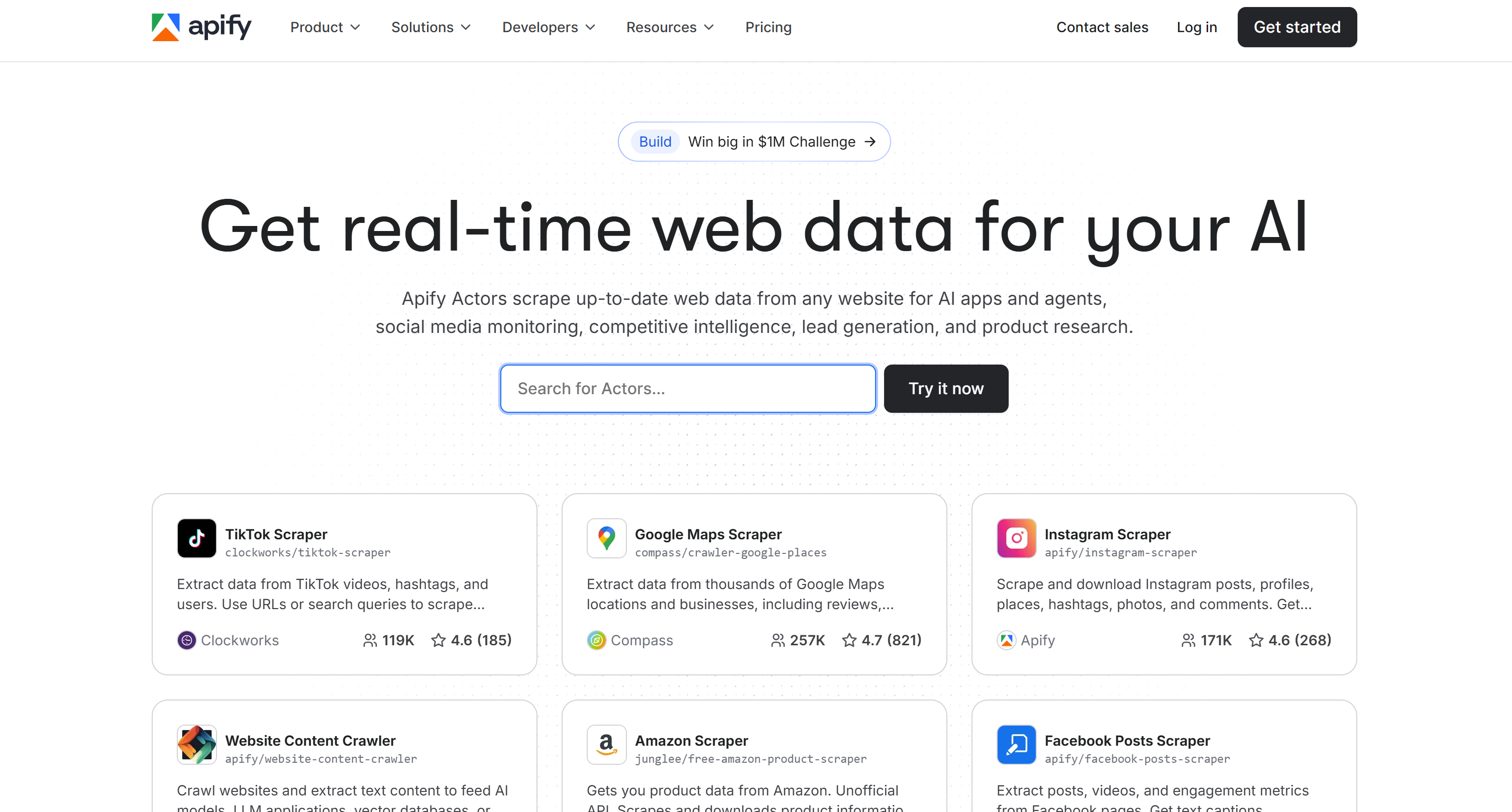
Apify is a cloud-based platform for web scraping and automation. It allows both developers to create and deploy serverless programs called Actors. In the Apify ecosystem, an Actor is a serverless cloud program that automates tasks, mainly for web data extraction, web crawling, or AI workflows.
These Actors can be integrated via APIs or other methods by developers. In a similar way, non-technical users can select Actors from the public marketplace (known as the Apify Store), try, and manage them directly on the platform via a no-code, visual experience.
Services, Products, and Features
Apify’s two main services are:
- Build, share, and monetize Actors: Create automation tasks (with a focus on web scraping), run them on Apify’s cloud platform, and optionally publish them on the Apify Store to earn money.
- Apify Store: Access a marketplace of thousands of ready-made Actors for various data collection and automation scenarios. Manage these Actors directly from the Apify Console, the web platform available after logging in.
To support those two solutions, Apify offers several features:
- Full API integration: Programmatically control the platform and manage Actor runs through the Apify API.
- SDKs and open-source libraries: Simplify Actor creation using official SDKs and libraries such as Crawlee.
- Built-in data cloud storage: Store and export scraping results and files in formats like JSON, CSV, XML, Excel, HTML, and RSS.
- Built-in proxy integration: Automatically rotate requests over residential and datacenter IPs to prevent blocks and avoid rate limiting.
- Custom scheduling: Automate Actor execution at specific times or recurring intervals.
- Third-party integrations: Connect Apify workflows to apps like Slack, Zapier, or Google Drive to create automated, productive data pipelines.
- Apify CLI: Initialize, manage, and run Actors directly from your terminal.
- MCP server: Enable LLMs to discover and execute Apify Actors in AI workflows and agents.
Pricing
Apify pricing depends on whether you are using pre-built Actors or building your own.
For community developers who use the Apify platform to create and publish Actors, there is a special Creator Plan. This costs $1/month and gives you access to $500 of platform usage for the first six months.
For users looking to leverage Actors, there are a few subscription plans. Each plan provides a specific set of features and a prepaid usage amount, which can be spent on the Apify Store or on running your own Actors. Any usage beyond that is charged via a pay-as-you-go model, ensuring your tasks continue running without interruption.
Apify’s pricing is summarized below:
| Plan | Monthly Price (Billed Monthly / Annually) | Prepaid Usage for Apify Store / Actor Runs | CU Price / 1 GB RAM per Hour | Support Level |
|---|---|---|---|---|
| Free | $0 / $0 | $5 | $0.30 | Community support |
| Starter | $29 / $26 | $29 | $0.30 | Chat support |
| Scale | $199 / $179 | $199 | $0.25 | Priority chat support |
| Business | $999 / $899 | $999 | $0.20 | Account manager |
The idea is that you first consume your prepaid usage based on one of the possible Actor pricing models:
- Pay per event: Charges based on specific actions triggered by the Actor (e.g., starting, retrieving results).
- Pay per result: Charges based on the number of results produced.
- Rental: Flat monthly fee for continued access to an Actor after a trial period.
Once your prepaid usage is exhausted, further consumption is billed pay-as-you-go using the compute unit price for your plan.
In addition to the base usage, Apify sells flexible add-ons to extend capabilities and tailor the platform to your needs:
| Add-On | Price | Description |
|---|---|---|
| Concurrent Runs | $5/run | Run multiple Actor instances simultaneously. |
| Actor RAM | $2/GB | Allocate more memory for heavier tasks. |
| Datacenter Proxy | From $0.6/IP | Access additional proxies for web scraping. |
| Priority Support | $100 | Faster response times and dedicated assistance. |
| Personal Training | $150/hour | Guidance to optimize Actors and workflows. |
Bright Data vs Apify: Main Differences
Now that you know what Bright Data and Apify are, you are ready to dive deeper into their differentiating aspects.
Approach to Scraping and Automation
Bright Data and Apify share some common ground, as both support web scraping and automation workflows. These are offered through either self-service tools or managed services. That said, the two platforms differ significantly in how these experiences are delivered.
Apify is structured around giving users the tools to craft, deploy, and execute their own automation programs in the cloud. Bright Data offers similar capabilities, but with a different focus. Its tools are designed to be embedded into custom scripts, pipelines, workflows, and existing systems. Instead, deployment and orchestration are left to you for greater flexibility.
On top of that, Bright Data’s offering is considerably broader. That is thanks to direct access to proxy servers, pre-collected datasets, a web archive API, and specialized data and AI products, as presented earlier.
When comparing the two solutions, it makes sense to start with what they have in common. In this case, that is the access to a wide range of ready-made scraping solutions across many target domains.
In Apify, those scraping options are delivered as Actors and can be used either through a no-code interface directly in the platform or via API calls. Similarly, Bright Data provides a large collection of Web Scraping APIs, which can be used in integrations, custom code, or directly from the dashboard via a code-based interface.
The pivotal difference lies in ownership and reliability. Most Apify Actors are built and maintained by the community, meaning support quality, maintenance, and long-term trust can vary. On the contrary, all Bright Data solutions are developed and maintained by a team of experts, run on enterprise-grade infrastructure, and are backed by one of the largest proxy networks in the world, achieving stronger guarantees around performance, stability, and support.
Ecosystem and Integrations
Apify is available as a node on popular automation platforms such as n8n, Zapier, and Make, and can also be integrated directly via API. Moreover, the platform includes a built-in integration system that allows you to connect Actors with tools like Google Drive, Slack, Gmail, and others to create simple, out-of-the-box automation workflows.
All Bright Data solutions are API-first and available across a wide range of automation and AI platforms, including n8n, Zapier, Make, and many others. Also, Bright Data officially supports 70+ integrations, including major AI and agent frameworks such as LangChain, LlamaIndex, CrewAI, Dify, Haystack, IBM Watsonx, Microsoft Copilot, AWS Bedrock AI Agents, Cursor, RooCode, and any other solution that supports MCP client integrations.
Bright Data’s proxy infrastructure can also be integrated into a wide variety of tools, including Phantombuster, GoLogin, and Kameleo. For example, Bright Data’s proxies and Browser API can be used directly within Apify itself. Thus, the two solutions are complementary.
Both Apify and Bright Data are supported by a local/remote MCP server. Apify’s MCP server has 700+ GitHub stars and allows users to search for and integrate Apify Actors to accomplish specific tasks. Bright Data’s Web MCP has 1.9k+ GitHub stars and supports 60+ tools for web search, web scraping, web interaction, and more.
Infrastructure and Scalability
Bright Data is built on an enterprise-grade infrastructure that allows you to scale seamlessly as your needs grow. You can start with small requirements as a single developer and then scale up to meet the demands of large enterprise projects.
Bright Data’s uptime and success rate of its scraping solutions are 99.99%. Being backed by one of the largest proxy networks in the world gives the platform virtually unlimited scalability. That is true for either global data collection or for more targeted tasks in specific countries or regions.
All users are supported with a standard SLA, with enterprise customers who can request custom SLAs. Plus, built-in alerts and notifications help you monitor changes, such as updates to the output schema of a Web Scraping API, to reduce the risk of unexpected issues.
By contrast, Apify is built primarily for developers who want to deploy their automation programs on the cloud and allow others to run them. This is evident in its pay-as-you-go model, which charges based on compute units and RAM usage over time. After all, that approach is common to most cloud hosting and deployment solutions.
As a result, Apify is a lower-level, developer-focused platform, whereas Bright Data abstracts the infrastructure details, allowing users to focus entirely on running scraping and data collection tasks.
Onboarding Experience and Learning Curve
Bright Data provides a very straightforward onboarding experience. You sign up, generate your API key, select the products you want to access in just a few clicks from the dashboard, and you are ready to integrate them via API.
Integrations are well explained in the documentation, supported by clear example code in cURL, Node.js, Python, Java, Ruby, and many other languages, along with thousands of guides and tutorials available in the official blog.
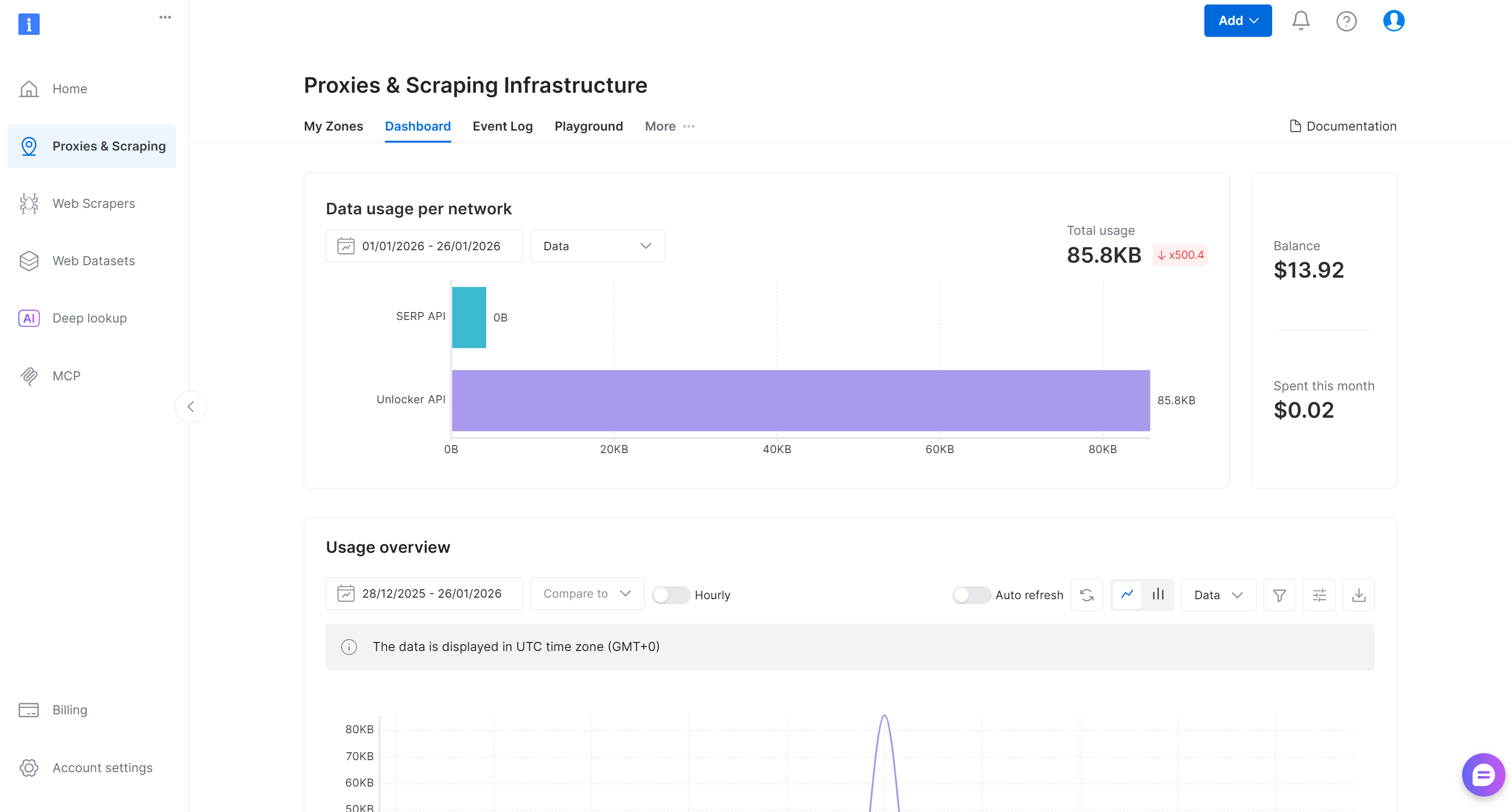
You can also test API integrations directly from the dashboard, monitor usage, see logs, track costs, explore past results, manage permissions, and much more. Alternatively, web scraping solutions can be tested and utilized directly within the platform through a no-code experience.
Apify offers a simple initial setup as well. You sign up, search for the Actor you want to use, and run it directly from the dashboard to get results, or integrate it via API. However, more advanced features like scheduling and integrations require deeper familiarity with the platform and some ramp-up time.
Then, deploying your own automated program to the Apify cloud is a different experience altogether. That is because Apify Actors must follow platform-specific guidelines and structural requirements. The overall development experience can be quite different from simply building a lightweight web scraping bot that connects to scraping APIs or proxies, as is typically done with Bright Data.
Pricing
Both Bright Data and Apify come with subscription-based plans as well as pay-as-you-go pricing. The main difference is how the pay-as-you-go option is structured.
With Apify, pay-as-you-go usage is available only as a complement to one of the subscription plans. In contrast, Bright Data also offers pay-as-you-go as a standalone option, enabling you to access premium services without committing to a monthly subscription. That is ideal for individual developers and small companies that do not want to commit to a recurring paid plan.
Sure, Apify provides a free plan, but Bright Data offers a generous free trial. Plus, some of its most useful tools can be used completely free via the Web MCP free tier, opening the door to fully free AI integrations.
When it comes to costs, a direct comparison is difficult, as Apify’s pricing depends heavily on the specific Actor being used. Some Actors may be cheaper than Bright Data, while others can be more expensive. By comparison, Bright Data’s pricing is transparent and highly predictable, making it easier to estimate and control spending over time.
Use Cases
Both Bright Data and Apify support a very similar set of use cases. These are focused mainly on general web scraping, automated workflows, and AI integrations across multiple industries.
In particular, the most interesting Bright Data and Apify use cases are:
- Web scraping: Unlock websites protected by CAPTCHAs, anti-bot systems, rate limits, and IP bans to reliably extract data and interact with any public website.
- Automated workflows and AI integrations: Integrate with automation tools like n8n, Make, Zapier, or AI frameworks and platforms to support process automation pipelines.
- SERP tracking: Track search engine results across multiple engines for SEO monitoring, keyword research, competitor analysis, and ad tracking.
- E-commerce and retail intelligence: Track competitors globally using live e-commerce data to analyze products, pricing, availability, and consumer sentiment.
- Travel data monitoring: Gather pricing, availability, and competitor data for flights, hotels, and travel services across different regions.
- Market research: Understand target audiences, monitor trends, and support product and strategy decisions using large-scale web data.
- Real estate analytics: Monitor listings, pricing trends, and market movements to optimize investments and anticipate changes ahead of competitors.
- Brand protection: Look for unauthorized sellers, detect counterfeit products, remove fake accounts, and enforce brand and trademark compliance across the web.
- Social media monitoring for marketing: Track trends, analyze engagement, and monitor brand presence across social platforms to optimize marketing campaigns.
- Healthcare data collection: Compare pricing for drugs and medical devices, monitor availability, and support healthcare and public health use cases.
- Data security and threat monitoring: Monitor exposed assets, malware, fraud signals, and suspicious activity across the public web.
- Website testing and monitoring: Identify UX issues, performance problems, and functional errors using screenshots and automated web interactions.
- Lead generation: Collect, validate, and enrich prospect and company data to improve CRM accuracy and sales performance.
- Insurance intelligence: Benchmark competitor policies, monitor pricing, improve underwriting models, and detect potential fraud.
- Apps and AI agents: Provide AI agents with structured, fresh web data for search, extraction, browsing, and RAG-based workflows.
- Finance and investment research: Aggregate financial data, track companies and portfolios, and surface actionable insights for investment decisions.
Thanks to its broader service portfolio, Bright Data also provides deeper or more specialized support for the following:
- Training data for AI and ML: Access domain-specific datasets or build custom pipelines for AI/ML model training, fine-tuning, and continuous data ingestion at scale.
- Ad verification: Verify ads, monitor campaigns, detect fraud, and gather ad intelligence to improve targeting and ROI.
- Data and AI for social impact: Provide NGOs, universities, and public institutions with pro-bono access to web data infrastructure for research and public-interest projects.
When to Use Bright Data vs Apify
The easiest way to conclude the Apify vs Bright Data comparison is to give you clear, actionable insights on when to choose one solution over the other.
Choose Bright Data when:
- You have any web scraping or automation needs.
- You are looking for a rich set of products for web data acquisition, including scraping APIs, datasets, and proxies.
- You want a quick and intuitive setup and easy onboarding for API integration.
- You want to build AI pipelines, workflows, or train ML/AI models with reliable, verifiable web data.
- You need enterprise-grade reliability and support.
- You want direct access to proxies.
- You do not want to be tied to a subscription-based plan.
Prefer Apify when:
- You want a cloud platform to deploy your scraping/automation programs without managing infrastructure.
- You want to monetize your scraping solution or share it with others.
- You trust community-based scraping templates for quick project setup.
- You prefer a developer-centric ecosystem where you can extend, customize, and automate tasks programmatically.
Final Comment
In this Bright Data vs Apify comparison, you have seen what each solution offers, how they differ, and which might be best for you. If you want a platform to deploy and monetize your scrapers, Apify is a solid choice. If you are looking for intuitive, no-code or API-based web scraping and AI integrations, Bright Data is the platform to go with!
Create a free Bright Data account today and explore our web scraping and automation products.
FAQ
What is Bright Data used for?
Bright Data is a web data platform used to collect structured public web data at scale via proxies, web scrapers, and AI-ready datasets. It enables you to bypass geo-restrictions, monitor competitors, verify ads, train AI models, conduct market research, and much more.
What is Apify used for?
Apify is used to connect to pre-built Actors or create custom web scraping and automation workflows. These allow you to extract, store, and process web data at scale from hundreds of websites.
Which is better for getting started with web scraping and integrations: Apify or Bright Data?
Bright Data is generally better for getting started. Its onboarding is quick and intuitive, with easy API access, clear documentation, example code in multiple languages, and no-code dashboard options. Create an account for free today!
Does Bright Data handle proxies, anti-bot measures, and anti-scraping challenges for you?
Yes, Bright Data handles proxies, anti-bot measures, and anti-scraping challenges for you. Its platform provides residential, datacenter, ISP, and mobile proxies, along with CAPTCHA solving, IP rotation, and fingerprint management. This means it equips you with everything you need to reliably and ethically scrape websites at scale, without blocks or operational headaches.



Technical Writer
 5.5 years experience
Antonello Zanini is a technical writer, editor, and software engineer with 5M+ views. Expert in technical content strategy, web development, and project management.