







In this article, you will see:
- What an AI harness is and what it does.
- How the AI agent architecture is structured, where the AI harness fits into it, and what it is responsible for.
- What the core components of the harness AI layer are.
- How harness engineering affects an agent’s performance.
- How Bright Data can support your agent harness with its AI-ready APIs.
Let’s dive in!
What Is an AI Harness?
An AI harness is the software layer that surrounds an AI model and turns its reasoning into reliable action. It gives an agent the structure and environment it needs to work toward a goal rather than simply generate responses.
In other words, a harness bridges the gap between what a model can reason about and what an AI agent can actually accomplish in real-world workflows.
A Step Back on AI Agent Architecture
To better understand what a harness is in AI, it helps to first look at the broader architecture of an AI agent.
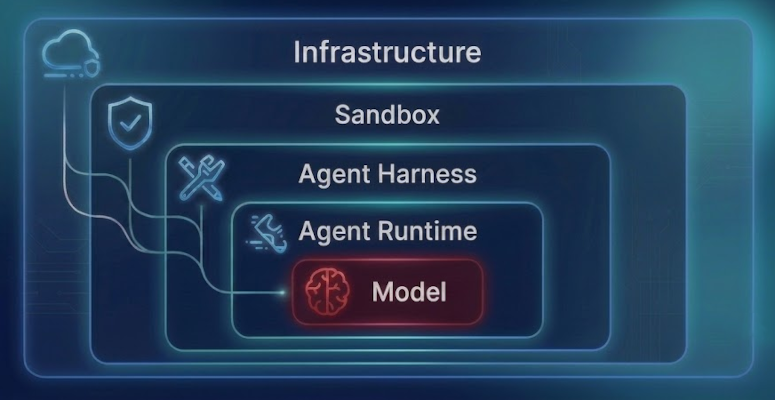
This gives you a clearer picture of where an AI harness fits, and the role it plays in helping an AI agent function properly.
Explore each high-level layer in an agent architecture, as explained by Red Hat.
Layer #1: Infrastructure
Infrastructure is the foundation that provides the compute, memory, networking, and storage needed to run AI agents.
For a single coding agent like Claude Code, Codex CLI, or Gemini CLI, the infrastructure could be your local machine. At scale, you typically need containers, Kubernetes, or a cloud platform to execute and orchestrate many agents concurrently.
The main challenge here is resource management, as agents compete for CPU, memory, GPUs, storage, and network capacity. Kubernetes is a common choice for this layer, while Amazon EKS, Google Kubernetes Engine, and Azure Kubernetes Service provide a managed experience. For GPU-heavy workloads, NVIDIA GPU Operator and Kubernetes GPU scheduling are good options.
Layer #2: Sandbox
A sandbox defines the boundaries within which an AI agent can operate. Its job is to isolate agent-generated code and actions so a mistake does not compromise the host system, credentials, or other workloads.
This becomes particularly important for agents that can execute arbitrary shell commands, install packages, modify files, spawn resources in the cloud, and so on. Thus, infrastructure determines where an agent runs, while the sandbox determines what it can touch.
Lightweight approaches to AI agent sandboxing include containers with restricted permissions. Network policies, filesystem restrictions, RBAC (Role-Based Access Control), and short-lived credentials also add further controls. For stronger isolation, you can consider technologies such as Firecracker microVMs, gVisor, Kata Containers, or NVIDIA OpenShell.
Layer #3: Agent Harness
The AI harness is the layer you deliberately engineer to make an agent better at a particular class of tasks. It shapes how the model receives context, uses tools, follows project-specific instructions, and verifies its work.
This might include an AGENTS.md file, custom tools, MCP servers, Agent Skills, linters, tests, and evaluation suites. Solutions such as OpenClaw, CrewAI, Hermes Agent, and the OpenAI Agents SDK provide building blocks for this layer. Discover more tools in the Awesome Harness Engineering repository.
At this layer, protocols such as MCP (Model Context Protocol) provide a standardized way to connect agents to third-party solutions and external data sources. Similarly, Agent Skills provide a structured way to package and reuse instructions and workflows across agents.
Layer #4: Agent Runtime
The runtime is the execution engine that drives the agent loop. It takes the model’s output, determines whether it contains a tool call, executes the required action, collects the result, and sends the updated context back to the model.
Libraries such as LangGraph and LlamaIndex can serve as agent runtime infrastructure. A custom agent loop can also be considered an agent runtime.
This layer is easy to confuse with the AI harness because the two interact closely. A useful distinction is that the runtime executes the loop, while the harness is the environment and set of instructions you engineer around that loop.
Layer #5: Model
At the innermost layer sits the AI model that performs the reasoning and generates the next response or action. This could be a hosted model such as GPT, Claude, or Gemini, or an open-weight model deployed through infrastructure such as vLLM, SGLang, or NVIDIA NIM.
Importantly, changing the model does not require rebuilding the rest of the stack. That is because most AI agent runtimes and harnesses are designed to be model-agnostic.
AI Agent Harnesses: Main Components
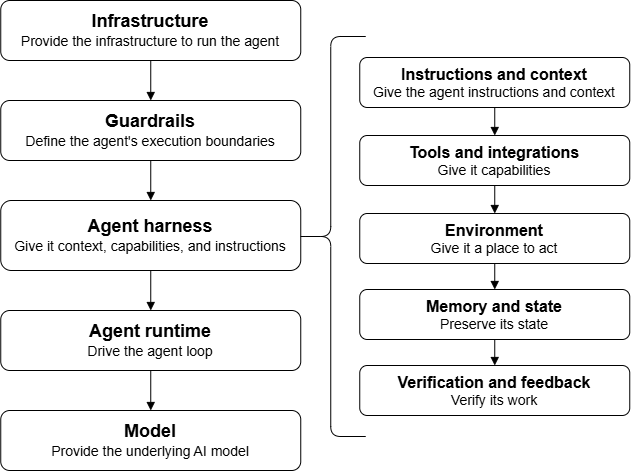
To turn a model from a content generator into a system capable of completing practical tasks, an AI agent harness combines several components.
Implementations vary, but most production harnesses include these elements:
| Component | What it does | Typical technologies |
|---|---|---|
| Instructions and context | Defines how the agent should behave and provides the information it needs to complete the current task. This can include system prompts, project-specific instructions, and strategies for selecting, organizing, and managing context and tools. | AGENTS.md, system prompts |
| Tools and integrations | Gives the agent access to external capabilities, such as APIs, databases, web search, browsers, code execution, and reusable skills. | MCP, function calling, custom APIs, Agent Skills |
| Environment | Provides a workspace where the agent can perform actions, such as running commands, modifying files, executing code, and interacting with the project it is working on. | Local OS, Docker, virtual machines, cloud development environments |
| Memory and state | Preserves relevant information across steps and sessions and manages the context available to the model through techniques such as retrieval, summarization, and compaction. | Redis, PostgreSQL, vector databases, file-based state |
| Verification and feedback | Checks whether the agent’s actions produced the expected results and provides feedback that allows it to identify and correct mistakes. | Unit tests, linters, evaluators, LLM-as-a-judge |
These components do not usually live in a single library. In practical terms, a harness is often an engineered combination of multiple specialized technologies.
A useful way to understand how these components work together is to look at them as a progression:
Give the agent instructions and context → Give it capabilities → Give it a place to act → Preserve its state → Verify its workWhen you combine these components with the other layers of AI agent infrastructure, you get:
The Impact of the AI Harness on Agent Performance
You may think that an AI agent’s performance depends mainly on its underlying model rather than its surrounding capabilities. However, while a large language model can reason about a task, reasoning alone does not make an AI agent useful or operational.
To be production-ready, agents need to access tools, work with external data, maintain state, operate in an execution environment, and verify their results. That is precisely what an AI harness provides, which is why that layer has a big impact on agent performance.
After all, the same underlying LLM can produce very different results depending on how effectively the harness manages context, calls tools, preserves state, and checks the produced output. Poor context management can cause context rot, excessive tools can make actions harder to select, and weak verification can allow errors to go undetected.
By contrast, a well-engineered AI agent harness can improve task success rates, consistency on long-running tasks, resource efficiency, and reliability without changing the underlying model. This also makes harness engineering an important part of an enterprise AI strategy.
How Bright Data Supports Enterprise-Ready AI Harness Solutions
Bright Data is the world’s leading web data provider, offering a suite of web data and automation APIs. These include:
- SERP API: Retrieve structured search results from Google, Bing, and other search engines.
- Web Unlocker API: Fetch raw HTML or LLM-ready Markdown web pages from websites.
- Web Scraper APIs: Get structured data from Amazon, LinkedIn, Google Maps, and 40+ other domains.
- Browser API: Control a remote browser programmatically to interact with dynamic web pages.
Note: Most Bright Data APIs come with a free plan for new users, including 5,000 requests per month.
These APIs provide programmatic access to live web information, allowing AI agents and other systems to search the web, scrape content, extract structured data, and automate browser interactions. All of that without worrying about CAPTCHAs, IP bans, fingerprinting issues, or other anti-bot protections.
Bright Data Integration in AI Agent Harnesses
Bright Data APIs can be integrated into any AI agent harness through several approaches:
- Bright Data MCP: The official Bright Data MCP server, providing 70+ tools for connecting to Bright Data APIs through MCP.
- Official integrations: Connect Bright Data with 70+ AI agent frameworks, including CrewAI, Agno, Dify, Mastra, LangChain, LlamaIndex, and many others.
- Agent Skills: Equip agents with 20+ skills that provide Bright Data API knowledge, best practices, and runnable scripts.
- OpenAPI specifications: Connect Bright Data APIs in agent workflows via OpenAPI specs.
- Bright Data CLI: Let AI agents access Bright Data solutions through CLI tools. Find out more in our official guide.
No matter which integration you choose, what sets Bright Data apart is its infrastructure. Built on a proxy network of 400+ million IPs across 195 countries, it offers 99.99% uptime and achieves a 99.95% success rate. This makes it suitable even for enterprise-level AI agent harnesses.
Further reading:
- Extend OpenClaw with Bright Data Skills for a Web-Data-Ready WhatsApp AI Assistant
- Give AstrBot the Ability to Interact With the Web Using Bright Data (MCP + Skills)
- Give Pi Agent the Tools to Explore and Interact with the Web via Bright Data MCP
- Integrate ZeroClaw With Bright Data for a Web-Aware AI Assistant
Conclusion
In this blog post, you learned what an AI agent harness is and how it fits into an agent architecture. You also saw how a well-designed harness can make AI agents less dependent on the capabilities of the underlying LLM and help them achieve better performance.
Bright Data supports AI agent harnesses with a complete, AI-ready infrastructure for web access. This includes multiple API-based products for web scraping, search, and browser automation.
You can integrate these Bright Data services in your harness directly through MCP tools, official plugins (e.g., for platforms such as OpenClaw, CrewAI, LangChain, and LlamaIndex), as well as via CLI, Agent Skills, and OpenAPI specifications.
Create a Bright Data account today and start exploring our enterprise-ready AI web tools!
FAQ
What is the difference between an AI agent and an AI harness?
An AI agent is the complete system that combines a model with a harness to perform tasks. The harness is the infrastructure around the model that provides tools, memory, execution environments, state management, and verification.
AI agent harness vs AI agent runtime: What is the difference?
| Concept | Primary role |
|---|---|
| AI agent harness | The broader system around the model that provides capabilities such as tools, context management, memory, state, execution environments, and verification. |
| AI agent runtime | The execution layer that runs the agent loop, invokes the model and tools, manages execution state, and coordinates actions at runtime. |
The runtime can be considered part of the harness. The agent harness describes the broader infrastructure and design, while the agent runtime is the machinery that executes it.
Agent vs model vs AI harness: What is the difference?
| Component | What it does |
|---|---|
| Model | Reasons about the task, interprets context, and generates decisions or outputs. |
| AI harness | Provides the infrastructure surrounding the model, including tools, memory, environments, memory and state management, and output verification. |
| AI agent | The complete working system that combines the model and harness to perform tasks. |
Prompt engineering vs context engineering vs harness engineering: What is the difference?
| Discipline | Primary focus |
|---|---|
| Prompt engineering | Designing instructions and prompts that guide the model toward better outputs. |
| Context engineering | Deciding what information the model receives at each step, including retrieved information, memory, and conversation history. |
| Harness engineering | Structuring the broader system around the model, including prompts and context as well as tools, execution environments, state, and verification. |
Does the AI harness matter more than the model in an agent?
It depends on the task. For simple tasks, model capability may matter more. For complex, multi-step workflows, harness quality can be equally or more important because tools, context management, memory, and verification determine how reliably the model can translate reasoning into practice.
What is likely to happen to AI harnesses as models keep improving?
As models improve, some harness responsibilities may move closer to the model. Still, AI harnesses are unlikely to disappear. They may become more adaptive and model-aware, with lightweight or disposable environments created for specific tasks.
Two emerging approaches illustrate that evolution:
- Natural-Language Agent Harnesses (NLAHs): Represent harness logic as editable natural-language instructions, making harnesses easier to inspect, modify, and reuse.
- Self-Harness: Enables agents to identify weaknesses in their own execution and propose, test, and validate harness improvements iteratively.



Technical Writer
 5.5 years experience
Antonello Zanini is a technical writer, editor, and software engineer with 5M+ views. Expert in technical content strategy, web development, and project management.