







Brave Search API operates its own independent search index and exposes that index via a clean, LLM-optimized API layer. Bright Data accesses the actual live web at scale: scraping real Google, Bing, and Yandex results, fetching pages behind anti-bot protection, and storing historical data across 50PB+ of web archive. The right choice depends entirely on what your agent or pipeline actually needs to do: results from an independent index, or ground-truth data from the live web.
TL;DR
- Brave Search API uses its own 30B-page index; Bright Data scrapes live Google/Bing/Yandex.
- Bright Data SERP API starts at $1.50/1K; Brave Search API costs $5/1K.
- Bright Data has no concurrent request limit; Brave Search API caps at 50 QPS.
- Brave’s LLM Context API is optimized for token-efficient AI grounding under 600ms.
- Bright Data’s Web Unlocker accesses Cloudflare-protected pages; Brave cannot.
- Brave offers native Zero Data Retention; Bright Data is GDPR compliant and holds SOC 2, SOC 3, and ISO 27701 certifications.
What Is Bright Data?
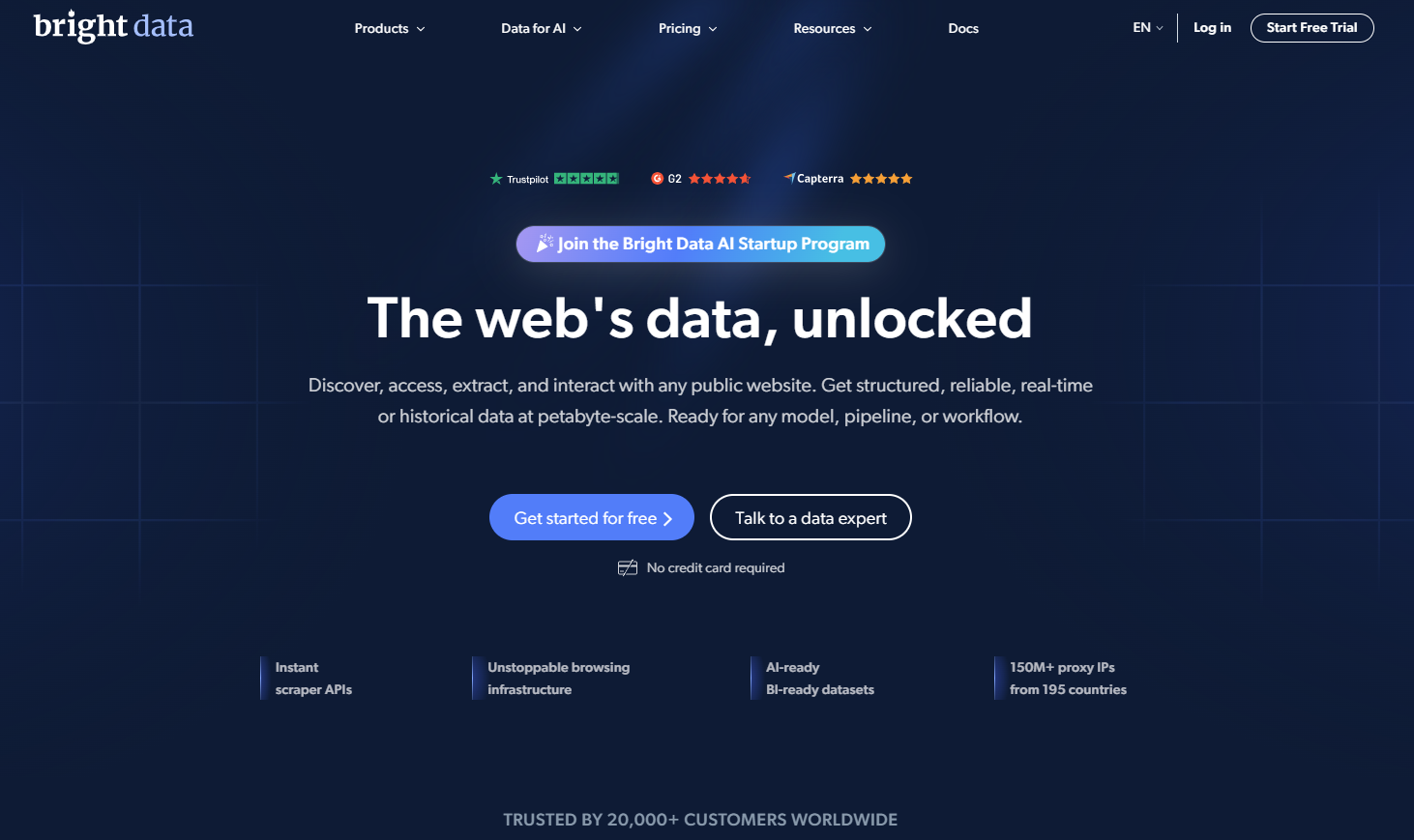
Bright Data is web data infrastructure. It doesn’t maintain its own search index; it accesses the actual live web at scale, through a suite of products built for different data acquisition patterns.
SERP API
The SERP API scrapes real search engine results pages in real time across seven major engines: Google, Bing, Yandex, Baidu, Yahoo, Naver, and DuckDuckGo. Results are geo-targeted to any of 195 countries with city-level precision and returned as structured JSON, HTML, or Markdown. There is no limit on concurrent requests. Pricing starts at $1.50/1K on PAYG and drops to $1.00/1K at 2M requests/month.
Web Unlocker
The Web Unlocker fetches any web page, including those behind Cloudflare, CAPTCHA walls, or JavaScript rendering, and returns clean content. It routes requests through a network of 400M+ residential IPs across 195 countries, handling browser fingerprinting and CAPTCHA solving automatically. For competitive pricing intelligence, brand protection, and any use case where the target pages also have strong bot protection, this is the critical capability.
Datasets & Web Archive
The Web Archive API holds 50PB+ of historical web data, growing daily. Pre-built Datasets cover 100+ domains with structured historical baselines for e-commerce, social media, real estate, and more. For anomaly detection, trend analysis, and longitudinal research, this layer has no equivalent in Brave’s product suite.
Bright Data is trusted by 50,000+ customers including Fortune 500 companies, is GDPR and CCPA compliant, holds SOC 2, SOC 3, and ISO 27701 certifications, and is recognized by Gartner in the Competitive Landscape for Web Data Collection Solutions.
What Is the Brave Search API?
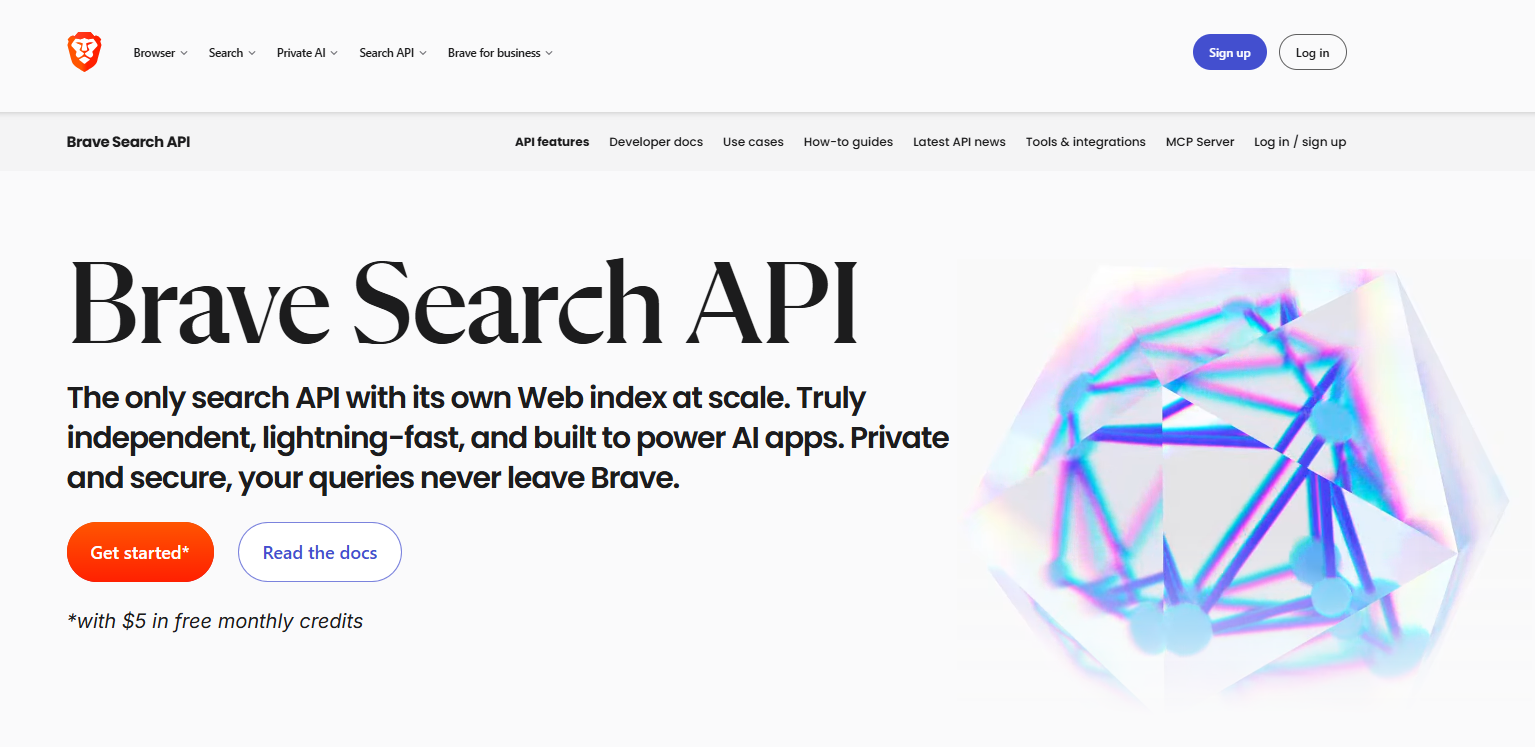
The Brave Search API gives developers programmatic access to Brave’s own independent web index, one of only three global-scale search indexes in the western world, alongside Google and Bing. That index currently spans more than 30 billion pages and receives over 100 million page updates every day.
The API has two main plans. The Search plan ($5/1K requests) returns full search results: URLs, snippets, news, images, and structured data, plus the LLM Context endpoint, which packages web content into token-optimized smart chunks for RAG pipelines. The Answers plan ($4/1K + $5/M tokens) uses Brave’s own LLM layer to return direct, cited answers to questions, and is OpenAI SDK compatible with streaming support. Both plans include $5 in free credit every month.
Brave is trusted by Axel Springer, Chegg, Cohere, Mistral AI, Snowflake, Together.ai, and Turnitin.
What the Brave Search API Does Well
LLM Context API. The /llm/context endpoint is purpose-built for AI grounding, not just search result retrieval. It extracts and structures content from the top results, including JSON-LD, tables, forum threads, and YouTube captions, into smart chunks with configurable token budgets. Latency is under 600ms at p90. Brave’s own Ask product uses this endpoint to power 22 million answers per day.
Goggles. This is a genuinely unique feature. Goggles let you define custom re-ranking and filtering rules: boosting specific domains, excluding others, or surfacing underrepresented content types. No other search API offers this level of result control.
Zero Data Retention (ZDR). Brave’s ZDR is architecturally native: queries are never logged, never stored, and never linked to user identities. For teams in regulated industries (healthcare, legal, finance) where data handling is a hard constraint, this is a real, documented advantage that no other search API in this category offers.
Freshness and quality. In blinded internal testing of 1,500 queries (November 2025), Brave’s Ask + LLM Context API ranked second behind Grok, ahead of ChatGPT, Google AI Mode, and Perplexity.
Brave Search API Limitations
Brave explicitly positions itself as not a scraper, and that clarity cuts both ways. It crawls the open web on its own schedule. It cannot access pages behind Cloudflare, login walls, CAPTCHAs, or JavaScript-based bot detection, the types of protections that guard the most commercially valuable pages. If your workflows require consistently bypassing Cloudflare at scale, Brave’s index simply won’t reach those pages.
It also returns results from Brave’s index, not from Google or Bing. For use cases where the exact SERP, what a real user sees on Google right now in a specific country, is the required output, Brave’s index is the wrong source. And at 50 QPS (Search plan) or 2 QPS (Answers plan), there is a fixed rate ceiling that production multi-agent systems will encounter.
Brave Search API vs. Bright Data: Head-to-Head Comparison
| Dimension | Brave Search API | Bright Data |
|---|---|---|
| Product category | Independent search index API | Web data infrastructure (SERP scraper + proxy network + datasets) |
| Search results source | Brave’s own proprietary index (30B+ pages) | Real Google, Bing, Yandex, Baidu, Yahoo, Naver, DuckDuckGo SERPs |
| Rate limits | 50 QPS (Search), 2 QPS (Answers) | No concurrent request limit |
| Pricing (entry) | $5/1K requests (Search) | From $1.50/1K (SERP API PAYG) |
| Anti-bot / CAPTCHA access | ❌ Cannot crawl protected pages | ✅ Web Unlocker, 400M+ residential IPs |
| Multi-engine support | Brave index only | 7 engines: Google, Bing, Yandex, Baidu, Yahoo, Naver, DuckDuckGo |
| Historical data | ❌ Live index only | ✅ 50PB+ Web Archive |
| Geo-targeting | Country + language targeting | 195 countries, city-level precision |
| LLM-optimized output | ✅ LLM Context API, smart chunks, token budget | ✅ Markdown output from SERP API |
| Zero Data Retention | ✅ Native ZDR (Enterprise plan) | ❌ Not available |
| Compliance certifications | SOC 2 Type II | GDPR, CCPA, SOC 2, SOC 3, ISO 27701 |
| MCP integration | ✅ Brave Search MCP Server (GitHub) | ✅ Bright Data MCP Server (draws on the 5K free requests/mo) |
| Free option | $5 credit/month (renews monthly) | Free tier: 5,000 requests/mo |
Pricing Comparison: Brave Search API vs. Bright Data
Brave Search API pricing:
| Plan | Price |
|---|---|
| Search (web, news, images + LLM Context) | $5 / 1,000 requests |
| Answers (LLM-grounded direct answers) | $4 / 1,000 requests + $5 / M tokens |
| Free monthly credit | $5 (renews automatically each month) |
| Enterprise | Custom |
Bright Data SERP API pricing:
| Volume | Price per 1,000 requests |
|---|---|
| Pay-as-you-go | $1.50 |
| ~380K/month | $1.30 |
| ~900K/month | $1.10 |
| 2M+/month | $1.00 |
At-scale cost comparison:
| Volume | Brave Search API | Bright Data SERP API |
|---|---|---|
| 10,000 requests | $50 | $15 |
| 100,000 requests | $500 | $130–150 |
| 1,000,000 requests | $5,000 | $1,000–1,500 |
Bright Data is 3–5x cheaper at every volume tier. At 1 million requests per month, the cost difference is $3,500–4,000. For teams building production-scale pipelines, this pricing gap compounds quickly.
Rate Limits and Scale
Bright Data’s SERP API has no limit on concurrent requests.
Brave Search API’s Search plan is capped at 50 QPS. The Answers plan is capped at 2 QPS. Enterprise customers can contact Brave for custom capacity, but the default ceilings are fixed.
For single-agent, sequential workloads, this doesn’t create friction. For production multi-agent systems, competitive intelligence stacks, SEO monitoring pipelines, brand protection tools running hundreds of parallel queries, Brave’s 50 QPS ceiling is an engineering constraint from day one. At 50 QPS continuous throughput, you hit 4.32 million requests per day maximum; but any burst above 50 simultaneous requests will queue or fail without rate limit handling.
Bright Data’s no-ceiling architecture means the infrastructure scales with your workload, not the other way around.
Index Ownership vs. Real-World Search Results
Brave Search API returns results from Brave’s own proprietary index, a high-quality, independent data source tuned to reduce SEO spam and increase recency. For general-purpose AI search grounding, this is genuinely valuable.
For specific professional use cases, it’s the wrong source. SEO rank tracking requires knowing exactly what Google shows for a keyword in a specific location. Ad intelligence tools need the actual Google SERP, not an approximation of what’s relevant. Brand protection systems need to monitor the live Google results a real user sees, because search results vary by geo, personalization, and algorithm updates that third-party indexes don’t capture immediately.
Bright Data’s SERP API returns what a real user in any of 195 countries and thousands of cities would actually see on Google, Bing, or Yandex at query time. The ground truth matters when your use case depends on it. For a broader view of how various providers handle this problem, the top SERP and web search API comparison for 2026 covers the full competitive landscape in detail.
Data Access: Open Web vs. Protected Pages
The most commercially valuable pages on the web are often the most protected. Competitor pricing pages, product listing pages behind login walls, job postings on gated platforms, restricted dashboards: these sit behind Cloudflare, CAPTCHA systems, and JavaScript-heavy anti-bot layers.
Brave’s index crawls what its crawler can access. Pages that block crawlers, require authentication, or serve different content to non-browser requests are not in Brave’s index and cannot be fetched via the API.
Bright Data’s Web Unlocker was built specifically for this problem. It routes requests through 400M+ residential IPs, handles browser fingerprinting, manages CAPTCHA solving, and renders JavaScript before returning content. Bright Data posted the highest average success rate, 98.87%, of the 16 scraping APIs in Scrape.do’s 2026 benchmark.
This is a structural capability gap. If protected page access is part of your use case, Bright Data is built for it.
Use Case Decision Guide
| Use Case | Best Choice | Reason |
|---|---|---|
| AI chatbot grounding with fresh web data (low-latency) | Brave | LLM Context API under 600ms, token-efficient, optimized for RAG |
| Real Google SERP data (SEO, rank tracking, ad monitoring) | Bright Data | SERP API returns actual Google results; Brave uses its own index |
| High-volume production pipelines (1,000+ concurrent queries) | Bright Data | No concurrent request limit vs. Brave’s 50 QPS cap |
| Accessing pages behind Cloudflare / CAPTCHA / login walls | Bright Data | Web Unlocker; Brave cannot reach protected content |
| Privacy-first AI applications (Zero Data Retention required) | Brave | ZDR is native to Brave’s architecture; Bright Data does not offer ZDR |
| Multi-engine search (Google + Bing + Yandex simultaneously) | Bright Data | 7 search engines; Brave only indexes its own results |
| Historical trend monitoring / anomaly detection | Bright Data | 50PB+ Web Archive; Brave is live index only |
| LLM training data collection | Both | Brave’s 30B-page index (storage rights plan); Bright Data’s 50PB+ Archive |
| RAG pipelines needing ranked snippets fast | Brave | Goggles filtering, smart chunks, sub-600ms at p90 |
| AI agent workflows via MCP | Both | Both offer official MCP servers |
| Cost-sensitive at 100K+ queries/month | Bright Data | 3–5x cheaper at every volume tier |
Code Comparison: Same Task, Two Approaches
Here is how both APIs handle a search query. The functional output is similar for basic queries; the differences emerge at scale, when parallel requests hit rate limits, or when the target page is behind bot protection.
# Bright Data SERP API: real Google results, no rate limit ceiling
import requests

response = requests.post(
    "https://api.brightdata.com/request",
    headers={
        "Authorization": "Bearer YOUR_API_KEY",
        "Content-Type": "application/json",
    },
    json={
        "zone": "YOUR_SERP_ZONE",
        "url": "https://www.google.com/search?q=competitor+SaaS+pricing+2026&gl=us&brd_json=1",
        "format": "raw",  # brd_json=1 returns parsed JSON
    },
)
results = response.json()
# Returns: actual Google results a US user sees right now
# Rate limit: none
# Cost: $1.50/1K requests (PAYG)
# Brave Search API: LLM Context endpoint, optimized for AI grounding
import requests
response = requests.get(
"https://api.search.brave.com/res/v1/llm/context",
headers={"X-Subscription-Token": "YOUR_BRAVE_API_KEY"},
params={
"q": "competitor SaaS pricing 2026",
}
)
results = response.json()
# Returns: token-optimized smart chunks from Brave's 30B-page index
# Rate limit: 50 QPS (Search plan)
# Cost: $5/1K requestsThe Brave response is structured for immediate LLM consumption with configurable token budgets. The Bright Data response is actual Google SERP data, what a real US user sees at that moment, returned as parsed JSON.
When to Choose the Brave Search API
Brave Search API is the right tool if:
- You need low-latency AI grounding for chatbots or agents. The LLM Context endpoint is under 600ms at p90 and returns token-optimized chunks rather than raw HTML. For real-time interactive applications, this matters.
- Zero Data Retention is a hard compliance requirement. No other search API in this category offers native ZDR. If your team is in healthcare, legal, or finance with strict data handling obligations, Brave’s architecture is genuinely differentiated.
- You want Goggles-based result control. If your application needs to re-rank results, boost specific domains, or filter out categories of content, Goggles is unique to Brave.
- Your query volume is under 100,000/month. At lower volumes, Brave’s $5/1K pricing is reasonable, and the $5 monthly credit means early-stage experimentation is free.
- You’re building an AI chatbot powered by an independent, privacy-preserving index. Brave’s approach, no ad bias, no Google/Bing dependency, is a legitimate architectural choice for privacy-first products.
When to Choose Bright Data
Bright Data is the right tool if:
- You need actual Google, Bing, or Yandex results. The SERP API returns exactly what a real user in any of 195 countries would see on each engine, right now. SEO monitoring, ad intelligence, rank tracking, and brand protection all require this.
- You’re running at production scale. No concurrent request limit and a 99.9% uptime SLA make Bright Data the infrastructure choice for high-throughput pipelines. It also posted the highest average success rate (98.87%) of 16 APIs in Scrape.do’s 2026 benchmark.
- You need to access pages behind bot protection. Web Unlocker handles Cloudflare, CAPTCHA walls, login gates, and JavaScript rendering. Brave cannot touch these pages.
- Your use case requires historical data. The Web Archive API holds 50PB+ of historical web data with no Brave equivalent. Anomaly detection, longitudinal trend analysis, and baseline-grounded agent outputs all depend on this.
- Cost at scale is a factor. At 1 million requests/month, Bright Data costs $1,000–1,500 vs. Brave’s $5,000. That’s a real budget difference.
- You need multi-engine coverage. The SERP API covers 7 engines simultaneously. Brave covers one: its own index.
For a deeper comparison with another AI-native search tool, see the Bright Data vs. Exa breakdown, which covers similar dimensions for a semantic neural search product. For broader context on the search API landscape, the best SERP and web search APIs of 2026 provides a full-market overview.
Conclusion: Two Different Products, One Decision
Brave Search API and Bright Data are not competing for the same job.
Brave built an independent search index and made it available via a clean, privacy-preserving, LLM-optimized API. Its genuine strengths, ZDR, Goggles, the LLM Context format, and sub-600ms latency, make it well-suited for AI chatbots, fast RAG pipelines, and teams with hard compliance constraints around data retention.
Bright Data is infrastructure for accessing the actual live web. The SERP API delivers real Google results in 195 countries at $1.50/1K with no rate limit ceiling. The Web Unlocker reaches pages Brave cannot. The Web Archive provides historical baselines no live-only index can offer. At enterprise scale, these are structural advantages.
Here is the decision framework:
- If your agent needs fast, token-optimized grounding from a privacy-first independent index, or if ZDR is a legal requirement, Brave Search API is designed for that.
- If your agent needs real Google data, protected page access, multi-engine coverage, historical baselines, or cost efficiency above 100,000 queries/month, Bright Data is the right infrastructure.
Many production AI teams use both: Brave for AI-native grounding in user-facing chatbots, and Bright Data for live SERP data, full-page extraction, and high-volume pipeline workloads. They’re not mutually exclusive. They just solve different problems.
Frequently Asked Questions
What is the difference between Bright Data and Brave Search API?
Brave Search API returns results from its own independent 30B-page index. Bright Data scrapes real Google, Bing, and Yandex SERPs in real time and can access pages behind anti-bot protection. Brave is optimized for AI-native search grounding with ZDR and low latency. Bright Data is optimized for live web data at production scale across 7 engines and 195 countries.
Is Bright Data cheaper than Brave Search API?
Yes. Bright Data’s SERP API starts at $1.50 per 1,000 requests on a pay-as-you-go basis. Brave Search API costs $5 per 1,000 requests. At 1 million requests per month, Bright Data costs approximately $1,000–1,500 versus $5,000 for Brave, a 3–5x difference at every volume tier.
Does Brave Search API have a rate limit?
Yes. The Search plan is capped at 50 queries per second. The Answers plan is capped at 2 QPS. Enterprise customers can contact Brave for custom capacity. Bright Data’s SERP API has no concurrent request limit by design.
Can Brave Search API access Cloudflare-protected pages?
No. The Brave Search API crawls the open web and cannot access pages behind Cloudflare, login walls, or CAPTCHA systems. Bright Data’s Web Unlocker is purpose-built for these protections, routing through 400M+ residential IPs with automatic CAPTCHA solving and fingerprint management.
Does Brave Search API support multiple search engines?
No. Brave Search API only returns results from Brave’s own proprietary index, not Google, Bing, or Yandex. Bright Data’s SERP API supports 7 major engines: Google, Bing, Yandex, Baidu, Yahoo, Naver, and DuckDuckGo.
What is the best search API for AI agents?
It depends on the use case. Brave Search API’s LLM Context endpoint is optimized for low-latency, token-efficient AI grounding with native Zero Data Retention. Bright Data’s SERP API and Web Unlocker are better for production-scale agents that need real Google results, access to protected pages, multi-engine coverage, or historical data without rate limit ceilings. Both offer official MCP servers for agent integration, with Bright Data’s drawing on the account’s 5,000 free requests per month. For the wider landscape, see the top MCP servers for AI workflows.



Web Data & AI Expert
 6 years experience
Daniel Shashko is a Senior SEO/GEO at Bright Data, specializing in B2B marketing, international SEO, and building AI-powered agents, apps, and web tools.