







In this blog post, you will see:
- What X data is, what it consists of, why fetching it via the official API may not be ideal, and the main obstacles in scraping it.
- How using a Twitter/X data provider provides a solid solution for data collection.
- The main factors to evaluate when selecting such providers.
- A detailed comparison of the top 5 X data providers.
Let’s dive in!
TL;DR: Twitter/X Data Providers Comparison Table
Compare the top Twitter/X dataests providers at a glance through the following table:
| Provider | Infrastructure | Live Data | Historical Data | Reports/Datasets | AI Integration | GDPR Compliance | Free Sample/Trial | Pay-as-You-Go Option | Pricing |
|---|---|---|---|---|---|---|---|---|---|
| Bright Data | Enterprise-grade, cloud-based, highly scalable, 400M+ proxy IPs, anti-bot measures, MCP-ready, multiple delivery formats | ✅ | ✅ | ✅ | MCP server for AI/LLM workflows, with integration support for 70+ AI technologies | ✅ | ❌ | ✅ | $2.50/1k records (datasets), $1.50/1k records (scraper) |
| Tweet Binder | Managed analytics platform + managed API infrastructure | ✅ | ✅ | ✅ | Claude AI support | ❌ | ✅ | ✅ | Platform: $62.99/mo– $564.99/mo; API: €0.00305–€0.00550 per tweet/post |
| TwitterAPI.io | Cloud-based API infrastructure | ✅ | ✅ | ❌ | ❌ | ❌ | ✅ | ✅ | $0.15/1k tweets, $0.18/1k profiles |
| Apify | Serverless, cloud-based platform | ✅ | ❌ | ❌ | Actor integration for AI pipelines | ✅ | ✅ | Depends on the chosen Actor | Depends on the chosen Actor |
| Awesome Twitter Data | — (No infrastructure) | ❌ | ✅ | ✅ | ❌ | Varies by dataset license | — | — | Free |
An Overview of Twitter/X Data
To fully appreciate the benefits of X data providers, it helps to first understand some background about Twitter/X data.
Why X Data Matters
X.com is the 6th most visited website in the world, and X is in the top 15 largest social platforms by user count. Estimates indicate that X receives around 3.6 billion visits per month. Notably, 59.7% of users visit X for news, making it a top platform for following current events.
These statistics highlight that Twitter/X data is extremely valuable for research, analytics, and business insights. Access to that data provides pivotal information about user behavior, sentiment, trending topics, and engagement patterns.
As a result, businesses and professionals rely on X data to support a wide range of strategic tasks, such as:
- Identifying trending topics, popular hashtags, and high-engagement content to inform marketing campaigns and increase audience reach.
- Monitoring competitor activity, campaigns, and user engagement strategies to benchmark performance and refine your own social media tactics.
- Analyzing audience behavior, preferences, and sentiment to create more relevant content and improve customer targeting.
- Optimizing social media performance and content reach to maximize engagement, conversions, and brand visibility.
- Forecasting trends and market demand based on social activity to make data-driven business and product strategy decisions.
Types of X Data
Twitter/X data can be grouped into these categories:
- Tweets/posts: Core content shared by users, including text, embedded media, links, precise timestamps, language codes, and IDs for historical tracking and analysis.
- User profiles: Public metadata such as bio, location, follower and following counts, verification status, and account creation date, useful for credibility scoring and audience segmentation.
- Engagement metrics: Counts of likes, retweets, replies, quote tweets, and views that measure public interaction, social resonance, and sentiment around content.
- Media and links: Images, videos, GIFs, and external URLs included in posts, providing context, enhancing content, and supporting cross-platform trend analysis.
- Hashtags and trending topics: Regional or global hashtags and keywords with associated volume and rank, helping identify emerging topics, viral content, and market trends.
- Conversation threads: Public replies and quote tweets/posts that map discussion structure, enabling sentiment tracking, discourse analysis, and community insights.
- Mentions and tags: References to users in tweets/posts or replies, showing public interactions and connections between accounts.
- Follower graphs: Public lists of who accounts follow and are followed by, useful for mapping influence networks and community clusters.
- Geospatial data: User-tagged locations or regional info from profiles, supporting hyper-local insights and location-based trend monitoring.
Why Not Use the X API Directly?
X comes with official APIs that give programmatic access to posts, users, Spaces, lists, trends, media, and more. These APIs are useful for sourcing data from Twitter/X, but they involve strict limitations that depend on the selected pricing plan:
- Free: Read up to 100 posts/tweets per month, limited to 1 request every 15 minutes.
- Basic ($200/month): Read up to 15,000 posts/tweets per month, limited to 15 requests every 15 minutes.
- Pro ($5,000/month): Read up to 1,000,000 posts/tweets per month, limited to 900 requests every 15 minutes.
As you can tell, these plans are expensive and come with restrictive quotas and rate limits. That significantly limits scalability and the ability to use them in large-scale projects.
In addition, when relying on official APIs, you are never fully in control. X can restrict access to endpoints, modify them, or change the structure and content of the returned data (often by removing data fields).
When comparing official APIs with web scraping, the latter tends to give you more control, better scalability, lower costs, and greater long-term flexibility. For this reason, scraping is the most effective way to access X data at scale.
The Challenges of Web Scraping X Data
Scraping X data from its web pages is not straightforward, either. The platform is protected by systems that require heavy JavaScript rendering.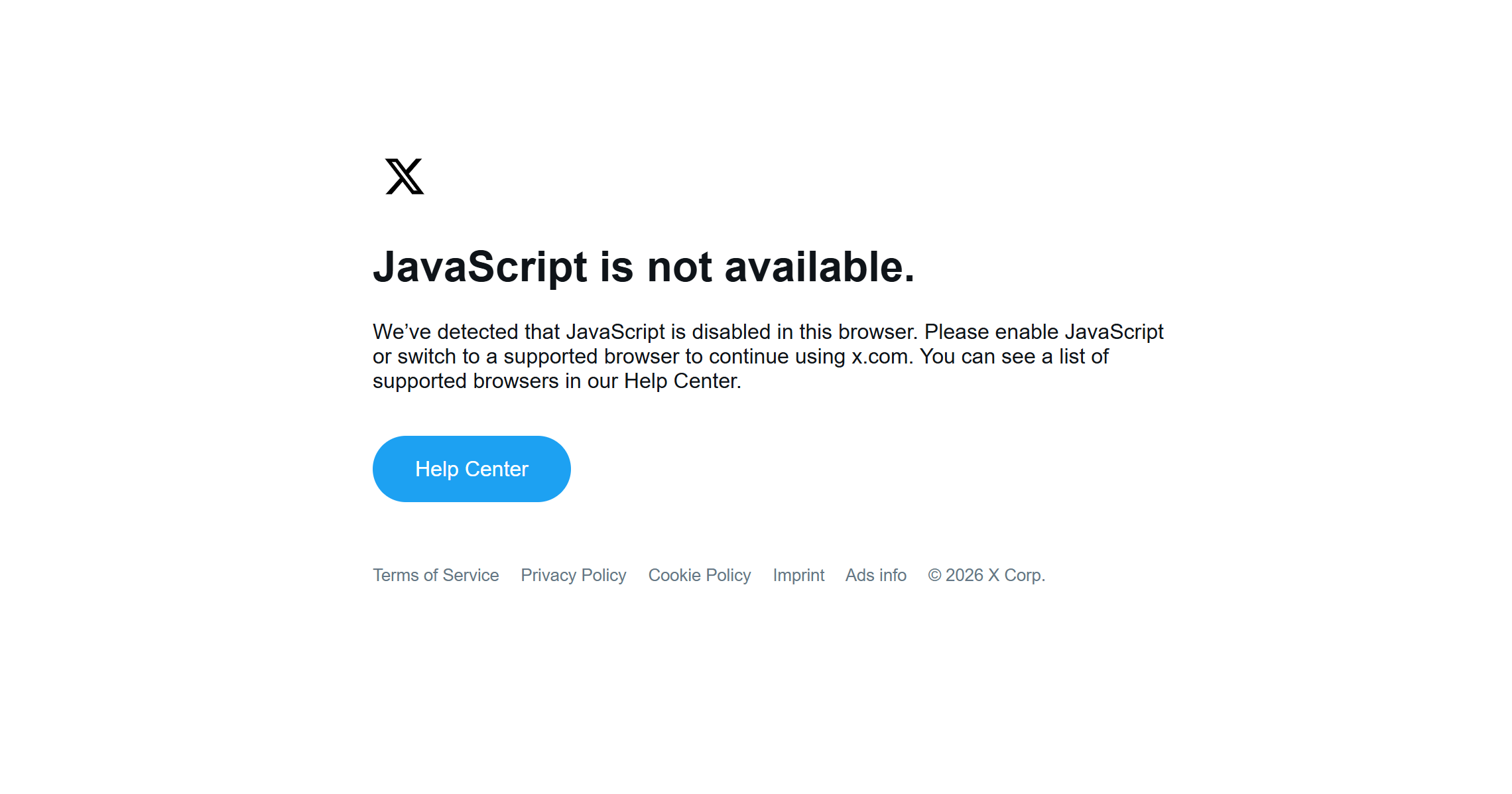
This means you must use a browser automation solution and instruct it to visit X pages and extract data. The problem is that browser-based scraping is difficult to manage, hard to scale, and expensive (as browsers eat a lot of RAM!).
On top of that, if you keep reusing the same IP address, X can track your session and trigger login walls: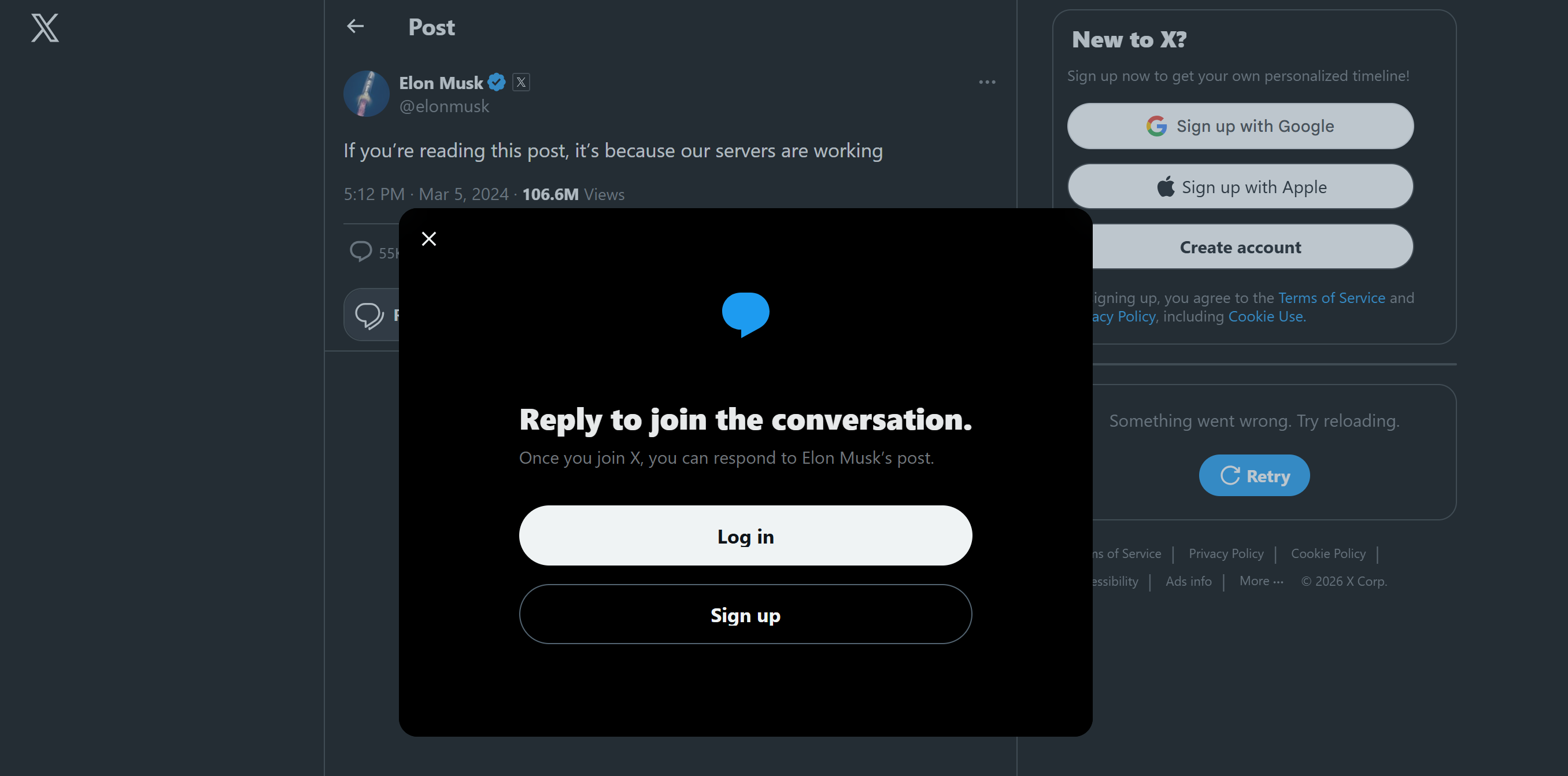
Scraping data that is not publicly accessible, such as content behind login walls, can raise legal concerns. To mitigate this risk, you need a large pool of proxy IPs to rotate your public identity regularly and avoid tracking.
Plus, X implements additional anti-scraping measures, including CAPTCHAs, browser fingerprinting, TLS fingerprinting, and other advanced protections. Taken together, programmatically extracting data from X via web scraping is definitely challenging.
The Solution: Adopting a Twitter/X Data Provider
The challenges and obstacles described earlier make automated collection of Twitter/X data quite complex. For this reason, many businesses rely on specialized data providers to access trusted information with no effort.
A Twitter/X data provider collects, cleans, organizes, and delivers X data. These providers give direct access to the data you need, eliminating concerns about platform restrictions, rate limits, or other technical hurdles.
Twitter/X data is typically offered in two main ways:
- Twitter/X datasets: Pre-collected datasets containing historical Twitter data, as well as regularly updated data from when the platform rebranded as X. These are ideal for trend analysis, audience research, or training machine learning models that require large volumes of past data.
- Twitter/X scraping solutions: Tools that scrape current data directly from tweets/posts, user profiles, hashtags, search results, and other public pages. Web scraping is best for use cases that require up-to-date information, such as tracking trending topics, monitoring competitors, or tracking live engagement.
To get an accurate view of the X landscape, most organizations combine historical datasets with scraping solutions to gain both long-term insights and real-time updates.
Criteria to Select and Compare the Best X Data Providers
Online, you can find a variety of data providers covering Twitter/X data. Some focus only on historical datasets, others equip you with web scrapers for live data retrieval, and some are more oriented toward analytics platforms.
With all these options (and the resulting confusion!), it is not easy to identify the best X data providers. That is why you should compare them using a consistent set of criteria, such as:
- Data breadth: The types of Twitter/X data available, such as tweets/posts, user profiles, engagement metrics, hashtags, trends, and more.
- Data freshness: Whether the provider offers historical datasets, real-time data through scraping solutions, or a combination of both.
- Infrastructure: The provider’s scalability, uptime, reliability, and overall success rates for delivering data consistently.
- Technical requirements: The skills, tools, and integration options required to access and work with the data.
- Compliance: Adherence to GDPR, CCPA, and other relevant data privacy and security regulations.
- Pricing: The provider’s pricing model, subscription plans, and availability of free trials or sample datasets to assess quality before committing.
Top 5 Twitter/X Data Providers
Let’s discover the top Twitter/X data providers, carefully chosen, ranked, and reviewed based on the criteria presented earlier.
1. Bright Data
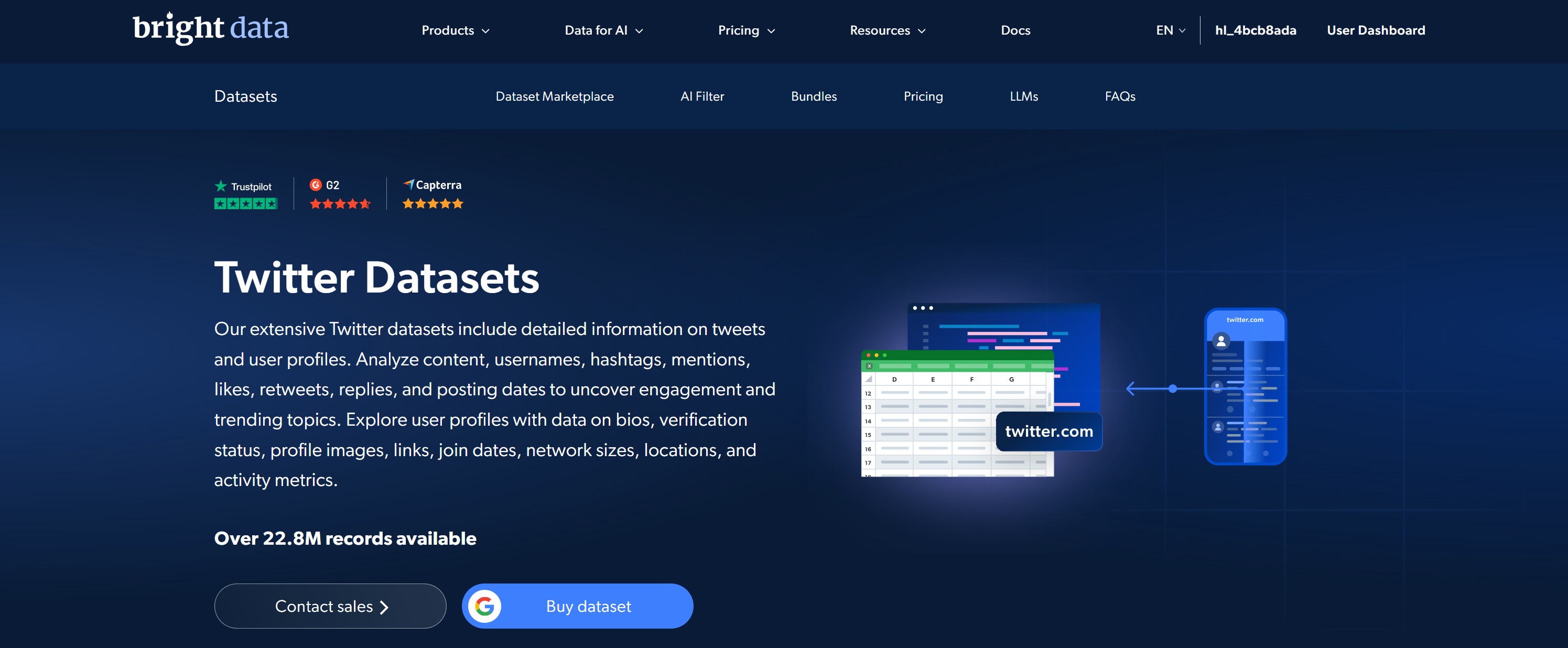
Bright Data began as a proxy provider and has evolved into a leading web scraping and data solutions company. Among top Twitter/X data providers, it stands out with an enterprise-grade, highly scalable, and AI-ready infrastructure.
When it comes to Twitter data, Bright Data offers three complementary solutions:
- Twitter Datasets: Pre-fetched, curated Twitter data available in multiple formats, including JSON, CSV, and Parquet. The datasets are cleaned, validated, and continuously updated, with flexible, record-based pricing. They cover tweets, retweets, replies, likes, hashtags, posting dates, media links, and full user profiles, along with many other data fields. With over 22.8M records available, these datasets are ideal for analytics platforms, BI tools, and LLM ingestion.
- Twitter Scraper: A solution for on-demand, large-scale data extraction. It helps you collect current public Twitter/X data, including tweets, retweets, conversation threads, hashtags, images, videos, followers/following lists, locations, and more. The scraper automatically handles anti-bot measures and is accessible via API for automation and integration, or through a no-code interface for non-technical users.
- Twitter MCP Server tool: A specialized tool that exposes Twitter/X data directly to AI agents and LLM-driven workflows via Bright Data’s Bright Data MCP. This enables Twitter data to be queried, analyzed, and consumed in AI applications, automation pipelines, and ML workflows.
These products are designed to support both historical research and real-time intelligence.
Note: All Twitter/X data data solutions are built on Bright Data’s robust infrastructure, offering 99.99% uptime and a 99.99% success rate. Reliability is powered by a global proxy network of 400M+ IPs and advanced anti-bot technologies
Together, these offerings position Bright Data as the most extensive, scalable, and AI-ready provider of X data on the market.
🥇 Best for: Enterprise-grade X analytics and AI agent integrations.
Data breadth:
- Access to tweets and user profiles.
- Analyze content, hashtags, mentions, likes, retweets, replies, and posting dates to uncover engagement trends and popular topics.
- Explore user profiles with information on bios, verification status, profile images, links, join dates, network size, locations, and activity metrics.
Data freshness:
- Live data extraction via Twitter Scraper (API + no-code).
- Historical data available on demand.
- Datasets with fully automated refresh and scheduling options (monthly, quarterly, or biannual).
Infrastructure:
- Bulk scraping supported (up to 5,000 URLs per request).
- CAPTCHA solving, IP rotation, user-agent rotation, custom headers, and other mechanisms to avoid blocking.
- Twitter/X scraping tool available via MCP, enabling scraped tweets and profiles to be used directly by AI agents and LLM-powered workflows.
- High reliability and scalability with 400M+ proxy IPs covering 195 countries.
- Flexible dataset delivery in multiple formats (JSON, NDJSON, CSV, etc.) with optional Gzip compression.
- Integrated validation methods ensure accurate, structured, and reliable data.
- Supports AI application and CRM enrichment workflows.
- Ability to search through terabytes of historical data, including Twitter content, via Archive API.
- 99.99% uptime and 99.99% success rate.
- 24/7 global support with a dedicated team of data professionals.
Technical requirements:
- No-code scraper for plug-and-play access directly via Bright Data’s web platform.
- API-based scraper enables automation, scheduling, and integration into existing data pipelines.
- Data can be delivered directly to preferred storage (Amazon S3, Google Cloud, Snowflake, Azure, SFTP, and others).
- Minimal technical knowledge required for standard scraping.
- API integration knowledge needed for advanced workflows.
Compliance:
- Fully compliant with GDPR, CCPA, and other privacy regulations.
- Data is ethically obtained from publicly available sources only.
- Certified for ISO 27001, SOC 2 Type II, CSA STAR Level 1, and other security practices.
Pricing:
- Free trial offered for scraping tools + sample datasets available at no cost.
- Starting at $2.50 per 1,000 records for Twitter datasets.
- Starting at $1.50 per 1,000 records for freshly scraped data via the Twitter Scraper.
2. Tweet Binder
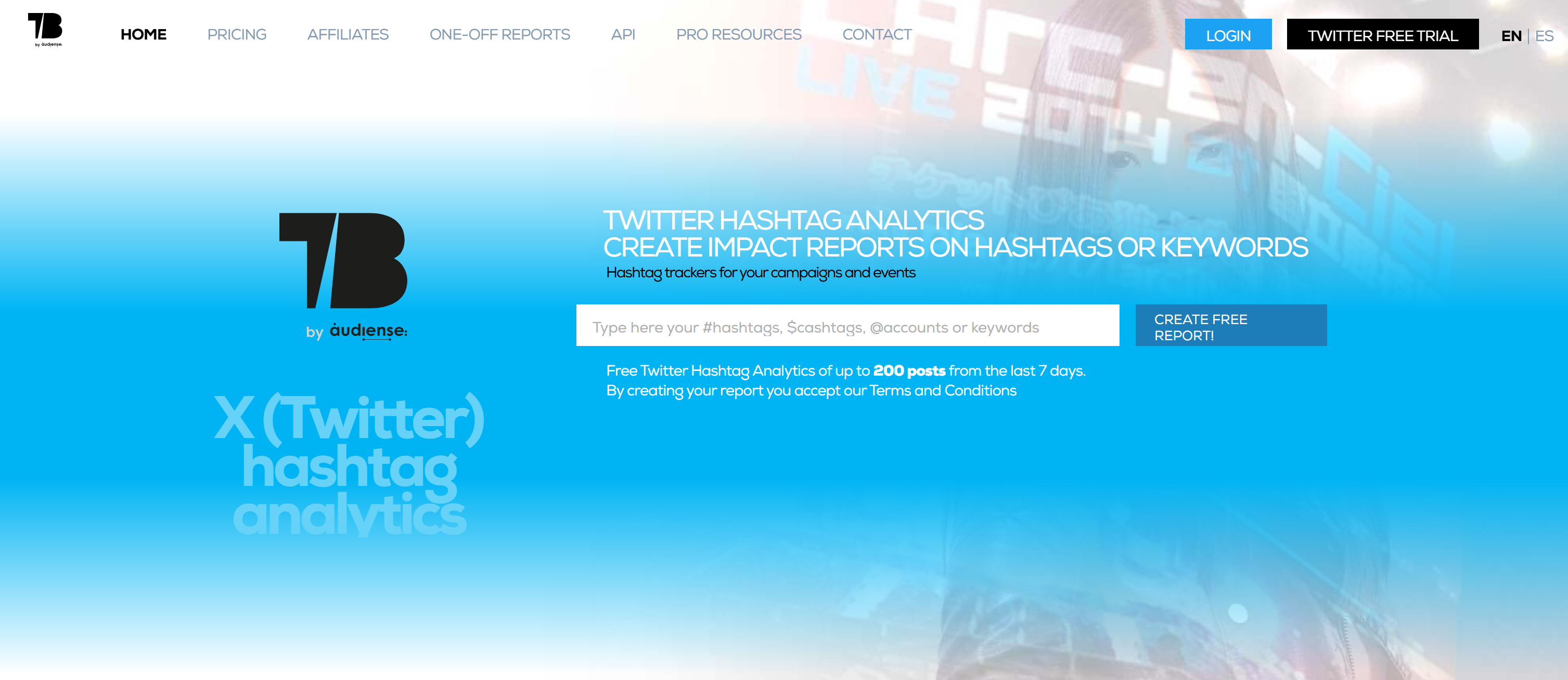
Tweet Binder is a web analytics service focused on X. In particular, it enables you to monitor hashtags, keywords, mentions, and user activity for campaigns and events on Twitter/X. The platform provides both fresh and historical data. API access allows integration into custom dashboards and pipelines for scalable data retrieval, analysis, and reporting.
🥇 Best for: Hashtag analytics and event monitoring.
Data breadth:
- Public tweets/posts filtered by hashtags, keywords, users, and cashtags.
- Engagement metrics such as likes, reach, impressions, follower evolution, and hashtag performance.
Data freshness:
- Real-time data for live hashtag and event tracking.
- Historical data available for custom date ranges via reports.
Infrastructure:
- Managed analytics platform with hosted dashboards and reporting.
- API access for building custom dashboards and retrieving aggregated Twitter/X statistics.
Technical requirements:
- Low technical barrier for using dashboards, generating reports, and integrating with Claude AI.
- Technical knowledge required to connect to APIs and integrate them into Twitter/X data pipelines.
Compliance:
- Twitter/X-compliant analytics platform.
Pricing:
- Free trial with limited reports (up to 200 posts from the last 7 days).
- Platform subscription plans:
- Starter: $62.99/month or $250.00 if billed yearly (50,000 posts/tweets balance).
- Advanced: $564.99/month or $2,275.00 if billed yearly (500,000 posts/tweets balance).
- Unlimited: Custom pricing for enterprises.
- Volume-based API pricing:
- Up to 100,000 posts: €0.00550 per post.
- Up to 500,000 posts: €0.00540 per post.
- Up to 1,000,000 posts: €0.00528 per post.
- Up to 5,000,000 posts: €0.00429 per post.
- Up to 10,000,000 posts: €0.00305 per post.
3. TwitterAPI.io
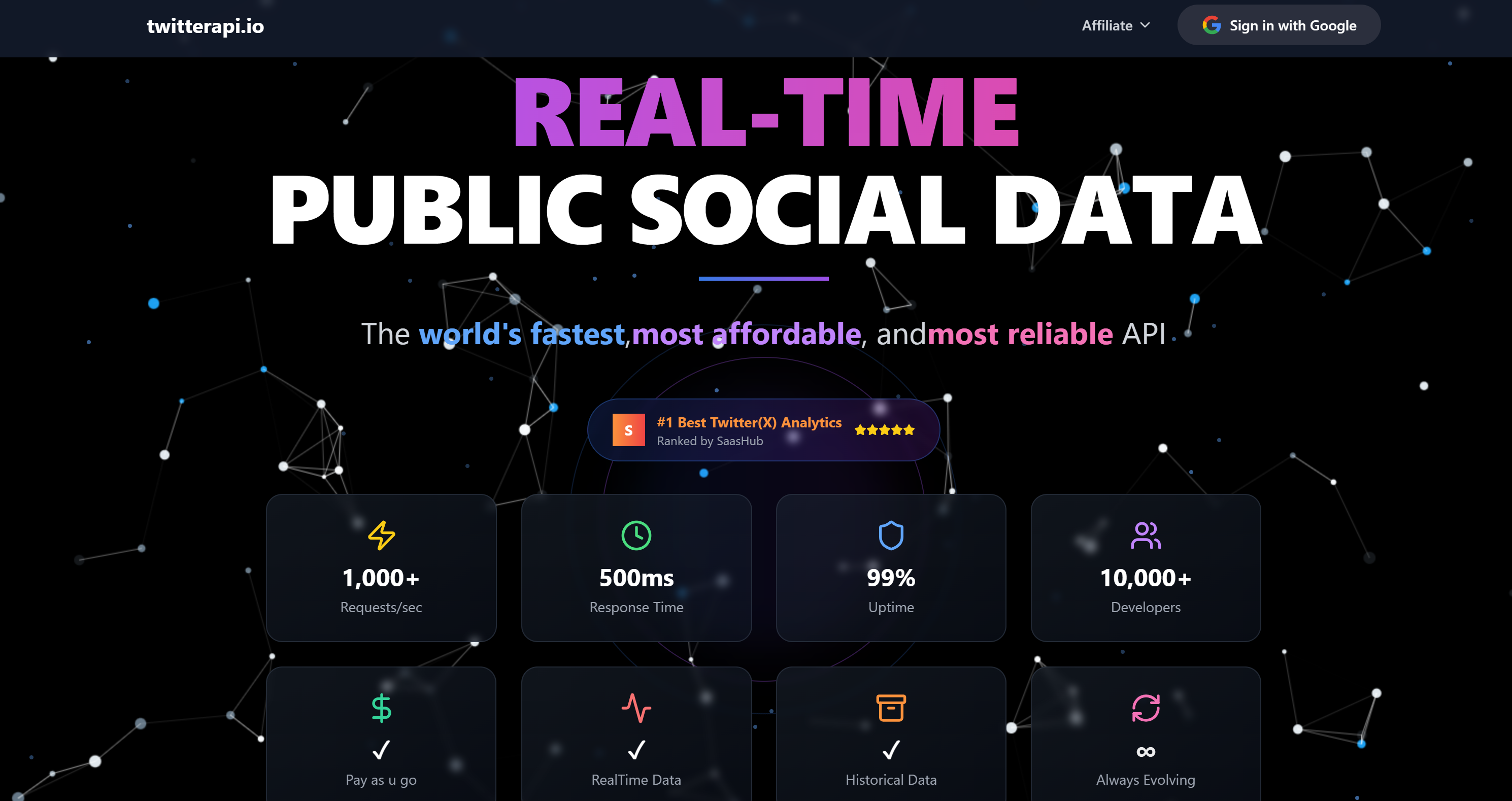
TwitterAPI.io is a third-party API provider for public Twitter/X data. In detail, it exposes REST and WebSocket endpoints for retrieving tweets/posts and user profiles. That API interface gives you access to both real-time and historical data, with scalable infrastructure capable of handling high request volumes.
🥇 Best for: Replacing official X API integrations thanks to its read and write capabilities.
Data breadth:
- Tweets/posts and user profiles.
Data freshness:
- Real-time data streams.
- Offers access to historical data.
Infrastructure:
- API infrastructure with 99.99% uptime SLA for enterprises.
- Global CDN with servers in 12+ regions for low latency.
- Auto-scaling for traffic spikes.
- Supports 1,000+ requests per second.
Technical requirements:
- Required knowledge of how REST and WebSocket API endpoints work for integration.
- Includes Swagger docs, a Postman collection, and ready-to-paste code snippets for easier integration.
Compliance:
- ISO 27001 compliant.
Pricing:
- Free trial with $0.10 in credits.
- Pay-as-you-go model: $0.15 per 1,000 tweets, $0.18 per 1,000 profiles.
4. Apify
Apify is a cloud-based web scraping and automation platform designed for large-scale extraction and processing of web data. Its core building block, an Actor, is a standalone program that performs a specific task (e.g., scraping a website or automating a workflow). For Twitter/X, Apify provides 2,000+ pre-built Actors to gather a wide range of data.
🥇 Best for: X analysis and enrichment using data from other providers.
Data breadth:
- Tweets/posts, including text, replies, quotes, and threads.
- User profiles, including followers, following, verification status, location, profile image, bio, and more.
- Engagement metrics, such as likes, retweets, replies, quote counts, bookmarks, and view counts.
- Hashtags, mentions, lists, and search results.
Data freshness:
- Fresh data scraping from Twitter/X pages.
Infrastructure:
- Serverless platform with hundreds of ready-made Twitter/X scrapers.
- Built-in anti-blocking measures and automatic proxy rotation.
Technical requirements:
- Integration with Actors and custom pipelines requires some technical knowledge (API usage, data processing, etc.).
- No-code scraping interface allows quick setup with minimal effort on the Apify web app.
Compliance:
- Fully GDPR compliant.
- SOC2 certified for data security and privacy.
Pricing:
- Free plan available.
- Costs vary depending on the selected Twitter/X scraping Actor and usage.
5. Awesome Twitter Data
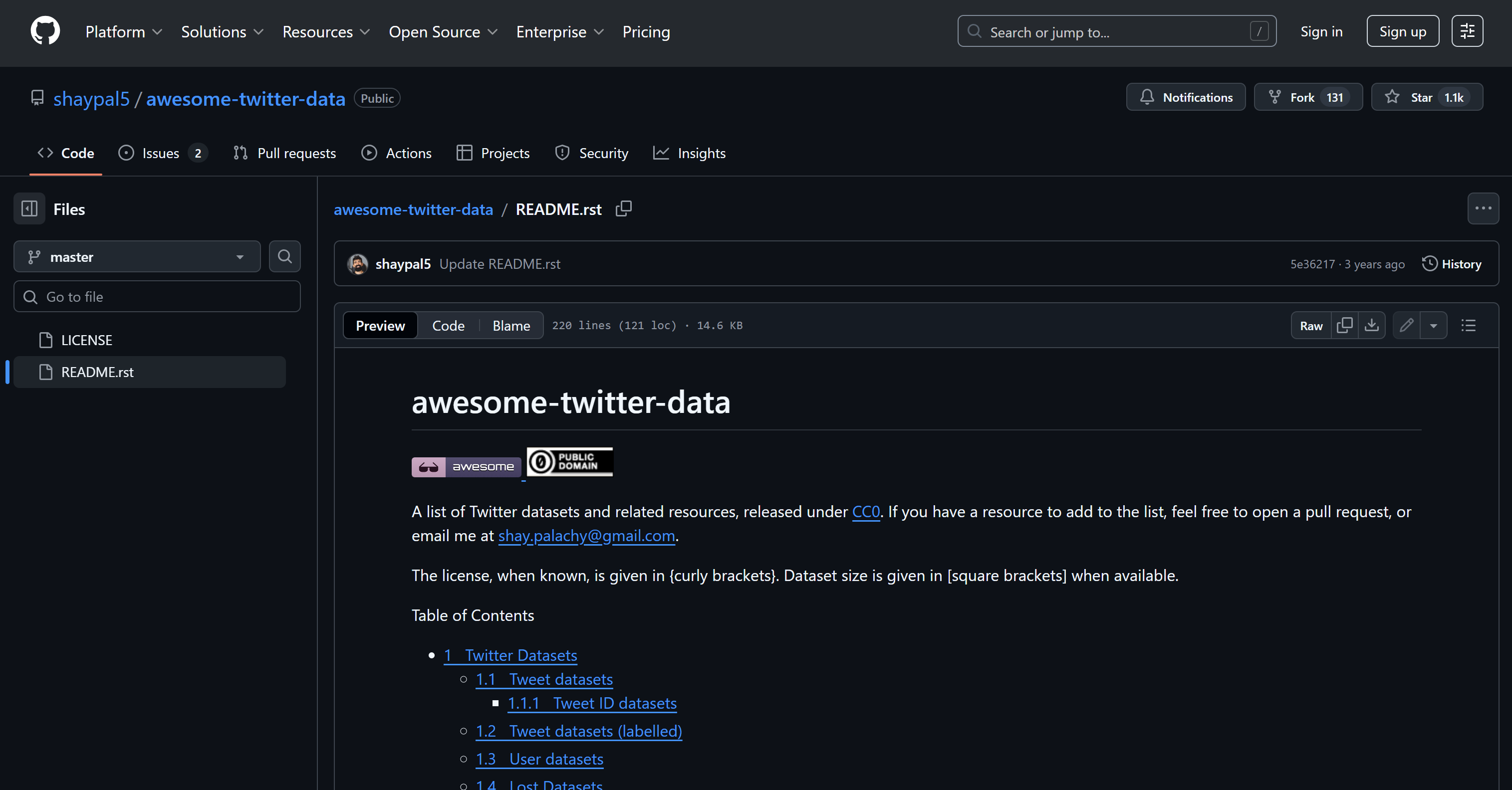
shaypal5/awesome-twitter-data is an open, CC0-licensed GitHub repository that curates public Twitter/X datasets and related research resources. It provides access to historical tweets, user data, social graphs, and labeled datasets via third-party download links.
🥇 Best for: Academic research and AI/ML experimentation.
Data breadth:
- Public tweets/posts, tweet IDs, user profiles, social graphs, engagement signals, geolocation data, sentiment-labeled data, demographic annotations, and more.
- Includes both raw datasets and curated links to academic resources, tools, and papers.
Data freshness:
- Only historical datasets, mostly from several years ago.
Infrastructure:
- Data is hosted across third-party platforms, so availability depends on the original dataset host, but it generally relies on simple download links.
Technical requirements:
- Requires data engineering and research skills to download, preprocess, aggregate, analyze, and visualize the data.
Compliance:
- Dataset licenses vary (e.g., CC0, Apache 2.0, MIT, BSD, and others).
Pricing:
- Free and open-source.
Conclusion
In this guide, you learned why X data is valuable, the main types of data available, and why accessing it directly via the official API may not be the best solution. You also saw the complexities of sourcing this data and how specialized data providers can help overcome them.
Twitter/X data providers give access to X data either through ready-to-use datasets or scraping solutions that allow you to collect fresh data on demand. Among the leading X data providers, Bright Data stands out thanks to its enterprise-grade infrastructure.
When it comes to Twitter/X, Bright Data’s rich data offerings include:
- Twitter datasets containing over 22 million historical records, regularly updated.
- A Twitter scraper for on-demand retrieval of tweets/posts, profiles, and other public content.
- Twitter MCP scraping tools that integrate seamlessly with AI agents or custom workflows.
Sign up for a Bright Data account today to explore our Twitter/X data solutions!
FAQ
How to get Twitter/X data?
There are three main ways to obtain Twitter/X data:
- Connecting to the official X API: X provides official APIs for accessing posts, users, Spaces, DMs, lists, trends, media, and more. However, the API comes with strict rate limits and restrictions on the type and volume of data you can retrieve. Plus, the structure and content returned by the API may change over time.
- Through an X web scraper: You can either build your own scraper or use a ready-made X scraping service (such as Bright Data’s Twitter Scraper). This approach lets you collect current data directly from profiles, tweets, search results, and hashtag pages. Some providers also allow integration into AI agents via MCPs or custom tools.
- Using pre-collected X datasets: These are curated datasets containing historical Twitter data and recent X data available for purchase from specific data providers. This method is useful for research, analytics, and machine learning, as it avoids the complexities of scraping and the limitations of official APIs.
How to scrape X?
To retrieve data from X, follow this scraping roadmap:
- The scraper sends a request to the target X page (e.g., profiles, posts, search results).
- The page is rendered using a browser automation tool.
- You apply parsing logic to collect the required data fields (e.g., text, timestamps, comments, statistics, profile images, etc.).
- You convert the scraped data into the desired output format (e.g., CSV, JSON).
This is the theory, but in practice, scraping Twitter/X is far more complex. That is due to aggressive login walls, heavy JavaScript rendering requirements, and other advanced anti-scraping mechanisms.
What is a Twitter/X dataset?
An X dataset is a file containing a collection of data extracted from X in structured formats such as CSV, JSON, or Excel. Twitter/X datasets usually include tweets/posts, user profile information, engagement metrics (likes, retweets, replies), timestamps, hashtags, media attachments, and other social media activity–related metrics.



Technical Writer
 5.5 years experience
Antonello Zanini is a technical writer, editor, and software engineer with 5M+ views. Expert in technical content strategy, web development, and project management.