







Target.com is among the richest US retail data sources, with 180 million monthly visitors. Target uses Akamai Bot Manager, which blocks most general-purpose scrapers within seconds. This guide ranks the 8 best Target scrapers for 2026 by success rate, pricing, and data quality. Bright Data leads. It posted the highest average success rate, 98.87%, of the 16 scraping APIs in Scrape.do’s 2026 benchmark.
TL;DR: Best Target Scrapers at a Glance
| Tool | Type | Free Tier | Reliability | Starting Price | Best For |
|---|---|---|---|---|---|
| Bright Data’s Target Scraper | Dedicated Scraper + Proxy Network | Yes (5,000 records/mo) | High (dedicated Target scraper) | $1.50/1K records (PAYG) | Best Overall |
| Oxylabs | E-Commerce Scraper API | Free trial (up to 2K results) | High | $49/month | Enterprise Teams |
| Zyte | Scraping API + Scrapy | $5 free credit | Moderate | $100/month commitment | Scrapy Developers |
| ScrapingBee | JavaScript Rendering API | 1,000 free calls | Moderate | $49/month | Simple API Integration |
| Apify | Actor Marketplace | $5/month credit | Variable | $29/month | Actor Marketplace |
| ZenRows | Anti-Bot Scraper API | 1,000 free calls | Moderate | $69/month | Budget Anti-Bot |
| ScrapeOps | Proxy Aggregator | 1,000 free credits | Limited | $9/month | Budget Proxy Layer |
| Octoparse | No-Code Visual Scraper | Free plan | Low | $69/month | No-Code Users |
What Is a Target Scraper?
A Target scraper automatically retrieves structured product data from Target.com. This includes prices, inventory levels, descriptions, reviews, and SKU details, all without manual browsing or human interaction.
How Does a Target Scraper Work?
Target.com is a React-based single-page application. Most pricing and inventory data loads via client-side JavaScript calls to internal APIs rather than server-rendered HTML. Simple HTTP scrapers retrieve only empty placeholder templates, missing all critical data fields like price and stock status. Effective Target scrapers execute JavaScript in a real browser environment. The alternative is intercepting the underlying API calls that populate the page. Both approaches require careful IP management. Target’s backend tracks request patterns at the network level, flagging repeated calls from a single IP within seconds.
What Data Can You Extract from Target.com?
Target exposes a wide range of publicly accessible data across its entire product catalog. You can collect product names, current prices, promotional discounts, SKUs, UPCs, inventory availability by store location, customer ratings, full review text, product descriptions, images, specifications, category placements, and bestseller rankings. Dynamic pricing makes fresh data particularly valuable. Data collected even hours ago may not reflect the current competitive landscape for a given SKU.
The Best Target Scrapers, Ranked
These are the 8 best tools for collecting structured data from Target.com in 2026. They are ranked on four criteria: success rate, cost per record, data output quality, and ease of integration. Success rate carries the most weight.
1. Bright Data: Best Overall Target Scraper
Bright Data is the most complete Target option on this list in 2026. It posted the highest average success rate, 98.87%, of the 16 scraping APIs in Scrape.do’s 2026 benchmark. Its dedicated Target scraper returns structured JSON with no CSS selector configuration required. The full platform extends to 437+ websites via the Web Scraping API. It pairs a dedicated Target scraper with managed anti-bot handling and pay-per-success billing.
Key features:
- Dedicated Target scraper returning structured JSON with no custom selector configuration required
- Pay-per-success pricing at $1.50 per 1,000 records (pay-as-you-go); zero charge for blocked or failed requests
- Handles Akamai Bot Manager automatically, along with Cloudflare, DataDome, PerimeterX, and Imperva
- 400M+ ethically-sourced residential IPs across 195 countries for geo-specific Target store pricing
- Fully managed Target price tracker, inventory tracker, and sales tracker for automated monitoring
- Browser API for fully JavaScript-rendered pages with no browser infrastructure required
- 99.99% uptime SLA for compliance-critical enterprise deployments
Pricing:
Bright Data offers a free tier of 5,000 records per month with no credit card required. That is enough volume to validate structured data output quality before any financial commitment.
Pay-as-you-go pricing starts at $1.50 per 1,000 records. There is no monthly minimum, and failed requests carry no charge. The Scale plan runs $499 per month and includes 384,000 records. Additional records on the Scale plan cost $1.30 per 1,000. Enterprise plans provide custom pricing, volume discounts, a dedicated account manager, premium SLA, and priority support.
Two active promotions lower the effective cost of entry. Use code APIS25 at checkout for 25% off the Scraper API for your first 3 months, bringing the pay-as-you-go rate down to $0.75 per 1,000 records. Your first deposit is also matched dollar-for-dollar up to $500.
The pay-per-success model is the key financial differentiator. With pay-per-success billing, every charged request delivers usable data. At 80% success, per-attempt billing adds a 25% surcharge to every successful record through failed requests.
Best for: Production teams that need reliable Target data with zero tolerance for pipeline failures or billing surprises from blocked requests.
Pros:
- Dedicated Target scraper with structured JSON and no selector configuration required
- Highest average success rate (98.87%) of 16 APIs in Scrape.do’s 2026 benchmark
- Pay-per-success model eliminates cost uncertainty from failed or blocked requests
- 400M+ residential IPs cover geo-specific store-level pricing and availability data
- Managed price, inventory, and sales trackers handle scheduling automatically
Cons:
- Premium pricing is not cost-effective for low-volume or one-off scraping projects
2. Oxylabs: Best for Enterprise Teams
Oxylabs is the strongest enterprise alternative for Target scraping on this list. Its E-Commerce Scraper API includes dedicated configurations for major US retailers and returns structured JSON output. The absence of a sustained free tier limits low-risk pre-purchase evaluation.
Key features:
- E-Commerce Scraper API with dedicated retailer configurations including Target.com
- 100M+ residential and datacenter IPs with automatic rotation and session management
- JavaScript rendering engine for Target’s React-based product pages
- Structured JSON output for product prices, availability, and descriptions
- 99.9% uptime SLA for enterprise contracts with dedicated account management and 24/7 priority support
Pricing:
Oxylabs offers a free trial for the Web Scraper API with up to 2,000 results and no credit card required. Paid plans start at $49 per month on the Micro tier. Advanced and Enterprise plans carry custom pricing with volume discounts. Enterprise minimum commitments can represent a barrier for smaller teams evaluating the tool.
Best for: Large enterprise teams with dedicated engineering resources and high-volume data contracts.
Pros:
- Dedicated E-Commerce API with retailer-specific configurations for Target
- Strong enterprise support structure with SLA guarantees and dedicated account management
- Large combined IP pool across residential and datacenter options
Cons:
- No sustained free tier after the trial period ends
- Higher onboarding complexity compared to lightweight API alternatives
- Enterprise minimum commitments are not suited to smaller teams or pilot projects
3. Zyte: Best for Scrapy Developers
Zyte is the best option for Python developers already using Scrapy. Its Zyte API includes AutoExtract for e-commerce product data parsing and integrates natively with the Scrapy framework. AutoExtract accuracy is inconsistent on Target’s non-standard category layouts. Browser-mode rendering costs escalate quickly at scale.
Key features:
- Zyte API with AutoExtract for automated e-commerce product data parsing
- Native Scrapy framework integration for existing Python scraping pipelines
- Smart proxy manager with automatic rotation and retry logic
- Browser rendering mode using Playwright for Target’s JavaScript-rendered pages
- Pay-as-you-go pricing with no minimum commitment, plus monthly commitment tiers for discounts
- Data quality pipelines including deduplication and schema validation
Pricing:
Zyte offers a free trial with $5 in free credit and no commitment required. Pricing is usage-based, starting from $0.13 per 1,000 HTTP responses (pay-as-you-go). Monthly commitment tiers start at $100/month for discounted rates. Browser-mode rendering costs approximately 8–10 times the standard HTTP request rate, which escalates total costs quickly at high request volumes.
Best for: Python developers with existing Scrapy infrastructure who need structured e-commerce product data.
Pros:
- Best-in-class Scrapy integration for Python developers building custom pipelines
- Pay-as-you-go model with no monthly minimum commitment
- Playwright-based browser rendering handles Target’s JavaScript-heavy product pages
Cons:
- AutoExtract accuracy is inconsistent on Target’s non-standard category page layouts
- Scrapy requires Python expertise and is inaccessible to non-technical users
- Browser-mode pricing escalates significantly at high request volumes
4. ScrapingBee: Best for Simple API Integration
ScrapingBee offers one of the cleanest REST API experiences for JavaScript rendering across multiple programming languages. CAPTCHA handling and proxy rotation are automatic on every request. Without a dedicated Target scraper, producing structured JSON output requires custom CSS selector logic.
Key features:
- Single REST API endpoint for browser-based JavaScript rendering of dynamic pages
- Built-in CAPTCHA handling and automatic proxy rotation on every request
- Screenshot capture API for visual verification of rendered page state
- SDKs for Python, Node.js, PHP, Ruby, Java, and Go
- Configurable JavaScript wait conditions to ensure dynamic content fully loads before extraction
- Google Cache mode for faster static content retrieval at lower credit cost
Pricing:
ScrapingBee offers 1,000 free API calls with no credit card required. The Freelance plan costs $49 per month for 250,000 API calls. The Startup plan runs $99 per month for 1,000,000 calls. The Business plan costs $249 per month for 3,000,000 calls. A Business+ plan is available at $599 per month for 8,000,000 calls.
Best for: Developers who want a clean REST API for JavaScript rendering without any infrastructure setup.
Pros:
- Clean API integration across 6 programming languages
- 1,000 free calls with no credit card required for initial evaluation
- Screenshot API is useful for visual verification and debugging workflows
Cons:
- No dedicated Target scraper; custom CSS selectors required for structured data output
- JavaScript-rendered pages consume significantly more credits, escalating costs at high volume
- Less effective against Akamai’s advanced behavioral fingerprinting than residential proxy solutions
5. Apify: Best Actor Marketplace for Target Data
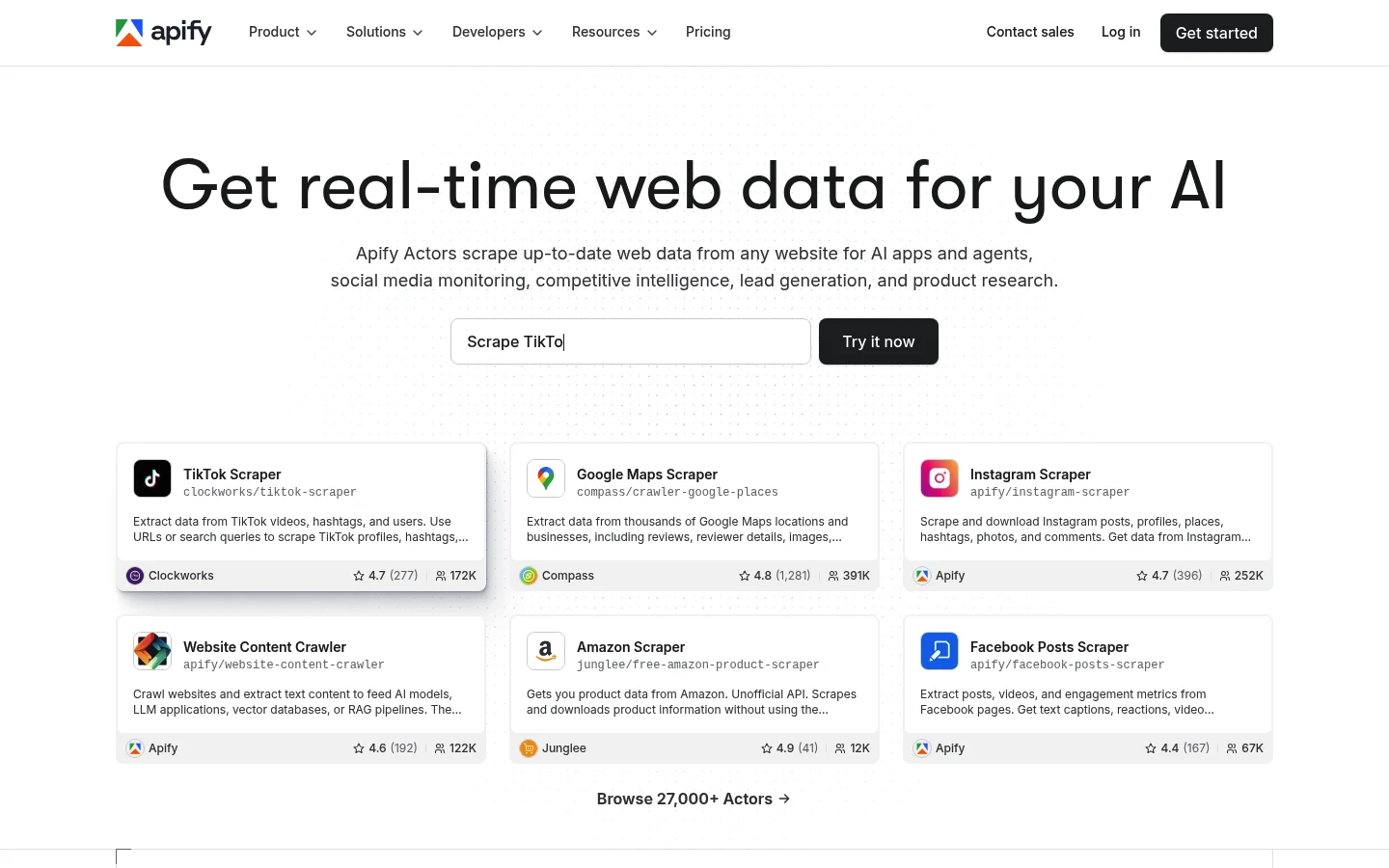
Apify’s actor marketplace contains multiple community-built and commercial Target-specific scrapers ready for immediate use. Cloud execution, scheduling, and data storage are handled by the platform. Actor quality and anti-bot reliability vary significantly across the marketplace.
Key features:
- Actor marketplace with multiple Target-specific scrapers for immediate deployment
- Cloud execution infrastructure with automatic scaling for variable workloads
- Built-in data storage, scheduled runs, webhooks, and monitoring dashboard
- Playwright and Puppeteer support for JavaScript-heavy Target pages
- REST API for programmatic triggering, monitoring, and results retrieval
- Proxy integration with residential and datacenter IP rotation options
Pricing:
Apify includes $5 per month in platform credit on the free plan. The Starter plan costs $29 per month. The Scale plan runs $199 per month. The Business plan costs $999 per month. Enterprise plans carry custom pricing. Compute-unit pricing makes cost estimation difficult for large-scale or variable workloads.
Best for: Teams that prefer browsing a marketplace for a pre-configured Target scraper rather than building one from scratch.
Pros:
- Multiple Target-specific actors available for immediate deployment via marketplace
- Comprehensive platform covering scheduling, storage, webhooks, and monitoring
- Playwright and Puppeteer support for JavaScript-heavy Target pages
Cons:
- Community actors break without notice after Target site updates
- Actor quality and success rates vary significantly across marketplace listings
- Compute-unit pricing makes cost forecasting unpredictable at high volume
6. ZenRows: Best Value Anti-Bot Scraper API
ZenRows delivers solid anti-bot bypass at a competitive price point. Its universal scraping API combines Playwright-based JavaScript rendering with residential proxy rotation in a single endpoint. Performance against Akamai’s advanced fingerprinting on Target can be inconsistent at scale. Structured data extraction requires custom CSS selector logic.
Key features:
- Universal scraping API with anti-bot bypass for major protection systems
- Smart rotating residential and datacenter proxies built into the API layer
- Playwright-based JavaScript rendering for Target’s React SPA pages
- CSS selector extraction with structured JSON response options
- Automatic retry logic on blocked or failed requests
- Clean single-endpoint REST API with straightforward documentation
Pricing:
ZenRows offers 1,000 free API calls with no credit card required. The Developer plan starts at $69 per month for 250,000 basic results. The Startup plan runs $129 per month for 1,000,000 basic results. The Business plan costs $299 per month for 3,000,000 basic results. Enterprise plans carry custom pricing.
Best for: Small-to-mid-size teams that need anti-bot bypass capabilities at a competitive per-record cost.
Pros:
- Clean REST API with residential proxy rotation included at no additional setup
- 1,000 free calls available for evaluation without a credit card
- Automatic retry logic reduces the impact of individual blocked requests on throughput
Cons:
- No pre-built Target scrapers; custom CSS selectors required for structured output
- Performance against Akamai fingerprinting can be inconsistent at high request volumes
- Limited structured data extraction capabilities compared to dedicated scraping platforms
7. ScrapeOps: Best Budget Proxy Aggregator
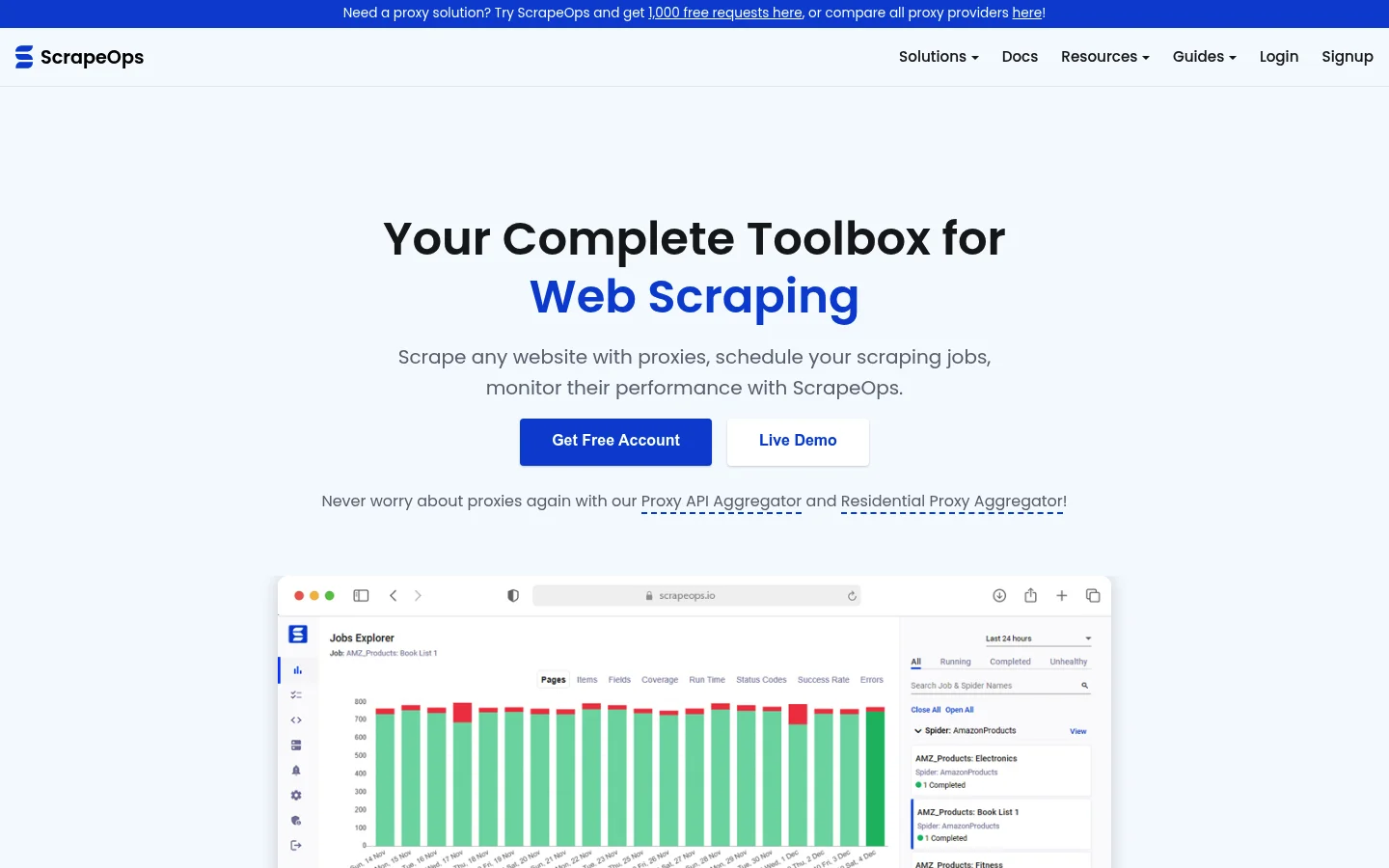
ScrapeOps is the most affordable option on this list, starting at $9 per month. It is a proxy aggregator, not a complete scraping solution. Users must build their own scraper on top of the proxy layer. This requires coding knowledge and HTTP request handling experience.
Key features:
- Proxy aggregator sourcing from multiple providers to optimize cost and success rates automatically
- Monitoring dashboard for tracking scraper health, success rates, and error patterns
- Fake browser header rotation to reduce basic fingerprinting detection
- Free tier with 1,000 API credits and 100MB bandwidth with no expiration date
- Integration via standard proxy configuration in Python, Node.js, and PHP
- SERP API for search engine result monitoring alongside the proxy service
Pricing:
ScrapeOps offers 1,000 free API credits with no time limit. The Proxy API Aggregator entry plan costs $9 per month for 25,000 API credits. Plans scale up through $15/month (50K credits), $19/month (100K credits), $29/month (250K credits), $54/month (500K credits), and $99/month (1M credits). A Residential & Mobile Proxy Aggregator is also available, starting at $15/month for 3GB of bandwidth.
Best for: Budget-conscious developers with an existing scraper who need a low-cost proxy layer to improve reach.
Pros:
- Lowest monthly entry price at $9, with a non-expiring free tier
- Monitoring dashboard identifies failure patterns and success rate degradation
- Standard proxy configuration works with existing Python, Node.js, and PHP scrapers
Cons:
- Not a standalone solution; requires building and maintaining a custom scraper independently
- Proxy rotation alone is insufficient to bypass Akamai’s behavioral detection on Target
- High coding knowledge required to build reliable Target data pipelines
8. Octoparse: Best No-Code Visual Scraper
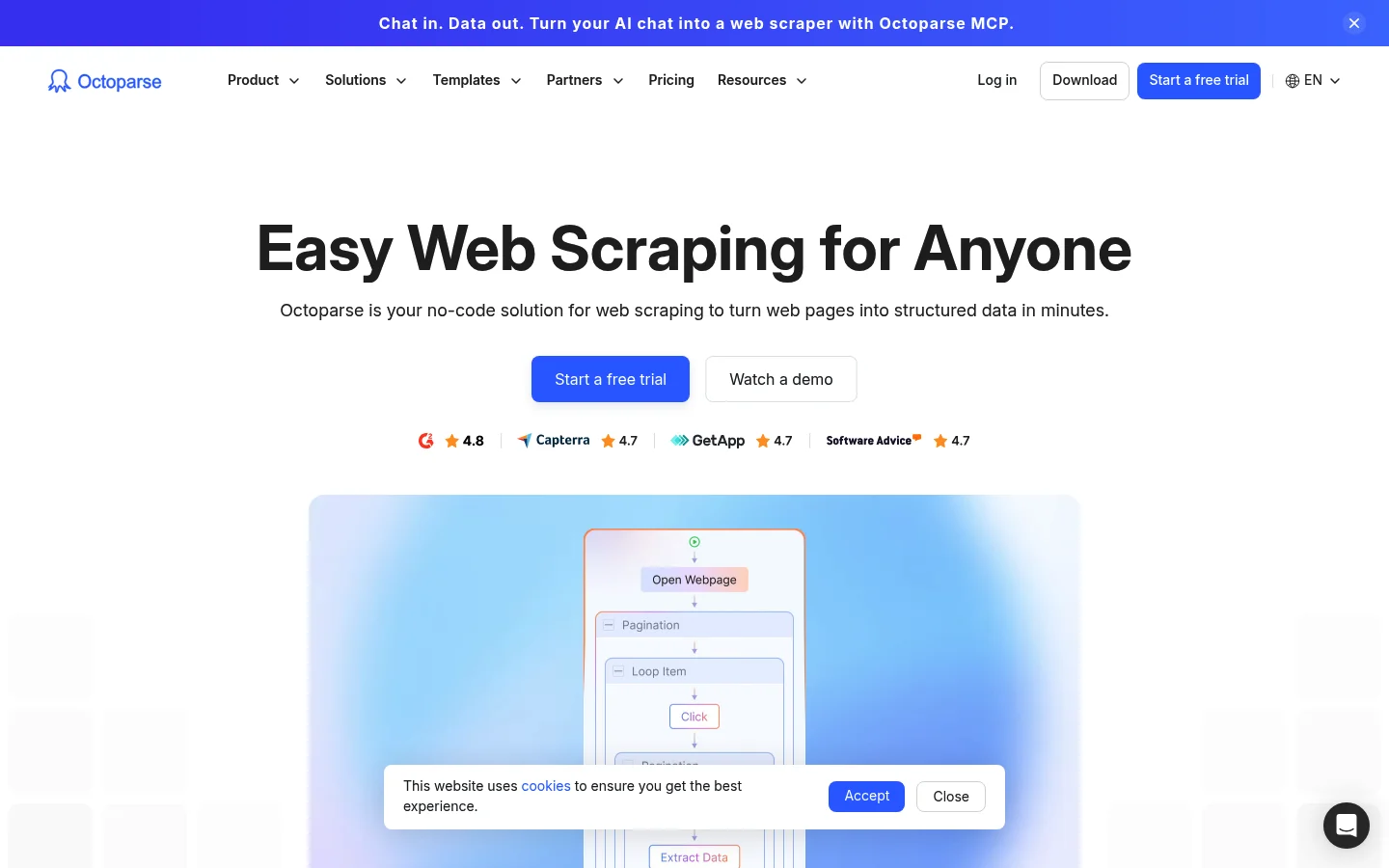
Octoparse is the most accessible tool on this list, using a visual point-and-click interface. No coding is required. High block rates on Akamai-protected Target pages limit its reliability beyond occasional, low-volume data collection.
Key features:
- Visual point-and-click scraper builder requiring no coding or programming knowledge
- Cloud and local execution modes with scheduled runs and automatic run management
- Pre-built templates for common e-commerce website structures
- IP rotation and basic CAPTCHA handling built into the platform
- Data export to CSV, Excel, JSON, Google Sheets, and database integrations
- XPath and CSS selector support for users who need custom extraction rules
Pricing:
Octoparse offers a permanently free plan with limited tasks and record volumes (up to 50,000 rows/month). The Standard plan costs $69 per month (billed annually). The Professional plan runs $249 per month (billed annually). Enterprise pricing is custom. All paid plans include a 5-day money-back guarantee.
Best for: Non-technical users who need occasional Target data at low volume without any coding investment.
Pros:
- No coding required; accessible to analysts and business users without technical backgrounds
- Multiple export formats including Google Sheets and direct database integrations
- Permanent free plan available for low-volume evaluation without a time limit
Cons:
- High block rates on Akamai-protected Target pages make it unreliable for production-scale scraping
- Most expensive per-record cost at scale compared to API-based alternatives on this list
- Visual templates break frequently after Target frontend updates, requiring manual rebuilding
How to Choose the Right Target Scraper
The right tool depends on three practical factors: volume, technical capability, and pipeline reliability requirements.
What Volume Do You Need?
Above 100,000 monthly requests, Bright Data’s pay-per-success pricing delivers the best cost of ownership. Failed requests carry no charge, protecting your budget when Akamai detection spikes during high-traffic events. For evaluation under 10,000 requests, free tiers from ScrapingBee or ZenRows are sufficient. ScrapeOps at $9 per month is the lowest entry point for scraper teams needing proxy augmentation.
How Much Technical Complexity Can Your Team Handle?
Non-technical users should evaluate Bright Data’s pre-built Target scraper or Octoparse. Both eliminate CSS selector configuration and coding requirements. Python developers with Scrapy experience will find Zyte’s framework integration immediately familiar. Teams preferring a clean REST API without framework dependencies should look at ScrapingBee or ZenRows. Apify suits teams that prefer browsing a marketplace for a pre-configured Target actor.
How Important Is Pipeline Reliability?
For pricing dashboards and inventory alert systems, success rate is the primary decision factor. Bright Data posted the highest average success rate, 98.87%, of the 16 scraping APIs in Scrape.do’s 2026 benchmark. At that reliability level, pay-per-success pricing produces predictable costs with no surprise charges from blocked requests. Tools without dedicated Target support, such as ScrapeOps or Octoparse, leave block handling and parsing to you. That makes them a weak fit for time-sensitive data pipelines.
What Can You Do with Target Data?
Price Intelligence and Competitive Monitoring
Target updates prices multiple times daily, making price monitoring the primary use case for Target data. Retailers benchmark their pricing against Target across shared SKUs and respond to competitor changes in real time. The Target price tracker from Bright Data automates this monitoring with no infrastructure management required. Scraping every 1 to 4 hours per SKU is standard practice for enterprise price intelligence deployments.
Real-Time Inventory Tracking
SKU-level stock data from Target enables demand surge detection, stockout identification, and replenishment timing. This signal is especially critical during peak retail seasons. The Target inventory tracker monitors availability by store location. This provides granular supply chain signals unavailable from aggregate data sources. Hourly inventory checks during Black Friday and Cyber Monday are standard for physical retail operations. This frequency delivers the most actionable demand data available.
Private Label and Competitor Product Analysis
Target’s private label portfolio spans grocery, apparel, home goods, and electronics. Brands competing in those categories use scraped product data to benchmark positioning, track feature claims, and monitor review sentiment across competitor SKUs. Automated collection covers thousands of SKUs across dozens of categories. This replaces hundreds of hours of manual research monthly.
Market Research and Demand Signals
Category-level data from Target surfaces early demand signals for trending products. This includes bestseller rankings, search placements, and promotional activity. According to SimilarWeb, Target.com receives 180 to 200 million monthly visits. This makes Target one of the most significant retail data sources for US consumer behavior analysis. Market researchers use this data to identify emerging preferences before they appear in quarterly sales reports.
AI Training Data Collection
Target’s product descriptions, verified reviews, and Q&A sections form high-quality corpora for natural language processing. These span thousands of categories. Recommendation systems, language model fine-tuning, and sentiment analysis all benefit from Target’s structured review data at scale. Ready-to-use Target datasets from Bright Data provide immediate access to this corpus. No scraping infrastructure is needed. According to Mordor Intelligence, the web scraping market was worth $1.34 billion in 2025. It is projected to reach $3.49 billion by 2031, a 17.39% CAGR.
What Makes Target Technically Hard to Scrape?
Target presents four distinct technical challenges that eliminate most general-purpose scrapers quickly.
How Does Akamai Bot Manager Block Scrapers?
Akamai Bot Manager performs multi-layer detection that is among the most aggressive in US retail. It analyzes TLS fingerprints to identify non-browser HTTP client libraries before returning any data. It captures canvas and WebGL signatures to detect headless environments. It monitors mouse movement patterns, scroll behavior, and JavaScript execution timing. These signals distinguish automated traffic from human behavior. Challenge-response verification activates when multiple detection signals trigger simultaneously. Simple HTTP scrapers fail within seconds of the first request. Residential IPs with realistic browser fingerprints are the minimum requirement for consistent access. For a technical step-by-step walkthrough of these barriers, see how to scrape Target.com.
Why Does JavaScript Rendering Matter for Target?
Target’s React SPA loads prices, inventory status, and promotional data via client-side JavaScript calls to internal APIs. Static HTTP scrapers retrieve empty HTML templates where price and availability data should appear. Target data scrapers take one of two approaches. The first executes JavaScript in a real browser environment. The second intercepts the internal API calls that populate product pages. The browser approach adds latency but captures all page state reliably. The API interception approach is faster but requires reverse-engineering Target’s internal API structure. This structure changes without notice. Bright Data’s Browser API handles browser-based rendering automatically with no infrastructure to manage.
How Do You Handle Rate Limiting on Target?
Target limits request frequency per IP address. A single IP making repeated requests to product pages triggers detection within minutes. Effective Target scraping requires rotating across a large residential IP pool. Session management must mirror natural human browsing patterns. The minimum viable configuration uses thousands of distinct IPs from real US residential internet service providers. Bright Data’s 400M+ residential IP network is the largest ethically-sourced network available. It is the most consistent option for bypassing Target’s combined detection stack.
How Do You Structure Data Across Target’s Categories?
Target’s product pages vary significantly in schema across categories. Electronics pages use different attribute structures than apparel or grocery pages. A parser built for consumer electronics will fail on food or clothing pages without significant rework. Maintaining custom CSS selectors across hundreds of category templates creates ongoing engineering costs and technical debt. Pre-built scrapers handle this automatically, parsing each category’s structure into a consistent JSON schema. Teams building custom parsers on raw HTML should budget for continuous maintenance. Target regularly iterates its React frontend between releases.
The best Walmart scrapers guide covers similar technical challenges for teams targeting Walmart alongside Target.
If collecting Target.com data at scale is the next step for your team, start for free with Bright Data and access the most reliable scraping infrastructure available.
Frequently Asked Questions
Q: What data can I extract from Target.com?
You can collect product names, prices and promotional discounts, SKUs, UPCs, inventory availability by store location, customer ratings and full review text, product descriptions, images, specifications, category placements, and bestseller rankings. Dynamic pricing requires frequent collection since Target updates prices multiple times daily.
Q: How does Target detect and block scrapers?
Target deploys Akamai Bot Manager performing TLS fingerprint analysis, browser canvas and WebGL fingerprinting, mouse movement and scroll behavior analysis, JavaScript execution pattern detection, and challenge-response verification. Simple HTTP scrapers and cheap datacenter proxies are blocked almost immediately. Residential IPs with realistic browser fingerprints are required for consistent access.
Q: What is the best free Target scraper?
Bright Data offers a free tier of 5,000 records per month for its dedicated Target scraper, making it the best free option for evaluating structured JSON output quality. ScrapingBee and ZenRows also offer 1,000 free API calls each. Octoparse has a permanently free plan but struggles with Target’s Akamai protection and is not suitable for production use.
Q: Does Bright Data have a pre-built Target scraper?
Yes. Bright Data offers a dedicated Target.com pre-built scraper that returns structured JSON without custom CSS selectors. Available via the Web Scraping API with pay-per-success pricing at $1.50 per 1,000 records (pay-as-you-go), it automatically handles Akamai Bot Manager. A promotional discount of 25% is available for the first 3 months using code APIS25. Bright Data also offers ready-to-use Target datasets, a Target price tracker, an inventory tracker, and a sales tracker as fully managed monitoring solutions.
Q: How often should I scrape Target.com for price data?
Target updates prices multiple times per day, particularly during promotional events. For real-time price intelligence, scraping every 1 to 4 hours per SKU is standard for enterprise deployments. For inventory monitoring, hourly checks during peak seasons such as Black Friday, Cyber Monday, and back-to-school provide the most actionable signals. Bright Data’s Target price tracker handles scheduling automatically.
Q: Can I scrape Target product reviews at scale?
Yes. Target product reviews, ratings, Q&A sections, and verified purchase indicators are publicly accessible and can be extracted at scale. Bright Data’s dedicated Target scraper and Web Scraping API support full review extraction with structured JSON output. The data is widely used for sentiment analysis, NLP model training, and competitive product benchmarking.
Q: What makes scraping Target harder than scraping Amazon or Walmart?
Target’s Akamai Bot Manager implementation is among the most aggressive in US retail, combining TLS fingerprinting, canvas fingerprinting, and behavioral analysis simultaneously. Target also runs a React SPA where most pricing and inventory data is injected client-side, requiring full JavaScript execution. Compared to Amazon’s more static product pages or Walmart’s less stringent bot management, Target demands higher-quality residential proxies and proper browser fingerprint spoofing to achieve consistent success rates.



Web Data & AI Expert
 6 years experience
Daniel Shashko is a Senior SEO/GEO at Bright Data, specializing in B2B marketing, international SEO, and building AI-powered agents, apps, and web tools.