







In this article, we are going to talk about:
- What research APIs are and their main types
- Top 11 APIs compared by performance and pricing
- How to choose the right one for your needs
- Technical challenges and best practices
- Why Bright Data leads the highest success rate
TL;DR: Best Research APIs at a Glance
| API | Type | Free Tier | Starting Price | Best For |
|---|---|---|---|---|
| Bright Data | Web Scraping | Free tier: 5,000 requests/month | $0.98/1K records (with promo) | Enterprise research |
| Linkup | Web Search | €5 credit/mo (~1K queries) | €5/1K queries | AI/LLM applications |
| SerpAPI | SERP | 250 searches/mo | $75/month (5K searches) | SEO research |
| ScrapingBee | Web Scraping | 1K free trial | $49/month | Custom extraction |
| Tavily | AI Search | 1K credits/mo ✓ | $0.008/credit ✓ | AI research |
| Exa | Semantic | $10 free credits | $5-25/1K requests | Research discovery |
| Apify | Web Scraping | $5 platform credits/mo | Pay-as-you-go | Scaled workflows |
| Serper | SERP (Google) | 2,500 queries ✓ | $50/50K queries ($1/1K) | Google-only projects |
| SearchAPI | SERP | 100 free requests ✓ | $40/month (10K searches) | Budget projects |
| ScraperAPI | Web Scraping | 1K-5K free credits | $49/month ✓ | Anti-bot challenges |
| Brave Search | Web Search | $5 credit/mo (recently changed) | $5/1K requests | Privacy-first research |
Researchers, data scientists, and businesses increasingly rely on APIs to collect web data at scale. Whether you’re tracking academic citations, monitoring competitors, or feeding AI models with real-time information, the right research API can save hundreds of hours of manual work.
But with dozens of options available, choosing the right one isn’t straightforward. Success rates vary wildly. Pricing models confuse even experienced developers. And anti-bot measures constantly evolve.
This guide compares the 11 best research APIs in 2026, breaking down their strengths, limitations, and ideal use cases. You’ll find real performance data, pricing comparisons, and actionable guidance for making the right choice.
What Are Research APIs?
Research APIs are tools that programmatically extract data from websites, search engines, or academic databases. Instead of manually copying information or building complex scrapers from scratch, these APIs handle the technical heavy lifting.
A typical research API manages proxy rotation, bypasses anti-bot detection, solves CAPTCHAs, and returns structured data in formats like JSON or CSV. This automation enables researchers to focus on analysis rather than data collection infrastructure.
Types of Research APIs
Research APIs fall into three main categories, each serving different needs:
SERP APIs specialize in extracting search engine results pages. They return structured data from Google, Bing, and other search engines, including organic results, ads, featured snippets, and related questions. These APIs excel at SEO research, rank tracking, and keyword analysis.
Web Scraping APIs offer broader flexibility. They can extract data from virtually any website – e-commerce platforms, social media, news sites, or academic databases. These APIs handle JavaScript rendering, proxy rotation, and anti-bot measures across diverse target sites.
Web Search APIs power AI and LLM applications with real-time web data. They’re optimized for retrieval-augmented generation (RAG) pipelines, providing clean, structured content that AI models can process directly.
How Research APIs Work
When you send a request to a research API, several processes happen behind the scenes. The API selects an appropriate proxy from its pool, configures browser fingerprints to appear human-like, and routes your request through infrastructure designed to avoid detection.
If the target site presents a CAPTCHA, the API solves it automatically. If a request fails, built-in retry logic attempts alternative approaches. The raw HTML response gets parsed into structured data, and you receive clean JSON or CSV output.
This entire process typically completes in 5-15 seconds, depending on the target site’s complexity and the API’s infrastructure quality.
Why Use Research APIs?
Manual data collection doesn’t scale. Copying information from websites takes hours, introduces errors, and can’t keep pace with rapidly changing data. Research APIs solve these problems while enabling entirely new research approaches.
Academic Research Automation
Academic researchers use APIs to track citations, analyze publication trends, and monitor emerging research topics. A sociology researcher studying misinformation, for example, might need to analyze thousands of social media posts daily. Manual collection would be impossible; an API makes it routine.
Citation network analysis presents similar challenges. Mapping relationships between academic papers requires extracting data from Google Scholar, PubMed, and institutional repositories. Research APIs handle these sources at scale while managing the anti-bot measures that block basic scrapers.
Market Research & Competitive Intelligence
Businesses monitor competitors through systematic data collection. Research APIs enable tracking of pricing changes, product launches, customer reviews, and market positioning across entire industries.
A retail company might track pricing across 50 competitors for 10,000 products. Real-time alerts trigger when competitors adjust prices, enabling rapid response. This level of monitoring requires enterprise-grade API infrastructure that handles millions of requests reliably.
SEO & SERP Analysis
Search engine optimization depends on accurate ranking data. SERP APIs track keyword positions, monitor featured snippets, and analyze competitor content strategies. This data drives content decisions worth millions in organic traffic value.
Large agencies track thousands of keywords across hundreds of client domains. Manual checking would require teams of analysts; SERP APIs automate the entire process with hourly or daily updates.
AI/LLM Data Collection
Large language models and AI applications need current information to provide accurate responses. Research APIs feed RAG (Retrieval-Augmented Generation) pipelines with real-time web data, grounding AI outputs in factual, up-to-date sources.
AI agents increasingly use web search APIs to gather information before responding to queries. This approach combines the reasoning capabilities of LLMs with the freshness and accuracy of live web data.
SERP APIs vs. Web Search APIs vs. Web Scraping APIs
Understanding the differences between API types helps you choose the right tool. Each category optimizes for different use cases, and mismatches lead to wasted resources or inadequate results.
Key Differences
SERP APIs extract raw search engine results with high fidelity. You get exactly what appears on Google or Bing, including ads, featured snippets, knowledge panels, and organic listings. Output is highly structured, making it ideal for SEO tools and rank tracking.
Web Search APIs prioritize AI-ready content. They often clean and summarize web pages, removing navigation elements and ads to deliver content that LLMs can process efficiently. Some maintain proprietary search indexes rather than scraping existing engines.
Web Scraping APIs provide the most flexibility. They can target any website, not just search engines, and handle complex scenarios like authenticated sessions, infinite scroll pages, and JavaScript-heavy applications. This flexibility comes with more configuration requirements.
Which One Should You Choose?
Choose a SERP API if you need structured search engine data for SEO, keyword research, or competitive analysis. These APIs offer the cleanest path to ranking data and search features.
Choose a Web Search API if you’re building AI applications that need real-time web knowledge. These APIs integrate directly with LLM frameworks and optimize for RAG pipelines.
Choose a Web Scraping API if your targets extend beyond search engines. E-commerce monitoring, social media analysis, academic database extraction, and custom research projects typically require web scraping APIs’ flexibility.
Many research projects benefit from combining API types. An AI research assistant might use a web search API for general queries and a web scraping API for deep dives into specific data sources.
Top 11 Best Research APIs in 2026
After testing performance, analyzing pricing, and evaluating documentation across leading providers, these 11 APIs emerged as the best options for research use cases.
1. Bright Data (Best Overall)
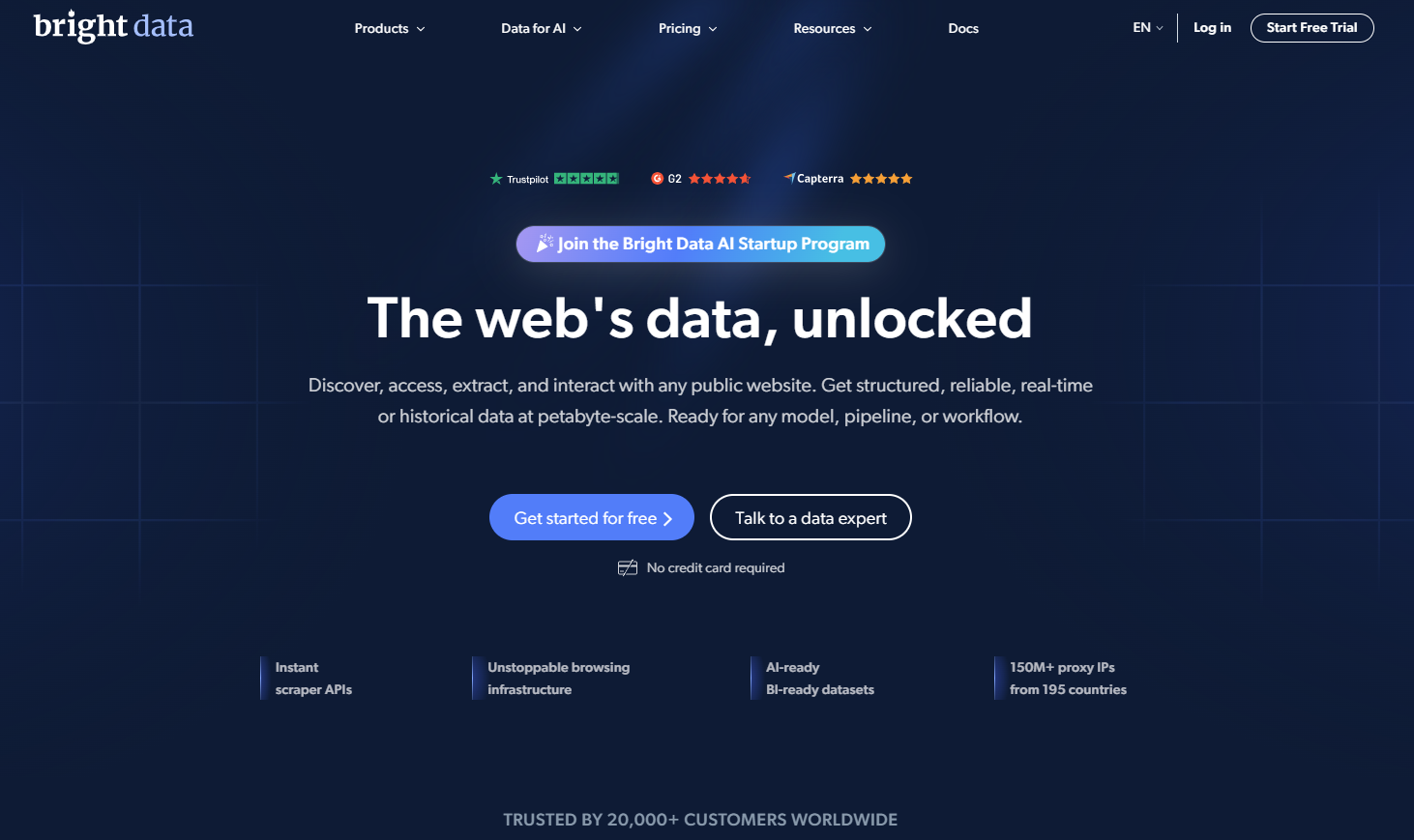
Bright Data delivers the most complete research API solution, combining industry-leading success rates with the largest proxy network available. The platform handles everything from simple SERP queries to complex e-commerce extraction without requiring proxy configuration or anti-bot tuning.
Key Strengths:
- 98.44% success rate, the highest among tested providers in independent benchmarks
- 400M+ residential IPs across 195 countries
- 120+ ready-made scrapers for popular sites (no code required)
- Automatic proxy selection, CAPTCHA solving, and retry logic
- Flat-rate pricing: $1.50/1K requests (standard)
Best For: Enterprise research teams needing reliable, scalable data collection across diverse sources. The combination of ready-made scrapers and custom API access suits both technical and non-technical users.
Limitations: Many products and services, might be hard to find the perfect fit by yourself.
2. Linkup Web Search API (Great for AI/LLM)
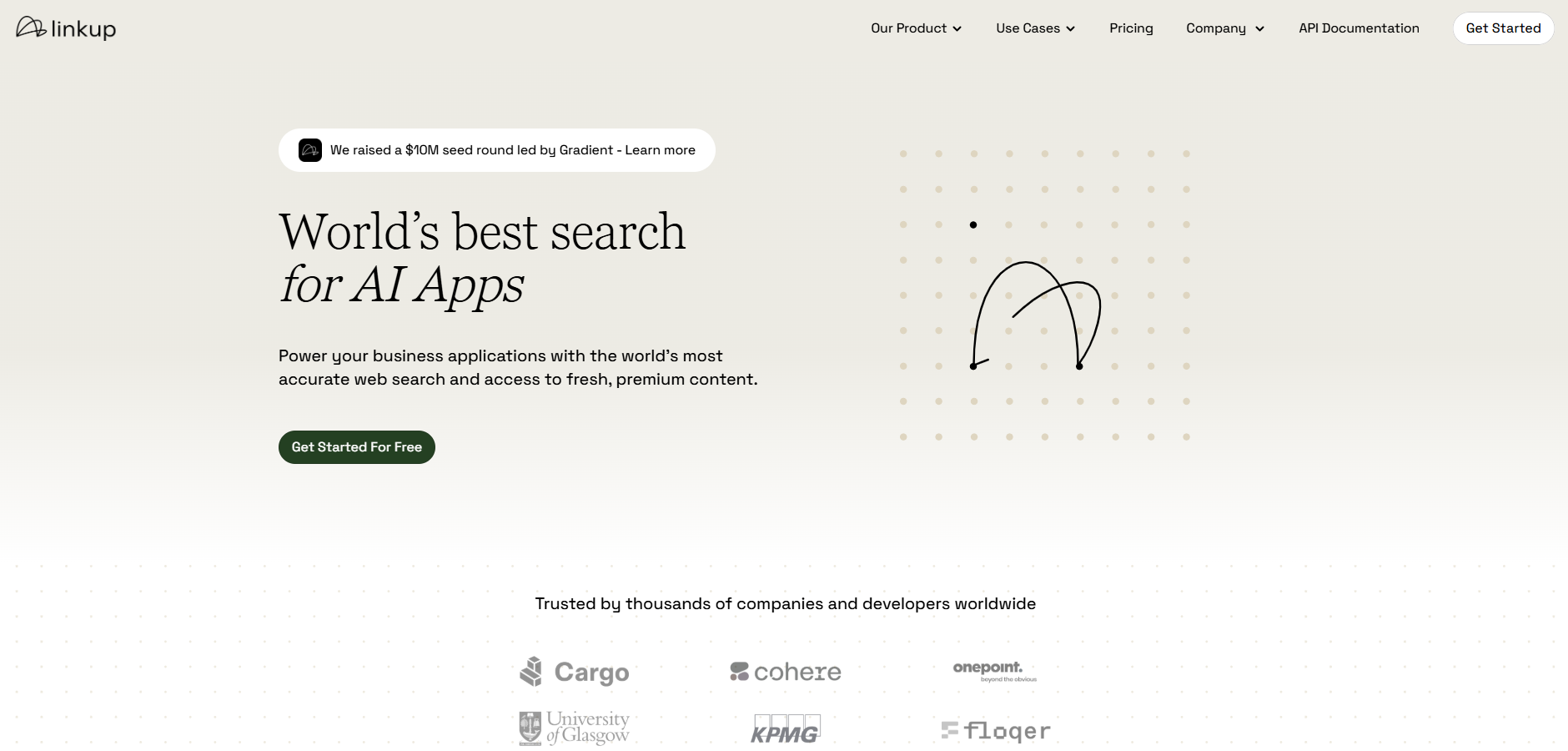
Linkup built its API specifically for AI applications. Native integrations with LangChain, LlamaIndex, and MCP (Model Context Protocol) make it the fastest path to adding web search capabilities to LLM projects.
Key Strengths:
- Purpose-built for RAG pipelines and AI agents
- Proprietary search index (not scraping Google)
- €5 per 1,000 standard queries, cost-effective for high-volume AI use
- Native LLM framework integrations
- 10-100 queries per second capacity
Best For: AI developers building chatbots, research assistants, or any application requiring real-time web knowledge. The AI-native architecture eliminates friction in LLM integration.
Limitations: Limited to search use cases, you can’t scrape arbitrary websites. The proprietary index may not match Google’s coverage for niche queries.
3. SerpAPI (Fast SERP API)
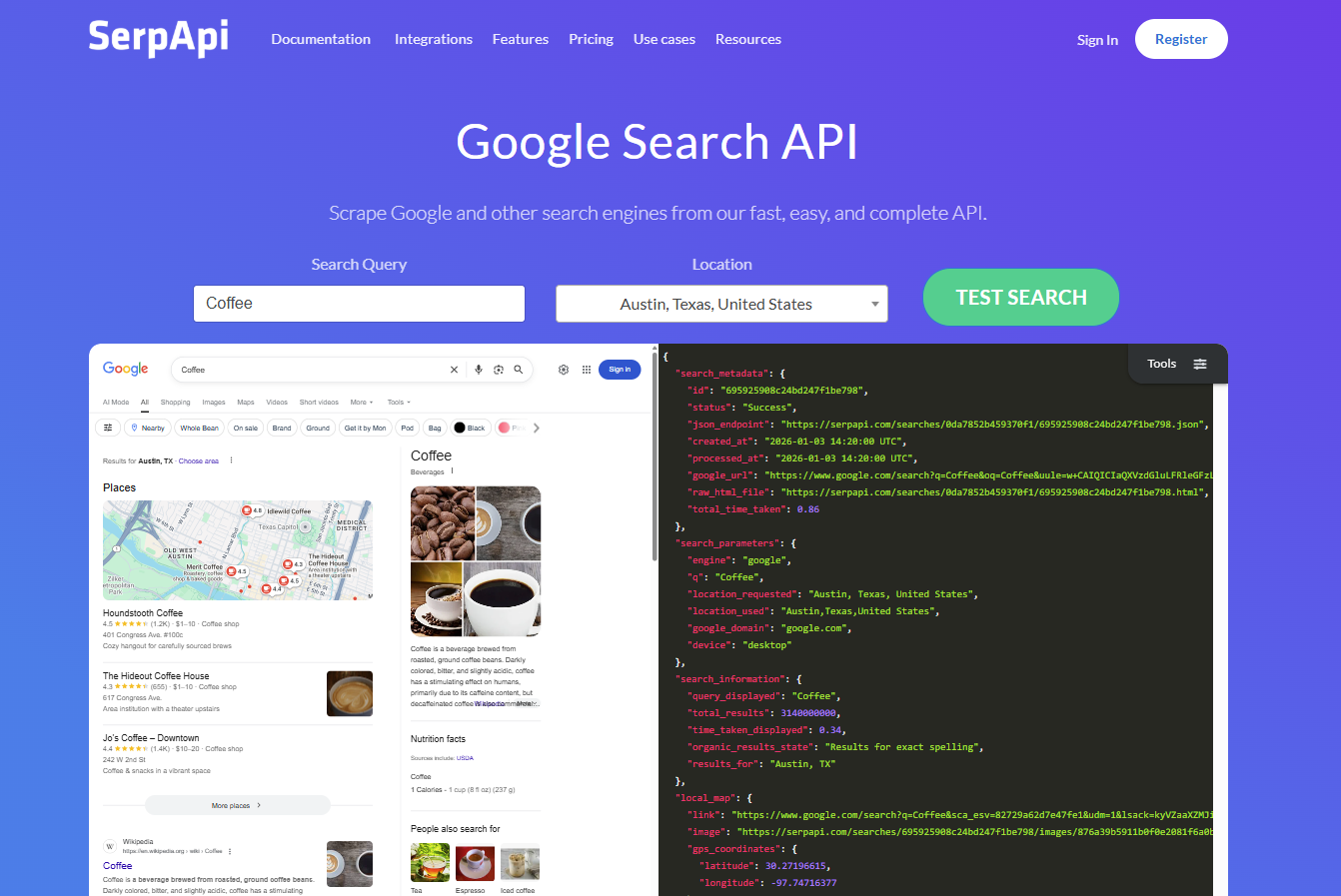
SerpAPI set the standard for structured search engine data extraction. Excellent documentation, consistent JSON output, and broad search engine coverage make it the go-to choice for SEO tools and SERP analysis.
Key Strengths:
- Structured JSON output from Google, Bing, Yahoo, and more
- Google Scholar support for academic research
- 250 free searches per month to start (upgraded from 100)
- Comprehensive documentation with code examples
- Starting at $75/month for 5,000 searches
Best For: SEO professionals, keyword researchers, and developers building search-related tools. The structured output eliminates parsing headaches.
Limitations: SERP-focused only, not suitable for general web scraping. Costs scale quickly at high volumes compared to flat-rate alternatives.
4. ScrapingBee (Good for Flexibility)
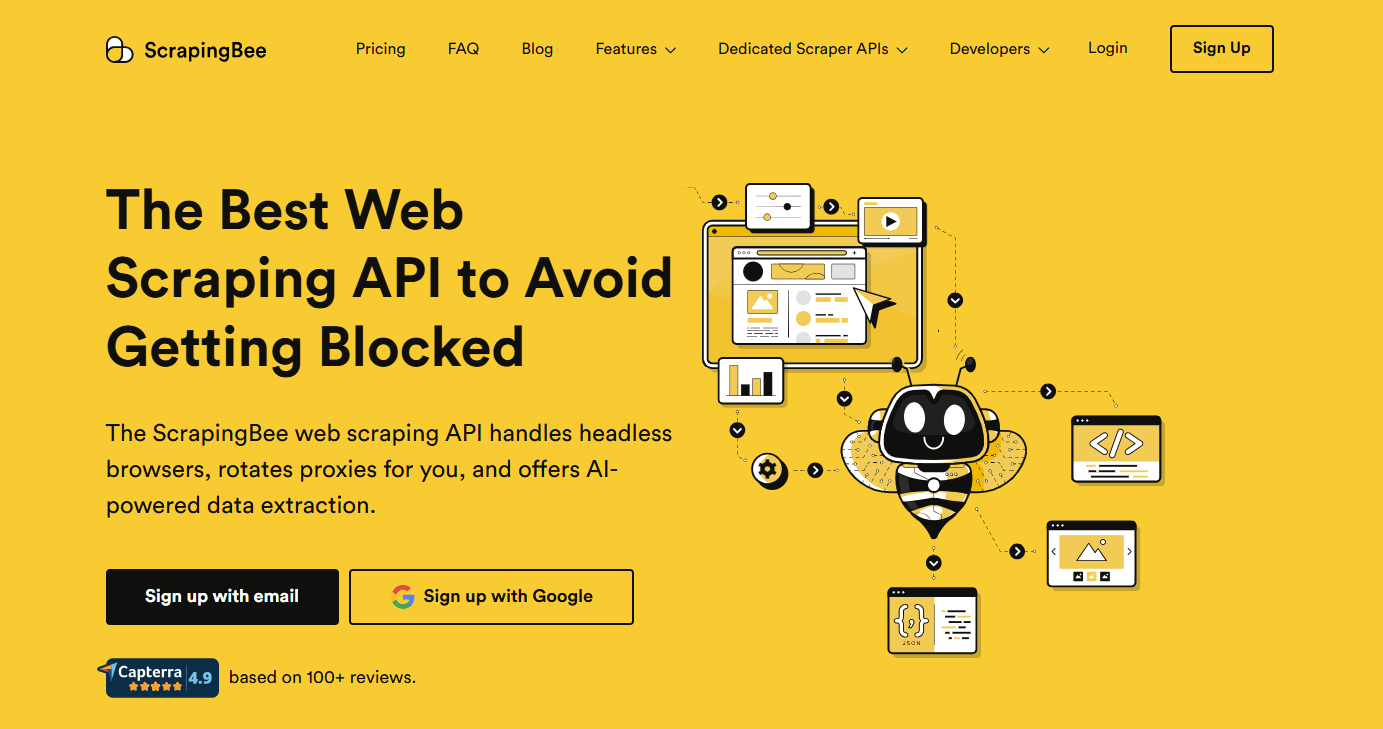
ScrapingBee gives developers complete control over extraction logic while handling proxy rotation and browser rendering. This flexibility suits custom research projects with unique requirements.
Key Strengths:
- Full control over extraction parameters
- JavaScript rendering with headless Chrome
- Proxy rotation across residential and datacenter IPs
- Screenshot capture and PDF generation
- Starting at $49/month for 150,000 API credits
Best For: Developers who need fine-grained control over scraping behavior. Custom academic research projects and specialized data extraction benefit from ScrapingBee’s flexibility.
Limitations: Requires more technical expertise than turnkey solutions. You’re responsible for parsing logic and error handling beyond what the API provides.
5. Tavily (Great Choice for AI Research)
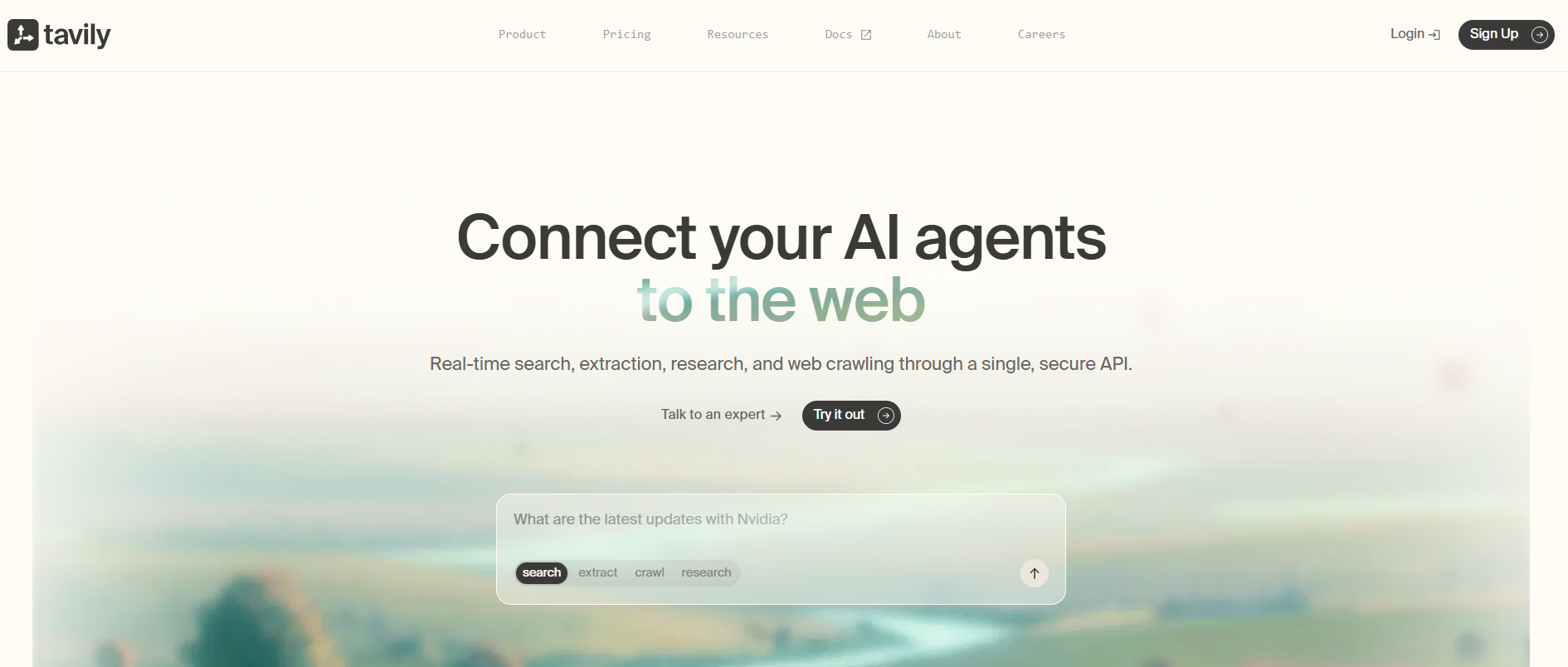
Tavily optimizes specifically for AI research applications, offering built-in content summarization and fact extraction. The API returns AI-ready snippets rather than raw HTML.
Key Strengths:
- AI-optimized response format
- Automatic content summarization
- Built-in fact extraction
- Free tier: 1,000 credits/month
- Pay-as-you-go: $0.008 per credit
Best For: Researchers building AI-powered analysis tools or content systems. The summarization features save significant post-processing work.
Limitations: Credit-based pricing can add up for high-volume projects. Less flexible than general-purpose scraping APIs for non-AI use cases.
6. Exa (Best Semantic Search)
Exa uses neural search to find semantically similar content, going beyond keyword matching. This approach excels at discovering related research, finding similar companies, or exploring topic spaces.
Key Strengths:
- Neural/semantic search capabilities
- “Find similar” functionality for content discovery
- Content highlighting and extraction
- Strong for research discovery use cases
- Developer-friendly API design
Best For: Research discovery, competitive analysis, and content recommendation systems. The semantic approach finds relevant results that keyword search misses.
Limitations: Smaller index than major search engines. Best as a complement to traditional search rather than a replacement.
7. Apify (Best for Scale)
Apify combines a marketplace of pre-built scrapers with infrastructure for running custom actors at scale. The platform handles scheduling, storage, and monitoring for complex scraping workflows.
Key Strengths:
- Marketplace with thousands of pre-built scrapers
- Cloud infrastructure for running custom code
- Built-in scheduling and storage
- Strong community and documentation
- Pay-as-you-go and subscription options
Best For: Teams running multiple scraping workflows who benefit from centralized management. The marketplace accelerates development for common use cases.
Limitations: Learning curve for custom actor development. Costs can be unpredictable for complex workflows with variable resource usage. Performance varies significantly between different actors.
8. Serper (Best Google-Only)
Serper focuses exclusively on Google, delivering fast, affordable access to search results. The narrow focus enables optimized performance and simple pricing.
Key Strengths:
- Google-specialized for optimized performance
- Fast response times (~2 second average)
- Simple, predictable pricing starting at $50/month for 50K queries
- Clean JSON output
- 2,500 free queries to start
Best For: Projects that only need Google data and prioritize speed and cost efficiency. The focused approach eliminates complexity.
Limitations: Google only – No Bing, Yahoo, or other engines. Limited flexibility for projects that expand beyond Google search.
9. SearchAPI (Best for Affordability)
SearchAPI offers competitive pricing across multiple search engines, making it accessible for budget-conscious research projects and startups.
Key Strengths:
- Multi-engine support (Google, Bing, Baidu, and more)
- Affordable starting at $40/month for 10,000 searches
- Real-time SERP data
- Straightforward API design
- Good documentation
Best For: Startups and individual researchers who need SERP data without enterprise budgets. The multi-engine support adds flexibility.
Limitations: Smaller infrastructure than market leaders may impact reliability at scale. Fewer advanced features than premium alternatives.
10. ScraperAPI (Best Proxy Infrastructure)
ScraperAPI emphasizes its proxy infrastructure, offering robust IP rotation and geo-targeting capabilities. The focus on proxy quality suits projects where avoiding blocks is the primary challenge.
Key Strengths:
- Strong proxy rotation and management
- Geographic targeting options
- JavaScript rendering support
- Simple API with automatic retries
- Starting at $49/month
Best For: Projects targeting sites with aggressive anti-bot measures where proxy quality determines success. The infrastructure focus delivers reliability.
Limitations: Less specialized for specific use cases like SERP or AI. May require more custom development for complex extraction needs. Credit multipliers can increase costs significantly on protected sites.
11. Brave Search API (Best Privacy-First)
Brave maintains an independent search index, offering an alternative to Google-dependent APIs. The privacy-first approach appeals to researchers concerned about data practices.
Key Strengths:
- Independent search index (not scraping Google)
- Privacy-focused data practices
- $5 free credit per month (covers ~1,000 queries)
- Web, news, and image search
- Transparent ranking without heavy personalization
Best For: Privacy-conscious researchers and projects requiring an independent data source. The free credits enable significant testing and small-scale projects.
Limitations: Smaller index than Google means potential gaps in coverage. May not match Google’s results for comparative research.
How to Choose the Right Research API
With 11 strong options, selection depends on matching API capabilities to your specific requirements. Four factors matter most: use case fit, pricing model, scalability needs, and data quality requirements.
Consider Your Use Case
Start by identifying your primary data sources and output needs.
For SERP and SEO research: SerpAPI or Serper deliver structured search data optimized for ranking analysis. Bright Data offers SERP capabilities within a broader solution.
For AI/LLM applications: Linkup and Tavily integrate directly with LLM frameworks. Their AI-optimized outputs reduce post-processing requirements.
For general web scraping: Bright Data, ScrapingBee, or Apify handle diverse targets. Bright Data’s ready-made scrapers accelerate common use cases.
For academic research: Consider success rates on scholarly sources. Bright Data’s 98.44% reliability minimizes data gaps. SerpAPI’s Google Scholar support serves citation analysis.
Evaluate Pricing Models
API pricing varies dramatically in structure and total cost. Understanding these models prevents budget surprises.
Flat-rate pricing (Bright Data: $1.50-$2.50/1K requests) offers predictability. You know exactly what 100,000 requests will cost before starting.
Credit multipliers complicate budgeting. Some APIs charge 5x-75x base rates for JavaScript rendering, premium sites, or geo-targeting. A nominal $0.001/request can become $0.075 in practice.
Subscription tiers (SerpAPI, Serper, SearchAPI) bundle fixed request volumes at monthly rates. These suit predictable, moderate-volume needs.
Usage-based pricing (Linkup, Tavily) scales linearly with consumption. This works well for variable workloads but requires monitoring.
Calculate realistic costs using your expected volume, target complexity, and feature requirements. Factor in retry rates – a cheaper API with 90% success may cost more than a pricier one with 98% success after accounting for failed requests.
Check Scalability & Rate Limits
Research projects often grow beyond initial estimates. Verify that your chosen API can scale.
Concurrent request limits determine throughput. Bright Data handles enterprise volumes; smaller providers may throttle at hundreds of simultaneous requests.
Daily/monthly caps on free and entry tiers restrict testing and production use. Ensure upgrade paths exist without major architecture changes.
Infrastructure quality affects reliability under load. APIs backed by millions of IPs (Bright Data: 400M+) maintain performance as volume increases.
Assess Data Quality & Structure
Raw success rates don’t tell the whole story. Consider what you receive when requests succeed.
Output format matters for downstream processing. JSON responses integrate easily with analysis tools; raw HTML requires parsing.
Data completeness varies by provider. Some APIs miss dynamic content, AJAX-loaded elements, or content behind interactions.
Consistency determines whether you can reliably compare data over time. APIs with stable output formats simplify longitudinal research.
Research API Use Cases
Different research applications have distinct requirements. These use case breakdowns help match APIs to specific needs.
Academic Citation Analysis
Citation networks map relationships between publications, revealing research trends and influential papers. This requires extracting data from Google Scholar, academic databases, and institutional repositories.
Key requirements: High success rate on academic sources, structured output for network analysis, ability to handle pagination across thousands of results.
Recommended: Bright Data for reliability and scale; SerpAPI for structured Google Scholar data.
Trend Monitoring
Tracking emerging topics requires continuous data collection across news sources, social media, and industry publications. Real-time alerting enables rapid response to developing stories.
Key requirements: Speed for near-real-time updates, broad source coverage, reliable scheduling and delivery.
Recommended: Bright Data for comprehensive coverage and enterprise reliability.
Competitive Intelligence
Understanding competitor positioning requires systematic data collection: pricing, product catalogs, marketing messages, customer reviews, and market presence.
Key requirements: E-commerce site success, structured product data extraction, geographic coverage for regional pricing.
Recommended: Bright Data’s ready-made e-commerce scrapers and 400M+ IP network.
AI Training Data Collection
Large language models and AI systems need diverse, high-quality training data. Web scraping APIs provide the scale and variety required for effective training sets.
Key requirements: Volume capacity (millions of pages), content quality and diversity, compliant data collection practices.
Recommended: Bright Data for scale and reliability; Linkup for AI-native integration.
Market Research
Understanding market dynamics requires data from multiple sources: industry reports, company filings, news coverage, and consumer sentiment across platforms.
Key requirements: Broad site coverage, ability to extract structured data from varied formats, reliable delivery for ongoing research programs.
Recommended: Bright Data for comprehensive capabilities; Apify for workflow management.
SEO Rank Tracking
Monitoring search positions across keywords and competitors drives SEO strategy. Accurate, consistent SERP data enables performance measurement and competitive analysis.
Key requirements: Structured SERP output, historical consistency, geographic targeting for local search.
Recommended: SerpAPI or Serper for dedicated SERP capabilities; Bright Data SERP API for enterprise needs.
Technical Challenges & Solutions
Research APIs exist because direct web scraping faces significant technical barriers. Understanding these challenges helps you evaluate API capabilities and set realistic expectations.
Anti-Bot Detection & CAPTCHA
Modern websites deploy sophisticated detection systems. These analyze browser fingerprints, request patterns, mouse movements, and dozens of other signals to identify automated access.
The challenge: Detection triggers blocks, CAPTCHAs, or misleading data. Simple scripts fail on protected sites within minutes.
How APIs solve it: Premium providers maintain detection research teams, continuously updating fingerprints and behaviors. Bright Data’s automatic parameter selection handles these adjustments without user configuration, achieving 98.44% success across diverse targets.
Rate Limiting
Sites throttle request rates to manage server load and discourage scraping. Exceeding limits triggers temporary or permanent blocks.
The challenge: Rate limits vary by site, time of day, and IP reputation. Hitting limits disrupts research and can burn IP addresses.
How APIs solve it: Intelligent request distribution across massive IP pools. Bright Data’s 400M+ IPs enable high throughput while staying under individual site limits. Built-in retry logic handles temporary blocks gracefully.
Data Parsing & Cleaning
Raw HTML contains navigation, ads, scripts, and formatting alongside target content. Extracting useful data requires complex parsing logic.
The challenge: HTML structures change without notice, breaking parsers. Maintaining extraction code for multiple sites demands ongoing development effort.
How APIs solve it: Ready-made scrapers (Bright Data offers 120+) return structured JSON for common sites. AI-powered extraction handles sites without dedicated parsers. These approaches eliminate most parsing maintenance.
Best Practices for Using Research APIs
Maximizing value from research APIs requires thoughtful implementation. These practices improve results while controlling costs.
Start with Free Trials
Every API performs differently on your specific targets. Free tiers and trials let you test real-world performance before committing budget.
Run your actual use cases during trials. Extract from your target sites, test your expected volumes, and verify output formats meet your needs. Theoretical specifications matter less than measured results.
Implement Error Handling
Even 98% success rates mean 2% failures. Robust error handling prevents data gaps and wasted credits.
Implement exponential backoff for retries. Log failures for analysis – patterns reveal problematic targets or configuration issues. Design workflows to handle partial results gracefully.
Optimize for Cost Efficiency
Small optimizations compound at scale. Reducing unnecessary requests directly improves ROI.
Cache responses when data freshness permits. Batch requests where APIs support it (Bright Data handles 5,000 URLs per batch). Target specific page elements rather than full-page renders when possible.
Monitor usage against value. Track cost-per-insight rather than cost-per-request. A premium API delivering usable data may cost less than a cheap one requiring extensive post-processing.
Why Bright Data Is the Best Research API
After comprehensive analysis, Bright Data emerges as the leading research API for most use cases. Five factors drive this conclusion:
Unmatched Reliability: The 98.44% success rate isn’t marketing – it’s measured performance across diverse targets in independent benchmarks. For research depending on complete data, this reliability prevents gaps that compromise analysis.
Massive Scale: 400M+ IPs across 195 countries provide infrastructure that handles enterprise volumes without degradation. Whether you need 1,000 or 100 million requests, the platform delivers consistently.
Transparent Pricing: Flat-rate pricing ($1.50 standard, $2.50 premium per 1K requests) eliminates the credit multiplier complexity plaguing competitors. You know costs before starting, enabling accurate project budgeting.
Zero Configuration: Automatic proxy selection, browser fingerprinting, and retry logic work without manual tuning. You focus on research questions while Bright Data handles technical infrastructure.
Complete Solution: Beyond the Web Scraper API, Bright Data offers SERP APIs, proxy networks, ready-made datasets, and no-code scrapers. One provider addresses the full spectrum of research data needs.
For researchers who need data they can trust at scales that matter, Bright Data provides the most complete, reliable solution available.
Conclusion
Choosing the right research API depends on your needs, budget, and technical requirements.
Bright Data stands out for most teams with its 98.44% success rate, 400M+ IP network, and transparent pricing. It scales from simple projects to enterprise deployments.
For AI applications, Linkup and Tavily offer native LLM integrations that reduce development time.
For SEO work, SerpAPI and Serper provide the most structured, reliable SERP data.
For budget-conscious teams, SearchAPI ($40/month) and Serper ($50/month) offer solid value, while Brave Search’s free monthly credits enable testing without cost.
Start with free trials to validate performance on your actual targets. Test thoroughly and choose the API that delivers reliable data for your specific use cases.
FAQs About Research APIs
What are research APIs?
Research APIs are tools that programmatically extract data from websites, search engines, or academic databases. They handle proxies, anti-bot measures, and data parsing, enabling automated research data collection at scale.
What’s the best API for web scraping research data?
Bright Data Web Scraper API is the best overall, with 98.44% success rate, 400M+ IPs, and enterprise-grade reliability. For AI-specific needs, Linkup offers native LLM integrations.
What’s the difference between SERP APIs and Web Scraping APIs?
SERP APIs extract structured search engine results (HTML/JSON) specifically from Google, Bing, and other search engines. Web Scraping APIs offer flexible extraction from any website with proxy rotation and anti-bot features. SERP APIs are specialized; Web Scraping APIs are generalized.
How much do research APIs cost?
Pricing ranges from €0.005/query (Linkup) to $2.50/1K requests (Bright Data premium sites). Most providers offer $40-$75/month starting plans with 5K-250K requests. Watch for credit multipliers that increase effective costs 5x-75x on some platforms.
Do I need proxies for scraping research data?
Yes, proxies and IP rotation are essential to avoid bans and CAPTCHAs on most sites. Top APIs like Bright Data handle this automatically with 400M+ IP pools, eliminating the need to manage proxies yourself.
Which research API has the highest success rate?
Bright Data achieved 98.44% success rate in independent testing by Scrape.do – the highest among major providers. The platform reaches 100% success on specific high-value domains including Indeed, Zillow, Capterra, and Google.
Can research APIs handle JavaScript-heavy websites?
Yes, modern research APIs include JavaScript rendering capabilities using headless browsers. Bright Data, ScrapingBee, and ScraperAPI all support full JavaScript execution, though rendering typically increases request time and may affect pricing.



Web Data & AI Expert
 6 years experience
Daniel Shashko is a Senior SEO/GEO at Bright Data, specializing in B2B marketing, international SEO, and building AI-powered agents, apps, and web tools.