









In this article, you will see:
- What flight data is, why it has become important, its key features, and the main challenges in sourcing it.
- Why counting on a flight data provider is the recommended way to access it.
- The main factors to consider when evaluating airline or flight datasets providers.
- A detailed comparison of the top eight flight data providers.
Let’s dive in!
TL;DR: Summary Table Comparing the Top Flight Data Providers
Compare the top flight data providers at a glance by inspecting the summary table below:
| Provider | Scalability | Live Data | Historical Data | API Interface | Datasets/Databases | AI Integration | GDPR Compliance | Free Sample/Trial | Pricing |
|---|---|---|---|---|---|---|---|---|---|
| Bright Data | Unlimited | ✅ | ✅ | ✅ | ✅ | ✅ (70+ AI integrations+ MCP server) | ✅ | ✅ | $1.50/1k records (scraping), $2.50/1k records (datasets), free trial available |
| OAG | Limited | ✅ | ✅ | ✅ | ✅ | Basic via API | ✅ | ❌ | — (Undisclosed) |
| OpenSky Network | Limited | ✅ | ✅ | ✅ | ✅ | Basic via API | — (Undisclosed) | ✅ | Free for academic/research use |
| Cirium | Limited | ✅ | ✅ | ✅ | ✅ | ✅ (via built-in AI assistants) | ✅ | ✅ | — (Undisclosed) |
| Travel Scrape | Limited | ✅ | ✅ | ✅ | ✅ | Basic via API | — (Undisclosed) | ✅ | — (Undisclosed) |
| Aviation Edge | Limited | ✅ | ✅ | ✅ | ✅ | Basic via API | ✅ | ❌ | $7–$39/mo |
| FlightAPI | Limited | ✅ | ✅ | ✅ | ❌ | Basic via API | — (Undisclosed) | ✅ | $49–$199/mo |
| Row Zero | Limited | ❌ | ✅ | ❌ | ✅ | ✅ (via chat with a built-in A agent) | ✅ | ✅ | $10–$15/user/month |
Getting Started with Flight Data
Before reviewing the flight data providers, get some insights into flight data!
What Is Flight Data and Why Does It Matter?
Flight data refers to information about flights, including schedules, routes, prices, delays, occupancy, and other metrics. It provides a window into how the aviation industry operates on a daily and historical basis.
The scale of the industry highlights why this data is so important. The FAA’s Air Traffic Organization (ATO), for example, oversees more than 44,000 flights across 29 million square miles of airspace.
In the EU, 814 million air passengers were carried between January and March 2025, a 5.1% increase compared to the same period in 2024. In the US alone, 3 million passengers fly every day.
Commercial aviation contributes $1.45 trillion to the U.S. GDP in 2024, which is roughly 5% of the total economy. In Europe, air transport supports 15 million jobs and generates $1.2 trillion in economic activity, accounting for 4% of employment and 4.6% of GDP in 2023.
Globally, the aviation industry creates 11.6 million direct jobs and 20.4 million indirect jobs, making it one of the largest and most influential sectors in the world.
Given the massive scale of the aviation industry, access to high-quality flight data supports several critical business use cases, such as:
- Finding the most cost-effective flights: Companies can identify the best fares to save money on business travel or logistics.
- Optimizing travel time: Businesses can select faster routes or avoid connections to improve efficiency and reduce downtime.
- Minimizing delays and disruptions: Data helps anticipate delays, cancellations, or congestion, enabling better planning and contingency strategies.
- Studying the outbound market: Travel agencies, tour operators, and investors can analyze trends in passenger flows and destinations to identify growth opportunities.
- Targeted marketing for travelers: Tourism boards and travel platforms can tailor campaigns and offers based on historical and live flight patterns, seasonal demand, and popular destinations.
Types of Flight Data
Planning a flight is not simple, and many metrics and data points are involved in this process. The most important types of flight data include:
- Flight schedules: Planned departure and arrival times, routes, and frequencies for airlines and airports.
- Real-time flight status: Live tracking of departures, arrivals, delays, and cancellations, including actual timestamps for gate departure, takeoff, landing, and gate arrival.
- Flight delays and cancellations: Historical or current data showing which flights were delayed or canceled, with reasons such as weather, technical issues, or air traffic.
- Aircraft positions: Real-time GPS locations of planes, including latitude, longitude, altitude, speed, and heading.
- Air traffic control data: Information on airspace usage, flight paths, and instructions issued by ATC (Air Traffic Control) to ensure safe and orderly aircraft movement.
- Flight plans: Routes, altitudes, and schedules filed by pilots or airlines with authorities before departure for regulatory approval and airspace coordination.
- Weather-related flight data: Conditions affecting flights, such as turbulence, wind, visibility, and storms.
- Airline performance metrics: On-time performance, load factors, reviews, and operational efficiency statistics that measure airline reliability and overall service quality.
- Passenger traffic data: Counts and trends of passengers per route, flight, or airport, used for planning, forecasting, and capacity management.
- Cargo and freight data: Volumes, types, and routing of goods transported by air, including mail and logistics information for supply chain optimization.
- Aircraft fleet data: Details about airline fleets, aircraft types, seating configurations, and operational status.
- Airport operations data: Gate usage, runway availability, ground handling, and turnaround times.
Obstacles and Challenges in Scraping Flight Data
Flight aggregators like Kayak, Skyscanner, and Google Flights provide access to publicly available flight data. At first glance, it might seem easy to build a scraping bot to automatically fetch that data.
However, that is much easier said than done. Most platforms are protected with anti-scraping measures such as rate limiting, TLS fingerprinting, browser fingerprinting, IP bans, CAPTCHAs, and more.
Even if you manage to bypass these protections, the biggest challenge is the highly dynamic nature of flight data. Prices and availability can change significantly within minutes, making it difficult to maintain accurate datasets.
As a result, you need a web scraping solution backed by enterprise-ready infrastructure that ensures high scalability, concurrency, and reliability. Unfortunately, that is something almost impossible to achieve in-house.
Negotiating directly with airlines and international clients for official access to their data is equally complex and can take months of negotiations…
Why the Solution Is a Dedicated Flight Data Provider
Flight data is highly valuable, but collecting it reliably is notoriously difficult due to the obstacles highlighted earlier. Consequently, the most effective way to overcome these challenges is to rely on a specific flight data provider.
A flight data provider gathers, organizes, and delivers diverse types of flight information while handling all the underlying complexities. These solutions make flight data available through two main approaches:
- Flight datasets: Pre-collected data covering schedules, historical prices, delays, and availability. This is ideal for market analysis, machine learning and AI model training, trend forecasting, and benchmarking.
- Flight API solutions: Endpoints that collect live data directly from a centralized database or by scraping airline websites and aggregators. They are best suited for real-time pricing strategies, dynamic availability checks, competitive intelligence, and inventory monitoring.
Most organizations combine both approaches. They rely on datasets for historical context and large-scale analysis, while trusting scraping for feeding AI-based applications.
Aspects to Consider When Selecting the Best Flight Data Providers
There is a plethora of data providers, but only a few cover flight and airline data. To identify and evaluate the best options, you need to compare them across common factors like:
- Data coverage: The types of flight data offered, including schedules, historical prices, availability, supported sources, and coverage of airlines, airports, or routes.
- Infrastructure: The provider’s scalability, uptime, success rates, and overall reliability to handle large volumes of requests and concurrent users.
- AI integrations: Special features that simplify the integration into AI agents, RAG pipelines, machine learning workflows, and other advanced analytics.
- Data freshness: Whether the provider delivers static historical datasets, live data via scraping, or a combination of both.
- Technical requirements: Skills, tools, and infrastructure needed to access and work with the given flight data.
- Compliance: Adherence to GDPR, CCPA, and other relevant data privacy and protection regulations.
- Pricing: Subscription models, pay-as-you-go or custom plans, plus availability of free trials or sample datasets for evaluation.
Top 8 Flight Data Providers
Discover the best flight data providers, carefully selected and ranked according to the criteria outlined above.
1. Bright Data
Bright Data has evolved from a proxy provider into a leading platform for web data collection and AI-ready data solutions. For aviation and flight data, it offers a comprehensive suite of tools designed for both historical research and real-time intelligence:
- Airline and flight datasets: Data structures covering public airline information, flight schedules, fleet details, passenger traffic, and emissions. All data is cleaned, validated, and delivered in formats like JSON, CSV, or Parquet. With tailored schemas, automated updates, and flexible record-based pricing, these datasets are ideal for analytics platforms, BI tools, and AI/LLM integration.
- Flight Scraper APIs: Scraping endpoints to collect live aviation data on demand, including flight status, schedule changes, fleet movements, airport activity, and operational metrics. The scrapers automatically handle anti-bot measures and can be accessed either via API or through simplified no-code workflows.
- MCP server integration: Bright Data’s Bright Data MCP server exposes flight data directly to AI agents and automated workflows via specialized tools. Thanks to Bright Data MCP, AI can query, analyze, and consume aviation data. Supported domains include Skyscanner, Google Flights, and others.
👍 Key advantages:
- Data-rich: Millions of records, fully tailored to your requirements.
- Scalable: Powered by Bright Data’s global network of 400M+ IPs, with support for unlimited concurrent requests.
- Reliable: 99.99% uptime and success rates, backed by advanced anti-bot technologies.
- AI-ready: Optimized for integration with AI models, analytics platforms, and LLM-driven workflows.
- Ethical: Data collection fully aligns with international regulations.
Together, these features position Bright Data as arguably the best aviation and flight data provider on the market.
👑 Perfect for: Highly scalable, large-scale flight and aviation data collection and analytics, AI/ML model training, and integration into AI applications.
Data coverage:
- Flight schedules, status updates, fleet movements, airport activity, and operational metrics, Flight times, prices, companies, dates, stops, and more.
- Historical price trends, availability, and passenger traffic.
- Coverage of airlines, airports, routes, andmore.
- Sources include Skyscanner, Google Flights, Kayak, Expedia, and many others.
Infrastructure:
- High scalability with 400M+ proxy IPs across 195 countries for global flight data coverage.
- 99.99% uptime and 99.99% success rate for scraping APIs.
- IP rotation, CAPTCHA solving, custom headers, and other anti-blocking bypass measures for effective data collection.
- Options for bulk scraping, with up to 5k target URLs per request.
- Pre-compiled, structured datasets, fully validated, cleaned, enriched, and LLM-optimized, delivered in formats like JSON, NDJSON, CSV, Parquet, and more.
- Supports AI applications, such as AI agents, pipelines, and workflows.
- Flexible dataset delivery via Amazon S3, Google Cloud Storage, Snowflake, Azure, SFTP, Pub/Sub, Webhooks, and other preferred channels.
- Access to historical flight and aviation data from several domains via Archive API.
- Standard SLAs for all users and custom SLAs for enterprises.
- 24/7 global support with a dedicated team of travel data professionals.
AI integrations:
- Supports integrations with 70+ AI technologies, including CrewAI, LlamaIndex, LangChain, Agno, and many others.
- Compatible with enterprise-ready AI agent platforms such as IBM Watsonx, AWS Bedrock AI Agents, and Microsoft Copilot Studio.
- Enables fast integration with AI agents and solutions through Bright Data’s MCP platform.
Data freshness:
- Live flight data collection through Bright Data’s API-based and no-code scrapers.
- On-demand access to historical flight data via pre-built datasets with scheduled updates (daily, weekly, monthly, etc.).
Technical requirements:
- Basic technical knowledge is sufficient to start collecting standard flight data.
- API-based flight scrapers enable automated data collection, scheduled updates, and smooth integration into your existing data pipelines.
- No-code flight scraper provides instant, plug-and-play access to live flight information directly from Bright Data’s platform.
- Flight data can be delivered straight to your preferred storage solution.
- API familiarity and integration skills are recommended for advanced workflows, custom automation, and AI/ML pipelines.
Compliance:
- Fully compliant with GDPR, CCPA, and other global data privacy regulations.
- Data is collected ethically from publicly available sources only.
- Holds certifications for SOC 2 Type II, ISO 27001, CSA STAR Level 1, and other top-tier security standards.
Pricing:
- Free trial + sample datasets.
- Starting at $1.50 per 1k records via flight data scraping.
- Starting at $2.50 per 1k records for aviation datasets.
2. OAG
OAG is a leading global aviation data platform that supports airlines, OTAs, and travel apps with real-time and historical flight information. Its offerings include APIs for schedules and live flight status, cloud-based datasets covering connections, seats, fares, and historical performance, as well as flight info alerts for instant operational updates.
👑 Perfect for: Airline planning, revenue management, route profitability, and network mapping.
Data coverage:
- Global airline schedules, flight status, seats, global connections, fleet data, passenger booking data, minimum connection times, flight emissions data, and airfare/pricing data.
- Coverage spans 900+ airlines worldwide.
- Departures, arrivals, cancellations, schedule changes, route performance, and airline pricing insights.
Infrastructure:
- Cloud-based platform powered by Snowflake and Azure for high scalability and integration.
- RESTful JSON APIs built for both real-time and near-real-time updates.
AI integrations:
- Integration possible via APIs, particularly within the Azure AI infrastructure.
Data freshness:
- Real-time updates for flight status.
- Near real-time airline schedules.
- Weekly updates for airfare and connections data.
- Monthly updates for passenger booking data.
- Historical flight and fleet data covering up to 30+ years.
Technical requirements:
- Access via RESTful JSON APIs or cloud-based data warehouse, with documentation, a test environment, and integration guides for quick setups.
- Basic programming skills required for API or cloud integration.
- Knowledge of BI tools like Tableau or Power BI is useful, especially for the visualization of flight datasets.
Compliance:
- GDPR and CCPA compliant.
Pricing:
- Not listed (you must contact OAG for details).
3. OpenSky Network
The OpenSky Network is a global, non-profit platform providing open access to live and historical air traffic data. It aggregates signals from thousands of volunteer-operated sensors worldwide. It features APIs for live aircraft tracking and alerts, as well as a Trino-accessible database and curated scientific datasets.
👑 Perfect for: Scientific research, AI/ML experimentation, and proof-of-concept projects.
Data coverage:
- Real-time and historical aircraft position data.
- Alerts for emergency squawks, loss of signal, and other notable flight anomalies.
- Data is aggregated from thousands of receivers worldwide based on ADS-B (Automatic Dependent Surveillance–Broadcast).
Infrastructure:
- Centralized datasets accessible via the Trino interface for large-scale research queries.
- Programmatic API access available, with anonymous users who can retrieve data with 10-second resolution and have access to up to 4,000 requests daily.
AI integrations:
- No direct AI agent or RAG pipeline tools available.
Data freshness:
- Live aircraft data updated continuously.
- Historical datasets available with periodic updates.
Technical requirements:
- API access requires basic web programming knowledge.
- SQL knowledge needed for Trino queries.
- Optional use of Python, R, MATLAB, or other wrappers for data processing.
Compliance:
- Data accessible for university researchers, government organizations, and aviation authorities.
- Private/commercial access requires a license.
Pricing:
- Free access for academic and research use via API or Trino.
4. Cirium
Cirium is a top aviation data and analytics platform for real-time, historical, and forecast intelligence. Its flight data is exposed via APIs and datasets for flight status, schedules, fleets, passenger traffic, and emissions. Then, the SkyStream technology delivers live push-based feeds. That opens the door to continuous flight tracking, making it easier to integrate aviation data into business systems.
👑 Perfect for: Anyone looking for an all-in-one, cloud-based aviation data, analytics, and insights platform.
Data coverage:
- Global flight schedules, routes, connections, and passenger traffic, as well as airline, airport, and route-level analytics.
- Flight status, delays, and tracking for over 99% of commercial flights worldwide.
- Aircraft and fleet data covering over 770 types and 300+ data points per aircraft.
- Forward-schedule and historical data, including seats, fares, and CO₂ emissions.
Infrastructure:
- Cloud-based platforms, downloadable datasets, and managed solutions for integration.
- Centralized data warehouse supporting large volumes, real-time feeds, and analytics.
- APIs built for high reliability, supporting both pull-based and push-based streams.
AI integrations:
- APIs and Sky Stream push feeds can be integrated into AI agents, RAG pipelines, and machine learning workflows.
- Cirium AI Assistants offer analytics-ready outputs for operational decision-making.
Data freshness:
- Live flight tracking and real-time status updates via Sky Stream.
- Historical and future schedules available for planning, analysis, and forecasting.
- Forward-looking emissions and fleet forecasts included.
Technical requirements:
- Basic programming skills needed for API integration, with support for REST (JSON, XML, JSONP), SOAP, and AMQP.
- SDKs compatible with Java, Python, C, C++, PHP, and Node.js.
- Optional use of BI tools like Tableau or Power BI for data visualization.
Compliance:
- GDPR compliant.
Pricing:
- Free trial available for some services, and flexible evaluation options like sample datasets.
- Custom subscription or enterprise plans based on dataset access, API calls, or Sky Stream usage.
5. Travel Scrape
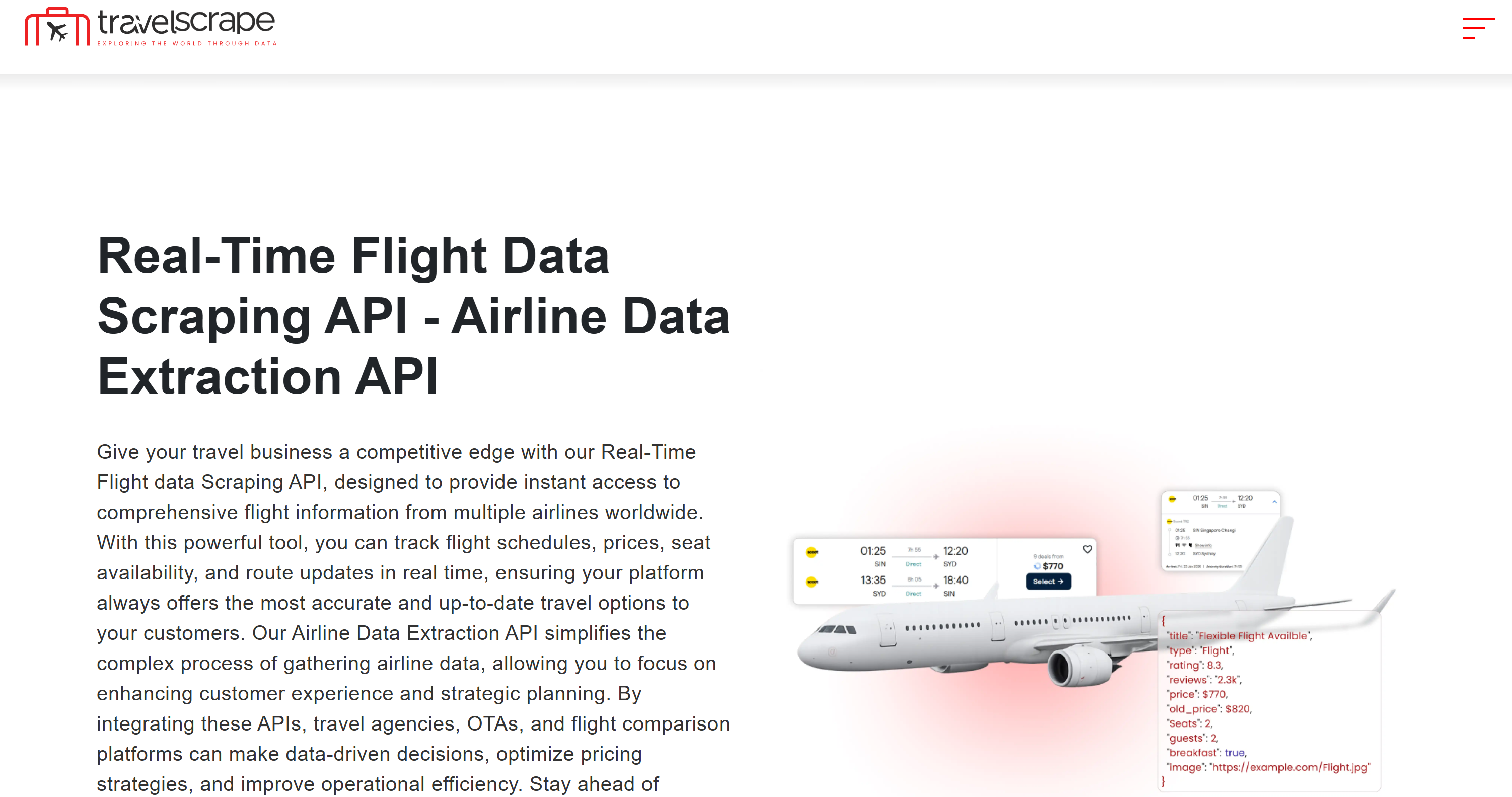
Travel Scrape is a data extraction and delivery platform specialized in the travel industry. It equips you with scraping APIs to help businesses optimize pricing, track competitors, and gain market insights. Specifically for flight data, it has both real-time APIs and historical datasets. These cover use cases such as analyzing price trends, schedule evolution, and more.
👑 Perfect for: Data needs that go beyond flights and extend across the entire travel industry.
Data coverage:
- Flight schedules, fares, seat availability, route updates, and airline information.
- Supports multiple global carriers, regional airlines, and low-cost operators.
- Covers multi-leg journeys, connecting flights, and stopovers.
Infrastructure:
- Scalable cloud-based API infrastructure.
- API usage is limited based on the subscription plan.
AI integrations:
- Supported via custom LLM-ready tools, as responses are provided in structured JSON.
- Enables AI-driven flight price intelligence and analytics through large datasets.
Data freshness:
- Real-time updates via web scraping APIs.
- Historical datasets available, covering flight price trends, schedules, and airport activity over time.
Technical requirements:
- API integration requires basic programming knowledge (HTTP requests, retries, etc.).
- Documentation, sample code, and support ensure smooth implementation.
- Flight information analytics require data analysis skills.
Compliance: Undisclosed.
Pricing:
- Demo available.
- Pricing not publicly listed (contact the sales team for details).
6. Aviation Edge
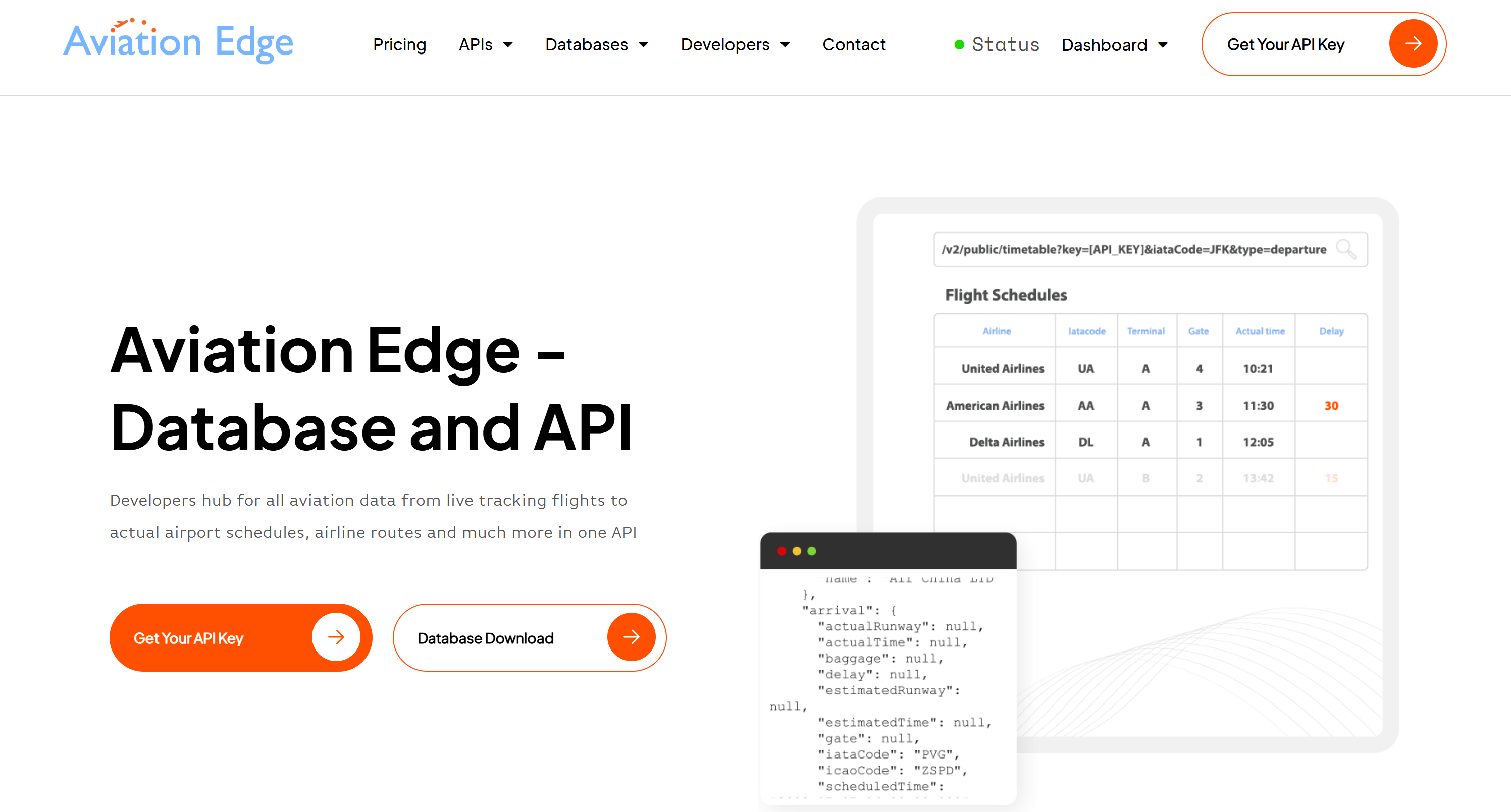
Aviation Edge is an aviation data provider offering APIs and databases rich in flight information. Its flight data includes APIs for live updates, as well as downloadable databases covering historical airlines, airports, and flight details. These solutions support applications such as flight trackers, logistics platforms, virtual maps, and market analysis.
👑 Perfect for: API-first flight data integrations, with offline SQL-based flight data exploration.
Data coverage:
- Flight tracking, schedules, routes, delays, flight departures/arrivals, airline routes, nearby airports/cities, historical and future timetables.
- Data on airports, airlines, aircraft, cities, countries, aviation taxes, and time zones.
Infrastructure:
- Centralized database with continuous updates, accessible via callable APIs.
- Option to download for local, offline access.
AI integrations:
- Possible via API integration, but no direct AI frameworks and technologies are supported.
Data freshness:
- Live flight tracking with updates every few minutes.
- Historical flight schedules and delays available globally.
- Future flight schedules accessible for planning purposes.
Technical requirements:
- Basic programming skills required for API integrations.
- Optional database downloads in CSV or Excel; data exploration and evaluation skills recommended.
- SQL knowledge needed for querying imported databases.
Compliance:
- GDPR compliant.
Pricing:
- Subscription-based plans:
- Developer: $7/mo for 30k API calls.
- Business: $15/mo for 100k API calls.
- Business Gold: $39/mo for 500k API calls.
- Unlimited Data: Custom pricing.
7. FlightAPI
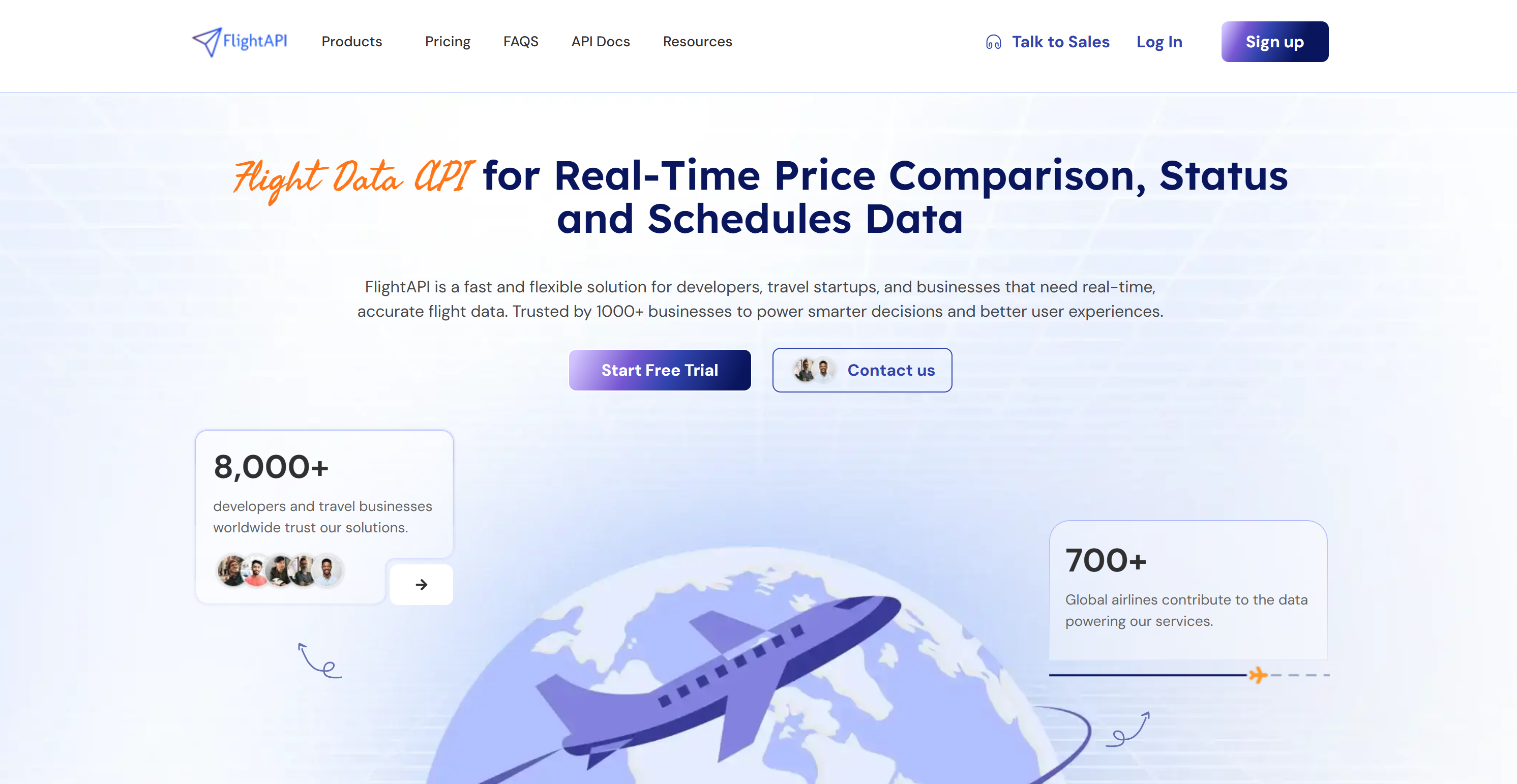
Flight API is a developer-focused platform that provides flight data via:
- Flight Price API: Offers fare comparisons across hundreds of airlines and OTAs.
- Flight Tracking API: Tracks live status, arrivals, departures, and flight locations.
- Airport Schedule API: Returns complete airport schedules from the past two days up to three days in advance.
Data is output in JSON or HTML, with a free trial available for testing.
👑 Perfect for: API-based flight data analysis integrations for small to medium projects.
Data coverage:
- Airport schedules, flight tracking, prices, status, including departure and arrival times, terminals, and current status.
- Metadata on flights, airlines, and airports.
- Data sourced from 700+ airlines and multiple vendors.
Infrastructure:
- Centralized API with 99.9% uptime, divided into three main endpoints.
- Scalability ranges from 5 to 50 concurrent API calls, depending on the plan.
AI integrations:
- Can be integrated with AI agents or machine learning pipelines via API, though no direct AI framework support is provided.
Data freshness:
- Real-time flight tracking and price updates.
- Historical and future airport schedules, with live updates.
Technical requirements:
- Basic programming skills needed to connect to the APIs.
Compliance: Undisclosed.
Pricing:
- Free trial with 20 free API calls.
- Subscription-based plan:
- Lite: $49/month for 30k API credits.
- Standard: $99/month for 100k API credits.
- Plus: $199/month for 500K API credits.
8. Row Zero
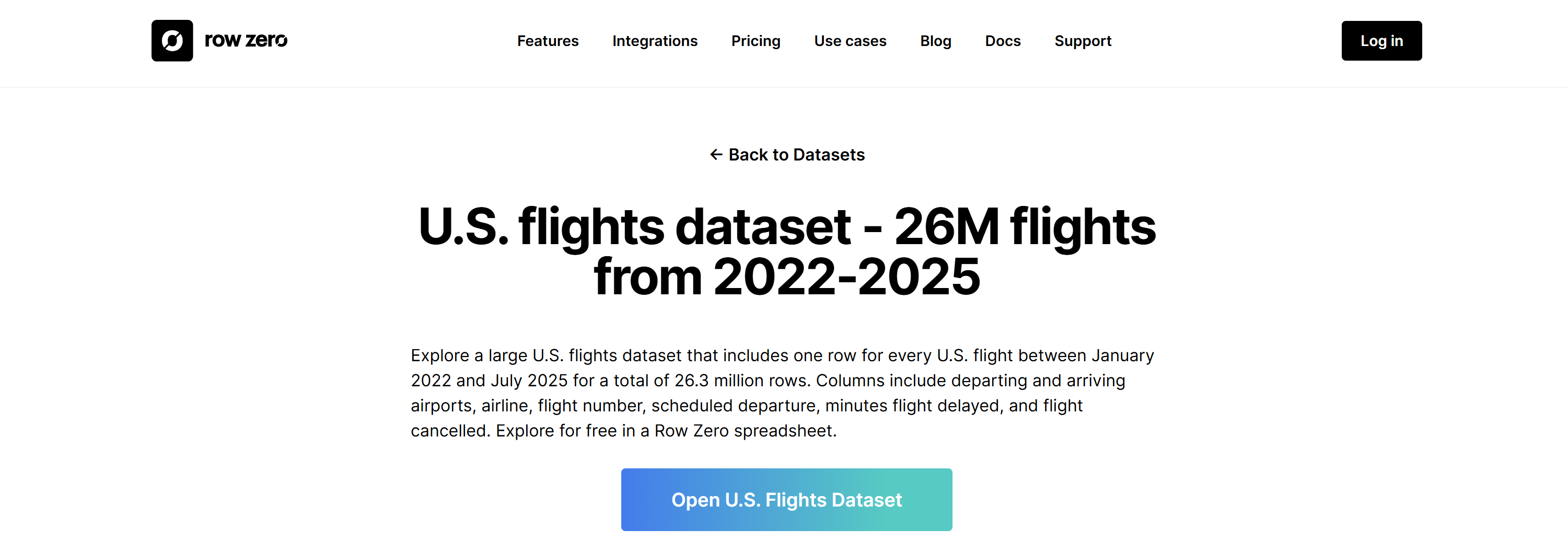
Row Zero is a cloud-based spreadsheet platform built for big data. It combines Excel-like ease with the ability to handle millions of rows, enterprise-grade security, and direct connections to data warehouses. In particular, its flight dataset includes millions of entries covering three years of U.S. domestic flights from 2022–2025.
👑 Perfect for: Large-scale historical analysis and U.S.-based trend insights.
Data coverage:
- 26.3 million U.S. domestic flights from 2022–2025, with data fields for airports, airlines, flight numbers, scheduled and actual departure times, delays, and cancellations.
- Covers major U.S. airlines, airports, and direct routes.
Infrastructure:
- Data is provided via Row Zero spreadsheets that can handle very large datasets.
- Supports pivot tables, charts, and large-scale analysis.
AI integrations:
- Ability to chat directly with an agent about the data within the cloud spreadsheet.
Data freshness:
- Historical data from 2022–2025.
Technical requirements:
- Ability to work with Row Zero spreadsheets.
- Basic data analysis skills required (pivot tables, calculated columns, charting, etc.).
- Knowledge of connecting to data warehouses, databases, and file storage systems.
Compliance:
- GDPR compliant.
- SOC 2 Type II compliant.
Pricing:
- Subscription-based pricing:
- Free: Explore up to tens of millions of rows in one workbook.
- Pro: $10/user/month for unlimited workbooks.
- Business: $15/user/month for premium features.
- Enterprise: Custom pricing.
Conclusion
In this blog post, you learned why flight data is valuable, the main types of data available, and why relying on specialized providers makes sense. Flight data providers achieve the goal through ready-to-use datasets or API-based solutions that connect to centralized databases or extract live data on the fly via web scraping.
Among the top providers, Bright Data stands out with its enterprise-grade infrastructure and AI-ready tools. Its flight data offerings include:
- Pre-compiled flight datasets covering schedules, flight status, fleet details, passenger traffic, and historical price trends.
- Flight Scraper APIs for on-demand collection of live flight data, including real-time status, delays, route changes, and airport activity.
- MCP server integration for seamless connection to AI agents, ML pipelines, and custom automated workflows, enabling advanced analytics.
Create a Bright Data account today for free to explore our flight and web data solutions!
FAQ
Where to scrape flight data?
Flight data is publicly available for web scraping from two main sources:
- Airline websites, such as Delta Air Lines, American Airlines, United Airlines, Ryanair, Qatar Airways, Singapore Airlines, Cathay Pacific, etc.
- Flight aggregator platforms, including Skyscanner, Momondo, Kayak, Expedia, Hopper, Google Flights, and similar services.
What is an airline dataset?
An airline dataset is a structured collection of airline-related data. This is usually delivered as a file in formats like CSV, JSON, Parquet, or Excel. It can include information such as flight schedules, prices, delays, occupancy, routes, flight times, and other relevant metrics. These datasets are historical and static, but providers tend to update them regularly to reflect new trends, patterns, or corrections.
How to scrape airline websites for flight data?
Each airline portal and flight aggregator website is different, so there is no universal approach to flight data scraping. At the same time, most of these portals are highly interactive, which means they require a dynamic web scraping approach:
- The scraper connects to the target airline website.
- A browser automation tool is used to render the page and simulate user interactions, such as search actions.
- The scraper waits for the flight data to load.
- Data parsing logic is applied to extract the information of interest.
- The scraped data is converted and output in the desired format.
For more guidance, refer to our guide on scraping Google Flights.



Technical Writer
 5.5 years experience
Antonello Zanini is a technical writer, editor, and software engineer with 5M+ views. Expert in technical content strategy, web development, and project management.