







Ecommerce is the single richest source of structured public data on the web: live prices, full product catalogs, reviews, ratings, seller details, and stock status across millions of SKUs. The web scraping market is worth USD 1.17 billion in 2026 and is projected to reach USD 2.23 billion by 2031 at a 13.78% CAGR, with retail and ecommerce data collection as a primary growth driver. This guide ranks and reviews the 8 best ecommerce scrapers in 2026, evaluated on real-world success rates, anti-bot bypass, platform coverage, and pricing, informed by Scrape.do’s independent benchmark of 11 providers.
In this article, we are going to talk about:
- Which ecommerce scraper delivers the highest success rate on heavily protected retail sites
- How each tool handles CAPTCHAs, JavaScript rendering, and bot detection across Amazon, Walmart, and other marketplaces
- A side-by-side comparison of free tiers and starting prices across all 8 tools
- The best ecommerce scraper for each job: price monitoring, catalog extraction, review mining, and bulk datasets
- How to choose the right tool based on data volume, target sites, and technical skill level
TL;DR: Best Ecommerce Scrapers at a Glance
| Tool | Type | Free Tier | Starting Price | Best For |
|---|---|---|---|---|
| Bright Data | Full-stack data infrastructure | 5,000 free requests | From $0.75/1K records | Best Overall Ecommerce Scraper |
| Oxylabs | Enterprise scraping API | 2,000 free results | $49/month | Enterprise-Scale Reliability |
| Apify | Cloud actor marketplace | $5/month credits | $29/month | Pre-Built Ecommerce Actors |
| Zyte | Developer scraping API | $5 free credit | $0.13/1K requests | Scrapy and Developer Pipelines |
| ScraperAPI | Proxy scraping API | 1,000 credits/month | $49/month | Structured Retail Endpoints |
| ScrapingBee | REST scraping API | 1,000 credits | $49/month | Simple API Integration |
| Octoparse | No-code scraper builder | Free forever (10 tasks) | $69/month | No-Code Ecommerce Scraping |
| Decodo | Budget scraping API | 2,000 free requests | $19/month | Budget-Conscious Teams |
What Is an Ecommerce Scraper?
An ecommerce scraper automates the extraction of public data from online retail pages: product listings, search results, category pages, seller storefronts, and review sections. These tools send programmatic requests to ecommerce sites and parse the structured fields that matter to retail and data teams.
Core extractable data points include product titles, prices, currency, discounts, availability and stock status, images, star ratings, review text, seller and brand names, category trees, and identifiers such as ASIN or SKU. Each of these fields is publicly visible on the page, which makes ecommerce one of the most valuable real-time data sources on the internet.
The people who rely on ecommerce data span many roles. Retail and pricing teams track competitor prices and enforce minimum advertised price (MAP) policies. Brands monitor their digital shelf across marketplaces. Data engineers build pricing pipelines that follow thousands of SKUs across categories. Dropshippers and product researchers use sell-through and review signals to find winning products. AI teams use product catalogs as training data for recommendation and pricing models.
The defining challenge of ecommerce scraping is breadth. A single project often spans Amazon, Walmart, eBay, Target, and a long tail of Shopify storefronts, and each site runs its own layout and its own anti-bot stack. A tool that handles Amazon cleanly may stall on Walmart, so platform coverage and reliable unblocking matter as much as raw speed.
How We Evaluated These Ecommerce Scrapers
Four criteria informed the rankings below. Each reflects a real operational problem teams hit when scraping retail sites at scale.
Success Rate and Anti-Bot Bypass
Success rate measures the percentage of requests that return complete, structured data without triggering blocks, CAPTCHAs, or 403 and 429 errors. Major retailers deploy aggressive bot detection, including TLS fingerprinting, behavioral analysis, and challenge pages. A tool that achieves 96% success sounds fine until you run a million requests a day, where a 4% failure rate is 40,000 missing records daily. Independent benchmark data is the primary reference for this criterion.
Platform Coverage and Pre-Built Scrapers
Ecommerce projects rarely target one site. The number of pre-built, marketplace-specific scrapers a tool offers directly affects time to first data, because a ready-made Amazon or Walmart scraper returns normalized JSON without writing or maintaining a custom parser. Tools with deep, dedicated retail coverage save weeks of engineering versus building from scratch.
Pricing Model and Cost per Successful Record
Pricing models vary widely. Some tools charge per request whether it succeeds or not. Others apply credit multipliers for JavaScript rendering that quietly inflate the real cost. Pay-per-success pricing is the most favorable model for ecommerce, where blocks and retries are a predictable part of operations. Cost per 1,000 successful records is the comparison metric that matters, not the sticker price per request.
Data Delivery and Ease of Use
The right delivery mode depends on the team. Developers want a clean API and SDKs. Non-technical users want a no-code interface or ready-made datasets. Output formats (JSON, CSV, Excel), the availability of pre-collected datasets, and the quality of documentation all factor into how fast a team can ship a working ecommerce data pipeline.
The Best Ecommerce Scrapers, Ranked
The eight tools below represent the strongest options for ecommerce data collection in 2026, ranked from most capable to most specialized.
1. Bright Data: Best Overall Ecommerce Scraper
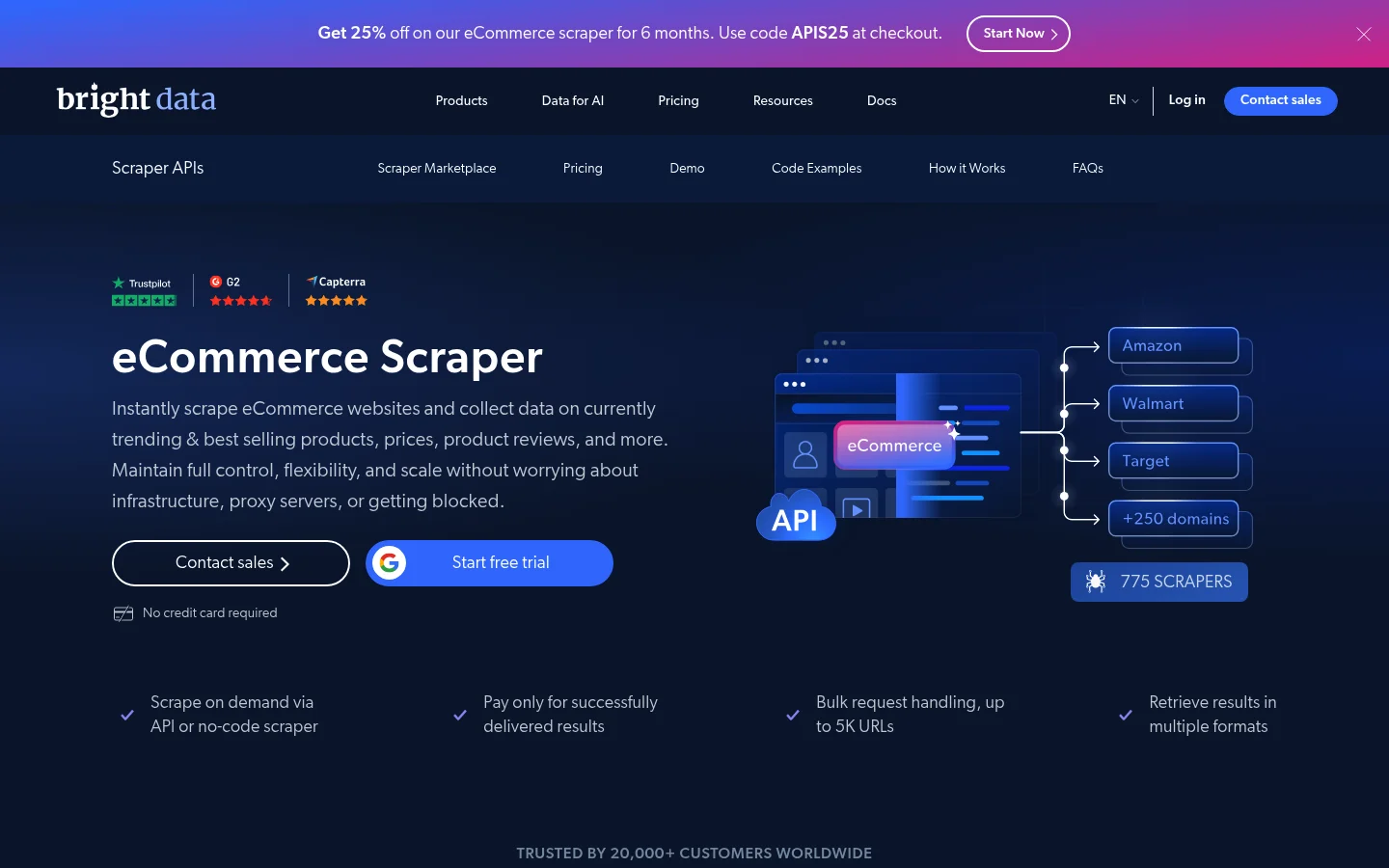
Bright Data achieved a 98.44% average success rate in Scrape.do’s independent benchmark of 11 providers, the highest result of any tool tested. It is the only infrastructure in this comparison that combines dedicated pre-built scrapers for every major marketplace, a 400M+ IP residential proxy network, a managed cloud browser for JavaScript-heavy pages, and ready-to-use ecommerce datasets in a single infrastructure.
A Dedicated Scraper for Every Major Marketplace
The eCommerce Scraper API is the hub for Bright Data’s retail coverage, with purpose-built scrapers for Amazon, Walmart, eBay, AliExpress, Etsy, Target, Best Buy, Shein, and Shopify stores, among others. Each scraper returns normalized JSON with the fields that retail teams actually use: product title, price, currency, discount, availability, images, ratings, seller, brand, and category, without any custom parser configuration. This breadth is the core reason Bright Data leads for ecommerce specifically: most projects span several marketplaces at once, and the dedicated scrapers cover them out of the box.
These scrapers are part of the broader Web Scraping API, a catalog of 600+ ready-made scrapers. Pricing is pay-per-success and starts at $0.75 per 1,000 successful records at scale ($1.50 on pay-as-you-go, currently 25% off for the first three months with code APIS25), which means teams are never charged for blocked or failed requests. At high ecommerce volumes, where block rates on aggressively protected endpoints can reach 5% to 15% with lower-tier tools, pay-per-success directly reduces the cost of a production pipeline.
Scraping Browser for JavaScript-Heavy Product Pages
Many product and search pages load the price, stock status, and reviews via JavaScript after the initial response. Standard HTTP scrapers miss those fields entirely and return a partial page. Bright Data’s Scraping Browser is a managed cloud browser that handles JavaScript rendering, automatic CAPTCHA solving, and fingerprint evasion with no infrastructure to manage. It connects to Playwright, Puppeteer, and Selenium through a standard remote browser session, so teams can route existing automation code through it without a rewrite. Developers who want a working starting point can follow Bright Data’s guide to ecommerce web scraping with Python.
400M+ IP Residential Proxy Network
Bright Data’s residential proxy network includes 400M+ ethically sourced IPs across 195 countries, the largest available from any provider. At ecommerce scale, where repeated requests from a narrow IP range trigger 429 rate-limit errors, the breadth of the residential pool is a direct operational advantage. Geo-targeting routes requests through specific countries so teams can collect localized pricing and availability from country-specific storefronts, which is essential for international price monitoring.
Review Mining, a Visual IDE, and Ready-Made Datasets
Beyond product data, the Reviews Scraper extracts ratings and review text from ecommerce sites, social platforms, and directories for sentiment and quality analysis. For custom targets, the Web Scraper IDE lets teams build and run scrapers as serverless functions on Bright Data infrastructure. And for teams that need bulk data without running a pipeline at all, the pre-collected ecommerce datasets cover 9 billion records, including an Amazon dataset with more than 1.5 billion records, available for immediate download or via API and refreshed on a schedule.
Anti-Bot Coverage and Enterprise Infrastructure
Bright Data handles every major anti-bot system deployed on retail sites: Cloudflare, DataDome, PerimeterX, Akamai, and Imperva. The 98.44% benchmark success rate is the empirical proof of that capability at scale. The infrastructure serves 50,000+ customers including Fortune 500 companies, maintains a 99.99% uptime SLA, and is GDPR, CCPA, and ISO 27001 compliant, with SDKs for Python, Node.js, Java, and C#.
Pricing
Web Scraping API: $1.50 per 1,000 successful records on pay-as-you-go (currently 25% off for the first three months with code APIS25), with a Scale plan at $499/month for 384,000 records and $1.30 per 1,000 additional records, dropping to $0.75 per 1,000 at the highest volumes. A free plan includes 5,000 requests with no credit card required. Full plan details are on the Web Scraper API pricing page, and you can start a free trial of Bright Data to test any scraper before committing.
Best for: Production ecommerce pipelines, multi-marketplace price monitoring, digital shelf tracking, AI training data collection, and enterprise teams that cannot tolerate high failure rates.
Pros:
- 98.44% average success rate in Scrape.do’s independent benchmark, highest of 11 providers tested
- Pay-per-success from $0.75/1K records at scale ($1.50/1K pay-as-you-go), with no charge for blocked or failed requests
- Dedicated pre-built scrapers for Amazon, Walmart, eBay, AliExpress, Etsy, Target, Best Buy, Shein, and Shopify
- 400M+ ethically sourced residential IPs across 195 countries for reliable rotation at scale
- Pre-collected ecommerce datasets for instant bulk access, plus a managed Scraping Browser and Reviews Scraper
Cons:
- Higher base price than the cheapest alternatives for low-volume scraping of unprotected pages
- The full infrastructure has a learning curve for teams new to proxy-based scraping infrastructure
2. Oxylabs: Best for Enterprise-Scale Reliability
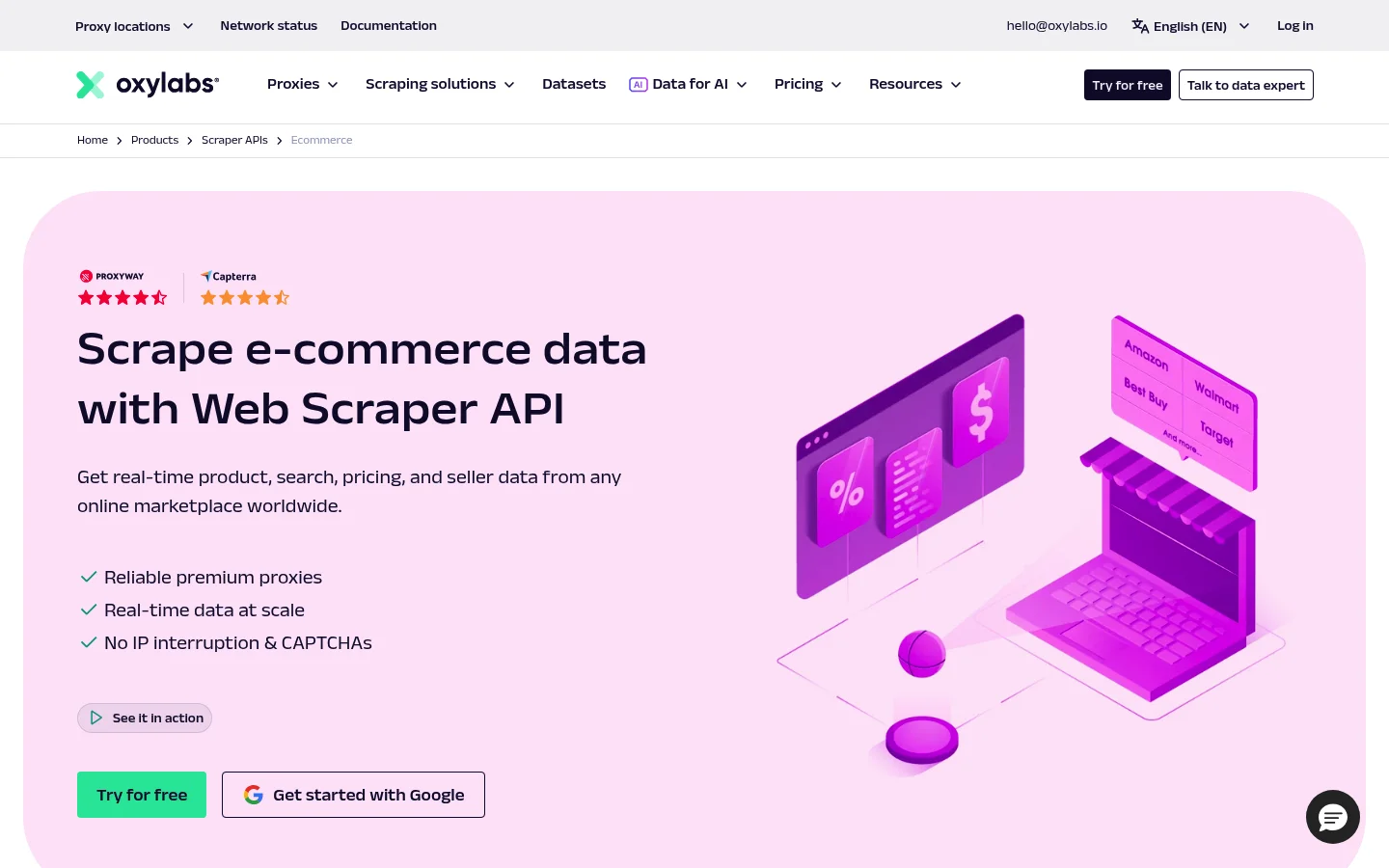
Oxylabs is a strong enterprise option with a dedicated E-Commerce Scraper API and broad marketplace coverage. It is a common choice for large retail monitoring programs that need SLA-backed infrastructure and structured ecommerce output.
Key features:
- Dedicated E-Commerce Scraper API with structured JSON output for major marketplaces
- Feature-based billing, so requests are priced by the features they actually use
- 100M+ residential IPs across 195 countries for rotation at scale
- OxyCopilot to generate parsing instructions without manual selector work
- Free trial with up to 2,000 results and no credit card required
Pricing: The Micro plan starts at $49/month for up to 98,000 results at $0.50 per 1,000 results. Higher tiers and enterprise pay-per-result contracts are available for large volumes.
Best for: Enterprise teams running large-scale price and availability monitoring that need dedicated support and structured ecommerce endpoints.
Pros:
- Dedicated ecommerce endpoints with reliable structured output across major retailers
- Strong enterprise support and SLA-backed infrastructure
- Feature-based billing can lower cost on simple targets
Cons:
- The $49 monthly minimum prices out small projects and occasional use
- Smaller proxy pool than Bright Data’s 400M+ network, and generally higher cost at comparable volume
3. Apify: Best for Pre-Built Ecommerce Actors
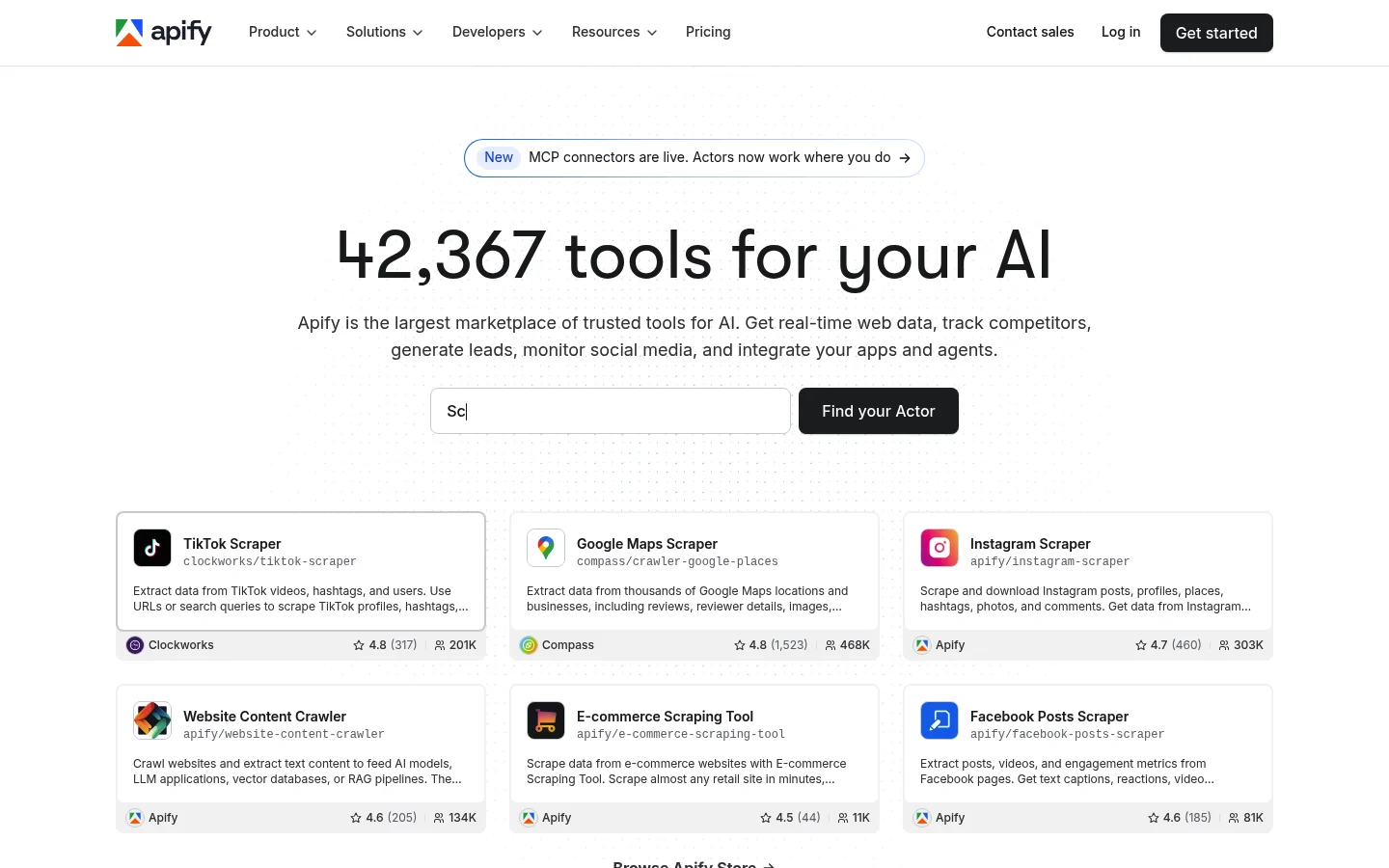
Apify is a cloud platform built around “Actors,” reusable scraping programs published in a large marketplace. It is a fast path to a working ecommerce scraper for developers who would rather configure a ready-made tool than build one.
Key features:
- 42,000+ community and official Actors, including Amazon, eBay, and Shopify scrapers
- Pay-per-result pricing on many ecommerce Actors, often a few cents per 1,000 results
- Outputs structured data in JSON, CSV, and Excel with no extra configuration
- Built-in scheduling, webhooks, and API access for pipeline automation
- MCP integration for connecting scrapers to AI agents
Pricing: The free plan includes $5/month in platform credits with no credit card required. Paid plans start at $29/month on the Starter tier, with pay-as-you-go usage beyond included credits.
Best for: Developers who want a ready-made ecommerce scraper from a large marketplace and are comfortable with community-maintained tools.
Pros:
- Huge Actor marketplace shortens time to first data for common marketplaces
- Flexible output formats and pay-per-result pricing on many ecommerce Actors
- Active developer community that publishes updates for popular sites
Cons:
- Community-maintained Actors can lag behind a marketplace’s latest anti-bot changes
- No proprietary residential network at Bright Data’s scale, so success rates on the most protected retail pages can be lower
4. Zyte: Best for Scrapy and Developer Pipelines
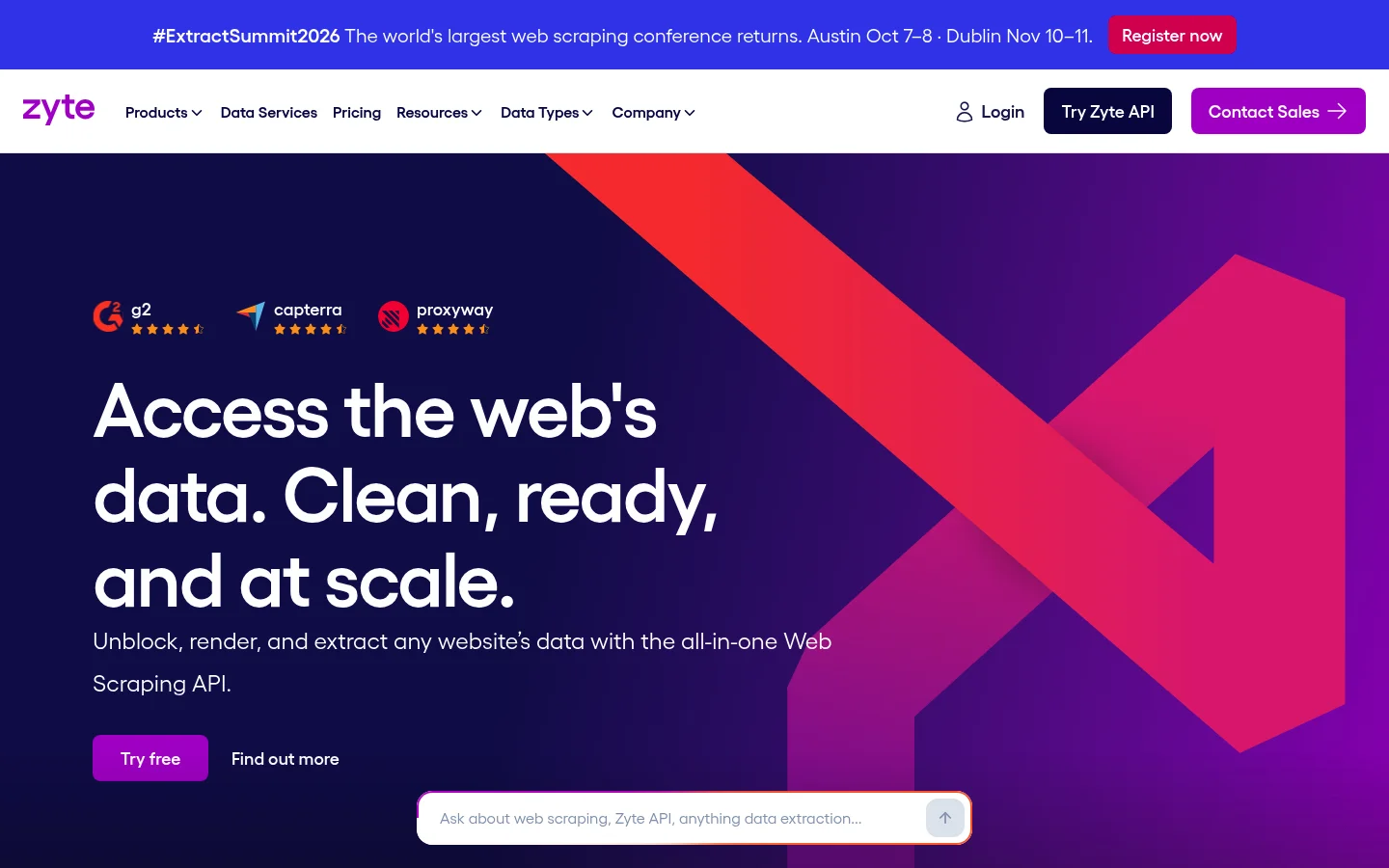
Zyte, the team behind the open-source Scrapy framework, offers the Zyte API for unblocking plus managed Scrapy Cloud hosting and AI-powered extraction. It suits Python developers who want fine-grained control and transparent per-site costs.
Key features:
- Zyte API combines proxy rotation, browser rendering, and anti-ban handling in one endpoint
- AI Extraction returns structured product data without custom parsers
- Scrapy Cloud for deploying and scheduling Scrapy spiders
- Per-site tiered pricing, so simple targets cost less than heavily protected ones
- No overage penalties on usage
Pricing: A $5 free credit covers a 30-day trial. Pay-as-you-go starts at $0.13 per 1,000 requests for simple sites, with browser-rendered requests from $1.01 per 1,000. A $100/month minimum commitment lowers per-request rates across tiers.
Best for: Python and Scrapy developers who want advanced customization and per-site cost transparency.
Pros:
- Deep integration with Scrapy and developer-friendly tooling
- Per-site pricing avoids overpaying for simple ecommerce targets
- AI Extraction reduces parser maintenance
Cons:
- The multi-tier per-site pricing model takes effort to estimate up front
- No no-code catalog of ready-made ecommerce scrapers, so marketplace coverage must be built
5. ScraperAPI: Best for Structured Retail Endpoints
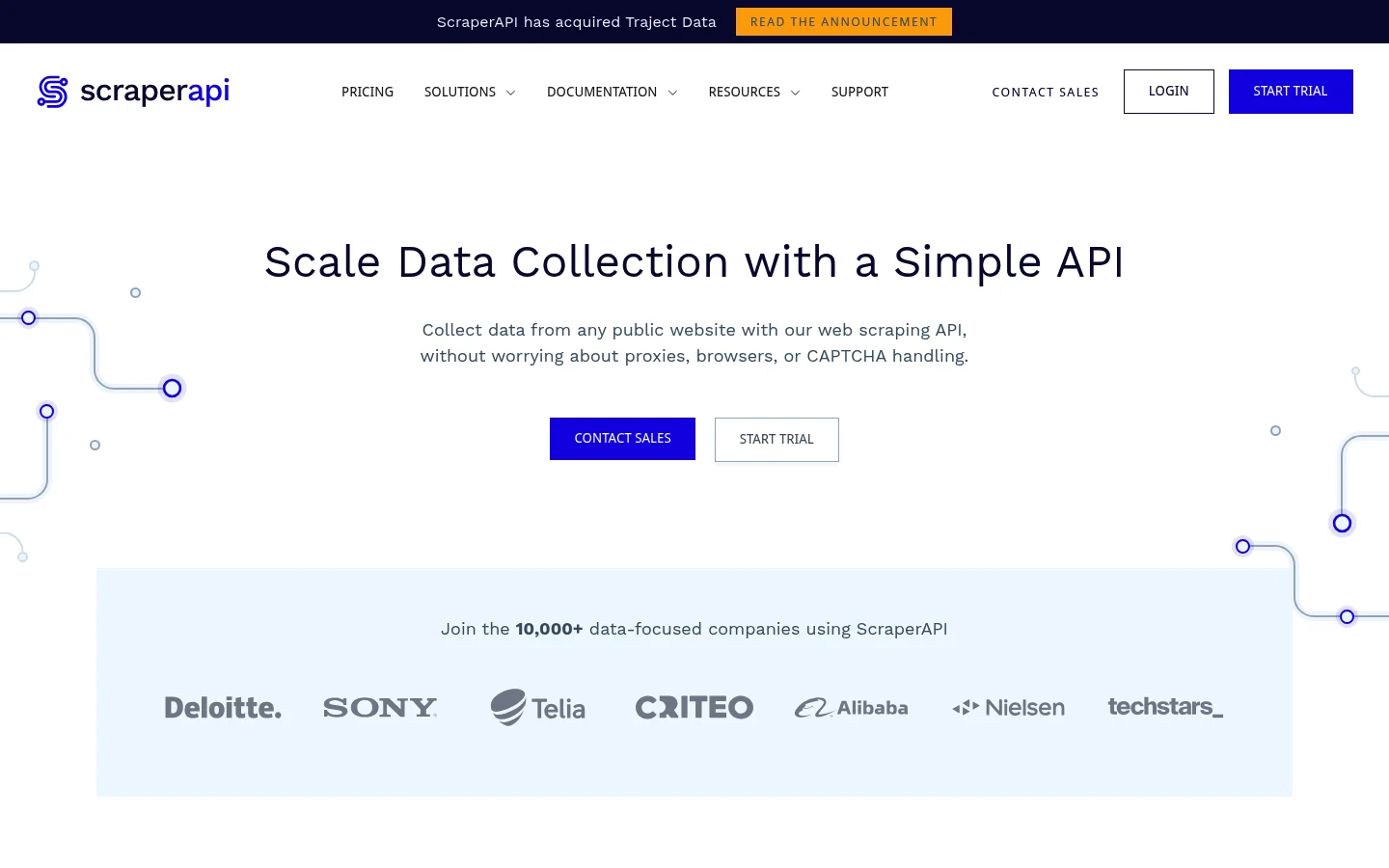
ScraperAPI is a proxy-routing scraping API with dedicated structured data endpoints for major retailers. It is a practical pick for developers who want clean retail JSON without managing proxies.
Key features:
- Structured data endpoints for Amazon, Walmart, eBay, Etsy, Target, and Home Depot
- Automatic proxy rotation, CAPTCHA handling, and JavaScript rendering
- Geo-targeting for country-specific marketplace domains
- Crawler access included on all plans
- Code examples across Python, Node.js, PHP, Ruby, and Go
Pricing: A permanent free tier includes 1,000 API credits per month, with a 7-day trial of 5,000 credits to start. The Hobby plan is $49/month for 100,000 API credits. Note that Amazon requests cost 5 credits each, and global geo-targeting is reserved for the Business plan at $299/month and above.
Best for: Developers who want drop-in retail endpoints with automatic unblocking for common marketplaces.
Pros:
- Dedicated structured endpoints for several major retailers
- Permanent free tier makes prototyping cost-free
- Simple integration with multi-language examples
Cons:
- Credit multipliers add up fast, since Amazon at 5 credits per request means 100,000 credits returns only 20,000 Amazon results
- Global geo-targeting is locked behind the $299/month tier
6. ScrapingBee: Best for Simple API Integration
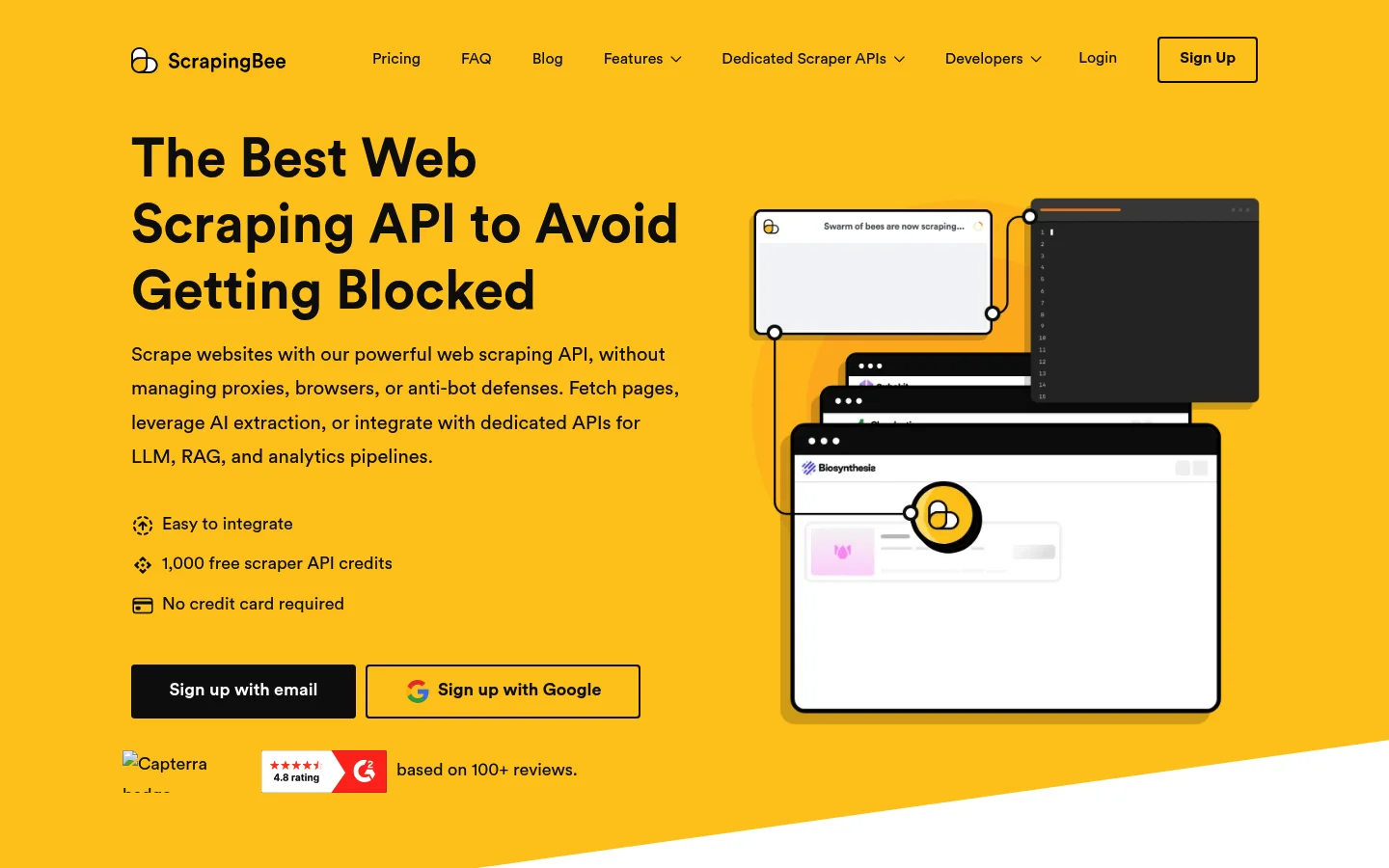
ScrapingBee takes a single-endpoint approach where one API call handles proxy rotation, JavaScript rendering, and CAPTCHA management. It is the fastest path to a working scraper for developers who want minimal setup, and it offers dedicated retail endpoints.
Key features:
- Single REST API endpoint that handles proxying and rendering in one call
- Dedicated Amazon and Walmart endpoints plus a Google API for shopping results
- Headless Chrome rendering for dynamic product pages
- Custom CSS and XPath selectors for targeted field extraction
- MCP server for AI agent integration
Pricing: A free tier includes 1,000 credits with no credit card. The Freelance plan is $49/month for 250,000 API credits, and the Startup plan is $99/month for 1,000,000 credits. JavaScript rendering consumes additional credits per request.
Best for: Small teams and solo developers who want a simple API with retail endpoints and no proxy configuration.
Pros:
- Minimal setup, with one call handling proxying and rendering
- Dedicated Amazon and Walmart endpoints for quick retail extraction
- Transparent credit-based pricing for lower volumes
Cons:
- The credit budget depletes quickly on JavaScript-heavy ecommerce pages
- No bulk dataset offering, and smaller scale than enterprise platforms
7. Octoparse: Best No-Code Ecommerce Scraper
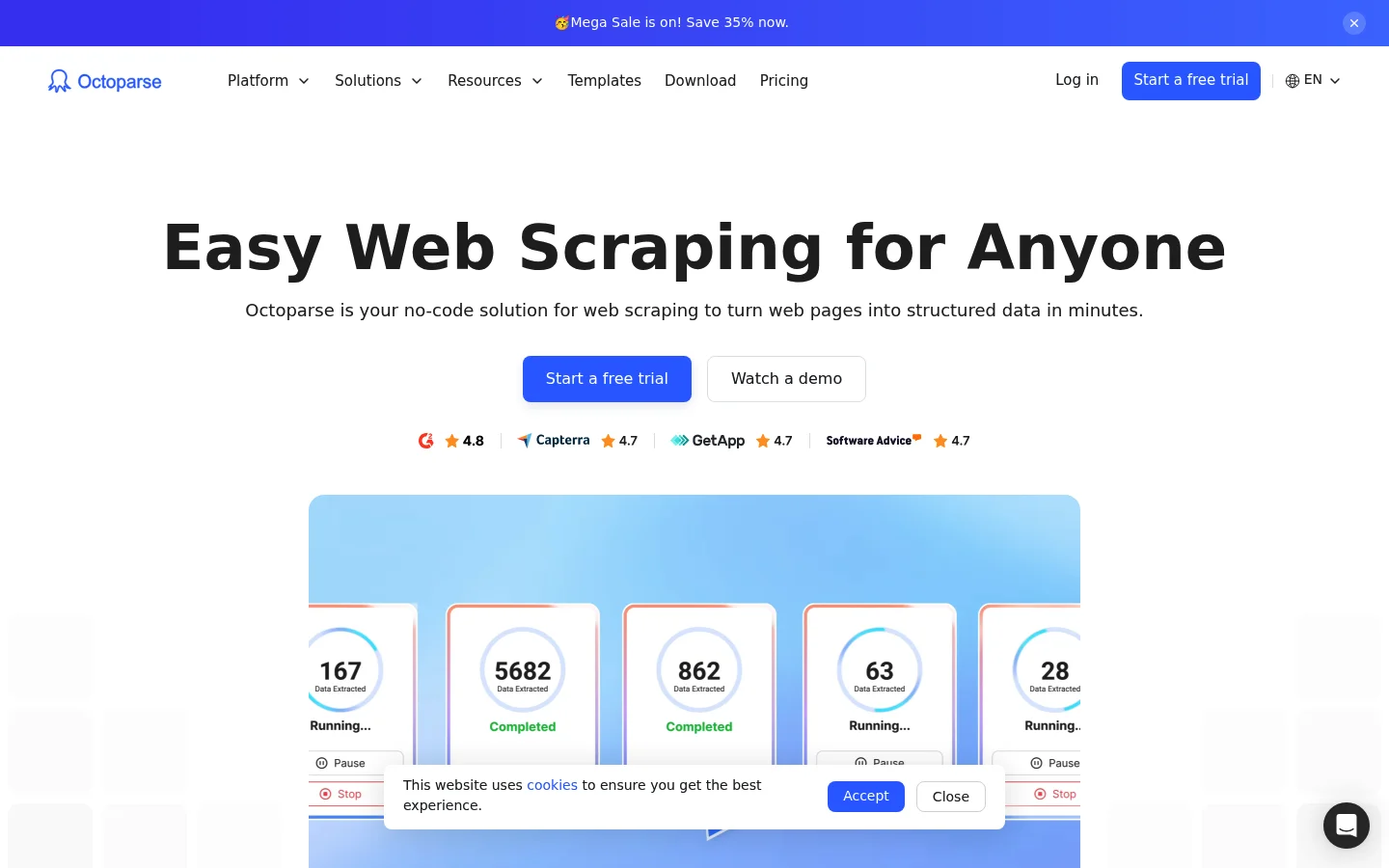
Octoparse is a visual, point-and-click scraper builder for users who want ecommerce data without writing code. It ships with a large library of retail templates and handles pagination automatically.
Key features:
- Visual point-and-click builder with no coding required
- 500+ preset templates, including Amazon, eBay, and Shopify scrapers
- Scheduled cloud scraping with automatic re-runs
- Built-in IP rotation and automatic CAPTCHA solving
- Direct export to Excel, CSV, Google Sheets, and databases
Pricing: A free-forever plan includes 10 tasks and up to 50,000 rows of export per month. The Standard plan is $69/month billed annually for 100 tasks and concurrent cloud runs, with the Professional plan at $249/month for higher concurrency.
Best for: Non-technical users, ecommerce sellers, and researchers who need retail data exports without programming.
Pros:
- No-code interface lets non-developers build ecommerce scrapers quickly
- Large library of ready-made retail templates
- Direct export to Google Sheets and Excel fits non-technical workflows
Cons:
- Not suited to high-volume programmatic pipelines
- Cloud performance on the most protected retail pages trails API-based enterprise tools
8. Decodo: Best for Budget-Conscious Teams
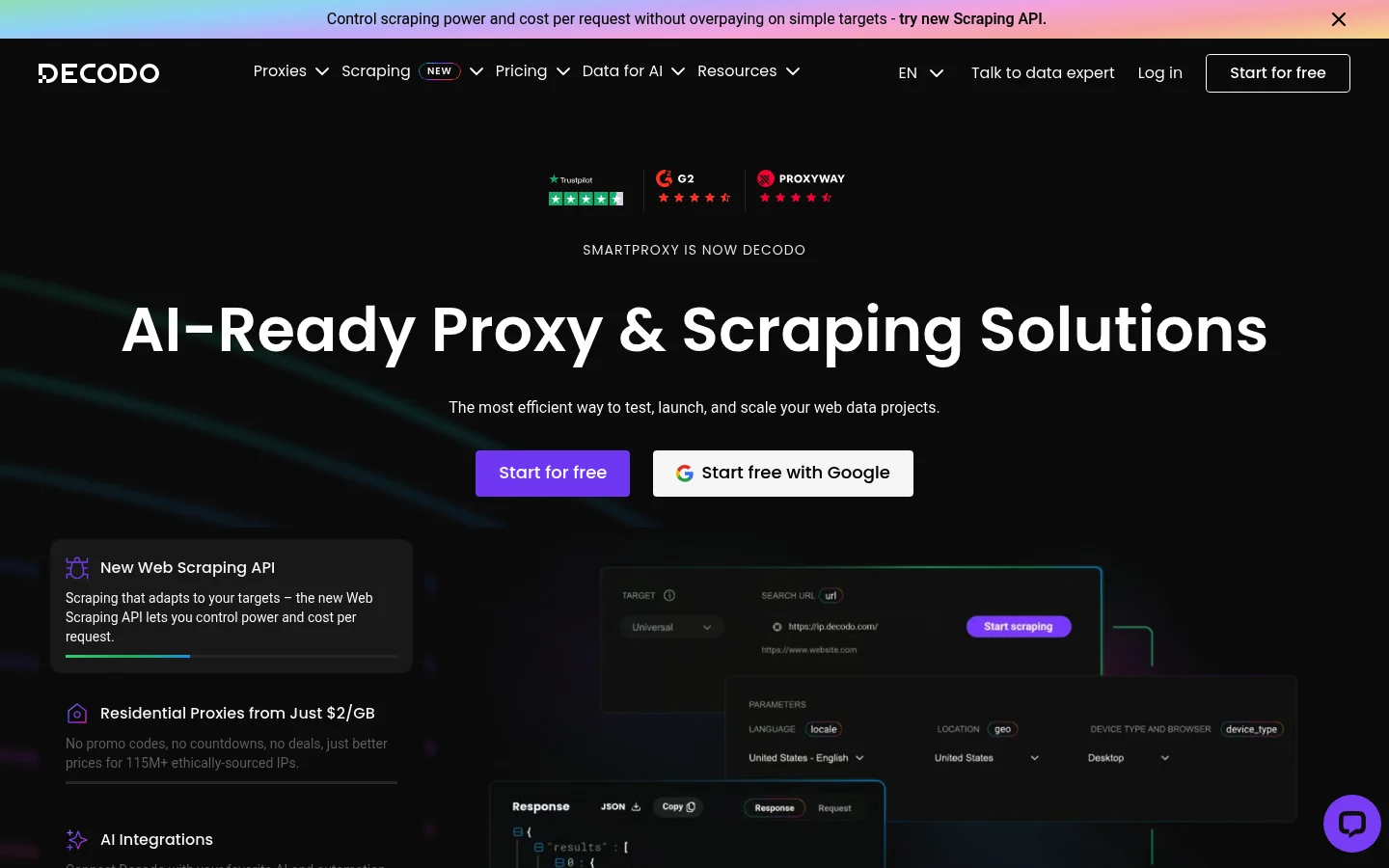
Decodo, formerly Smartproxy, pairs a proxy network with a Web Scraping API and a dedicated eCommerce Scraping API. It is a reasonable option for smaller teams that want solid anti-bot features at a lower entry price.
Key features:
- Dedicated eCommerce Scraping API plus an Amazon ASIN scraper
- 100+ pre-built templates with LLM-ready markdown output
- 125M+ proxy IPs with geo-targeting
- MCP server and a 14-day money-back guarantee
- Per-request credit model with standard and JavaScript-rendered tiers
Pricing: A free plan includes 2,000 requests. Paid plans start at $19/month for 38,000 standard requests at $0.50 per 1,000, with a more ecommerce-focused plan at $49/month for 163,000 requests at $0.30 per 1,000.
Best for: Budget-conscious teams with moderate ecommerce volume that want a low entry price with workable anti-bot features.
Pros:
- Low entry price and a genuine free tier
- Dedicated ecommerce API with LLM-ready output
- Money-back guarantee lowers the risk of trying it
Cons:
- Smaller 125M proxy pool than Bright Data’s 400M+ network
- Premium proxy and JavaScript rendering get expensive on the most protected retail sites
Side-by-Side Ecommerce Scraper Comparison
The reviews above cover each tool in depth. The table below is a quick reference for comparing options at a glance.
| Tool | Type | Free Tier | Starting Price | Best For |
|---|---|---|---|---|
| Bright Data | Full-stack data infrastructure | 5,000 free requests | From $0.75/1K records | Best Overall Ecommerce Scraper |
| Oxylabs | Enterprise scraping API | 2,000 free results | $49/month | Enterprise-Scale Reliability |
| Apify | Cloud actor marketplace | $5/month credits | $29/month | Pre-Built Ecommerce Actors |
| Zyte | Developer scraping API | $5 free credit | $0.13/1K requests | Scrapy and Developer Pipelines |
| ScraperAPI | Proxy scraping API | 1,000 credits/month | $49/month | Structured Retail Endpoints |
| ScrapingBee | REST scraping API | 1,000 credits | $49/month | Simple API Integration |
| Octoparse | No-code scraper builder | Free forever (10 tasks) | $69/month | No-Code Ecommerce Scraping |
| Decodo | Budget scraping API | 2,000 free requests | $19/month | Budget-Conscious Teams |
How to Choose the Right Ecommerce Scraper
The right tool depends on which sites you target, how much data you need, and how much engineering time you can spend on infrastructure. The criteria below map to operational reality.
Match the Tool to Your Target Sites
If your project lives entirely on one marketplace, a single dedicated endpoint may be enough. Most ecommerce projects do not. Tracking prices across Amazon, Walmart, Target, and a set of Shopify storefronts means you need broad, reliable coverage in one place. The depth of a tool’s pre-built scraper catalog is the clearest signal here, because building and maintaining a custom parser for each new marketplace is where projects stall. Bright Data’s dedicated scrapers for every major retailer remove that maintenance burden.
Calculate Cost per Successful Record, Not Sticker Price
Per-request and per-credit pricing is misleading at scale. A tool priced at $0.50 per 1,000 requests with a 96% success rate costs more per usable record than a pay-per-success tool at $1.50 per 1,000 with a 98.44% success rate, once you account for retries on blocked requests. Credit multipliers make this worse: when a single Amazon request costs five credits, a headline credit allowance shrinks fast. Always model the cost per 1,000 successful records for your actual target sites.
Decide Between Live Scraping and Ready-Made Datasets
If you need current prices and stock, live scraping is the answer. If you need historical pricing, a large catalog snapshot, or a one-time bulk pull, a pre-collected dataset is faster and cheaper than building a pipeline. Bright Data’s ecommerce datasets cover billions of records and avoid the need to maintain scraping infrastructure for retrospective analysis. For a broader view of the options, see this roundup of the best ecommerce data providers.
Weigh No-Code Versus API Versus Serverless
Non-technical teams should favor a no-code builder or ready-made datasets. Developers building a production pipeline will want a clean API, SDKs, and the option to run custom logic, which is where an API plus a serverless Web Scraper IDE fits. Matching the delivery mode to your team’s skill level is the difference between shipping in a day and stalling for weeks.
Common Ecommerce Scraping Use Cases
Ecommerce data serves a wide range of needs. The five use cases below are the most common in 2026.
Competitive Price and MAP Monitoring
Price monitoring tracks competitor prices and promotions in near real time so retail teams can adjust their own pricing and enforce MAP agreements. The operational requirement is freshness and reliability: a failed pull on an actively monitored product introduces direct revenue risk. This is a natural fit for Bright Data’s ecommerce data collection capabilities, where pay-per-success pricing means you are not paying for the blocked requests that price-monitoring workloads generate constantly.
Product Catalog and Assortment Tracking
Brands and marketplaces track which products competitors list, how assortments change, and when items go in or out of stock. This means crawling category and search pages across Walmart, Target, and other retailers on a schedule and diffing the results. Pre-built scrapers that normalize fields across sites keep the resulting dataset consistent.
Review and Ratings Analysis
Review data powers product quality analysis, sentiment tracking, and competitive intelligence. A dedicated Reviews Scraper pulls ratings and review text across marketplaces so teams can quantify customer sentiment at scale rather than reading listings by hand.
Dropshipping and Product Research
Product researchers find winning items by tracking demand signals, price gaps, and review velocity. This often means comparing prices on AliExpress and Shein against marketplace selling prices to spot sufficient margin. High-volume research across many categories needs consistent access to product data that does not break on protected pages.
AI and ML Training Data
Product catalogs are among the largest publicly available datasets for training recommendation engines, pricing models, and classifiers. Bright Data serves 75% of AI training data traffic globally, and its pre-collected ecommerce datasets give AI teams analysis-ready product data without building a collection pipeline first.
Key Technical Challenges When Scraping Ecommerce Sites
Ecommerce sites are a demanding scraping target. Four challenges affect every team running retail data pipelines at scale.
Anti-Bot Systems and Fingerprinting
Major retailers deploy Cloudflare, DataDome, PerimeterX, Akamai, and Imperva, which inspect TLS fingerprints, browser behavior, and request patterns to flag non-human traffic. Standard HTTP libraries produce fingerprints that differ from real browsers and get blocked before the application server is reached. Scrapers must rotate IPs, emulate real browser sessions, and pass fingerprint checks, which is why Bright Data’s Scraping Browser and large residential network drive its 98.44% benchmark result.
JavaScript Rendering and Dynamic Pricing
Prices, stock status, and reviews frequently load via JavaScript after the initial response. A plain HTTP GET to a product page often returns markup with the product name but no price, which is exactly the kind of silent partial result that breaks a pipeline without raising an error. Rendering those fields requires a headless or managed browser that executes JavaScript and returns the fully loaded page.
Rate Limiting and IP Rotation
Repeated requests from a narrow IP range trigger 429 errors once a retailer’s threshold is crossed, and every subsequent request fails until the IP rotates or the cooldown ends. Rotating across a large, diverse residential pool is the most reliable countermeasure, which is why a 400M+ residential proxy network sustains high-volume retail scraping where smaller pools degrade.
Structured Extraction Across Many Site Layouts
Retail layouts vary by category, seller, and listing type, and a parser that works on one product template can fail silently on another, leaving gaps in the output. Pre-built scrapers with field-level normalization, like those in Bright Data’s Web Scraping API, absorb these variations internally, while custom setups require ongoing parser maintenance as retailers change their frontends.
If collecting ecommerce data at scale is the next step, start a free trial of Bright Data and access the most reliable scraping infrastructure available.
Frequently Asked Questions
Q: What data can you extract from ecommerce sites?
Public ecommerce data available for extraction includes product titles, prices, currency, discounts, availability and stock status, product images, star ratings, review text, seller and brand names, category trees, and identifiers such as ASIN or SKU. Search and category pages add ranking and assortment data, while seller storefronts expose listing counts and store-level ratings. All of these fields are publicly visible on the page.
Q: Which ecommerce scraper has the highest success rate?
Bright Data achieved a 98.44% average success rate in Scrape.do’s independent benchmark of 11 scraping providers, the highest result of any tool tested. That result reflects its 400M+ residential proxy network, managed Scraping Browser, and automatic handling of Cloudflare, DataDome, PerimeterX, Akamai, and Imperva, which are the systems most retailers deploy.
Q: Can I scrape Amazon and other retailers without getting blocked?
Avoiding blocks on major retailers requires three capabilities working together: residential IP rotation to prevent rate-limit triggers, browser fingerprint evasion to pass TLS and behavioral checks, and automatic CAPTCHA solving when a challenge appears. Tools like Bright Data’s Scraping Browser handle all three automatically. Without all three, scrapers hit blocks, 429 errors, and incomplete data on the most protected product pages.
Q: Does Bright Data have pre-built ecommerce scrapers?
Yes. Bright Data’s eCommerce Scraper API includes dedicated, pre-built scrapers for Amazon, Walmart, eBay, AliExpress, Etsy, Target, Best Buy, Shein, and Shopify, among others, as part of a catalog of 600+ ready-made scrapers. Each returns normalized JSON without custom parser work. Pricing is pay-per-success from $0.75 per 1,000 records at scale ($1.50 pay-as-you-go), and a free plan is available at /cp/start.
Q: What is the best free ecommerce scraper?
For a permanent free option, Bright Data offers a free trial of 5,000 requests with no credit card. Free tiers suit prototyping and small pulls; production volume requires a paid plan.
Q: Should I use live scraping or a pre-collected dataset?
Use live scraping when you need current prices and stock, such as competitive price monitoring. Use a pre-collected dataset when you need historical pricing, a large catalog snapshot, or a one-time bulk pull, because it avoids building and maintaining a pipeline. Bright Data offers both: live scrapers via the eCommerce Scraper API and ready-made ecommerce datasets covering billions of records.
Q: What programming languages work best for ecommerce scraping?
Python and Node.js are the most widely used. Python’s Requests, BeautifulSoup, Scrapy, and Playwright libraries cover everything from basic HTTP scraping to full browser automation, and Node.js with Puppeteer or Playwright suits JavaScript teams. Bright Data provides SDKs and examples for Python, Node.js, Java, and C#, and integrates with Playwright, Puppeteer, and Selenium for browser-based extraction.



Web Data & AI Expert
 6 years experience
Daniel Shashko is a Senior SEO/GEO at Bright Data, specializing in B2B marketing, international SEO, and building AI-powered agents, apps, and web tools.