







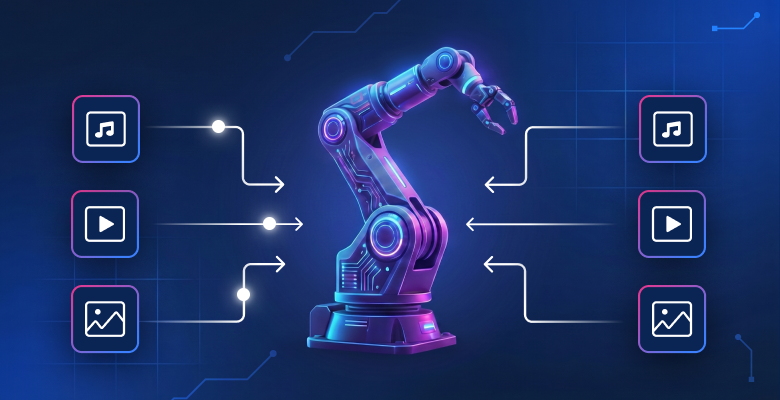
Robots have been able to weld a car or move a pallet for decades. What they still cannot do reliably is the thing a toddler does without thinking: pick up an unfamiliar object, turn it over in one hand, and use it. That skill is robotic dexterity, and it has become the most heavily funded frontier in robotics. The surprising part, once you look closely, is that the hard problem is no longer the hand. It is the data.
This guide explains robotic dexterity the way a technical reader needs to understand it: what it is, how the leading systems are built, which breakthroughs got the field here, and why the binding constraint has quietly shifted from hardware and algorithms to training data. That last point is where web data enters the story.
In this article:
- What robotic dexterity is, and why it is so much harder than it looks
- The dual-system architecture behind modern dexterous robots
- The model breakthroughs that moved the field from scripted motion to learned skill
- Why data, not compute or hardware, is now the bottleneck
- Where web-scale data fits, and how teams actually assemble it
What robotic dexterity actually means
Robotic dexterity is the ability of a robot to manipulate objects skillfully, the way a human hand does. The most useful distinction is between simple pick-and-place, where a gripper moves a known object from A to B, and dexterous manipulation, where the robot reorients an object within its grasp, adjusts force on the fly, and handles shapes and materials it was never explicitly programmed for. In-hand reorientation, not lifting, is the part that separates a true dexterous system from an industrial arm.
Three things make this genuinely hard.
Degrees of freedom. The human hand has 27 degrees of freedom. A research-grade robotic hand such as the Shadow Hand has around 24 actuated joints. Coordinating that many joints in real time, under contact, is a high-dimensional control problem that grows badly with each added finger and joint.
The tactile gap. Humans manipulate objects largely by feel. There are roughly 17,000 tactile mechanoreceptors in the skin of a single human hand, giving dense, high-frequency feedback about slip, pressure, and texture. Most robots still operate with sparse or no touch sensing, which is why a robot can crush an egg or drop a wine glass while looking like it has a perfect grip.
Generalization under contact and occlusion. During manipulation the object is usually partly hidden by the hand itself, and small differences in friction, weight, or shape change the right action completely. A system that works on the exact mugs it was trained on can fail on a mug with a slightly different handle. Generalizing to unseen objects is the real prize, and the hardest one.
This is also why dexterity is a software and learning problem as much as a mechanical one. Better hands help, but the gap between a robot that grips and a robot that manipulates is mostly about perception, reasoning, and learned control. For a tour of the software side, the rundown of robotics AI libraries is a good companion to this piece.
How it works: the dual-system architecture
Modern dexterous robots are increasingly built on Vision-Language-Action (VLA) models: a single learned system that takes in camera images and a language instruction and outputs motor actions. The dominant design pattern, used in various forms by Physical Intelligence, NVIDIA, Google DeepMind, and Figure, is a dual-system architecture that borrows loosely from the idea of fast and slow thinking.
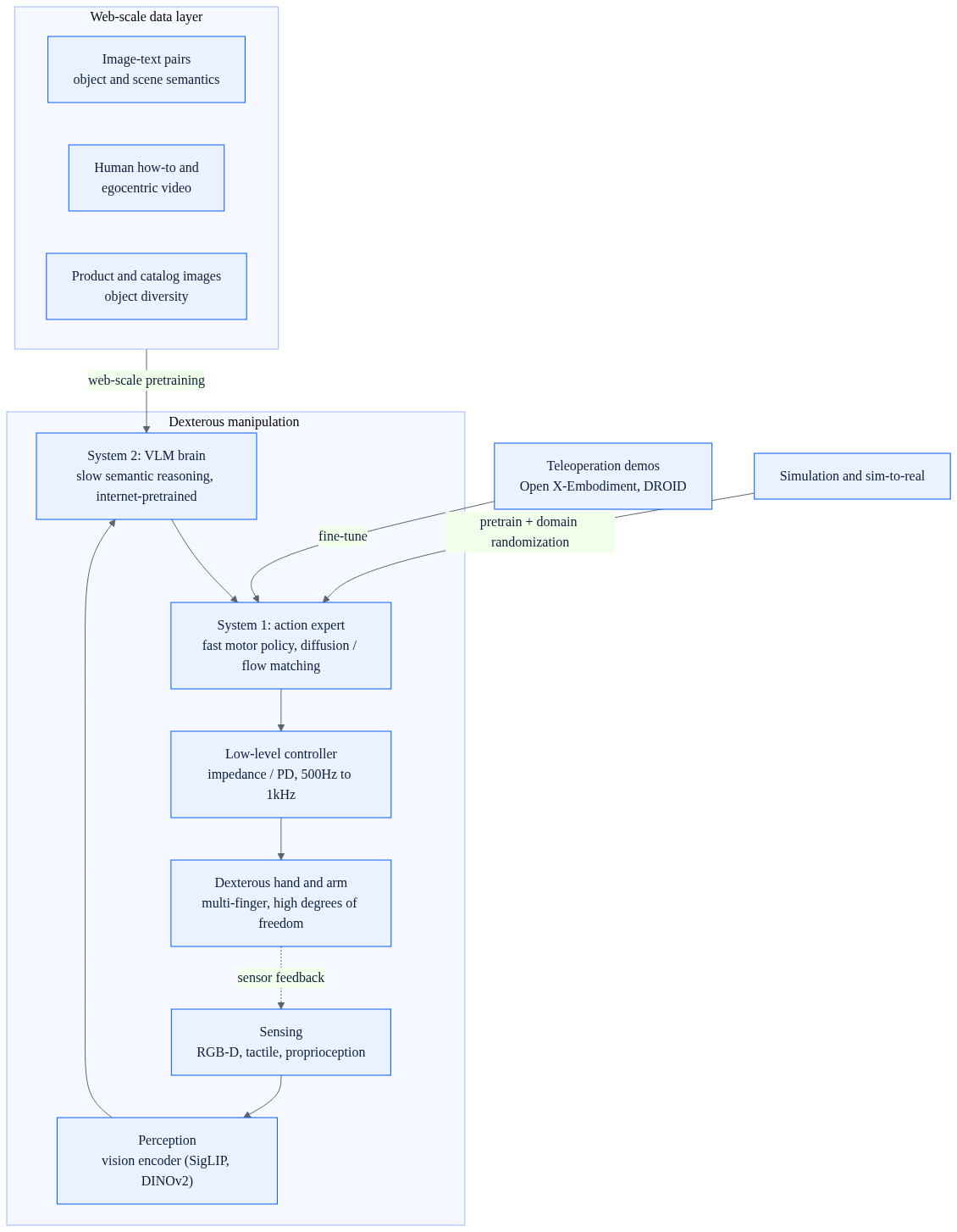
The dual-system stack. Web-scale data pretrains the System 2 reasoning brain, while teleoperation and simulation train the System 1 motor policy. Sensing, perception, control, and the hand form a closed loop.
The pieces, from input to action:
- Sensing. RGB-D cameras, joint encoders for proprioception, and increasingly tactile sensors feed raw state into the system.
- Perception. A pretrained vision encoder, often something like SigLIP or DINOv2, turns pixels into features the rest of the model can reason over. These encoders are themselves trained on enormous image collections.
- System 2, the brain. A vision-language model does the slow, semantic work: understanding the scene, parsing the instruction, and deciding what to do. This component is pretrained on internet-scale image and text data, which is what gives the robot common-sense knowledge of objects it has never physically touched.
- System 1, the action expert. A fast policy, often a diffusion or flow-matching model, converts the brain’s intent into smooth, high-frequency motor commands. This is the part trained on actual robot demonstrations.
- Controller and hand. A low-level controller runs an impedance or PD loop at hundreds of hertz to execute the motion on the physical hand and arm, with sensor feedback closing the loop.
The split matters because the two systems have completely different data diets. System 1 needs real action data, which is scarce and expensive. System 2 is pretrained on the kind of web-scale image, text, and video data that already exists in abundance. Keeping that distinction in mind makes the rest of the field legible. Examples of this pattern in the wild include Physical Intelligence’s pi-0, NVIDIA’s GR00T N1, Google DeepMind’s Gemini Robotics, and Figure’s Helix.
The breakthroughs that got the field here
Dexterity went from scripted to learned over a short, dense run of results.
Imitation learning got good. The Action Chunking Transformer (ACT) and then Diffusion Policy showed that robots could learn fine manipulation directly from human demonstrations. Diffusion Policy, introduced at RSS in 2023, reported a 46.9% average improvement over prior state-of-the-art across 15 tasks by treating action generation as a denoising process, which handles the multimodal, ambiguous nature of real manipulation far better than earlier methods.
Generalist policies arrived. Physical Intelligence’s pi-0, released in late 2024, was a flow-based VLA trained across many robot types that demonstrated long-horizon, contact-rich tasks such as folding laundry from a hamper, a task that combines perception, deformable-object handling, and sustained planning.
Synthetic data scaled. NVIDIA’s GR00T N1, announced in March 2025, leaned on simulation to manufacture training data: its pipeline generated 780,000 synthetic trajectories, the equivalent of about nine months of human demonstrations, in roughly 11 hours, and combining that synthetic data with real data improved performance by around 40% over real data alone.
On-device learning got sample-efficient. Google DeepMind’s Gemini Robotics On-Device, shown in 2025, could be adapted to a new task with as few as 50 to 100 demonstrations, a sign of how much the pretrained brain reduces the amount of robot-specific data each new skill requires.
Touch is improving too, with dense tactile sensors like Meta’s DIGIT line bringing the feel-based feedback that pure vision misses. But notice the pattern across every one of these wins: the lever is almost always better or more data, not a fundamentally new gripper.
Why data, not hardware, is the bottleneck
Here is the claim that reframes the whole field. According to a 2025 analysis from Epoch AI, the largest robotic manipulation models are trained on only about 1% of the compute used for frontier large language models, and the binding constraint is not compute or model size but a shortage of training data. Robotics is data-starved in a way that language and vision no longer are.
The reason is brutal in its simplicity. Language models had the internet: trillions of words sitting in public, ready to be collected. Dexterous manipulation has no equivalent. As the authors of Apple’s EgoDex dataset put it plainly, there is no internet-scale corpus of data for dexterous manipulation. The data has to be created, and each source has a catch:
- Teleoperation produces gold-standard action data, a human puppeteering the robot, but it is slow and expensive. It does not scale to the millions of hours that pretraining a brain demands.
- Simulation is cheap and parallelizable but suffers the sim-to-real gap: a policy that works in simulation often fails on a real robot because physics, friction, and sensor noise never match exactly.
- Human video is abundant and rich, but it lacks robot actions and force labels, so it teaches what to do far better than exactly how to move a specific manipulator.
- Web-scale image and text is the one input that already exists at the scale a foundation model needs, and it is what pretrains the perception and reasoning layers.
That taxonomy is the strategic map of the field. If you want the broader context on how these inputs become a model, the explainer on how AI models are trained and the deeper look at LLM training data both translate directly to the robotics setting. The reason web data keeps coming up is that, as a growing body of work argues, web data is the cornerstone of modern AI infrastructure, robotics included.
Where web-scale data fits
Web data does not teach a robot how to move its fingers. It does something arguably more important: it teaches the robot about the world before it ever picks anything up. There are three concrete contributions, all supported by published results.
Semantic grounding. DeepMind’s RT-2 showed that co-training a robot policy on web-scale image-text data, alongside robot data, roughly doubled its ability to generalize to novel objects and backgrounds, and unlocked emergent behaviors such as picking the object that is an improvised tool or identifying a category it only ever saw on the internet. The web knowledge transfers into physical action. This is the same transfer-learning logic behind fine-tuning a model on web data, applied to a robot.
Object diversity. A 2025 study on data scaling laws in robot imitation learning found that generalization improves as a power law with the diversity of objects and environments in the training set, not merely the number of demonstrations. The authors found that collecting data across roughly 32 diverse objects was enough to reach about 90% success on completely unseen objects. Diversity of objects is, in practice, a web-scale image problem: product catalogs, marketplaces, and image search are where that variety lives, which is exactly what guides on collecting image data at scale address.
Manipulation priors from human video. Egocentric video of people using their hands is the closest thing to a natural manipulation corpus. Meta’s Ego4D assembled 3,670 hours of it, and Apple’s EgoDex added 829 hours across 338,000 episodes and more than 90 million frames specifically for dexterous tasks. This is the raw material researchers mine to teach robots human-like manipulation strategy, even without action labels.
Put together, these three inputs, image-text pairs, diverse object images, and human how-to video, are what fill the System 2 brain. They are all public web data, and assembling them reliably at scale is a data-collection problem. The strategic version of this idea, where better data compounds into a better model that generates better data, is the data flywheel that the strongest AI teams now build deliberately.
Building the data layer in practice
Collecting this kind of data sounds simple until you try it at scale. The image and video sources that matter are exactly the ones that are heavily defended: marketplaces, search engines, and large media platforms rate-limit, geo-restrict, and actively block automated collection, and they render much of their content with JavaScript. Assembling a clean, diverse, multi-region corpus is an infrastructure problem before it is a machine-learning one.
This is where Bright Data fits as the web-data layer beneath a robotics training stack. It is the collection infrastructure that turns the open web into structured, model-ready data, the upstream input to the System 2 brain in the diagram above.
- The Web Scraper API turns image and product sources into structured endpoints, with pre-built scrapers that handle anti-bot systems automatically, so an object-diversity corpus can be pulled without building and maintaining collectors by hand.
- A residential proxy network of 400M+ ethically sourced IPs across the globe is what makes geographic and visual diversity achievable: the same product or scene collected across many regions, which the data-scaling-law results say matters more than raw volume.
- The Scraping Browser renders JavaScript-heavy media and catalog pages that static collection would miss, which is where a large share of real-world object imagery actually lives.
- Ready-made and custom AI and LLM datasets deliver pre-collected, structured corpora directly, exported as JSON, CSV, or Parquet, so a team can feed a pretraining pipeline without standing up collection at all.
Reliability is the part that separates a usable corpus from a poisoned one, because a silent collection failure quietly biases the dataset. Bright Data reports a 98.44% average success rate in an independent benchmark of eleven providers, and maintains GDPR, CCPA, SOC 2, and ISO 27001 compliance while collecting only publicly available data, the kind of provenance that matters when the dataset will train a physical system. If you are weighing how to source this data, the comparisons of datasets versus web scraping APIs and the overview of AI training data providers lay out the options, and the primers on what a dataset is and structured and unstructured data cover the fundamentals. The same collected web data also powers adjacent techniques like embeddings, AI-ready vector datasets, and the RAG versus fine-tuning decision once the raw data extraction is done.
The honest limits
It is important to be precise about what web data does and does not do, because overclaiming here is easy and wrong.
Web data pretrains the brain, not the motor skills. It gives a robot semantic understanding, object knowledge, and visual priors. It does not contain the action trajectories, contact forces, or 3D interaction labels that System 1 needs to actually move a hand. Those still come from teleoperation, simulation, and on-robot learning. Web data raises the ceiling on what a robot can understand and generalize to; it does not replace the physical practice that produces skilled motion.
The tactile gap is also real and unsolved by any amount of imagery. The roboticist Rodney Brooks argued in 2025 that today’s humanoids will not learn true dexterity from motion demonstrations and video alone, because they lack the rich, high-bandwidth touch sensing that human manipulation depends on. That critique is a useful counterweight: better perception data is necessary but not sufficient, and the field still needs progress in tactile hardware and sim-to-real transfer. The right way to read all of this is that data is the current bottleneck, not the only one.
Where this is heading
The trajectory is clear even if the timeline is not. Dexterous manipulation is converging on large, pretrained, multi-modal models, the same recipe that worked for language and vision, and the field itself now names better data, especially video and web-scale pretraining, as the path out of the data constraint. As hands, tactile sensors, and sim-to-real methods improve in parallel, the differentiator between teams will increasingly be the quality and diversity of the data they can assemble.
That is the quiet conclusion under all the humanoid funding announcements. The robots that learn to manipulate the world will be the ones trained on the best picture of it, and most of that picture is public web data. Bright Data is the layer that turns that open web into reliable, structured, model-ready data. Ready to build the data layer for your AI systems? Start for free and see how quickly the open web can become training data.
Frequently Asked Questions
Q: What is robotic dexterity?
Robotic dexterity is a robot’s ability to manipulate objects skillfully, the way a human hand does, including reorienting an object within its grasp, adjusting force in real time, and handling shapes and materials it was not explicitly programmed for. It goes well beyond simple pick-and-place, where a gripper moves a known object between fixed points. The defining capability is in-hand manipulation of unfamiliar objects.
Q: Why is dexterous manipulation so hard for robots?
Three reasons. First, high degrees of freedom: a human hand has 27 and a research robotic hand around 24 actuated joints, which is a difficult real-time control problem. Second, the tactile gap: humans rely on roughly 17,000 touch receptors per hand for dense feedback, while most robots have little or no touch sensing. Third, generalization: during manipulation the object is often occluded by the hand, and small changes in shape or friction change the correct action, so transferring skills to unseen objects is very hard.
Q: What is a Vision-Language-Action (VLA) model?
A VLA model is a single learned system that takes in camera images and a natural-language instruction and outputs robot motor actions. Modern dexterous robots often use a dual-system version: a slow vision-language brain that understands the scene and plans, pretrained on internet-scale image and text data, paired with a fast action expert, often a diffusion or flow-matching policy, that converts that plan into high-frequency motor commands trained on real robot demonstrations.
Q: Why is data the bottleneck for robot dexterity instead of hardware?
Analysis from Epoch AI in 2025 found that the largest robotic manipulation models use only about 1% of the compute of frontier language models, and that the limiting factor is a shortage of training data rather than compute or model size. Unlike language, dexterous manipulation has no internet-scale dataset to learn from, so the action data has to be created through expensive teleoperation or imperfect simulation, while the perception and reasoning layers are pretrained on web-scale image and text data.
Q: How does web data help train a dexterous robot?
Web data pretrains the robot’s perception and reasoning brain rather than its motor control. It contributes in three ways: semantic grounding, where web image-text pretraining roughly doubled generalization in DeepMind’s RT-2 work; object diversity, where studies on data scaling laws show generalization improves with the variety of objects and scenes, which is a web-scale image problem; and manipulation priors from human video such as Ego4D and EgoDex. It does not replace the action and force data that physical practice provides.
Q: Can a robot learn dexterity from web data and video alone?
No. Web data and video give a robot semantic understanding and visual priors, but they do not contain the action trajectories, contact forces, and 3D interaction labels needed to control a hand. Those come from teleoperation, simulation, and on-robot learning. Critics such as Rodney Brooks also argue that true dexterity needs rich tactile sensing that current humanoids largely lack. Web data raises what a robot can understand and generalize to, but physical practice and better touch sensing are still required.



Technical Writer
Arindam Majumder is a developer advocate, YouTuber, and technical writer who simplifies LLMs, agent workflows, and AI content for 5,000+ followers.