







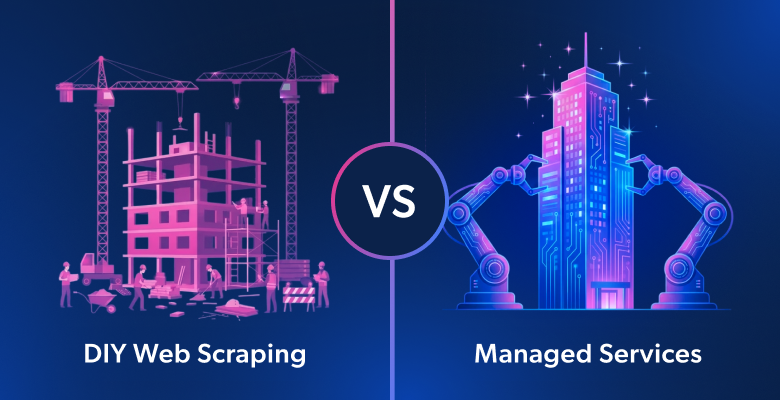
Every data team hits the same fork in the road. You can own the entire collection pipeline: every scraper, every proxy, every retry loop. Or you can hand that layer to a managed data service and let your engineers focus on using the data instead of chasing it. The in-house path feels safer on day one. The bill arrives later, and it rarely looks like the original estimate.
The web scraping market sits at $1.56 billion in 2026 and is on track for $3.49 billion by 2031, a 17.39% CAGR, according to Mordor Intelligence. As anti-bot defenses harden, the effort required to maintain an in-house pipeline grows with them. This guide helps you make the call with clear numbers rather than optimistic estimates.
Quick answer: which model fits your team?
Use a managed service if your goal is to use data, not to build a collection capability. It is faster to set up, cheaper to run at most scales, and needs almost no maintenance. Build in-house only when collection is your core competency, your volumes are massive on simple targets, or compliance rules prevent third-party handling.
| If you… | Choose | Why |
|---|---|---|
| Need data quickly with a small team | Managed service | Operational from day one, near-zero upkeep |
| Have 20+ active sources to maintain | Managed service | Complexity compounds faster than most teams expect |
| Scrape enormous volumes of simple, static pages | In-house | Per-page economics favor a homegrown crawler at scale |
| Have strict data-residency requirements | In-house or hybrid | Full control over where data flows |
| Need sources no provider supports | Hybrid | Managed service for the hard ones, in-house for the rest |
| Want engineers focused on analysis and product | Managed service | Maintenance is the provider’s problem, not yours |
The true cost of running it yourself
When teams budget for in-house scraping, they plan for engineering time and infrastructure. Both are real. Neither is the biggest line item. The costs that appear later are the ones that hurt: maintenance every time a target site changes, fixing broken collectors, handling silent failures that pass your monitoring checks, incident response, compliance work, and the opportunity cost of senior engineers not building product. Every one of these is recurring, and none of them shrink as your source list grows.
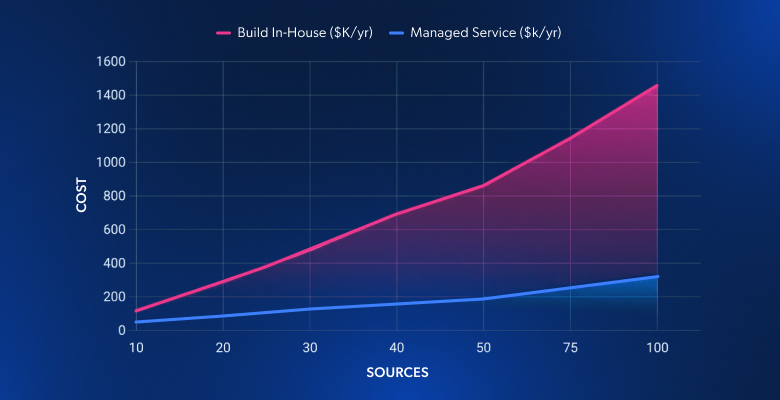
Industry data shows the initial build accounts for only 30 to 40% of a scraper’s lifetime cost. The remaining 60 to 70% is maintenance and operations. Here is what that looks like in practice, at 50 active sources and 2 million pages per month.
Assumptions (50 sources)
| Input | Estimate |
|---|---|
| Number of active scrapers | 50 |
| Maintenance hours per scraper / month | 4 |
| Loaded engineering rate | $125 / hour |
| Monthly page volume | 2,000,000 pages |
| Average blended infrastructure cost / page | $0.004 |
| Medium-impact incidents / month | 3 |
| Estimated cost per incident | $2,000 |
| Additional engineering time diverted to maintenance | 80 hours / month |
Monthly cost breakdown
| Category | Calculation | Monthly cost |
|---|---|---|
| Engineering time | 50 × 4 × $125 | $25,000 |
| Infrastructure | 2,000,000 × $0.004 | $8,000 |
| Missing data and downtime | 3 × $2,000 | $6,000 |
| Opportunity cost | 80 × $125 | $10,000 |
| Total monthly cost | $49,000 | |
| Annual cost | $588,000 | |
| 3-year cost | $1.76M |
Notice what dominates. Labor, meaning engineering time plus opportunity cost, accounts for roughly 70% of the total. That proportion does not change as you scale. It usually gets worse.
Why complexity compounds
A common assumption is that adding more sources scales linearly. It does not. Costs grow faster than volume. More sources mean more independent failure points, and fifty scrapers are not fifty times the effort of one. They are fifty systems that fail in fifty different ways. Higher collection frequency multiplies risk, and harder targets cost disproportionately more. The long tail of smaller sources tends to break quietly and gets discovered late. Scraping expertise also concentrates in a few engineers, so losing any of them becomes an operational risk.
Build vs. buy, side by side
This is not a question of whether your team can build scrapers. Most teams can. It is a question of who owns the ongoing operation.
Initial setup
| Activity | Build (in-house) | Buy (managed service) |
|---|---|---|
| Source scoping and requirements | Your team researches sources, flows, and edge cases | Defined together with the provider |
| Collector development | 3 to 15 days per source | Handled by the provider |
| Access and traffic management | Configure proxies, sessions, retries, rendering | Included in the service |
| Monitoring and alerting | Build and maintain your own | Included |
| Data validation and QA | Build your own validation rules and checks | Included in delivery |
| Delivery and integration | Build export logic to your systems | Configured to your destination |
Ongoing operations
| Activity | Build (in-house) | Buy (managed service) |
|---|---|---|
| Site changes and maintenance | 4 to 16 hours per incident, ongoing | Handled by the provider |
| Scaling to new sources | New engineering project each time | Scoped as an expansion |
| Incident response | Your team owns detection and fixes | Provider-owned response |
| Access and infrastructure tuning | Continuous internal effort | Included |
| Backfills and reprocessing | Engineering-owned | Included where scoped |
| Compliance and governance | Your team’s responsibility | Supported by the provider |
When each model makes sense
Building in-house is the right call when your sources are simple, stable, and few. It also fits when collection itself is a competitive differentiator, meaning the way you get data is part of what makes your product different. The same applies when compliance rules mean data cannot flow through a third party at all.
A managed service wins when the source list is large or growing, the data is business-critical, and your engineers already spend meaningful time on maintenance rather than product work. If you hesitate to expand into new markets because of the added scraping burden, that is a clear signal the pipeline has become a drag rather than an asset. The core question is simple. Are you trying to build a data collection capability, or are you trying to use reliable web data? If collection is your competitive edge, build it. If data is what creates value and collection is just the machinery to access it, a managed service is usually the better fit.
What about AI coding assistants?
Tools like Claude Code, Cursor, and Copilot can cut the initial build by 30 to 50% and speed up routine fixes. But look at where in-house pipelines actually lose money. It is not writing code. It is the recurring fight against anti-bot systems, proxy churn, and infrastructure overhead. An AI assistant can rewrite a broken parser in minutes. It cannot detect a new Cloudflare challenge, rotate a proxy pool, or catch a silent failure. Those costs do not shrink because your editor got smarter.
AI narrows the build gap, not the operating gap. If anything, it strengthens the hybrid case: AI-assisted scripts for simple, stable sources, and a managed service for dynamic or business-critical ones.
The signals that your pipeline has become a bottleneck
Most teams do not switch models because they planned to. They switch because the maintenance weight finally outgrows the value of owning it. These are the signs:
Engineering
- Engineers are regularly pulled off product work to fix scrapers
- Only a few people understand how the system works
- Failures are discovered downstream, not by your own monitoring
Cost
- Infrastructure bills rise faster than your data volume
- The actual monthly cost is well above the original estimate
Strategic
- Collection work competes directly with your core product roadmap
- Your team spends more time getting data than using it
Any one of these is manageable. When several appear together, the pipeline has become the constraint rather than the source of advantage.
How Bright Data fits the picture
Whether you want to own the pipeline or hand it off entirely, Bright Data covers the full range without forcing you to switch vendors as your needs evolve. If you want a fully managed service, the Data Services team operates the entire collection layer for you: source scoping, maintenance, monitoring, and delivery. You define what you need and receive clean, structured data at your destination, on managed service pricing scoped to your source list.
If you prefer to run your own stack, Bright Data gives you the infrastructure to do it:
- Web Scraper API: 1,300+ pre-built scrapers returning structured JSON with zero maintenance on your end
- Scraper Studio: build a custom scraper for any site from a plain-English prompt
- Web Unlocker: raw HTML from any URL when you want to write your own parser
- Scraping Browser: a scriptable browser for JavaScript-heavy pages with clicks, scrolls, and forms
- Datasets: pre-collected, ready-to-use data when you would rather skip scraping entirely
Most teams start by moving their highest-priority sources to managed delivery, then gradually shift the rest of the operation over time. Few go back. If you are still mapping the landscape, our guide to data as a service covers how the delivery models differ.
Conclusion
DIY gives you total control at the price of permanent maintenance. A managed service gives you speed, reliability, and predictable costs at the price of some customization. For most teams the managed model is the rational default, and in-house is the deliberate exception.
Run the numbers against your own source count, engineering rate, and incident history before you commit. The total is almost always higher than the infrastructure bill alone, and that gap is what the decision should actually be based on. Bright Data offers 5,000 free records per month so you can test before you commit, with no credit card required.
Frequently asked questions
Is a managed data service cheaper than running scrapers in-house?
It depends on your scale and the complexity of your sources. On simple, stable sites with a small number of scrapers, in-house can stay cost-effective. But as your source list grows, or as targets become more dynamic and access-sensitive, the maintenance burden compounds fast.
What does in-house scraping really cost per month?
At 50 active scrapers and 2 million pages per month, the fully loaded cost lands around $49,000 per month, or $588,000 per year. Engineering labor dominates that figure, not infrastructure.
Do AI tools change the math?
They cut build time, sometimes by half. They do not reduce proxy costs, infrastructure overhead, or the anti-bot arms race, which are the costs that dominate a mature in-house operation.
When does building in-house make sense?
When collection is a genuine competitive differentiator, your sources are simple and stable, compliance rules prohibit third-party handling, or you only need a one-time collection.
Can I mix both approaches?
Yes, and many teams do. Managed service for dynamic, protected, or business-critical sources. Lightweight scripts for simple, low-stakes targets. A hybrid keeps costs down without drowning your team in maintenance.


Senior Product Marketing Manager
 20 years experience
Creative and energetic Product Marketing Manager with more than 20 years marketing experience from leading hi-tech companies, as well as early stages startups.