







In this article, you will learn:
- What embodied AI is.
- How it works and the components it involves.
- Where it is applied and which scenarios it covers.
- The steps required to build an embodied AI system.
- How Bright Data supports embodied AI applications.
- The current challenges and what the future holds for this technology.
Let’s dive in!
What Is Embodied AI?
Embodied AI refers to artificial intelligence embedded in physical systems that can perceive, reason, and act in the real world.
Embodied AI interacts with physical environments through sensors, computer vision, machine learning, and control systems. It combines perception, decision-making, and physical action in a continuous feedback loop, enabling machines to adapt to changing environments and perform complex tasks autonomously.
How Embodied AI Works
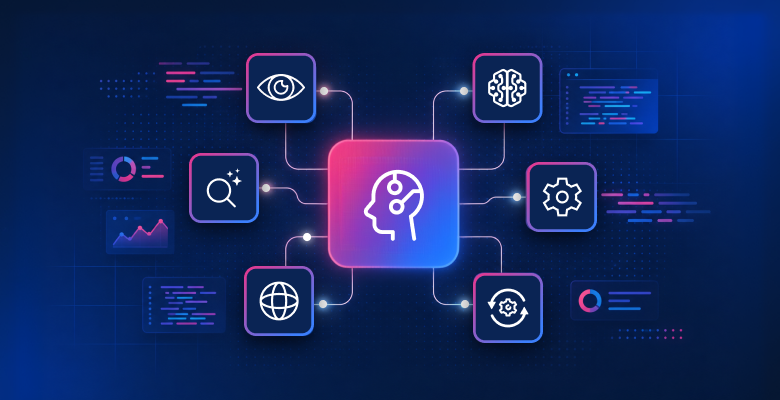
At a high level, you can think of embodied AI as a combination of three core components working together:
- Brain: Interprets situations, makes decisions, and plans actions using machine learning, large language models, and reinforcement learning.
- Body: Perceives the environment through sensors and computer vision systems, then physically interacts with it through actuators.
- Physical space: Provides context, feedback, and continuous learning opportunities.
In simple terms:
Embodied AI = AI models (Brain) + Sensors and actuators (Body) + Physical spaceThe brain determines what is happening and decides what to do next. The body gathers information from the environment and executes actions. Meanwhile, the physical world constantly introduces new variables, forcing the system to adapt and improve over time.
For example, a warehouse robot may use cameras, lidar, and tactile sensors to understand its surroundings. Computer vision helps it identify shelves and packages, while AI models determine the best route or next task. Reinforcement learning can further improve performance over time by helping the robot learn from successes and mistakes.
Real-World Applications of Embodied AI
The global embodied AI market was valued at USD 5.1 billion in 2025 and is projected to reach USD 58.9 billion by 2033, growing at a CAGR of 35.8% between 2026 and 2033.
As the market continues to expand rapidly, new applications and use cases are emerging. However, some of the most relevant and impactful ones today include:
- Humanoid robots: Enables humanoid robots to walk, manipulate objects, follow instructions, and adapt to dynamic environments.
- Warehouse automation: Autonomous mobile robots (AMRs) use AI to navigate warehouses, pick inventory, move goods, avoid obstacles, and optimize fulfillment operations.
- Autonomous vehicles: Self-driving cars, trucks, and robotaxis rely on embodied AI to perceive roads, detect obstacles, interpret traffic conditions, and make driving decisions in real time.
- Manufacturing and smart factories: Industrial robots that perform assembly, quality inspections, predictive maintenance, and adaptive production tasks in changing factory environments.
- Healthcare and medical robotics: Robotic surgery, rehabilitation systems, patient assistance, and hospital automation by enabling safe, context-aware physical interactions.
- Agriculture and farming: Autonomous machines that monitor crops, detect diseases, harvest produce, and optimize irrigation and pesticide use with minimal human intervention.
- Smart spaces and buildings: Robots and intelligent systems that monitor facilities, transport items, improve security, and optimize energy use in offices and commercial buildings.
- Home robotics: Consumer robots that can clean spaces, assist elderly individuals, recognize objects, and adapt to household routines and environments.
- Search, rescue, and hazardous environments: Robots that operate in dangerous settings, such as disaster zones, mines, or industrial accidents, where human intervention is risky.
How to Build Embodied AI
Building embodied AI is a multi-stage process that combines data, learning, and simulation through specialized robotics AI frameworks. This involves:
- Pre-training: Builds general intelligence.
- Post-training: Refines behavior in safe learning environments.
- Inference: Enables real-time action.
- Deployment: Connects systems to the physical environment.
- Evaluation: Ensures safety, reliability, and accountability over time.
Together, these components form a closed loop between perception, reasoning, and physical interaction. Explore each of the required steps to build an embodied AI system!
Stage #1: Pre-Training
Pretraining involves using datasets to teach AI models foundational skills and knowledge before they are fine-tuned for specific tasks. The goal is to expose models to diverse data so they can develop strong reasoning and perception capabilities.
Web data provides large-scale knowledge about human behavior, language, and common sense. This requires high-quality, AI-optimized web data providers to ensure the information is structured, relevant, and optimized for training.
Robotics-specific data then adds grounding in physical interactions. Here, data annotation plays a pivotal role in making raw sensor streams usable. Humans (or semi-automated systems) label images, videos, and robot logs with object categories, spatial information, and actions such as object detection, segmentation, and behavior recognition. These annotated datasets allow models to connect raw sensory input with meaningful interpretations of the physical world.
Stage #2. Post-Training
Once pretrained, embodied AI systems undergo post-training to adapt their behavior to specific tasks. This stage focuses on improving performance, stability, and safety before deployment in physical environments. Post-training is typically achieved through techniques such as fine-tuning, reinforcement learning, and imitation learning.
Simulation plays a central role at this stage. Before interacting with physical systems, robots are trained and tested in simulated environments and digital twins, which are virtual replicas of physical settings.
Those environments enable safe experimentation. In detail, they allow systems to explore thousands of scenarios, including rare and dangerous edge cases, without physical risk. This improves generalization and helps close the sim-to-real gap, increasing the likelihood that learned behaviors remain stable once transferred outside controlled environments.
Within these simulations, reinforcement learning helps agents improve through trial and error by maximizing rewards for successful actions. Over time, robots learn more effective navigation, manipulation, and decision-making strategies.
Imitation learning complements that process by allowing systems to learn directly from human demonstrations. Here, data annotation and labeling play an important role, as expert actions are mapped to specific states, objects, and tasks. This structured supervision helps robots acquire efficient behaviors faster, reducing the need to learn everything from scratch through experimentation alone.
Stage #3: Inference
Inference is where embodied AI becomes active in the real world. Here, trained models process live sensory input and decide what actions to take in real time.
Computer vision systems interpret images and spatial data, enabling object detection, navigation, and scene understanding. LLMs allow robots to understand instructions, generate responses, and interact naturally with humans. Vision-language models (VLMs) and vision-language-action models (VLAMs) extend that capability by linking perception directly to physical action.
Together, these AI systems support intelligent, context-aware behavior in dynamic environments.
Stage #4: Deployment
Once deployed, embodied AI systems keep improving through interaction with the physical world. Every action generates new data, which feeds back into future training cycles. This forms an ongoing loop where perception, action, and learning reinforce each other.
Over time, systems become more adaptable, resilient, and capable of handling complex physical-world tasks. In this sense, embodied AI is not a static model, but an evolving process that improves through repeated experience in the physical domain.
Stage #5: Evaluation
After deployment and iterative learning, embodied AI systems must be continuously evaluated to verify they operate safely, reliably, and effectively. Unlike traditional AI, evaluation is not only about model performance, but also about how well the system behaves in dynamic environments where physical consequences matter.
A production-ready embodied AI evaluation framework is built around three key dimensions:
- Autonomy: Measures how independently a system can perceive, decide, and act with minimal human intervention, even under changing conditions.
- Accuracy: Evaluates how precisely the system interprets its surroundings and executes actions, where even small errors can lead to significant physical consequences.
- Accountability: Focuses on transparency and traceability, ensuring decisions can be explained and linked back to data, models, or policies.
Bright Data: Datasets and Annotation for Embodied AI
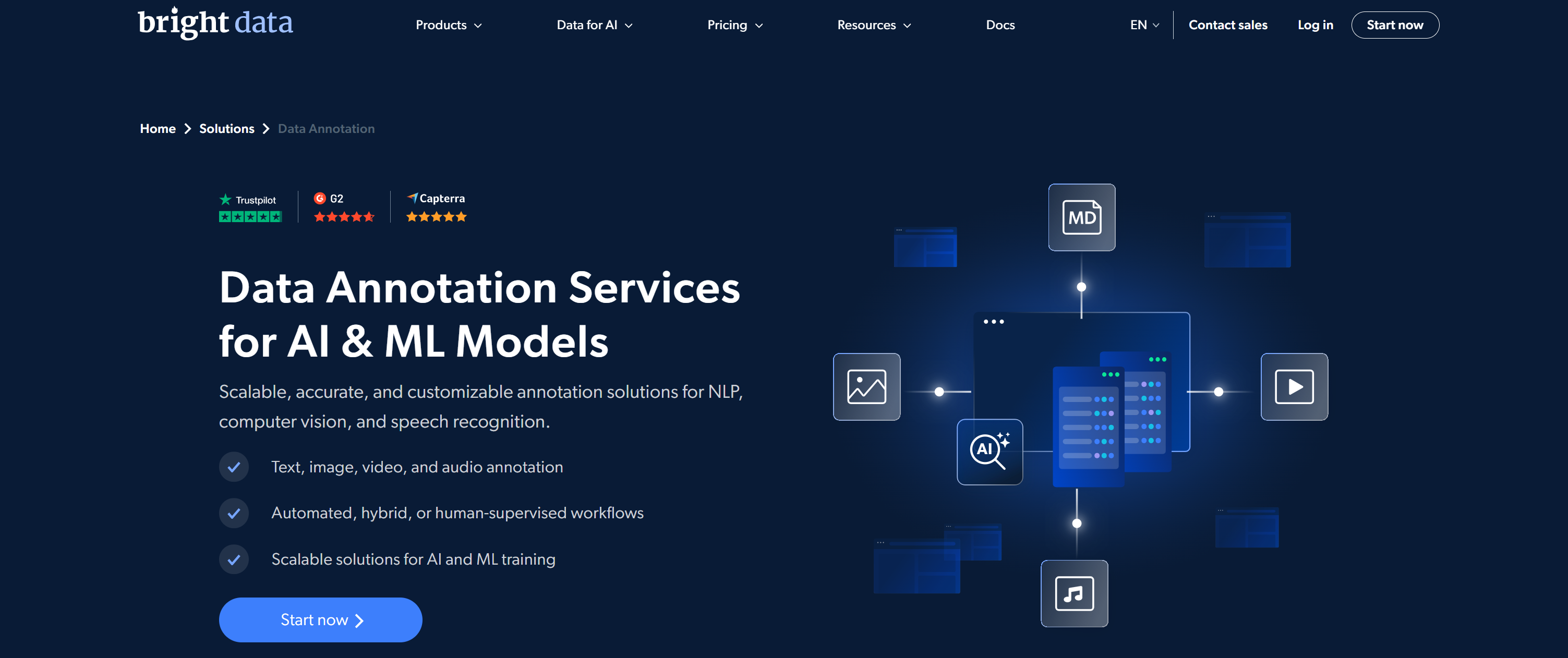
Bright Data is an enterprise-grade web data infrastructure provider. It supports the development of embodied AI systems through:
- Robotics dataset marketplace: Large-scale, multimodal datasets for robotics and physical AI applications. These curated datasets include over 4 billion structured records, covering video streams, audio recordings, sensor readings, motion data, and environmental context.
- Data annotation services: High-quality labeling services for AI training, including object detection, segmentation, pose estimation, and behavioral annotation. These services support text, image, video, and audio data, and are delivered through automated, hybrid, or human-supervised workflows.
What makes Bright Data stand out is its strong focus on compliance, reliability, and security. It provides GDPR- and CCPA-ready data pipelines and adheres to industry standards such as ISO 27001, SOC 2, SOC 3, and CSA STAR. That ensures that data collection, processing, and annotation meet strict privacy and governance requirements, which are essential for robotics systems operating in safety-critical environments.
To support scalability and deployment, Bright Data also offers continuous dataset updates (monthly, quarterly, biannually) and cloud-based delivery (S3, GCS, Azure). Combined, these capabilities position Bright Data as an enterprise data backbone for building, training, and maintaining embodied AI systems at scale.
Current Challenges and the Future of This Branch of AI
Today, the embodied AI field is held back by a set of fundamental challenges:
- Sim-to-real gap: Models can be trained efficiently in simulation, but virtual environments cannot fully replicate real-world physics such as friction, lighting, or material behavior.
- Hardware and compute limitations: LLMs, VLAMs, and VLAMs are computationally heavy, yet robots must operate with onboard power and limited energy. This creates serious trade-offs between intelligence, latency, and battery life.
- Safety: Predicting physical outcomes from learned models is still unreliable, especially in complex 3D environments where small errors can lead to unsafe actions.
- Catastrophic forgetting: AI models can overwrite previously learned skills when adapting to new environments.
Looking ahead, progress will likely come from richer multimodal sensing, combining vision, touch, and depth, alongside more accurate world models. Multi-agent systems may enable collaborative robotics, while improved simulation pipelines and safety-by-design frameworks will be essential for real-world trust and deployment.
Conclusion
In this blog post, you learned what embodied AI is, how it works, and its main applications and use cases. You now understand that building an embodied AI system requires high-quality web datasets combined with specialized robotics datasets. It is also important to have access to enterprise-grade data labeling and annotation services to complete the data pipeline.
Bright Data supports this by offering one of the largest AI-optimized web dataset marketplaces, along with leading data annotation services designed for AI and ML models. These services help you build, train, and scale robust AI systems.
Create a Bright Data account today and get started with their services for free!
FAQ
What is the difference between embodied AI and AI?
Traditional AI systems mainly operate in the digital world and learn patterns from fixed datasets. In contrast, embodied AI is grounded in physical systems that perceive and act in real environments.
Embodied AI vs AI in robotics: What is the difference?
AI in robotics is a broad term covering any AI used in robotic systems, including rule-based control or narrow automation. Embodied AI is a more advanced subset where robots actively learn, adapt, and reason through real-time interaction with the environment, tightly integrating perception, decision-making, and physical action in a unified system.
Embodied AI vs physical AI: How do they compare?
Physical AI is a broad term that generally refers to AI systems deployed in physical systems or devices. Embodied AI is more specific, focusing on agents that continuously perceive, reason, and act within their environment. Thus, embodied AI is a branch of physical AI.
How does Bright Data support embodied AI?
Bright Data supports embodied AI by providing large-scale multimodal robotics datasets and enterprise-ready data annotation services. Its platform delivers billions of structured records, including video, audio, and sensor data, along with labeled training data for perception tasks like detection and segmentation. Discover all Bright Data services and products for AI.



Technical Writer
 5.5 years experience
Antonello Zanini is a technical writer, editor, and software engineer with 5M+ views. Expert in technical content strategy, web development, and project management.