







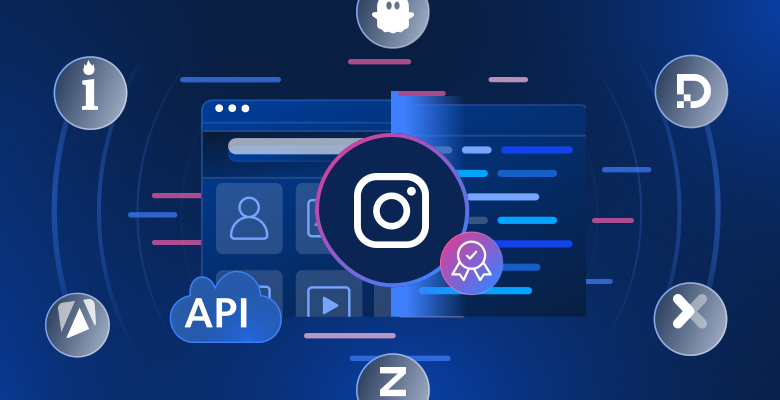
Scraping Instagram at scale requires tools that defeat TLS fingerprinting, IP reputation scoring, CAPTCHA systems, and JavaScript rendering. This guide ranks 8 Instagram scrapers on success rate, data structure, pricing, and integration depth. Bright Data leads. It posted the highest average success rate, 98.87%, of the 16 scraping APIs in Scrape.do’s 2026 benchmark.
TL;DR: Best Instagram Scrapers at a Glance
| Tool | Type | Free Tier | Starting Price | Best For |
|---|---|---|---|---|
| Bright Data | Scraping API + Datasets | 5,000 records/mo, no CC | $0.75/1K requests + double funds up to $500 | Best Overall |
| ScrapingBee | Scraping API | 1,000 free credits | $49/month | Benchmark Success Rate |
| Apify | No-Code Actors | $5 free credits | $49/month | No-Code Scraping |
| Oxylabs | Scraping API | Free trial | $49/month | Enterprise Scale |
| Decodo | Social Media API | 1K free results | $20/month | Budget Pricing |
| Zyte | Scraping API | $5 free credits | $1.01/1K | Cost Efficiency |
| PhantomBuster | Social Automation | 14-day free trial | $56/month | Lead Generation |
| Octoparse | No-Code Visual | Free plan | $99/month | Visual Interface |
What Is an Instagram Scraper?
An Instagram scraper automates extraction of publicly available Instagram data at scale. It returns profiles, posts, reels, comments, hashtags, and engagement metrics in structured formats such as JSON or CSV.
What Instagram Data Types Are Available?
Public Instagram data includes user profiles (username, bio, follower count, post count, engagement rate, verified status), posts (captions, hashtags, likes, comments, media URLs, location tags), reels (view counts, play counts, audio data), comments (text, author, timestamp, reply count), and hashtag feeds. The web scraping market was valued at USD 1.17 billion in 2026. Social media data drives a large share of that enterprise demand.
Why Does the Official Instagram API Fall Short?
Instagram’s Graph API is restricted to your own business account. It requires Meta app review. It does not expose competitors’ posts, public profiles, or hashtag-level feeds. For competitive intelligence, market research, and influencer analysis, third-party scraping tools are the standard approach.
Three Categories of Instagram Scraper Tools
Three tool categories address different team needs. Scraping APIs handle anti-bot automatically and return structured or raw data per request. Pre-collected datasets provide bulk historical data without any scraping infrastructure. No-code visual tools serve teams without developer resources.
The Best Instagram Scrapers, Ranked
The eight tools below are ranked on four criteria: anti-bot success rate, data structure and endpoint coverage, cost per usable record at volume, and integration depth.
1. Bright Data: Best Overall Instagram Scraper
Bright Data is the only tool in this comparison delivering a complete five-product Instagram data platform. It posted the highest average success rate, 98.87%, of the 16 scraping APIs in Scrape.do’s 2026 benchmark.
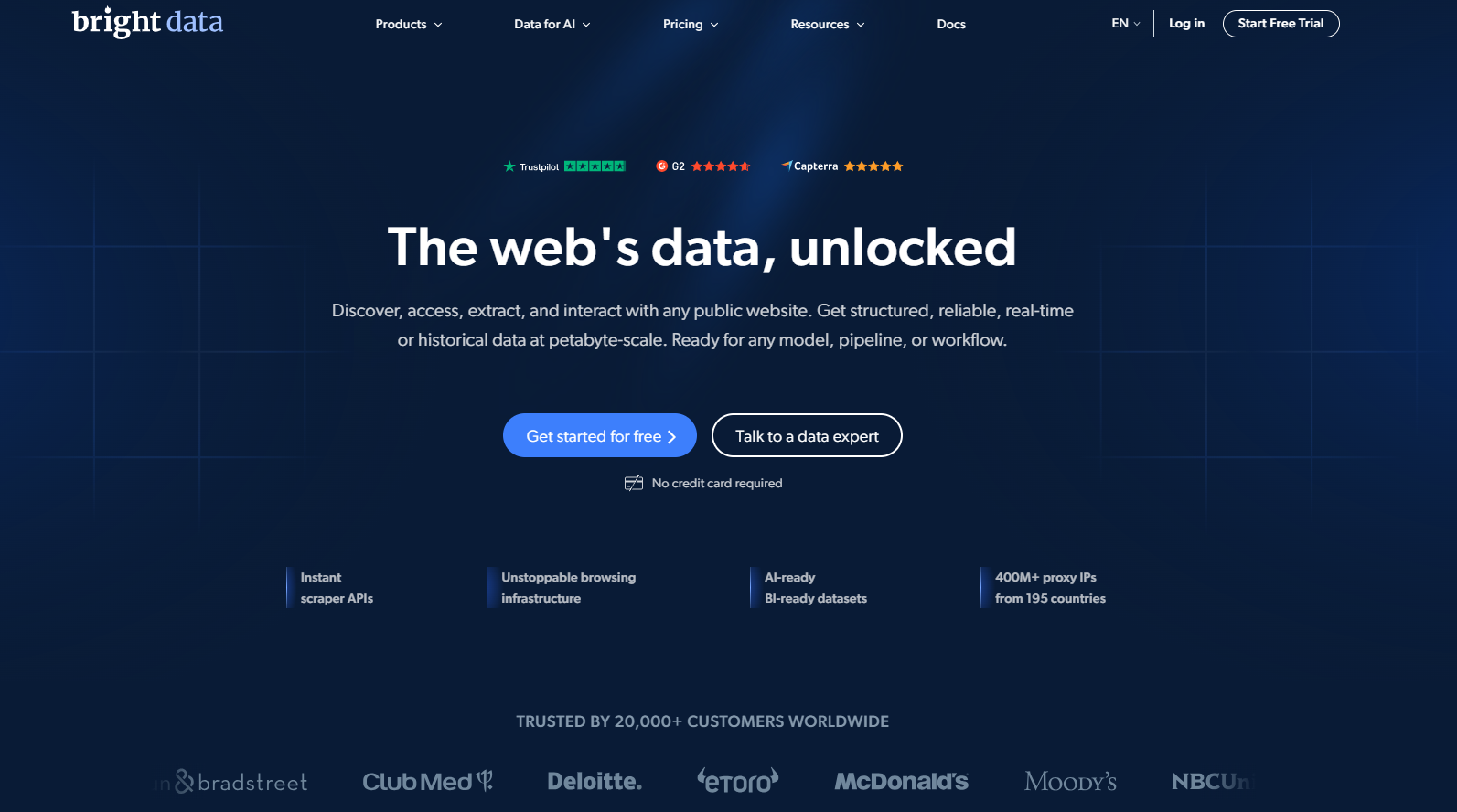
No other tool combines real-time scraping API endpoints, pre-collected datasets, managed browser automation, a 400M+ residential IP network, and an AI-native MCP Server in a single platform. Each product addresses a distinct Instagram data use case. Teams select the right tool for their workflow rather than adapting a general-purpose scraper to Instagram’s anti-bot requirements.
Instagram Scraper API Endpoints
The Instagram Scraper API covers seven endpoint types: profiles, posts, reels, comments, hashtags, followers, and images. Every endpoint returns structured JSON. No custom parser is required. A request to the Instagram profiles scraper returns username, bio, follower count, post count, engagement rate, and verified status in one structured response. Teams building competitive intelligence pipelines skip the extraction logic entirely. Layout changes on Instagram’s front end do not break pipeline output when using endpoint-specific APIs.
Instagram Datasets
Instagram Datasets provide pre-collected snapshots covering posts, profiles, comments, images, hashtags, influencers, and reels. Pricing starts at $250/100K records. For bulk historical analysis, datasets are faster and cheaper than running live scraping jobs at equivalent volume. No scraping infrastructure is required. Data is available for immediate download or via API on a scheduled refresh cycle.
Web Unlocker
The Web Unlocker operates as a proxy server or real-time API. It handles TLS fingerprinting, CAPTCHA solving, and IP rotation automatically. Requests route through Bright Data’s 400M+ residential IP network across 195 countries. At $0.75/1K results, it replaces any proxy setup requiring manual rotation and fingerprint management. Teams with existing scraper code point it at the Web Unlocker endpoint without rewriting request logic.
Browser API
The Browser API is a managed cloud browser compatible with Puppeteer, Playwright, and Selenium. It handles JavaScript rendering, infinite scroll, session management, and CAPTCHA resolution. No headless browser infrastructure needs to be managed. Teams already using Playwright or Puppeteer connect with a single endpoint change. All existing automation code remains intact.
Instagram MCP Server
The Instagram MCP Server connects Instagram data directly to AI agent workflows. Agents call it to pull structured Instagram data on demand, with no scraper code to maintain. Demand is growing fast: the AI-driven web scraping market reached USD 10.2 billion in 2026.
Anti-Bot Coverage
Bright Data’s infrastructure handles CAPTCHA solving and anti-bot systems such as Cloudflare, DataDome, PerimeterX, Akamai, and Imperva. The platform runs on a 99.99% uptime SLA and serves 50,000+ customers, including Fortune 500 companies.
Pricing
Instagram Scraper API: $0.75/1K successful requests with pay-per-success pricing. Blocked requests are never billed. Instagram Datasets: from $250/100K records. Web Unlocker: $0.75/1K results. The first deposit is matched up to $500. The free tier includes 5,000 records every month with no credit card required.
Best for: Production-grade Instagram data pipelines requiring real-time structured data, bulk historical datasets, AI agent integration, or enterprise-scale collection with 99.99% uptime.
Pros:
- Highest average success rate (98.87%) of 16 APIs in Scrape.do’s 2026 benchmark
- Seven Instagram-specific endpoints returning structured JSON with no parser required
- Pay-per-success pricing: blocked requests are never billed
- 400M+ residential IPs across 195 countries, the largest ethically-sourced network available
- Five-product platform: Scraper API, Datasets, Web Unlocker, Browser API, and MCP Server
Cons:
- Higher starting price than budget tools for low-volume or unprotected-site use cases
2. ScrapingBee: Best Benchmark Success Rate
ScrapingBee is a general-purpose scraping API. The Proxyway 2025 benchmark tested it against live Instagram URLs at 2 requests per second. It achieved a 99.65% success rate. Its 4.54-second average response time was the fastest among all benchmarked providers.
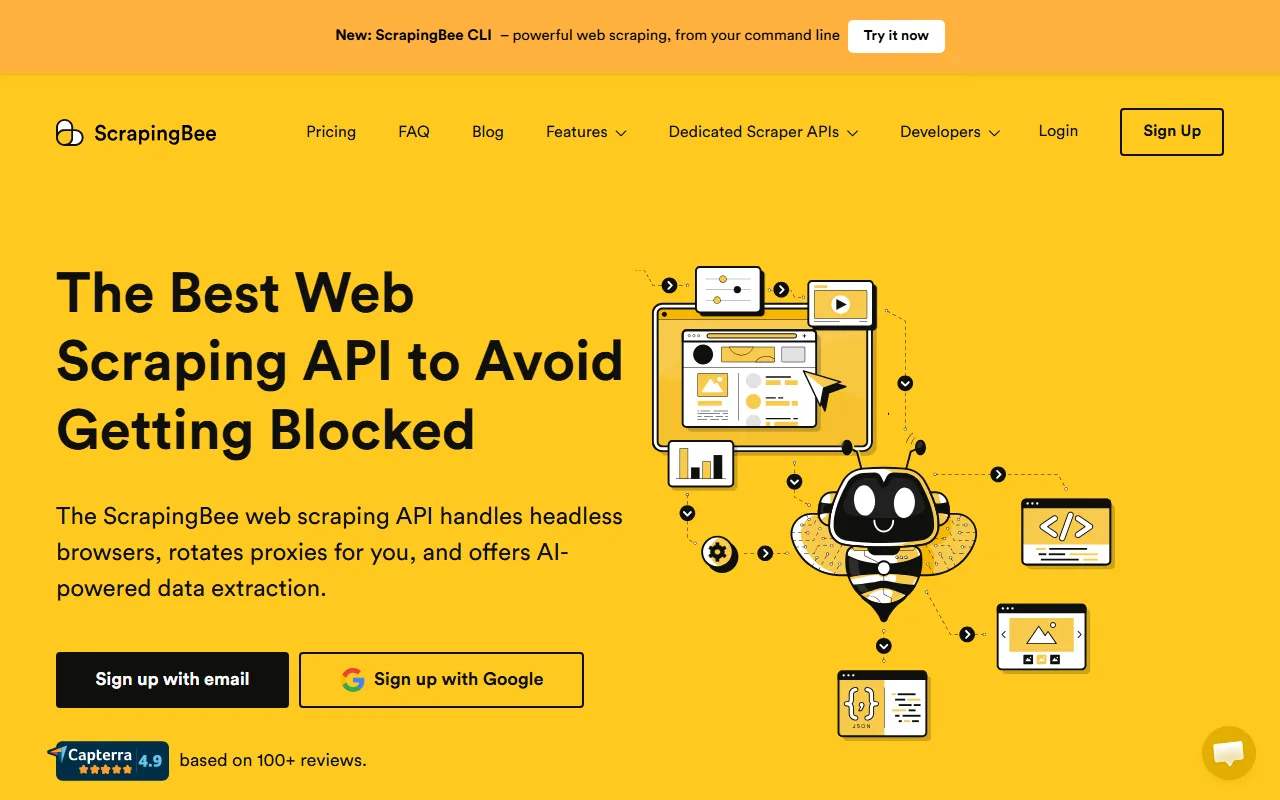
ScrapingBee handles headless browser rendering for JavaScript-heavy Instagram content. Automatic proxy rotation covers 150+ geographic locations. SDKs are available for Python, Node.js, PHP, and Ruby. New accounts receive 1,000 free API credits for initial testing.
The core limitation is output format. ScrapingBee returns raw HTML, not structured Instagram data. Custom extraction logic is required to parse profiles, posts, or hashtag data. For teams with strong in-house parsing capability, this is manageable. For teams expecting endpoint-specific structured JSON, it adds development work and ongoing maintenance overhead when Instagram updates its layout.
Pricing: From $49/month (250K credits). Premium proxy usage costs additional credits per request.
Best for: Teams with strong in-house parsing capability who prioritize raw speed and high success rate over structured output.
Pros:
- 99.65% Instagram success rate (Proxyway 2025 benchmark), highest of individually tested tools
- 4.54s average response time, fastest among all benchmarked providers
- SDKs for four languages reduce integration time
Cons:
- Returns raw HTML with no Instagram-specific parser or structured endpoint
- Premium proxy usage increases cost significantly per request
- No dedicated Instagram data endpoints
3. Apify: Best No-Code Instagram Scraping
Apify provides purpose-built Instagram Actors for profiles, posts, hashtags, comments, and followers. Each returns structured JSON, CSV, or Excel output with no custom parsing required.
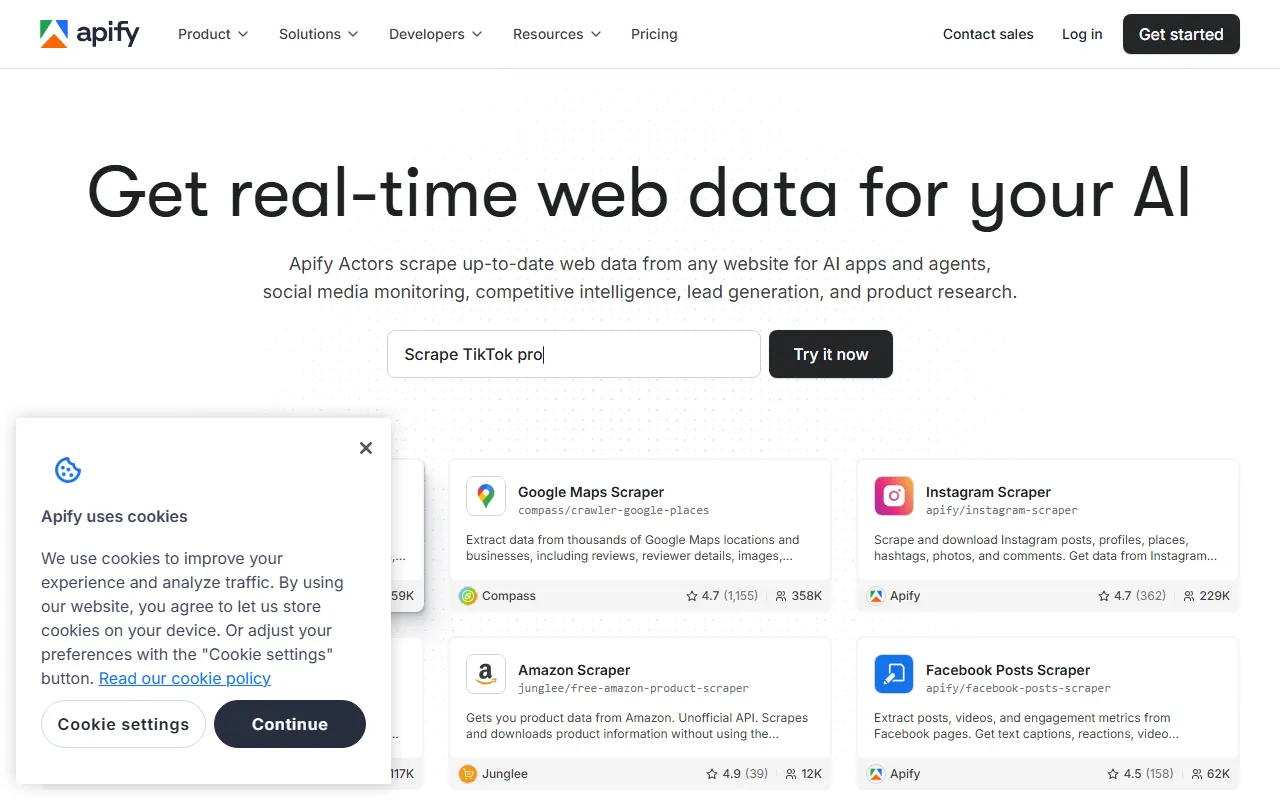
In the Proxyway 2025 benchmark, Apify processed 5,956 results in 22 minutes 42 seconds. Proxyway put its cost at about $1.50 per 1,000 results on a $500 budget. The Apify Store contains 5,000+ Actors including multiple Instagram-specific scrapers. Cloud deployment supports webhook notifications for async job completion. Integrations with GitHub, Slack, Zapier, and Make allow non-technical teams to schedule and route Instagram data without writing code. The free plan includes $5 in platform credits.
Proxy control is the main limitation. Apify uses datacenter proxies by default. The residential IP add-on increases cost for tougher anti-bot scenarios. Request-level rate control is managed by each Actor, not the user, which limits fine-grained tuning for high-volume production pipelines.
Pricing: Free plan: $5 credits. Starter: $49/month. Scale: $179/month. Per-use (pay as you go): $1.50/1K results.
Best for: Non-technical teams who need structured Instagram data from a no-code interface with scheduling and integration support.
Pros:
- Structured JSON/CSV output from Instagram-specific Actors with no parser required
- 5,000+ Actors in the store with no-code configuration and scheduling
- Webhook support and integrations with Slack, Zapier, and Make
Cons:
- No per-request rate control; concurrency is Actor-managed, not user-managed
- Actor quality and maintenance vary across contributors
- Residential proxies are an add-on that increases cost for tougher scenarios
4. Oxylabs: Best for Enterprise Scale
Oxylabs is a scraping infrastructure provider with a 100M+ residential proxy pool and enterprise-grade SLAs. Its Web Scraper API includes built-in JavaScript rendering and smart proxy rotation.
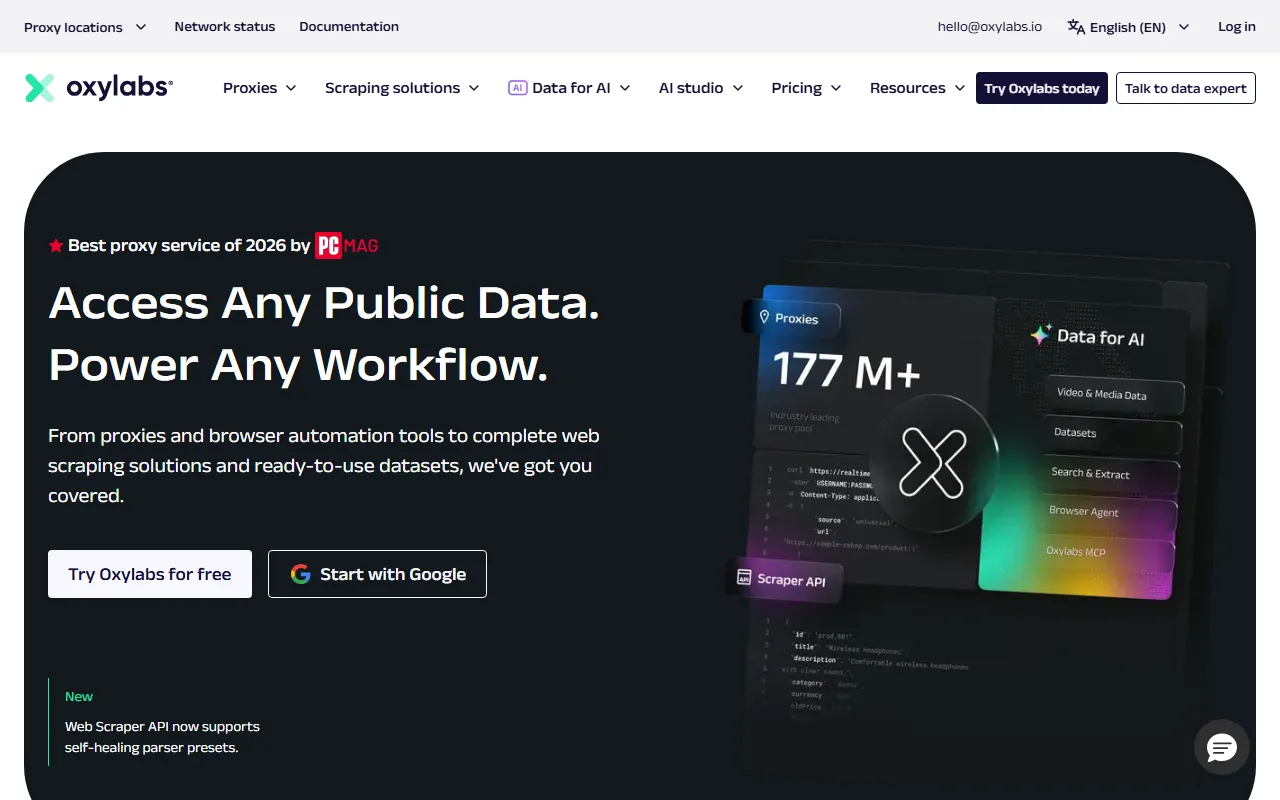
Real-time and async scraping modes support flexible pipeline integration. Dedicated account management and 24/7 enterprise technical support make Oxylabs well-suited for large organizations. The infrastructure holds SOC 2 Type II certification, which satisfies enterprise procurement requirements.
The main limitation for Instagram-specific work is the absence of dedicated Instagram endpoints. The general-purpose Scraper API returns page content requiring custom parsing for structured profile, post, or hashtag extraction. Teams expecting endpoint-specific structured JSON must build and maintain a parsing layer.
Pricing: Web Scraper API from $49/month. Residential proxies from $8/GB. Free trial available.
Best for: Enterprise teams needing robust infrastructure with dedicated support and async/real-time modes.
Pros:
- 100M+ residential proxy pool supports high-volume Instagram traffic
- Real-time and async modes for flexible pipeline design
- Dedicated account manager and 24/7 enterprise technical support
Cons:
- Higher price per usable record compared to pay-per-success tools at equivalent volume
- No Instagram-specific endpoints; custom parsing logic required
5. Decodo: Best Budget Instagram Scraping API
Decodo offers a Social Media Scraping API with Instagram-specific structured output at the lowest base price in this guide.
At $0.88/1K requests, it is the most affordable per-request option. The Proxyway 2025 benchmark tested Decodo at 2 requests per second against live Instagram URLs. Decodo achieved an 87.62% success rate. Its 24.14-second average response time was the slowest of the three APIs in Proxyway’s Instagram comparison. The 12+ percentage point success rate gap compared to top performers translates to higher retry costs. Lower effective throughput per dollar follows directly from that gap.
Country-level geo-targeting covers 150+ proxy locations. An API playground, GitHub code examples, and a Postman collection support fast onboarding. The 7-day free trial includes 1,000 results.
Pricing: From $20/month for approximately 23K requests ($0.88/1K). 14-day money-back guarantee.
Best for: Budget-constrained projects where lower success rates are acceptable and response time is not a priority.
Pros:
- $0.88/1K requests, lowest per-request price in the lineup
- Instagram-specific structured output without raw HTML parsing
- API playground and Postman collection for fast onboarding
Cons:
- 87.62% success rate trails top performers by over 10 percentage points (Proxyway 2025)
- 24.14s average response time, the slowest of three APIs in Proxyway’s Instagram comparison
- Limited Instagram parser coverage compared to endpoint-specific solutions
6. Zyte: Best for Cost-Efficient Scraping
Zyte is a scraping API with a strong benchmark result at a low entry price. The Proxyway 2025 benchmark tested it at a 98.63% Instagram success rate at 2 requests per second. Its 11.64-second average response time was second fastest among all tested providers.
At $1.01/1K responses on a pay-as-you-go basis, Zyte is the most cost-efficient high-accuracy option in this guide. A cloud IDE supports scripting multi-step browser interactions for complex Instagram flows. Automatic IP rotation, ban detection, and request retries are built in. New accounts receive $5 free platform credits valid for 30 days.
The limitation is output format. Zyte returns page content without an Instagram-specific parser. Custom extraction logic is required for structured data. Costs scale quickly when JavaScript rendering and advanced features are enabled, narrowing the cost advantage at higher feature tiers.
Pricing: From $1.01/1K responses (pay-as-you-go). Subscription plans also available. $5 free credits valid for 30 days.
Best for: Cost-sensitive teams with parsing expertise who need high benchmark accuracy at low per-request cost.
Pros:
- 98.63% Instagram success rate (Proxyway 2025 benchmark)
- $1.01/1K, lowest pay-as-you-go price among high-accuracy tools
- Built-in retry logic, ban detection, and IP rotation
Cons:
- No built-in Instagram parser; raw content requires custom extraction logic
- Advanced feature tiers increase cost significantly
- Less Instagram-specific tooling than Bright Data or Apify
7. PhantomBuster: Best for Lead Generation
PhantomBuster provides purpose-built Instagram automations for profile scraping, hashtag search, follower export, and comment scraping, all running in the cloud on a configurable schedule.
Each automation outputs to CSV, Google Sheets, or a webhook for CRM and marketing tool integration. Marketing teams use it to build influencer outreach lists, export follower lists, and track competitor profiles. It covers LinkedIn, Twitter, Facebook, and YouTube alongside Instagram. This makes it useful for multi-platform social media data workflows.
The core limitation is volume. Usage is capped by execution slot time. At $56/month for 2 hours per day of execution, the cost per record increases quickly at moderate volumes compared to API-based tools. It is not suitable for bulk data pipelines or continuous high-volume extraction.
Pricing: From $56/month (2 hours/day execution slot time). 14-day free trial available.
Best for: Marketing teams building influencer outreach lists and audience research reports at low to moderate volume.
Pros:
- Purpose-built Instagram automations with no coding required
- CSV, Google Sheets, and webhook output for CRM and marketing integration
- Covers five social platforms from one subscription
Cons:
- Slot time cap limits daily volume; not suitable for large-scale data pipelines
- Rate-limited by design; cannot support bulk extraction workflows
- Social media platforms only; cannot scrape non-social web properties
8. Octoparse: Best Visual No-Code Scraper
Octoparse is a visual point-and-click scraper with 100+ pre-built templates including Instagram-specific patterns. No coding is required to configure or run it.
The tool runs 24/7 in the cloud with built-in IP proxy support to reduce Instagram detection. Scheduled scraping and automated data export reduce manual effort for recurring collection tasks. For non-technical users who need structured data from specific Instagram pages or profiles, the visual selector interface reduces setup time to minutes.
The limitation at scale is performance. Octoparse degrades under large-volume extraction. The desktop application for template configuration is Windows-only. Proxy rotation control and request behavior customization are limited compared to API-based tools. The Standard plan at $99/month is the lowest paid tier.
Pricing: Free plan with limited features. Standard: $99/month. Professional: $249/month. Enterprise: custom.
Best for: Non-technical users who need structured data from specific Instagram pages at low volume with no coding required.
Pros:
- Visual interface requires no coding or technical setup experience
- 100+ pre-built templates including Instagram-specific patterns
- 24/7 cloud execution with scheduled runs and automated export
Cons:
- Desktop configuration application is Windows-only
- Performance degrades significantly at large-scale extraction volumes
- Limited proxy rotation control compared to API-based tools
How to Choose an Instagram Scraper
The right Instagram scraper depends on three decisions: what your pipeline must produce, how much success rate variance you can tolerate, and real cost per usable record at your target volume.
Which Instagram Scraper Type Fits Your Needs?
Real-time pipelines need a scraping API with Instagram-specific endpoints. Bulk historical analysis is faster and cheaper with pre-collected Instagram Datasets than with live scraping jobs at equivalent scale. Non-technical teams benefit from no-code Actors (Apify) or visual scrapers (Octoparse) that reduce setup to minutes. For teams comparing scraping tools across other platforms, the best Amazon scrapers guide covers equivalent options for e-commerce data collection.
Why Prioritize Anti-Bot Success Rate?
At scale, a 10-percentage-point success rate gap means 10% more retries, 10% higher cost, and unreliable throughput. The difference between Decodo at 87.62% and ScrapingBee at 99.65% (Proxyway 2025) represents significant real-world cost and reliability impact. Pay-per-success pricing removes blocked request cost from the equation entirely.
How Do You Calculate Cost at Target Volume?
Compare cost per 1K successful records at your expected monthly volume. A $20/month tool at 87.62% success delivers more blocked requests per dollar than a $0.75/1K pay-per-success model, which bills only for delivered records. Factor in retry costs, parsing development time, and proxy add-on fees when calculating total cost of ownership.
What Data Structure Requirements Do You Have?
If your pipeline consumes structured JSON directly, choose a tool with dedicated Instagram endpoints. If your team has parsing expertise and wants maximum flexibility, a general-purpose high-accuracy API may suffice. Endpoint-specific structured output reduces development cost and eliminates maintenance overhead when Instagram updates its front end.
What Are Common Instagram Data Use Cases?
Instagram data powers a wide range of business intelligence applications. Instagram reached 3 billion monthly active users in 2026, making it one of the most valuable publicly accessible sources of consumer behavior and brand engagement data at scale.
Influencer Marketing Research
Scraping follower counts, engagement rates, bio data, verified status, and posting frequency across thousands of profiles builds data-driven influencer shortlists. The Instagram Influencer Dataset provides pre-collected bulk data covering follower counts, engagement rates, verified status, and contact data. This is ideal for large-scale influencer analysis without running scraping jobs.
Brand Monitoring and Sentiment Analysis
Monitoring comment sentiment, hashtag mentions, and engagement trends on brand-related posts provides real-time market feedback. Structured comment and post data feeds directly into sentiment classifiers and trend detection systems. Time-stamped structured JSON enables continuous monitoring pipelines with minimal ETL complexity.
Competitor Content Analysis
Tracking competitors’ posting cadence, hashtag strategies, engagement per post, and audience growth over time enables time-series competitive analysis. Structured data exports directly to BI tools such as Tableau or Looker. Weekly dataset snapshots make it possible to measure relative audience growth across competitor accounts.
Market Research and Trend Tracking
Hashtag feed data reveals emerging product trends, seasonal demand patterns, and regional audience behavior. Time-stamped post data and engagement metrics enable predictive modeling for content and campaign planning. Structured JSON from Instagram scrapers feeds directly into data warehouse pipelines without additional ETL work.
AI and Machine Learning Training Data
Instagram image-caption pairs and comment datasets are widely used for computer vision models, sentiment classifiers, and social trend prediction systems. AI applications increasingly depend on real-time structured social media data as training and inference inputs. This demand is one key driver behind the growth of AI-driven web scraping as a distinct market category.
Key Technical Challenges When Scraping Instagram
Instagram runs one of the most sophisticated anti-bot stacks of any social media platform.
How Does Instagram Detect and Block Scrapers?
Instagram’s defense stack operates at multiple layers. TLS fingerprinting identifies non-browser HTTP clients at the TCP handshake level before any request content is evaluated. IP reputation scoring flags datacenter IP ranges and reused proxy pools within seconds. Browser fingerprint consistency checks catch mismatched User-Agent, Accept-Language, and canvas fingerprint signals. Cloudflare holds an 82.16% share of the global DDoS and bot protection software market, and these systems are integrated across Instagram’s infrastructure. Basic Python requests fail immediately without browser simulation.
Why Does Instagram Require JavaScript Rendering?
Most Instagram content loads dynamically via JavaScript after the initial page load. A scraper must execute a full browser, handle infinite scroll, and manage session state to collect complete data. A self-managed headless browser stack requires infrastructure maintenance, version management, and proxy configuration. A managed browser such as Bright Data’s Browser API removes that overhead and keeps existing scraping code intact.
How Does Instagram Handle Rate Limiting?
Residential proxy rotation is mandatory at any production scale. Randomized request timing and per-session IP assignment reduce velocity and concurrency detection triggers. High-volume scraping from a fixed IP pool or from datacenter IP ranges triggers rate limiting within minutes. Instagram proxies that route through residential IP ranges with per-session assignment are the baseline requirement for any production Instagram pipeline.
How Do You Structure Raw Instagram Data?
Raw HTML from a browser-rendered Instagram page requires significant parsing to extract structured fields such as follower count, engagement rate, and caption text. Every Instagram front-end layout change breaks custom parser logic. Endpoint-specific APIs that return structured JSON insulate pipelines from front-end changes and eliminate custom extraction code from the production stack entirely.
If collecting Instagram data at scale is the next step, start for free with Bright Data and access the most reliable scraping infrastructure available.
Frequently Asked Questions
Q: What data can you scrape from Instagram?
Publicly available Instagram data includes user profiles (username, bio, follower count, post count, engagement rate, verified status), posts (captions, hashtags, likes, comments, media URLs, location tags), reels (view counts, play counts, audio data), comments (text, author, timestamp, reply count), and hashtag feeds (top posts, recent posts, associated accounts). Private account content is not accessible through any scraping tool.
Q: What is the difference between an Instagram Scraper API and Instagram Datasets?
An Instagram Scraper API collects data in real time on demand. You send a request with target URLs or search parameters and receive structured JSON immediately, making it ideal for fresh data and dynamic workflows. Instagram Datasets are pre-collected snapshots of historical data (profiles, posts, images, influencer data) available for immediate bulk download. Datasets are faster and cheaper for large-scale historical analysis but are not suitable when you need current or frequently updated data.
Q: How do Instagram scrapers handle Instagram anti-bot systems?
Professional Instagram scrapers bypass anti-bot detection through several mechanisms: residential proxy rotation (Bright Data provides 400M+ IPs) to avoid IP-based blocking, TLS fingerprint spoofing to mimic real browser handshakes, headless browser execution to render JavaScript and generate legitimate behavior signals, automatic CAPTCHA solving, and adaptive request timing to stay within rate limits. Basic Python scripts using the requests library fail immediately because they make no-browser HTTP calls from datacenter IPs with no fingerprint management.
Q: Can I scrape Instagram without writing code?
Yes. No-code options include Apify’s Instagram Actors (point-and-click configuration with structured JSON or CSV output), Octoparse (visual selector interface for non-technical users with 100+ templates), and PhantomBuster (social media automation with scheduling). For pre-collected bulk data, Bright Data’s Instagram Datasets provide ready-to-download files without any scraping infrastructure. For teams with developer resources, API-based tools like Bright Data’s Instagram Scraper API or ScrapingBee offer higher throughput and more control.
Q: What is pay-per-success pricing and why does it matter for Instagram scraping?
Pay-per-success pricing means you are only charged when the scraper successfully returns data. Blocked requests, CAPTCHAs, and failed attempts are not billed. For Instagram scraping, where anti-bot systems block a portion of requests even with professional tools, this model directly reduces wasted spend. Bright Data’s Instagram Scraper API uses pay-per-success at $0.75/1K successful requests, compared to subscription plans that charge a flat rate regardless of how many requests are blocked.
Q: How much does it cost to scrape Instagram data at scale?
Cost depends on volume and tool choice. At $0.75/1K successful requests with Bright Data’s pay-per-success model, scraping 1 million Instagram profiles costs approximately $1,500. Pre-collected Datasets start at $250/100K records ($2.50/1K), making them more cost-effective for bulk historical analysis. Budget APIs like Decodo start at $0.88/1K but deliver an 87.62% success rate, meaning effective cost per usable record is higher than it appears. No-code tools like Octoparse charge flat monthly fees ($99 to $249/month) best suited for lower volumes.
Q: Which Instagram scraper is best for influencer marketing research?
For influencer research at scale, Bright Data offers two dedicated options: the Instagram Scraper API for real-time profile scraping (follower counts, engagement rates, bio data, verified status) and the pre-collected Instagram Influencer Dataset for bulk analysis of millions of profiles without running scraping jobs. Apify’s Instagram Actors are a strong no-code alternative for smaller lists. PhantomBuster suits small-scale outreach list building but is rate-limited and not designed for bulk extraction.
Q: What is an Instagram scraper?
It is a tool that collects public Instagram profiles, posts, reels, and comments at scale. Results arrive as structured JSON or CSV.
Q: Why does the official Instagram API fall short for data collection?
The Graph API only covers your own business account and requires Meta app review. Competitor posts, public profiles, and hashtag feeds stay out of reach, so third-party scrapers fill the gap.
Q: How does Instagram detect and block scrapers?
Instagram checks TLS fingerprints, IP reputation, and browser fingerprint consistency. Plain HTTP clients and datacenter IPs get flagged almost immediately.
Q: Why does Instagram require JavaScript rendering for scraping?
Instagram loads most content with JavaScript after the first page load, so a scraper needs a full browser. Bright Data’s Browser API runs that browser layer for you, with no changes to existing scraping code.



Web Data & AI Expert
 6 years experience
Daniel Shashko is a Senior SEO/GEO at Bright Data, specializing in B2B marketing, international SEO, and building AI-powered agents, apps, and web tools.