







In this guide, you will learn:
- Why hotel data matters, what it consists of, and the main challenges in obtaining it.
- Why embracing a hotel datasets provider is the best way to access it.
- The main aspects to consider when selecting such providers.
- A comprehensive comparison of the top five hotel data providers.
Let’s dive in!
TL;DR: Comparison Table of the Top Hotel Data Providers
Start this comparison blog post by quickly reviewing the best hotel data providers:
| Provider | Infrastructure | Historical Data | Real-time Data | Data Filtering Options | AI Integration | GDPR Compliance | Free Sample/Trial | Pricing |
|---|---|---|---|---|---|---|---|---|
| Bright Data | Enterprise-grade, cloud-hosted, massively scalable, | ✅ | ✅ | Plain-English AI filters, customizable exports, and more | Integrates with 70+ AI platforms + support for MCP | ✅ | ✅ | $1.50/1k records (scrapers), $2.50/1k records (datasets) |
| CoStar | Cloud-based | ✅ | ✅ | Filter by vacancy, leases, location, type | Basic | ✅ | ❌ | Custom pricing |
| Actowiz Solutions | Cloud-based | ✅ | ✅ | — (Undisclosed) | — (Undisclosed) | — (Undisclosed) | ✅ | Custom pricing ($500–$50,000+) |
| Lighthouse | Cloud-based SaaS | ✅ | ✅ | Granular, customizable datasets | Basic | ✅ | ✅ (only for some services) | Custom pricing |
| iWebScraping | Self-service + managed | ❌ | ✅ | — (Undisclosed) | — (Undisclosed) | ✅ | ❌ | Custom pricing |
An Introduction to Hotel Data: What You Need to Know
To be prepared for a hotel data provider comparison, you first need to get some context on hotel data.
Why Hotel Data Is So Relevant
The hotel industry is massive and continues to play a pivotal role in the global economy. According to STR, there are 17.5 million guestrooms across 187,000 hotels worldwide.
In the United States, the hotel industry has a substantial economic footprint. In 2024, it supported:
- $1.7 trillion in business sales.
- 9.2 million jobs with $526 billion in wages, salaries, and other compensation.
- $894 billion in GDP.
Europe also sees massive engagement in hospitality, with over 3 billion nights spent in hotels recorded in 2024. Globally, the hotels and resorts sector employs over 10.8 million people as of 2024.
These figures underscore how important hotels are not only as service providers but also as engines of employment and economic activity. Therefore, they highlight the relevance of the hotel industry worldwide.
Not surprisingly, having access to accurate and timely hotel data has become essential. That is true not just for hotel owners, but for a wide array of businesses and users. In this regard, some of the interesting use cases include:
- Understanding trends in occupancy, revenue, and customer preferences.
- Planning infrastructure and tourism strategies based on visitor patterns.
- Evaluating hotel portfolios, benchmarking performance, and assessing market opportunities.
- Identifying the best locations, availability, and seasonal trends for client needs.
- Accessing information on hotel availability, rates, and reviews for informed travel decisions.
In short, hotel data supports countless industries, fueling smarter decisions, better experiences, and more efficient operations.
Types of Hotel Data
The main types of hotel data are:
- Property descriptive data: Static details about the hotel, including name, address, and proximity to attractions or transport.
- Availability data: Shows which rooms are open on specific dates, supporting booking analysis and accurate occupancy forecasting.
- Pricing data: Tracks room rates, seasonal variations, discounts, and dynamic pricing for historical and real-time rate monitoring.
- Booking data: Records reservations, cancellations, and lead times to analyze booking trends and customer demand patterns.
- Room type data: Details different room categories, sizes, layouts, and amenities provided.
- Occupancy data: Percentage of rooms booked and overall hotel capacity planning.
- Review and rating data: Customer reviews, star ratings, and sentiment analysis from platforms like TripAdvisor or social media.
- Loyalty and customer data: Guest profiles, loyalty program participation, and repeat customer behavior.
- Promotion and discount data: Information on campaigns, bundled services, event bookings, seasonal packages, special offers, or coupons that influence booking behavior and seasonal demand.
- Cancellation and no-show data: Tracks canceled or missed bookings and rescheduling trends.
- Competitor data: Pricing, availability, and offers from competing hotels for benchmarking.
- Revenue and financial data: Total revenue, revenue per available room (RevPAR), average daily rate (ADR), and other profit indicators.
The Challenges Behind Sourcing Hotel Data
One of the biggest and most obvious challenges in hotel data scraping is the high variability of sources. Every hotel has its own website, each structured and presented in a unique way.
As a result, building a universal hotel data scraper is extremely difficult. Such a tool should be able to discover hotel sites, connect to them, navigate to the correct pages, simulate the right interactions, and extract data in a structured format.
A possible approach is to outsource these tasks to an AI agent. Yet, this requires access to AI-ready web scraping tools capable of interacting with diverse and dynamic web interfaces.
A simpler alternative is to target hotel aggregators (like Trivago or Booking.com), but this comes with limitations:
- They only cover a subset of the total market, leaving many hotels unlisted.
- They are typically protected by anti-scraping measures, such as CAPTCHAs and automated access blocks.
- Their listings are highly dynamic, often reflecting temporary promotions or special offers, which may not match the original hotel prices.
In short, scraping aggregator sites is easier but provides incomplete and sometimes unreliable data. Instead, scraping individual hotel sites is more comprehensive but also technically challenging.
Hotel Data Providers: The Easiest Way to Get High-Quality Data
Hotel data is undeniably valuable, but collecting it accurately and at scale is surely challenging. That is why the most recommended way to access it is through a specialized hotel data provider.
A hotel data provider is a service that gathers, organizes, and delivers different types of hotel information. That information ranges from point-specific fields to detailed, enriched, aggregated insights.
These providers handle the technical and logistical challenges of data collection. They give you direct access to the data or provide tools that greatly simplify building your own custom hotel data retrieval system, through:
- Hotel datasets: Pre-compiled, structured, ready-to-use files that list historical and regularly updated hotel information. Perfect for trend analysis, market research, or training AI models.
- Hotel scraping tools: Solutions that collect live data directly from hotel websites, booking platforms, or OTAs. They are best for real-time scenarios like tracking price changes, room availability, promotions, or competitor activity.
Most organizations combine both approaches, trusting datasets to gain historical context and scraping solutions to capture live intelligence.
Main Elements to Consider When Evaluating Hotel Data Providers
Finding platforms that provide hotel data or hospitality intelligence is not particularly difficult. On the contrary, finding a reliable and trustworthy provider is the real challenge.
To identify the most credible hotel data providers, you should compare them across aspects like:
- Data coverage: The types of hotel data offered, including availability, room types, pricing, occupancy, reviews, and the sources from which this data comes.
- Infrastructure and architecture: The provider’s scalability, uptime, success rates, etc.
- Data timeliness: Whether the provider offers historical datasets, fresh data via web scraping, or a combination of the two.
- Filtering and exploration: The ability to search, filter, and drill into hotel data, such as by city, star rating, room type, or amenities.
- Technical requirements: Skills, tools, or infrastructure needed to access, process, and integrate the hotel data to meet your needs.
- Regulatory compliance: Adherence to GDPR, CCPA, and other data privacy and security regulations.
- Pricing: The presence of subscription models, custom plans, and the availability of free trials or sample datasets for evaluation.
Top 5 Hotel Data Providers
Explore the list of the best hotel data providers, selected and ranked according to the factors outlined earlier.
1. Bright Data
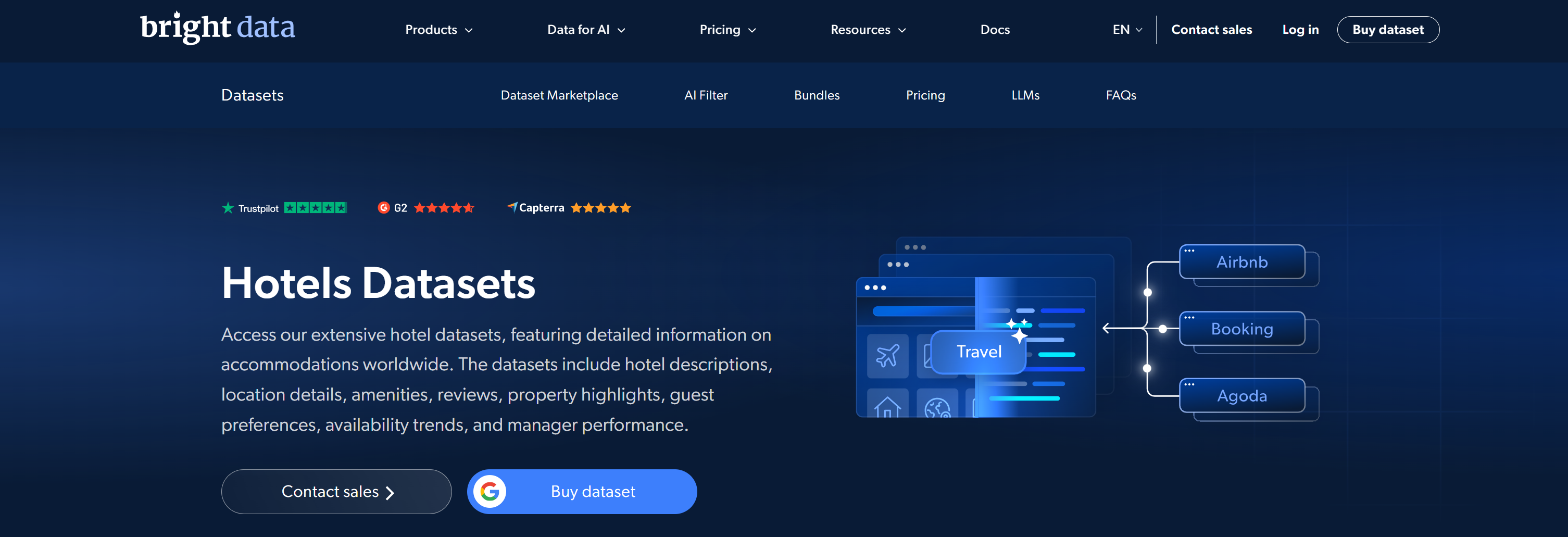
Bright Data is a top web data platform that powers a limitless infrastructure for AI and business intelligence. Compared to other hotel data providers, it stands out thanks to its enterprise-grade, AI-ready infrastructure for web data collection.
Its hospitality data offerings include:
- Hotel datasets: Curated, validated, enriched datasets ready for analytics, AI/ML models, and BI tools. Available in JSON, CSV, Parquet, and other formats, these datasets cover hotel descriptions, location details, amenities, reviews, ratings, availability trends, prices, property highlights, and guest preferences. Continuous updates and flexible, record-based pricing make it easy for businesses to optimize pricing, occupancy, and competitive intelligence. Specific datasets are also available for hotel bookings and hotel reviews.
- Hotel Scraper APIs: Tools available via APIs and a no-code interface for on-demand extraction of live hotel data at scale. Collect current rates, availability, promotions, booking trends, and social insights across platforms such as Booking.com, Airbnb, Trip.com, Tripadvisor, Expedia, Google Hotel, and more. Anti-bot bypass and IP rotation are handled automatically for you. Most of these tools are also accessible via MCP integration for seamless connection with AI agents.
All hotel data solutions run on Bright Data’s robust infrastructure, featuring over 150 million proxy IPs worldwide, advanced anti-bot technologies, 99.99% uptime, and 99.99% success rates. With this combination of features, Bright Data positions itself as the best provider of hotel data globally!
🏆 Best suited for: Enterprise-grade hotel data collection and analytics, machine learning model training, and integrations into AI-powered applications.
Data coverage:
- Hotel descriptions, location information, amenities, room types, availability trends, pricing, and promotions.
- Dedicated datasets on hotel bookings and reviews with millions of entries.
- Past booking trends, seasonal occupancy rates, price fluctuations, and guest traffic patterns.
- Data on regions, cities, neighborhoods, and aggregated from Airbnb, Booking.com, Trip.com, Google Hotels, and other known hospitality platforms.
Infrastructure and architecture:
- High scalability with 400M+ proxy IPs across 195 countries, with support for unlimited concurrency.
- 24/7 dedicated support from data professionals for uninterrupted operations and expert assistance.
- 99.99% uptime and success rate for scraping APIs.
- Advanced anti-bot bypass features, including IP rotation, CAPTCHA solving, and custom headers for seamless scraping.
- Bulk scraping capabilities, handling up to 5,000 target URLs per request.
- Access to historical hotel data through the Web Archive API service.
- Validated, cleaned, enriched, and LLM-optimized datasets, delivered in JSON, NDJSON, CSV, Parquet, and more.
- Flexible dataset delivery via Amazon S3, Google Cloud, Snowflake, Azure, SFTP, Pub/Sub, Webhooks, and other preferred channels.
- Integrates with 70+ AI solutions, such as CrewAI, LlamaIndex, LangChain, Agno, IBM Watsonx, AWS Bedrock AI Agents, Microsoft Copilot Studio, and more.
Data timeliness:
- Live hospitality data collection through Bright Data’s API-based and no-code scrapers.
- Historical hotel data availablevia pre-built datasets with flexible updates (daily, weekly, monthly, etc.).
Filtering and exploration:
- Possibility to describe your data needs in plain English, allowing AI to understand and apply precise filters automatically.
- Quickly narrow large datasets, focusing on the most relevant information to streamline analysis and decision-making.
- Advanced filtering options let you skip unnecessary data, reduce costs, and export the results in your preferred format.
Technical requirements:
- Basic technical knowledge is enough to start collecting standard data via API-based hotel scrapers.
- No-code scrapers provide a simplified data retrieval experience directly from Bright Data’s platform.
- Familiarity with APIs is recommended for advanced workflows and custom automation.
Regulatory compliance:
- Fully adheres to GDPR, CCPA, and other international data privacy regulations.
- Certified for SOC 2 Type II, ISO 27001, CSA STAR Level 1, and other leading security standards.
- Data is sourced ethically, targeting publicly available information only.
Pricing:
- Free trial available + sample hotel datasets.
- Pricing starts at $1.50 per 1k records via hotel scrapers.
- Pricing starts at $2.50 per 1k records through hotel datasets.
2. CoStar
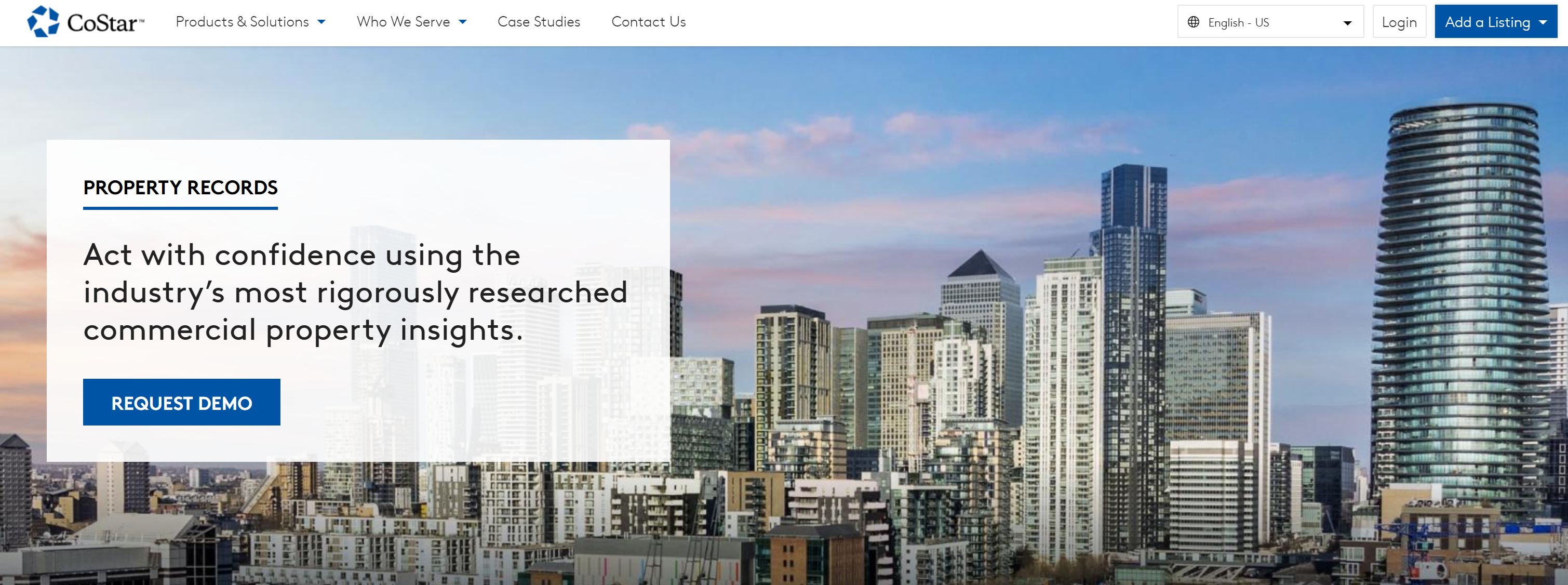
CoStar Group is the leading provider of commercial real estate analytics, offering actionable insights for brokers, investors, lenders, and property managers. For hotel data, CoStar provides detailed property information, analytics, and forecasts. Through its platform, users can set alerts, access benchmarking, and explore analytics to evaluate hotel performance, compare competitive sets, and more.
🏆 Best suited for: Real estate agencies, companies, and agents looking for an all-in-one analytics and market intelligence platform.
Data coverage:
- 8.5M+ continuously updated commercial property records globally.
- Detailed commercial property data, including hotels, multifamily, office, industrial, and retail properties.
- Data fields cover availability, vacancy, rents, property attributes, floor plans, 3D models, amenities, tenants, prior transactions, ownership, star ratings, and other performance indicators.
- Data sources include HM Land Registry, Google Maps, Microsoft Virtual Earth, Preqin, Sirene, and Urban Mapping.
Infrastructure and architecture:
- Scalable, cloud platform built to support commercial real estate professionals, also in the hotel industry.
- Supports over 1,100 system integrations.
Data timeliness:
- Top-line historical data.
- Real-time insights from the platform.
- Predictive trends and forecasts.
Filtering and exploration:
- Ability to filter and search by vacancies, lease expirations, redevelopment prospects, building type, location, or submarket.
- Custom searches can be saved with alerts for matching new properties.
- Possibility to filter data according to your needs and export it to Excel.
Technical requirements:
- Some technical knowledge may be required for integrations.
- Limited to no knowledge is needed to use the platform, though training may be required, as it is a feature-rich solution with a somewhat legacy UI.
Regulatory compliance:
- GDPR and CCPA compliant.
Pricing:
- Possibility to request a demo to test the platform.
- Pricing is undisclosed.
3. Actowiz Solutions
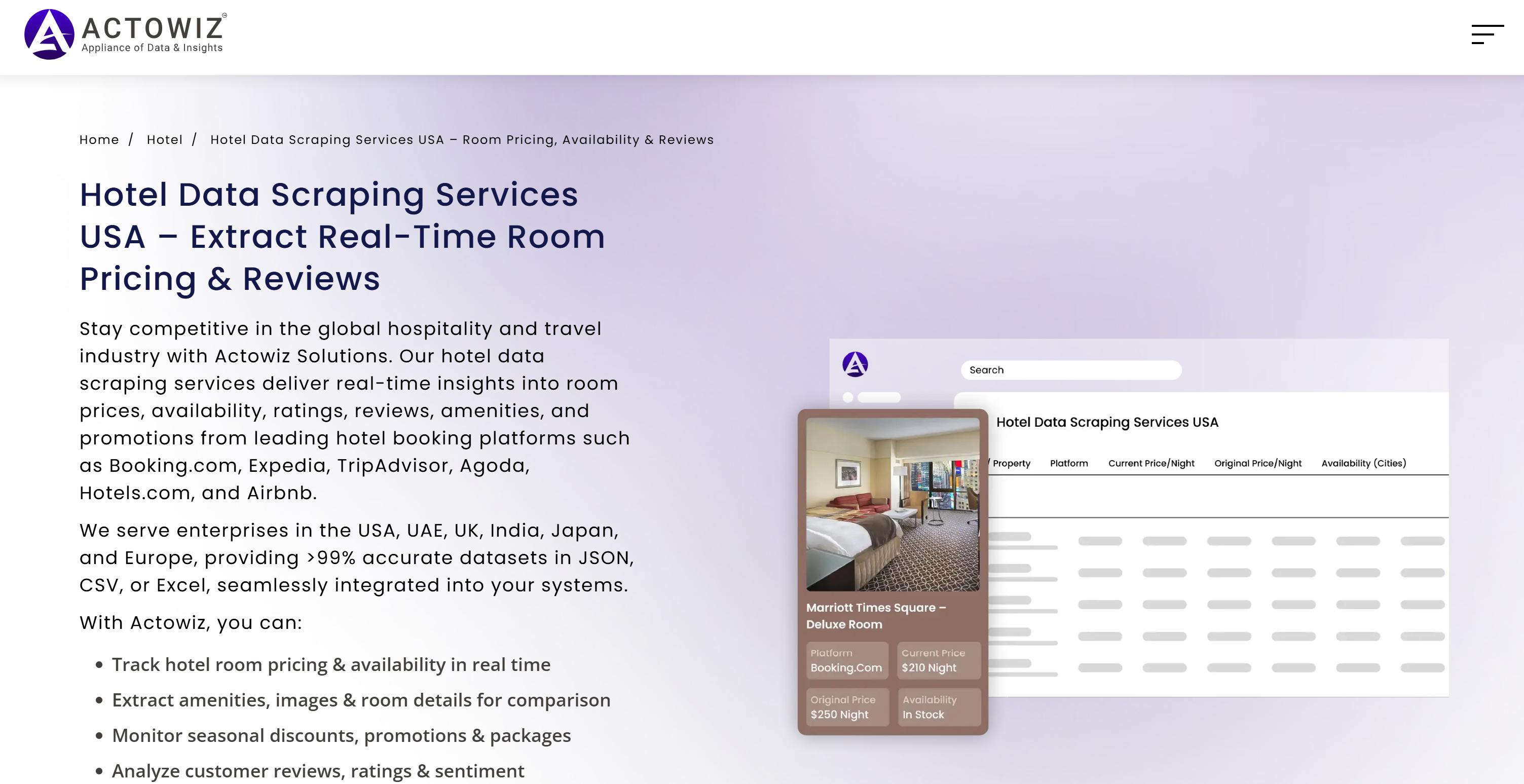
Actowiz Solutions is a well-known platform for large-scale web data extraction. Its goal is to help businesses turn unstructured online information into actionable insights. Specifically for hotels, it comes with:
- Rich hotel datasets available via multiple data formats.
- Hotel scraping solutions enabling businesses to gather up-to-date data on the fly.
🏆 Best suited for: Hotel market intelligence and benchmarking.
Data coverage:
- Hotel room pricing, availability, ratings, reviews, amenities, promotions, competitor benchmarking, and hyperlocal and city-level market intelligence.
- Data sources include Booking.com, Expedia, TripAdvisor, Agoda, Hotels.com, and Airbnb.
- Covered data fields include hotel name, hotel ID, address, phone number, website URL, star rating, guest rating, number of reviews, room types, room prices, room amenities, hotel amenities, check-in time, check-out time, and more.
Infrastructure and architecture:
- Scalable infrastructure that supports large-scale data extraction via high data requests.
- Both ready-made hotel web scraping tools and web scraping APIs.
- Options to access data via datasets and APIs.
- Data delivery in JSON, CSV, XML, or JSONLines formats via SFTP, FTP, email, Dropbox, Google Drive, or AWS S3.
Data timeliness:
- Real-time data capture on room availability, pricing, and guest sentiment via API.
- Historical and predictive insights via datasets and special features.
Filtering and exploration: Undisclosed.
Technical requirements:
- APIs and web scraping integrations require technical knowledge.
Regulatory compliance: Undisclosed.
Pricing:
- Sample hotel data available.
- Pricing depends on data scope, project requirements, and delivery method (you need to contact sales to request a quote).
- Budget tiers range from $500 to $50,000+, depending on scale and customization.
4. Lighthouse
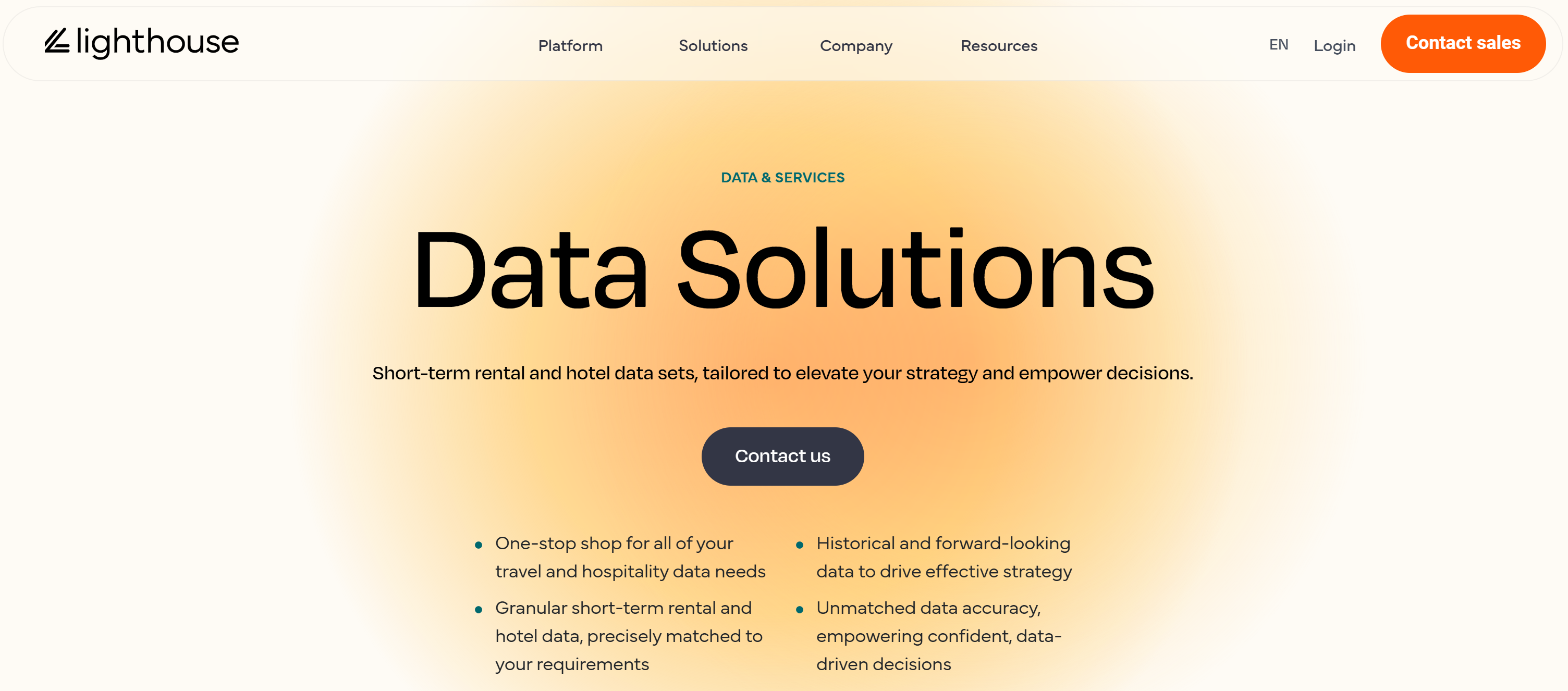
Lighthouse is a commercial intelligence platform for the travel and hospitality industry. It helps hotels and enterprises in the sector turn complex market signals into confident, revenue-driving decisions. Its hotel data offerings include real-time and historical datasets covering pricing, demand, occupancy, performance metrics, and market benchmarks. As a one-stop data shop, it delivers reliable, actionable hotel data through intuitive tools, dashboards, and data solutions.
🏆 Best suited for: Data–driven insights for hotel revenue growth.
Data coverage:
- Hotel and short-term rental data, covering supply, demand, pricing, performance metrics, occupancy indicators, hotel rates, and flight–hotel search behavior.
Infrastructure and architecture:
- Large-scale data ecosystem handling 1.7 billion daily searches and 16.4 million property profiles.
Data timeliness:
- Covers historical, current, and forward-looking data, including predictive insights based on early travel intent and booking behavior.
Filtering and exploration:
- Options for granular, customized datasets and analytics.
Technical requirements:
- Data accessible via APIs, requiring technical knowledge for HTTP requests and integration into existing systems and workflows.
- Simplified data feeds available with multiple delivery options.
- No technical knowledge required to access data through custom dashboards and scheduled reports.
Regulatory compliance:
- ISO 27001:2022 compliant.
- GDPR compliant.
Pricing:
- 14-day trial on some services, but not for the data solutions.
- Pricing is based on data volume and scope (you must contact Lighthouse directly for quotes).
5. iWebScraping
iWebScraping is a data scraping company offering both self-service and managed crawling solutions for businesses and startups. When it comes to hotel data, it equips you with scraping solutions to retrieve information in multiple formats via APIs, including a specialized service dedicated to hotel price monitoring and tracking.
🏆 Best suited for: Hotel price monitoring.
Data coverage:
- Hotel names, addresses, phones, emails, website URLs, number of rooms, check-in/check-out dates, prices, included/excluded amenities, popular facilities, star ratings, reviews, room type, and more.
- Data sources include major OTAs and travel sites like TripAdvisor, Agoda, Expedia, Hotels.com, and Booking.com.
Infrastructure and architecture:
- Both ready-made hotel scrapers and hosted web scraping solutions.
- Data is sent in multiple formats, including XLS and CSV.
Data timeliness:
- Live hotel data retrieval via web scraping, with specialized options for price monitoring.
Filtering and exploration: Nothing special to mention.
Technical requirements:
- Requires technical knowledge for integrations through the web scraping APIs.
Regulatory compliance:
- GDPR and CCPA compliant.
Pricing:
- Custom quotes available depending on project scope and complexity.
Conclusion
In this article, you understood why hotel data is crucial, the types of information it includes, and the challenges of collecting it at scale. You also saw how specialized hotel data providers simplify access by delivering structured datasets and live scraping solutions.
Bright Data emerges as the top provider thanks to its enterprise-ready infrastructure. It offers LLM-optimized hotel datasets alongside real-time scraping APIs for complete hotel data coverage. These services deliver reliable, scalable, and up-to-date hotel information, from pricing and availability to reviews and amenities.
Sign up with Bright Data today to try our web data solutions for free!
FAQ
Where to get hotel data?
Fetching hotel data is tricky because each hotel can have its own website, and not all hotels are listed on aggregator platforms. This means that to collect hotel data, you either need to scrape public hotel websites or gather information from hotel data aggregators like Trivago, Google Hotel, Booking.com, and similar platforms.
How to retrieve hotel data?
There are two main ways to obtain hotel data:
- Accessing hotel datasets: These contain historical hotel information, aggregated and enriched over time by providers. They are ready for immediate analysis and can be used for insights and predictions, such as pricing trends and occupancy patterns over specific time periods.
- Using a hotel web scraper: You can either build a custom hotel data scraper or use a ready-made hotel scraping API. This approach allows you to collect up-to-date information directly from hotel websites and aggregator platforms, including availability, pricing, reviews, ratings, and more.
What is a hotel dataset?
A hotel dataset is a collection of hotel-related information. This is typically provided as a file in CSV, JSON, XML, Parquet, or Excel format. It can list room availability, pricing, ratings, reviews, amenities, location, and other relevant data fields. These datasets are generally historical and static, but many providers update them regularly to reflect new data and trends.
How to scrape hotel websites?
Each hotel website and aggregator platform is different, so there is no one-size-fits-all approach to hotel data scraping. At a high level, you can follow this scraping roadmap:
- The scraper connects to the target hotel website or aggregator.
- The page is rendered using a browser automation tool or parsed with an HTML parser.
- Data extraction logic is applied to extract the information of interest, often via AI-powered parsing, letting you use the same scraper across multiple hotel websites.
- The scraped data is converted and output in the desired format.
For more guidance, refer to the tutorials:



Technical Writer
 5.5 years experience
Antonello Zanini is a technical writer, editor, and software engineer with 5M+ views. Expert in technical content strategy, web development, and project management.