







Monitoring them at scale requires automated tools that bypass aggressive bot detection.
This guide ranks the 8 best flight scrapers in 2026 by anti-bot success rate, pricing, and output quality.
In this article, we are going to talk about:
- What flight scrapers are and the types of data they extract from booking platforms
- How we evaluated each tool on anti-bot capability, pricing, and integration quality
- The top 8 flight scrapers ranked with verified pricing for 2026
- How to choose the right tool based on volume, team skill level, and target platforms
- Why Bright Data leads with a 98.44% success rate in an independent benchmark of 11 providers
TL;DR: Best Flight Scrapers at a Glance
| Tool | Type | Reliability | Free Tier | Starting Price | Best For |
|---|---|---|---|---|---|
| Bright Data’s Flight Scraper | Web Scraping API + Dataset | 98.44% benchmark success rate | Yes (5,000 records/mo) | $0.75/1K requests | Best overall flight scraper |
| SerpApi | SERP API | High (Google Flights) | Yes (250 searches/mo) | $25/month | Google Flights data |
| Apify | Scraper marketplace | Variable (community actors) | Yes ($5 credit) | $29/month | Pre-built flight actors |
| Octoparse | No-code scraper | Limited on protected sites | Yes (limited) | $69/month | No-code flight scraping |
| Oxylabs | Enterprise proxy + crawler | High (enterprise proxy) | No | $49/month | Enterprise proxy infrastructure |
| Smartproxy (Decodo) | Proxy network | Moderate | No | $2/GB | Budget proxy for custom scripts |
| Scrapy | Open-source framework | Configurable | Free | Free (infra costs apply) | Custom open-source scrapers |
| ParseHub | Visual scraper | Low on protected sites | Yes (5 projects) | $189/month | Small-scale visual scraping |
What Is a Flight Scraper?
A flight scraper is an automated tool. It extracts publicly visible data from airline websites, booking aggregators, and travel platforms. This data powers fare comparison products, competitive intelligence systems, and travel analytics pipelines. The market for this infrastructure is growing fast. According to MarketsandMarkets, the global web scraping market will reach USD 2.55 billion by 2029. It was valued at USD 1.05 billion in 2024, growing at a CAGR of 19.4%.
How Do Flight Scrapers Extract Real-Time Data?
Flight scrapers work in two ways. Simple sites accept standard HTTP requests. JavaScript-heavy platforms like Google Flights and Expedia require full browser rendering. Most modern booking platforms use dynamic JavaScript to serve pricing data. This means scrapers must render the page in a headless browser before extracting fields. Airlines update prices up to 1,000 times per day. A price snapshot from 30 minutes ago may already be stale on high-demand routes.
What Data Types Can a Flight Scraper Collect?
A configured flight scraper extracts a standard set of fields. These include origin and destination airports, departure and arrival times, flight duration, number of stops, operating airline, fare class, ticket price, currency, and seat availability. Some platforms also expose fare basis codes, baggage allowance policies, and carbon emissions estimates.
How Did We Evaluate These Tools?
We assessed each tool on the factors that matter most for production flight data pipelines. No single tool fits every team, so the rankings reflect real trade-offs.
Does Success Rate Matter Most for Flight Sites?
Yes. Major booking platforms deploy aggressive bot-detection systems. A tool with a 70% success rate doubles your effective cost per delivered record. We prioritized tools with verified performance on Cloudflare-protected airline sites, Google Flights, and Expedia. Bright Data’s 98.44% success rate is the highest result of any tool evaluated. Scrape.do’s independent benchmark of 11 providers confirmed this figure.
What Should You Pay Per 1,000 Records?
Pricing models vary significantly across tools. Pay-per-success models are strongly preferred for flight scraping. Blocked requests are common on booking sites. You should not pay for failed requests. We compared effective cost-per-record at realistic usage volumes across free tiers, pay-as-you-go rates, and monthly subscriptions.
How Easy Is It to Integrate and Parse Output?
We evaluated the effort to get the first structured record from each tool. This covers API authentication complexity, documentation quality, output format, and whether the tool normalizes fields automatically. For teams without dedicated engineering resources, integration simplicity is decisive.
The Best Flight Scrapers, Ranked
The tools below are ranked by overall performance across all evaluation criteria. Anti-bot success rate carries the most weight. A scraper that fails on Cloudflare or DataDome is not useful for flight data. Anti-bot capability outweighs other features in this evaluation.
1. Bright Data: Best Overall Flight Scraper
Bright Data leads all 8 tools reviewed with a 98.44% average success rate. Scrape.do’s independent benchmark of 11 providers confirmed this as the highest result of any provider tested.
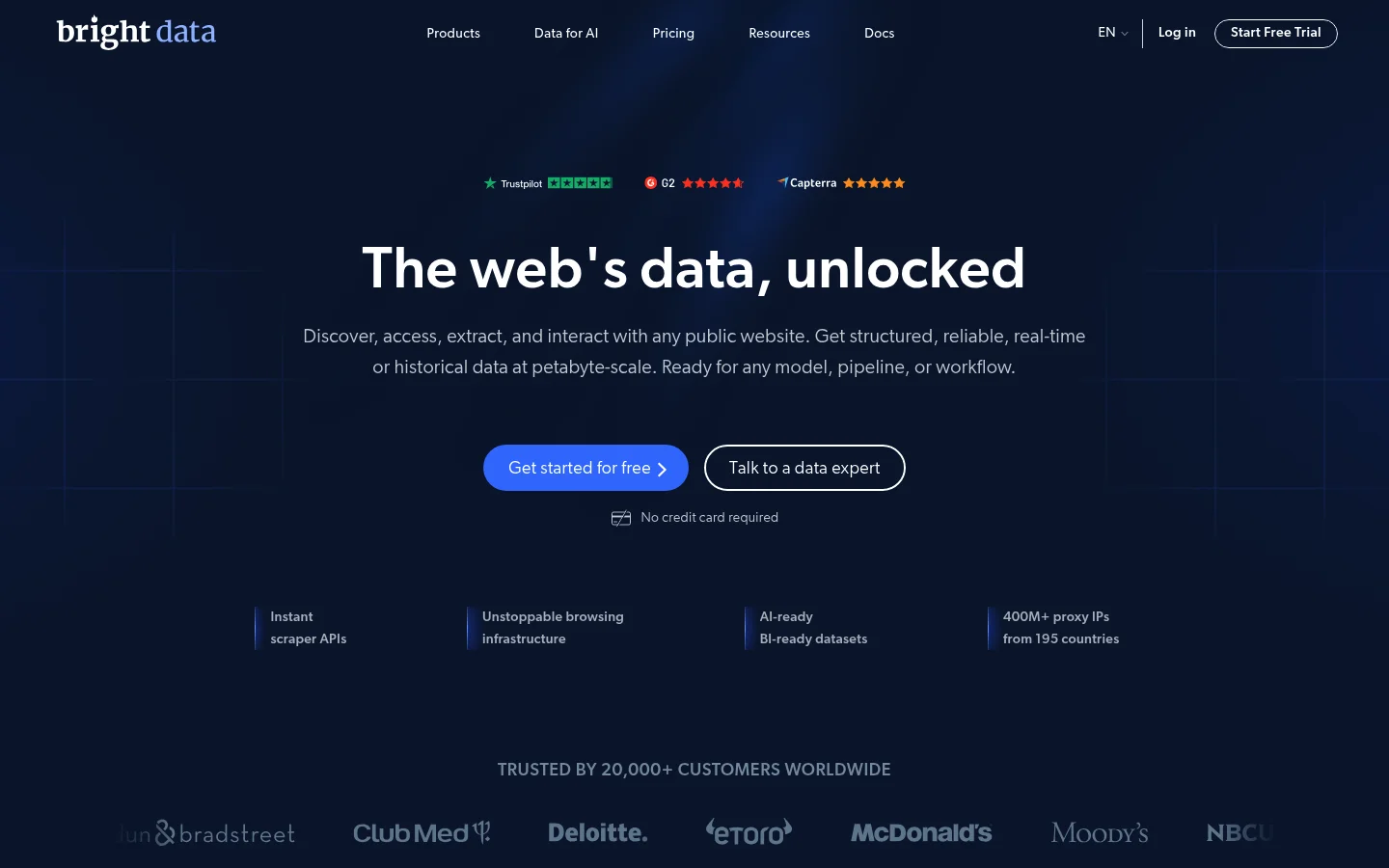
Its dedicated flight scraper is pre-configured for Google Flights, Expedia, Kayak, and direct airline sites. It delivers structured JSON without any custom parser development required. This is the only tool here combining a pre-built flight scraper, pay-per-success pricing, and the highest independently verified success rate.
Key features:
- Dedicated flight scraper for major booking platforms. No custom selector configuration required. Output covers price, airline, origin, destination, departure time, arrival time, stops, and cabin class.
- 400M+ residential, datacenter, ISP, and mobile IPs across 195 countries. Use geo-specific IP pools to retrieve location-sensitive fares from any market.
- Scraping Browser for JavaScript-heavy booking sites. Managed cloud browser handles fingerprint evasion and CAPTCHA solving without any headless browser infrastructure to maintain.
- Built-in bypass for Cloudflare, DataDome, PerimeterX, Akamai, and Imperva. Anti-bot handling is part of the managed infrastructure, not a client-side responsibility.
- Pre-collected Flight Club dataset for immediate download. Teams that want structured flight data without running infrastructure can access it on demand.
- Real-time and scheduled batch delivery via API or webhook. Supports one-off collection and recurring production pipelines.
- 99.99% uptime SLA. Trusted by 50,000+ customers including Fortune 500 companies.
Pricing:
Bright Data uses pay-per-success pricing. You only pay for records that are successfully delivered. Failed or blocked requests do not count toward your bill.
The free tier includes 5,000 records per month with no credit card required. It renews monthly, giving teams enough volume to validate the scraper against real booking sites.
Pay-as-you-go pricing starts at $1.50 per 1,000 successful records with unlimited concurrency and no monthly commitment. The Scale plan is $499 per month and includes 384,000 records. Additional records are billed at $1.30 per 1,000. Enterprise plans are custom-quoted with volume discounts, a dedicated account manager, priority support, and premium SLA terms.
Currently, Bright Data offers 25% off the Scraper API for the first three months with code APIS25 at checkout. New accounts receive a first-deposit match of up to $500. These promotions significantly reduce the effective entry cost for teams evaluating the platform against alternatives.
Best for: Enterprise teams and production pipelines collecting flight data from heavily protected booking sites at scale.
Pros:
- ✅ 98.44% success rate in an independent benchmark, the highest of any provider tested
- ✅ Pay-per-success pricing means no spend on blocked or failed requests
- ✅ Dedicated flight scraper with pre-built parsers for Google Flights, Expedia, Kayak, and airline sites
- ✅ Pre-collected Flight Club dataset for teams wanting data without running infrastructure
- ✅ Handles Cloudflare, DataDome, PerimeterX, Akamai, and Imperva automatically
- ✅ 400M+ IP pool for geo-specific fare retrieval across 195 countries
Cons:
- ❌ Premium pricing is higher than basic proxy providers for simple, unprotected sites
- ❌ Full feature set has a learning curve for teams new to API-based scraping
2. SerpApi: Best for Google Flights Data
SerpApi provides a dedicated Google Flights API endpoint. It returns structured JSON directly from Google Flights search results.
The API requires no proxy management or browser automation on the client side. Send a query with origin, destination, and date parameters. Receive structured JSON covering prices, airlines, durations, stops, and carbon emissions estimates.
Key features:
- Dedicated Google Flights endpoint with structured JSON output
- Fields include price, airline, duration, stops, and carbon emissions estimates
- Real-time data with no proxy configuration required
- Simple REST API with API key authentication
Pricing:
SerpApi starts at $25 per month for 1,000 searches. The free tier includes 250 searches per month. This covers development testing but not production volumes.
Best for: Teams focused exclusively on Google Flights data who want a simple API with no infrastructure management.
Pros:
- ✅ Simple REST API with clean structured JSON output
- ✅ No proxy management required on the client side
- ✅ Carbon emissions data from Google Flights included in output
Cons:
- ❌ Limited to Google Flights only. No Expedia, Kayak, or direct airline site coverage.
- ❌ Monthly subscription costs scale quickly at high search volumes
- ❌ No dataset or bulk data option for historical flight data
3. Apify: Best for Pre-Built Flight Actors
Apify offers a marketplace of community and official Actors for scraping flight data. Actors cover Google Flights, Kayak, Expedia, and select airline booking pages.
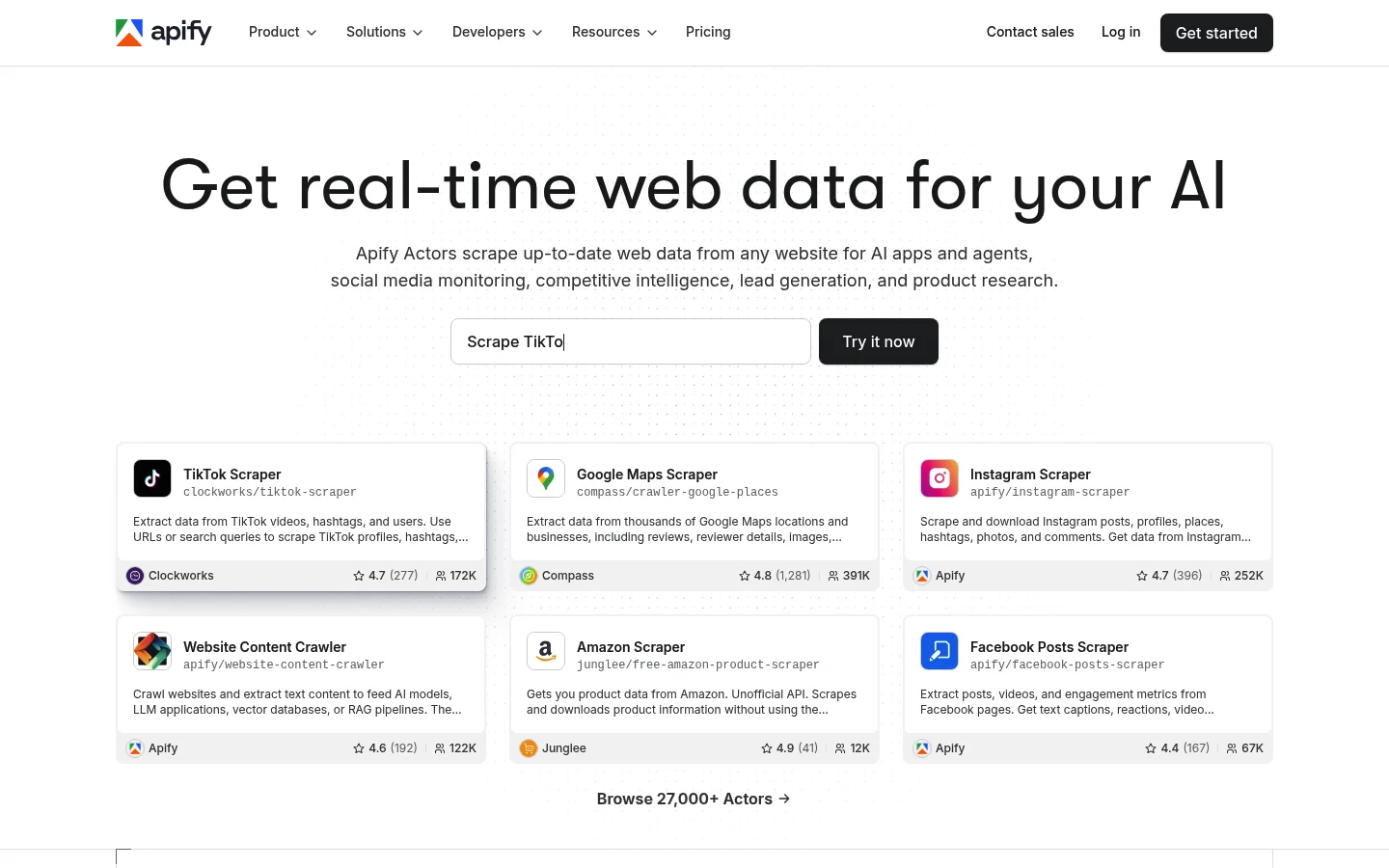
Cloud-based scheduling and monitoring are built into the platform. This reduces infrastructure overhead for recurring data collection without requiring custom cloud deployment.
Key features:
- Marketplace of Actors for Google Flights, Kayak, Expedia, and airline booking pages
- Cloud scheduling, monitoring, and storage included in the platform
- Pay-per-use Actor pricing or flat monthly subscription
- API, webhook, and storage integrations included
Pricing:
The free tier includes $5 per month in platform credit. Paid plans start at $29 per month (Starter), with the next tier at $199 per month (Scale). Actor runs are billed on compute units, so costs increase with collection volume.
Best for: Teams wanting pre-built coverage across multiple flight platforms who can manage Actor quality and update cycles.
Pros:
- ✅ Broad marketplace coverage across multiple flight and booking platforms
- ✅ Built-in scheduling, monitoring, and cloud storage
- ✅ Community Actors reduce time-to-first-data on many sites
Cons:
- ❌ Community Actors vary in quality and may break when booking sites update their structure
- ❌ Less reliable on heavily anti-bot-protected airline sites than managed scraping APIs
- ❌ Per-run compute costs compound significantly at high collection volume
4. Octoparse: Best No-Code Flight Scraper
Octoparse is a visual, point-and-click scraper builder for teams with no coding experience.
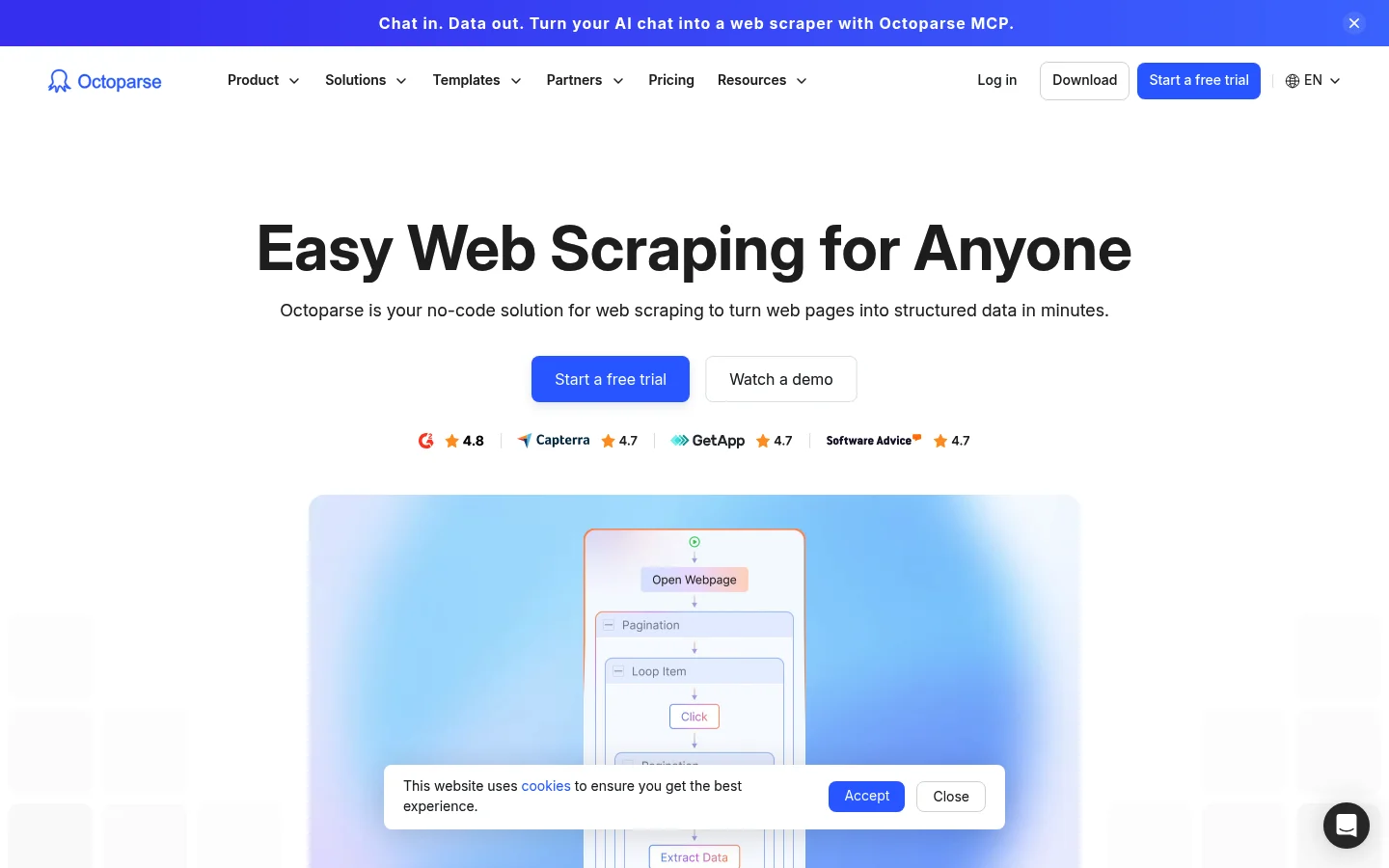
Pre-built templates are available for popular travel and airline booking pages. Users define extraction rules by clicking on page elements in a live browser view. Those rules then deploy to Octoparse’s cloud for scheduled collection runs.
Key features:
- Visual select-and-extract interface requiring no coding
- Pre-built templates for travel sites including airline booking pages
- Cloud-based scheduled runs with export to CSV, Excel, and Google Sheets
- Desktop app for local configuration and testing
Pricing:
The free plan is capped at 10,000 rows per export (50,000 rows per month). Paid plans start at $69 per month (Standard, billed annually) for cloud scraping and scheduling, with the Professional tier at $249 per month.
Best for: Small teams or individual researchers who need flight data without coding or managing infrastructure.
Pros:
- ✅ Zero coding required, accessible to non-technical users
- ✅ Pre-built templates reduce setup time for common booking sites
- ✅ Direct Google Sheets export for lightweight reporting workflows
Cons:
- ❌ Struggles with advanced anti-bot systems on major booking platforms without external proxy setup
- ❌ Not suitable for real-time or high-frequency monitoring at production scale
- ❌ Free plan is capped at 10,000 records per export
5. Oxylabs: Best Enterprise Proxy for Flight Data
Oxylabs provides enterprise-grade proxy infrastructure and a Real-Time Crawler with JavaScript rendering support.
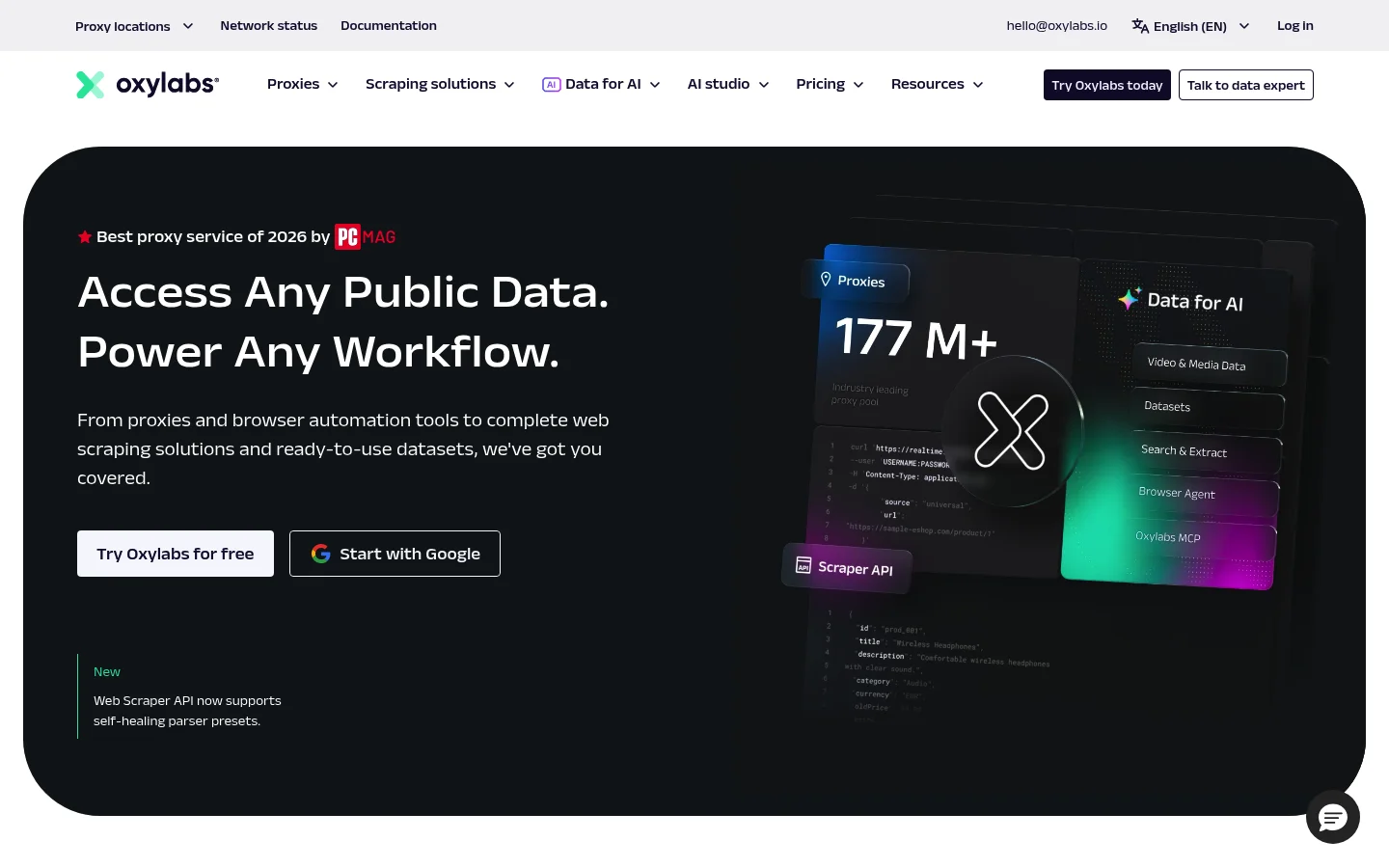
It is built for teams needing city-level geo-targeting as a foundation for custom flight scrapers. Retrieve location-sensitive fares by simulating requests from specific cities using the residential IP network.
Key features:
- Real-Time Crawler with JavaScript rendering for dynamic booking pages
- 100M+ residential IPs with geo-targeting down to city level
- Dedicated account management and enterprise SLAs
- Compatible with Python, Node.js, and major scraping frameworks
Pricing:
Oxylabs starts at $49 per month for basic access. Enterprise plans are custom-quoted based on volume.
Best for: Enterprise teams building custom flight scrapers that need city-level geo-targeting and enterprise SLA guarantees.
Pros:
- ✅ City-level geo-targeting for location-sensitive fare retrieval
- ✅ Enterprise SLAs with dedicated account management
- ✅ Real-Time Crawler handles JavaScript rendering on dynamic booking pages
Cons:
- ❌ No dedicated flight scrapers. All custom scraping logic must be built from scratch.
- ❌ Success rates on aggressively protected airline sites trail Bright Data’s benchmark result
- ❌ High total cost of ownership when accounting for custom scraper development and maintenance
6. Smartproxy: Best Budget Proxy for Custom Scripts
Smartproxy offers a rotating residential proxy network at competitive per-gigabyte pricing.
It is a building block for developers with existing custom flight scrapers who need affordable IP rotation. The low per-GB rate makes it practical for scaling an already-built scraper without high infrastructure costs.
Key features:
- 115M+ rotating residential proxies across 195+ locations
- Pay-per-GB pricing starting at $2 per GB (volume tiers)
- API integration compatible with Python, Node.js, and common scraping libraries
- Sticky session support for multi-step booking page navigation
Pricing:
Residential proxies start at $2 per GB on the largest volume tier (1,000 GB), with entry pricing at $3.75 per GB for the 3 GB plan and $4 per GB on pay-as-you-go. No dedicated flight scraper product is included.
Best for: Budget-conscious developers with existing custom scripts who need affordable IP rotation for production scale.
Pros:
- ✅ Competitive per-GB pricing for high-volume proxy use
- ✅ Simple API integration with standard scraping frameworks
- ✅ Sticky sessions support multi-step booking navigation flows
Cons:
- ❌ No dedicated flight scraper. All custom scraping logic must be built and maintained independently.
- ❌ Lower success rates on Cloudflare and DataDome protected sites compared to Bright Data
- ❌ JavaScript rendering, CAPTCHA solving, and data normalization must be handled separately
7. Scrapy: Best Open-Source Flight Scraper Framework
Scrapy is an open-source Python framework for building custom web scrapers with full architectural control.
For flight scraping, Scrapy is the foundation layer, not a finished tool. Anti-bot bypass and proxy infrastructure must be added separately. Teams building on Scrapy maintain complete control over every layer of the scraping pipeline.
Key features:
- Open-source and free, with no licensing fees
- Extensible middleware for proxy rotation, request headers, and retry logic
- Built-in item pipelines for data validation, cleaning, and storage
- Large community with extensive documentation and third-party plugins
Pricing:
Scrapy is free. Additional costs include proxy networks, cloud hosting, CAPTCHA solving services, and developer time for maintenance and anti-bot adaptation.
Best for: Engineering teams with strong Python expertise who want full control over every layer of their scraping architecture.
Pros:
- ✅ Full architectural control with extensible middleware and item pipelines
- ✅ Zero licensing costs
- ✅ Large open-source community with documented patterns and third-party plugins
Cons:
- ❌ Significant Python expertise required for setup, anti-bot adaptation, and maintenance
- ❌ No built-in anti-bot bypass. Proxies and CAPTCHA solvers must be integrated manually.
- ❌ High total cost of ownership when factoring in developer time and infrastructure overhead
8. ParseHub: Best Visual Scraper for Small Projects
ParseHub is a visual web scraper with AJAX and JavaScript rendering support for dynamically loaded booking pages.
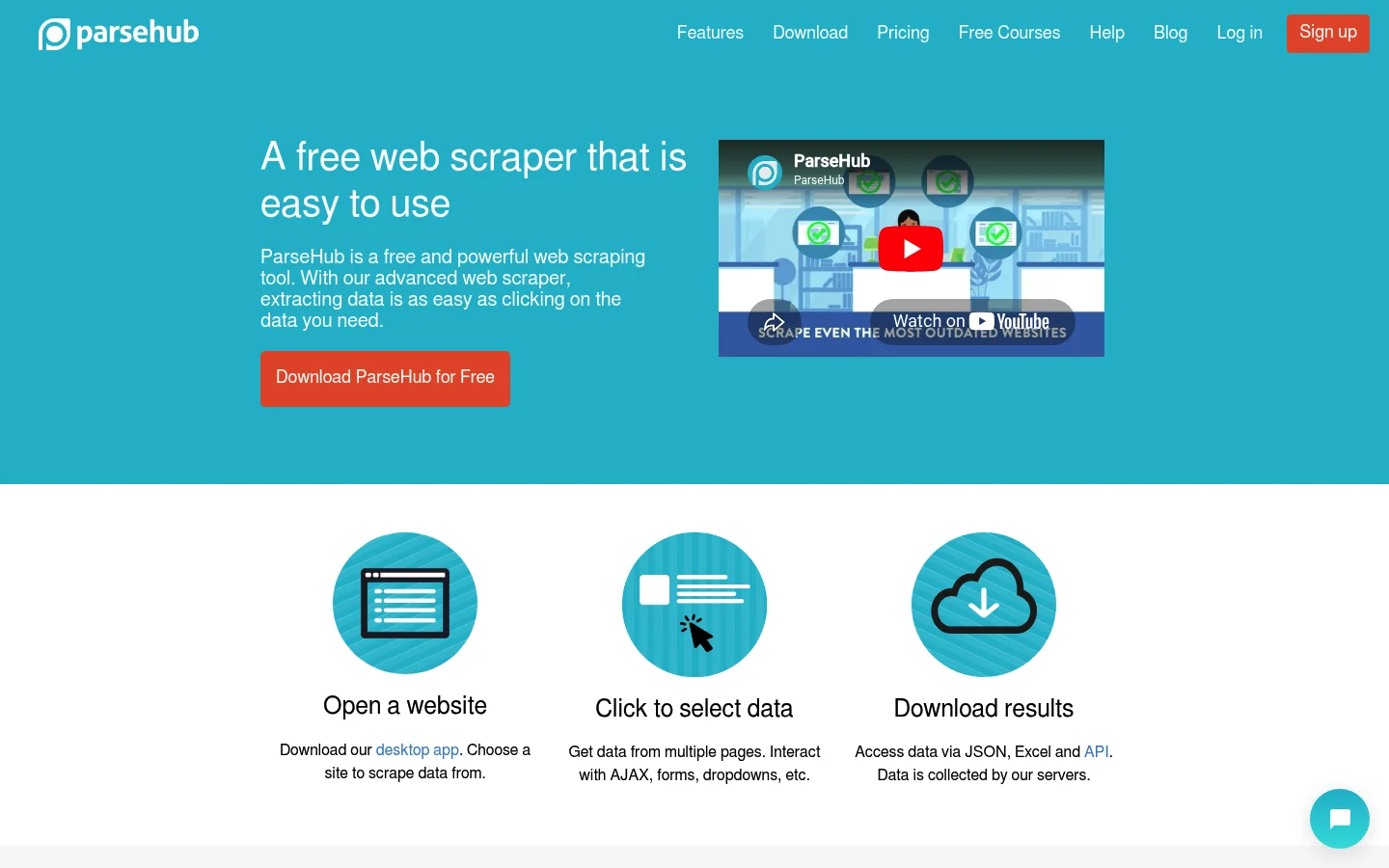
It targets non-technical users collecting flight data from a small set of pages on an infrequent basis. A desktop app handles visual configuration. Rules then deploy to ParseHub’s cloud for scheduled runs and export.
Key features:
- Visual extraction interface with multi-page and pagination support
- AJAX and JavaScript rendering for dynamically loaded booking content
- Scheduled cloud runs with export to JSON, CSV, and Excel
- Desktop application for local configuration and testing
Pricing:
The free plan includes 5 projects and 200 pages per run. Premium plans start at $189 per month.
Best for: Researchers and small teams running infrequent, low-volume flight data projects with no coding requirements.
Pros:
- ✅ Visual interface handles multi-page and paginated booking flows
- ✅ JavaScript rendering included without additional configuration
- ✅ Flexible export formats including structured JSON
Cons:
- ❌ $189 per month premium pricing is steep for the anti-bot capability delivered
- ❌ Limited scalability for high-frequency or high-volume flight monitoring
- ❌ Anti-bot performance is insufficient for major airline sites without external proxy setup
How Do These Eight Tools Compare?
The table below provides a quick reference for all eight tools reviewed.
TL;DR: Best Flight Scrapers at a Glance
| Tool | Type | Reliability | Free Tier | Starting Price | Best For |
|---|---|---|---|---|---|
| Bright Data | Web Scraping API + Dataset | 98.44% benchmark success rate | Yes (5,000 records/mo) | $0.75/1K requests | Best overall flight scraper |
| SerpApi | SERP API | High (Google Flights) | Yes (250 searches/mo) | $25/month | Google Flights data |
| Apify | Scraper marketplace | Variable (community actors) | Yes ($5 credit) | $29/month | Pre-built flight actors |
| Octoparse | No-code scraper | Limited on protected sites | Yes (limited) | $69/month | No-code flight scraping |
| Oxylabs | Enterprise proxy + crawler | High (enterprise proxy) | No | $49/month | Enterprise proxy infrastructure |
| Smartproxy (Decodo) | Proxy network | Moderate | No | $2/GB | Budget proxy for custom scripts |
| Scrapy | Open-source framework | Configurable | Free | Free (infra costs apply) | Custom open-source scrapers |
| ParseHub | Visual scraper | Low on protected sites | Yes (5 projects) | $189/month | Small-scale visual scraping |
How to Choose the Right Flight Scraper
Choosing the wrong tool wastes engineering time and budget. Three factors determine which scraper fits your situation.
Volume and Frequency Requirements
High-volume pipelines need tools built for scale. Pay-per-success pricing becomes critical at volume. A 70% success rate effectively doubles your cost per delivered record due to retry overhead and failed requests. For recurring, high-frequency collection, look for unlimited concurrency and reliable uptime SLAs. For one-time or low-frequency research, a free tier or pay-per-use model is usually sufficient.
What Is Your Team’s Technical Skill Level?
No-code tools like Octoparse and ParseHub suit non-technical users. API-based tools like Bright Data suit developers comfortable with REST APIs and JSON parsing. Open-source frameworks like Scrapy require dedicated Python engineers. If your team sits between those extremes, the AI Scraper Studio lets you build scrapers visually and deploy them on managed cloud infrastructure. For a broader comparison of no-code options, see the guide to best no-code scrapers.
Which Platforms Need the Strongest Anti-Bot Bypass?
Google Flights, Expedia, and major airline sites deploy Cloudflare, DataDome, and custom WAF rules. Scraping these without purpose-built anti-bot bypass produces high block rates regardless of the scraper framework. For heavily protected booking sites, success rate is the primary selection criterion over sticker price. Prioritize tools with fingerprint evasion, automatic CAPTCHA solving, and a large rotating residential IP pool.
Common Use Cases for Flight Scrapers
Flight data powers a wide range of analytical and commercial applications. These are the five most common production use cases for flight scraping infrastructure.
Price Monitoring and Fare Alert Systems
Fare tracking is the most common use case for flight scrapers. Price alert products notify consumers when a target route drops below a threshold fare. These systems require near-real-time scraping at high frequency. Airlines update prices continuously, so collection intervals of 15 to 60 minutes are standard for accurate fare alerts on high-demand routes.
How Do Competitive Intelligence Teams Use Flight Data?
Airlines and OTAs track competitor fares on overlapping routes. Understanding pricing by route, cabin class, and days-to-departure helps revenue management teams adjust fares in response to competitive moves. This is a high-volume use case requiring consistent, normalized data across dozens of routes and carriers.
Travel Deal Aggregators and Comparison Sites
Comparison platforms aggregate fares from multiple sources and surface the lowest available price. These products depend on reliable, structured flight data at scale. The Flight Club dataset serves aggregator teams wanting pre-collected, normalized data without running custom scraping infrastructure.
Revenue Management and Demand Forecasting
Airlines and travel-focused investment firms use real-time flight data to model demand curves and forecast revenue by route. According to IMARC Group, the global airlines analytics market reached USD 8.5 billion in 2024 and is projected to reach USD 24.9 billion by 2033, growing at a 12.7% CAGR. That growth reflects surging institutional demand for structured flight data across pricing research and demand modeling.
Academic Research and Market Analysis
Researchers studying pricing behavior and market concentration in air travel use flight scrapers to build evidence-based datasets. Academic teams typically need large historical samples with coverage across carriers, routes, and booking windows to draw statistically valid conclusions.
What Are the Key Technical Challenges?
Flight scraping is more demanding than scraping most website categories. Four challenges account for the majority of failures in production pipelines.
How Do Anti-Bot Systems Block Flight Scrapers?
Imperva reports that 44.5% of internet traffic in the travel sector consists of bots. Airlines and booking platforms respond with layered detection stacks including Cloudflare, DataDome, PerimeterX, Akamai, and custom WAF rules. These systems analyze browser fingerprints, TLS signatures, and request timing to identify automation. Tools that do not rotate fingerprints are blocked within seconds on major booking sites. Bright Data’s Scraping Browser manages a pool of realistic browser sessions with unique fingerprints. This makes automated requests behaviorally consistent with human traffic.
Does Dynamic Pricing Break Scraping Workflows?
Dynamic pricing creates a fundamental freshness challenge. Airlines use yield management algorithms that adjust prices in real time based on demand, booking pace, and competitive signals. Data older than 30 minutes can be meaningless for active competitive analysis. Scrapers must be designed with strict freshness requirements. Scheduling intervals must reflect the price volatility of target routes, especially during peak travel periods.
How Do You Handle Rate Limiting and IP Bans?
Booking platforms enforce rate limits at the IP address level. A single IP exceeding a few requests per minute is throttled or banned. Effective flight scraping requires a rotating IP pool large enough to distribute requests at scale. Residential IPs are preferred because they carry the same trust signals as human user traffic. Bright Data’s residential proxy network, with 400M+ IPs across 195 countries, distributes request volume without triggering per-IP rate limits.
Structuring and Normalizing Raw Flight Data
Raw HTML from booking sites is inconsistent across platforms. Price formats, time conventions, fare basis codes, and route representations all vary by platform. A production pipeline requires a normalization layer converting raw output into a consistent schema. Bright Data’s ready-to-use datasets and dedicated flight scraper normalize output automatically. Teams building on Scrapy or bare proxy solutions must design this normalization logic from scratch.
For a broader look at flight data sources beyond scrapers, see the guide to the best flight data providers. If your data needs extend into hospitality and short-term rentals, the best Airbnb scrapers guide covers tools used in adjacent travel markets. To begin collecting flight data at scale, start for free with Bright Data and test the free tier of 5,000 records per month against real booking sites with no credit card required.
Frequently Asked Questions
Q: What is the best flight scraper overall in 2026?
Bright Data is the best overall flight scraper in 2026. It achieves a 98.44% average success rate in an independent benchmark of 11 providers, the highest of any tool reviewed. It combines a dedicated pre-built flight scraper for Google Flights, Expedia, and Kayak with pay-per-success pricing at $0.75 per 1,000 successful requests (or $1.5 with PAYG) and a 400M+ IP pool for geo-specific fare retrieval across 195 countries. For teams collecting flight data from heavily protected booking sites at production scale, no other tool matches this combination of performance and pricing structure.
Q: How do flight scrapers handle dynamic pricing?
Flight scrapers handle dynamic pricing by collecting data on a recurring schedule rather than a one-time basis. Airlines update fares up to 1,000 times per day, so production pipelines typically run at 15 to 60 minute intervals. Tools with webhook support or real-time collection modes handle high-volatility routes more effectively. Data older than 30 minutes should be treated as potentially stale for active competitive analysis use cases.
Q: Can I scrape Google Flights data?
Yes, Google Flights data can be scraped. Bright Data’s dedicated flight scraper and SerpApi both support Google Flights. SerpApi offers a specialized Google Flights endpoint for straightforward structured output. Bright Data provides broader coverage including Google Flights, Expedia, Kayak, and direct airline sites through a single API.
Q: What data fields can a flight scraper extract?
A flight scraper can extract origin airport, destination airport, departure time, arrival time, total flight duration, number of stops, airline name, operating carrier, cabin class, current ticket price, currency, fare basis code, seat availability, and baggage policy. Some platforms also expose carbon emissions estimates and loyalty program fare categories.
Q: How much does it cost to scrape flight data?
Costs range from free for self-hosted open-source solutions like Scrapy (with infrastructure costs on top) to $1.50 per 1,000 successful records for Bright Data’s PAYG plan. SerpApi starts at $25 per month for 1,000 searches. Octoparse starts at $69 per month. ParseHub starts at $189 per month. At production scale, pay-per-success models are typically more cost-efficient than flat monthly subscriptions because you only pay for successfully delivered records.
Q: Do I need coding skills to use a flight scraper?
It depends on the tool. Octoparse and ParseHub require no coding. Bright Data and SerpApi require basic ability to call a REST API and parse JSON. Scrapy requires strong Python expertise to build and maintain custom spiders. Bright Data also offers a Web Scraper IDE for teams that want a visual builder deployed on managed cloud infrastructure, bridging the gap between no-code tools and full API access.
Q: How often should I run a flight scraper to get accurate pricing?
For fare alert systems and competitive intelligence, scrape every 15 to 60 minutes. Airlines update prices up to 1,000 times per day, so data older than 30 minutes can be stale for high-demand routes. For demand forecasting and historical research, daily collection is typically sufficient. Adjust scraping frequency based on the price volatility of your target routes and the freshness requirements of your use case.



Web Data & AI Expert
 6 years experience
Daniel Shashko is a Senior SEO/GEO at Bright Data, specializing in B2B marketing, international SEO, and building AI-powered agents, apps, and web tools.