







In this article, you will learn:
- What quantum AI is, how it works, how it represents the next evolution of today’s foundation AI, and how it compares with current AI systems.
- Whether web datasets are relevant to quantum artificial intelligence as they are for large language models.
- Why quantum computing AI workflows still depend on web data.
- How Bright Data enables web data retrieval for hybrid AI systems that combine classical infrastructure with quantum computing.
Let’s dive in!
An Introduction to Quantum AI
Before discussing how web data fits into quantum AI, you need to understand the basics of this emerging approach to AI.
What Is Quantum AI?
Quantum AI, short for quantum artificial intelligence, refers to the combination of artificial intelligence and quantum computing. The end goal is to create AI systems that leverage quantum technologies.
Foundation models run on classical computers using binary bits, while quantum AI uses quantum computers built on qubits. Unlike classical bits, which are strictly 0 or 1, qubits harness quantum mechanics to exist as 0, 1, or a “spinning” blend of both simultaneously.
This could allow AI models to solve problems beyond the capabilities of traditional computing systems. Potential applications include faster AI training, improved optimization, scientific discovery, and more advanced machine learning algorithms.
Keep in mind that quantum AI is still in its early research phase. Right now, AI workloads continue to rely on the current AI stack. At the same time, researchers are exploring how quantum computing can enhance future AI systems.
How Quantum AI Works
Quantum AI is built around quantum algorithms that operate on qubits. These algorithms leverage quantum properties such as superposition and entanglement to process certain types of calculations in ways that differ from bit-based processors.
Although still experimental, some promising approaches to quantum artificial intelligence are:
- Quantum optimization algorithms: Aim to solve difficult-to-solve optimization problems by exploring many possible solutions. In AI, they could help optimize model parameters, improve reinforcement learning, or solve problems involving countless possible combinations.
- Quantum classifiers: Harness quantum circuits to classify data and identify patterns. For instance, researchers are exploring variational quantum classifiers as a method for improving decision-making.
- Quantum neural networks (QNNs): Attempt to replicate neural network operations using quantum circuits. They could enable new approaches to pattern recognition and machine learning, although they remain mostly theoretical today.
- Quantum-enhanced reinforcement learning: Explores whether quantum systems can help AI agents analyze many possible actions and optimize learning tasks in environments with many variables.
The Shift from Foundation AI to Quantum Computing for AI
Today’s AI models are powered by classical computing architectures. These systems face known challenges, such as high computational costs, increasing energy requirements, and difficulty handling some problems at scale.
Quantum AI investigates how quantum processors could address some of those limitations. This could enable future AI processes to perform specific tasks where quantum computing should offer an advantage, such as probabilistic modeling.
This transition involves designing AI architectures that go beyond classical hardware. These architectures should incorporate qubits to represent and process information in new ways.
As of this writing, most quantum AI experiments run on quantum simulators or small-scale quantum processors. In the near term, hybrid quantum-classical models are considered the most practical path toward real-world applications. That is because they combine the reliability of bit computing systems with the potential advantages of quantum computing.
Quantum AI vs Current AI: Main Differences
Compare quantum AI with the current state of AI in the table below:
| Aspect | Current AI | Quantum AI |
|---|---|---|
| Computing foundation | Runs on classical computing architectures based on binary bits (0 and 1). | Uses quantum computing architectures based on qubits. |
| Current status | Widely deployed across industries and powers foundation models, generative AI systems, and machine learning applications. | Still in the research phase, with experiments mainly running on quantum simulators and small-scale quantum processors. |
| Hardware maturity | Built on mature infrastructure, including CPUs, GPUs, and specialized AI accelerators. | Relies on emerging quantum hardware that is still being improved in areas such as scalability, reliability, and error correction. |
| Main strengths | Performs a broad range of AI tasks reliably, including language generation, image recognition, and prediction. | Could provide advantages for specific workloads involving optimization, simulation, and probabilistic modeling. |
| Main limitations | Require significant computing resources, energy consumption, and infrastructure to train and run large AI models. | Currently limited by hardware constraints, small qubit counts, and the difficulty of developing practical quantum algorithms. |
Do Quantum Machine Learning and AI Still Depend on Web Datasets?
Artificial intelligence owes much of its recent progress to the sheer volume of massive web datasets used for training. In contrast, quantum AI and machine learning (QML) do not primarily depend on large-scale web datasets.
The main challenge is that quantum computers cannot directly process structured web data in its original form. Converting, transforming, encoding, and processing petabytes of web content into quantum states remains difficult due to hardware limitations and data-loading constraints.
Furthermore, QML research suggests that some quantum models may achieve higher sample efficiency. That means they could learn patterns from fewer examples compared to regular deep learning models.
However, web datasets are still important for a few quantum AI scenarios, such as:
- Benchmarking models: Some AI models are trained on tailored datasets so they can be compared with quantum AI models to evaluate whether quantum approaches outperform traditional ML methods.
- Building hybrid quantum-classical architectures: Current approaches combine classical infrastructure for data preparation and processing with quantum processors for specific tasks where quantum methods may provide an advantage.
The Role of High-Quality Scraped Web Data in Quantum AI
Web datasets are often viewed only as fuel for the initial training phase of AI models. Yet, the value of web data extends across the entire AI lifecycle. High-quality extracted data supports workflows such as RAG, evaluation, fine-tuning, and grounding.
In this context, web data extraction tools help AI systems reduce inaccurate or outdated outputs. They achieve that by providing access to contextual, up-to-date, and verifiable information collected from online sources.
Now, quantum AI does not currently depend on massive web datasets in the same way as today’s foundation models. Still, as hybrid quantum-classical architectures evolve, web data will likely remain a fundamental component of quantum-enhanced AI workflows.
For example, to handle a specific task, an AI agent could need to retrieve meaningful web data. This will be sent through a specialized data pipeline, which would convert it into structured inputs for a Quantum algorithm / AI model. The resulting outputs could then be analyzed, processed, and integrated back into the AI agent’s reasoning loop to support further decisions or actions.
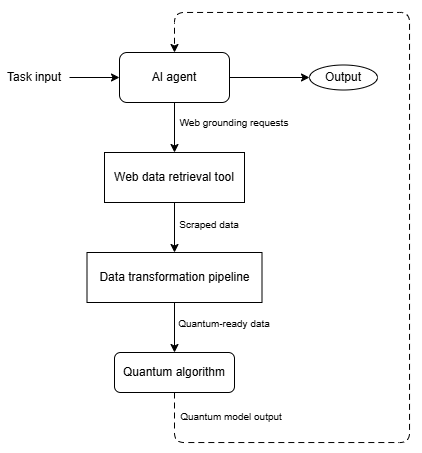
Thus, classical infrastructure would likely continue handling data collection, preprocessing, retrieval, and transformation. At the same time, quantum processors would focus on specialized operations where they may provide an advantage.
In short, high-quality scraped data serves as a bridge between quantum computing and practical AI usage. It provides the context needed to transform theoretical capabilities into useful, actionable outcomes.
Application Examples
To better understand how web data could support quantum computing AI applications, consider the examples below:
- Quantum-powered supply chain optimization: A quantum-enhanced supply chain system could combine web data about market trends, supplier information, regulations, and external events with quantum optimization algorithms.
- Financial modeling and risk analysis: A quantum AI system for finance might combine real-time market data, economic indicators, and news signals with quantum algorithms devised to explore improved asset allocation strategies while balancing expected returns and risk.
- AI agents for technical research: An AI agent could collect information from scientific publications, documentation, and industry reports before using quantum-enhanced models to explore simulation tasks.
How Bright Data Supports Web Data Delivery for Quantum AI Processes
Bright Data is the world’s leading web data provider, offering petabyte-scale datasets optimized for AI and ML training. These datasets help build the foundation models powering today’s AI systems.
However, web datasets are not the primary bottleneck for quantum AI. Instead, the key challenge is enabling the classical side of hybrid quantum-classical architectures to retrieve, validate, and prepare high-quality web data before it reaches quantum computing processes. This is where Bright Data comes in!
Its suite of web data APIs gives AI systems access to live web information, allowing them to search the web, retrieve content, and extract structured data without worrying about CAPTCHAs, IP bans, or other anti-bot protections.
These APIs can be integrated through Bright Data’s Bright Data MCP or directly into more than 70 AI agent frameworks. Some of Bright Data’s main APIs include:
- SERP API: Collect search results from Google, Bing, and other search engines.
- Web Unlocker API: Retrieve raw HTML or Markdown from any web page.
- Web Scraper APIs: Extract structured data from websites such as Amazon, LinkedIn, and 40+ other domains.
- Crawl API: Turn entire websites into structured datasets for downstream AI workflows.
- Browser API: Control a remote browser programmatically to interact with dynamic websites.
Note: All Bright Data APIs come with a free forever plan (5k requests per month).
What sets Bright Data apart is its enterprise-grade infrastructure. Built on a proxy network of 400+ million IPs across 195 countries, it offers 99.99% uptime and achieves a 99.95% success rate.
Bright Data provides the live web access needed to retrieve trustworthy, up-to-date information. That enables AI agents to ground their reasoning in contextual web data while leaving specialized tasks to quantum processors.
Conclusion
In this blog post, you learned what quantum AI is, how it differs from foundation AI, and why hybrid quantum-classical architectures are considered the most practical path toward practical adoption.
You also saw that, while quantum AI does not rely on massive web datasets for pre-training in the same way as large language models, it still requires web data. After all, quantum AI cannot operate in isolation. It still requires relevant data to process and analyze.
In this context, Bright Data provides enterprise-grade, AI-ready web scraping APIs that give AI systems reliable and scalable access to fresh web information.
Create a Bright Data account and explore how our services can help you build the next generation of AI applications!
FAQ
Why is “quantum AI” trending?
“Quantum AI” is trending because it promises to tackle problems that are difficult or impractical for today’s computing systems. By leveraging qubits instead of classical bits, it could unlock major advances in computational performance and energy efficiency when it comes to AI processing.
What is the relationship between AI and quantum computing?
Artificial intelligence and quantum computing are complementary technologies. AI provides systems that learn from data and make decisions, while quantum computing offers a new computing paradigm that could accelerate selected workloads and tasks.
What is the difference between quantum AI and quantum machine learning?
Quantum AI is the broad, high-level vision of creating computer systems that exhibit human-like intelligence using quantum physics. Instead, quantum machine learning is a practical subfield of quantum AI focused on using quantum algorithms to enhance or replace traditional ML tasks.



Technical Writer
 5.5 years experience
Antonello Zanini is a technical writer, editor, and software engineer with 5M+ views. Expert in technical content strategy, web development, and project management.