





Gemini is now a primary answer engine. GEO and AI-visibility teams need scrapers that extract prompts, responses, and citations at scale. Bright Data tops Scrape.do’s independent benchmark of 11 providers with a 98.44% average success rate. This guide ranks seven Gemini scrapers in 2026, covering the Gemini app and Google AI Mode.
In this article, we are going to talk about:
- What Gemini scrapers are and the two surfaces they cover: the Gemini app and Google AI Mode
- The 7 best Gemini scrapers in 2026, ranked by reliability, data completeness, and verified pricing
- Which tools scrape the Gemini app directly versus Google AI Mode
- How to choose the right Gemini scraper for your GEO or AI-visibility program
- Key technical challenges and how leading tools solve them
TL;DR: Best Gemini Scrapers at a Glance
| Tool | Type | Free Tier | Starting Price | Best For |
|---|---|---|---|---|
| Bright Data | Gemini app (direct) | 5,000 records/mo, no CC | $1.50/1K records (PAYG) | Best overall, GEO tracking, full citation data |
| DataForSEO | Gemini app (direct) | Trial credits on signup | $1.20/1K results (standard) | API-only, cheapest direct Gemini scrape |
| Decodo | Google AI Mode | 2,000 requests/mo | $0.50/1K (Core plan) | Budget AI Mode coverage |
| Oxylabs | Google AI Mode | None listed | Custom pricing | Enterprise AI Mode and Perplexity |
| SerpApi | Google AI Mode | 250 searches/mo | $25/mo (1,000 searches) | Google Search AI answer tracking |
| ScrapingBee | Google AI Mode | None listed | 15 credits/request | Teams already using ScrapingBee |
| Apify community Bard actor | Gemini app (defunct) | N/A | ~$30/mo (unverified) | Experiments only; not production |
What Is a Gemini Scraper?
A Gemini scraper extracts structured data from a Gemini-powered surface. There are two distinct surfaces, and they return different data. Knowing which one your use case requires determines which tool you should use.
Gemini App vs Google AI Mode
The Gemini app is the standalone conversational assistant at gemini.google.com. Scraping it returns full response text, sources cited, citation URLs, prompt and response IDs, conversation URLs, and timestamps. The citation layer is the most valuable output for AI-visibility tracking.
Google AI Mode is a different surface. It is the Gemini-powered answer block embedded in a standard Google Search results page. Scraping it returns AI summary text and inline references within the SERP context. It does not return the full conversational citation layer that the Gemini app provides.
Only two tools in this guide scrape the Gemini app directly: Bright Data and DataForSEO. The remaining five cover the Google AI Mode surface inside Google Search.
Why GEO Teams Need Gemini Data
Generative Engine Optimization (GEO) tracks brand presence inside AI-generated answers. Gemini is one of the highest-reach answer engines in the world. A brand not monitoring Gemini citations is missing a growing share of its visibility.
Manual monitoring cannot scale beyond a handful of queries per day. Automated Gemini scraping lets teams track citation frequency over time. It also monitors competitor mentions and detects answer drift. The citation and source fields are the most critical outputs for any GEO program.
How We Evaluated These Scrapers
This ranking evaluated more than a dozen Gemini-related tools against four criteria. Tools with no Gemini coverage were excluded from the list.
Does It Cover the Right Gemini Surface?
The first filter was surface coverage. Direct Gemini-app scrapers return richer citation data than Google AI Mode scrapers. Every tool in this guide is tagged by surface so GEO teams can match tools to their specific data requirements.
What Data Fields Does It Return?
For Gemini-app scrapers, we looked for: prompt text, response content, sources, citations, conversation URL, and timestamps. For AI Mode scrapers, we evaluated the AI summary text, inline references, and follow-up context. Tools missing citation or source fields scored lower for GEO tracking use cases.
What Is the Reliability at Scale?
Anti-bot evasion, session handling, and concurrency determine whether a scraper works at production volumes. Where available, we cited independent benchmark data over vendor self-reporting. Bright Data was the standout performer for Gemini in that independent benchmark, the only provider tested that reliably scraped the Gemini interface.
How Transparent Is the Pricing?
All prices are verified from each vendor’s live pricing page as of June 8, 2026. Where pricing is not public, we say so. No figures were estimated or invented.
The Best Gemini Scrapers, Ranked
Seven tools made the final list. Two scrape the standalone Gemini web interface directly. Five cover the Google AI Mode surface inside Google Search. Every tool is tagged by surface so you can match it to your use case before reading its review.
1. Bright Data: Best Overall Gemini Scraper
Bright Data is the strongest Gemini scraper available in 2026 for GEO and AI-visibility teams.
The Web Scraping API includes a dedicated Gemini Scraper that hits gemini.google.com directly. Bright Data’s Gemini Scraper was the only tool in AIMultiple’s independent benchmark to clear the 90% reliability threshold on Gemini. The benchmark ran 1,000 tests per provider (100 prompts repeated 10 times each) across ChatGPT, Gemini, Perplexity, and Google AI Mode. No other tool in this guide matched that result across every category. Scrape.do’s independent benchmark of 11 web scraping providers recorded a 98.44% average success rate for Bright Data, the highest of any provider tested.
Surface: [Gemini app, Google AI Mode] (direct)
What Bright Data Returns
Bright Data’s Gemini Scraper returns structured data across multiple fields:
- Prompt ID and prompt text
- Response ID and response content
- User ID and conversation URL
- Sources and citation links
- Timestamps and keyword metrics
The citation and source fields are the data points that make longitudinal GEO tracking possible. Track which domains Gemini cites, at what frequency, and how that shifts over time. This level of citation depth is not matched by any other tool reviewed here.
The Full AI Scraper Suite
Bright Data’s Gemini Scraper is part of a unified AI scraper suite. The same platform covers ChatGPT, Gemini, Perplexity, Microsoft Copilot, and Google AI Mode. One integration feeds a full multi-engine GEO program. The LLM Scraper handles multi-platform collection without managing five separate vendor accounts.
Bright Data is the only platform covering all AI surfaces under one account. It supports a ChatGPT scraper, Perplexity scraper, and Microsoft Copilot scraper alongside Gemini monitoring.
Infrastructure and Reliability
Bright Data runs on 400M+ ethically sourced residential IPs across 195 countries. It handles fingerprinting, CAPTCHA solving, and JavaScript rendering automatically. The platform bypasses Cloudflare, DataDome, PerimeterX, Akamai, and Imperva. No infrastructure management is required on your end.
The uptime SLA is 99.99%. Batch jobs accept up to 5,000 URLs. Output formats include JSON, NDJSON, and CSV. Unlimited concurrency is available on paid plans.
No-Code and API Access
A no-code Scraper Marketplace and Playground lets non-technical users run Gemini jobs without writing code. Developers use the full Scraper API. Both interfaces are available on the same account. This matters for GEO teams where strategists and engineers share the same data pipeline.
Compliance and Enterprise Trust
Bright Data is GDPR compliant, CCPA compliant, ISO 27001 certified, and SOC 2 Type II certified. The proxy network is ethically sourced. These credentials matter for enterprise procurement reviews.
The platform is trusted by 50,000+ customers including Fortune 500 companies. It also serves 75% of AI training data traffic globally.
Pricing
Four tiers cover every volume level:
- Free tier: 5,000 records per month, no credit card required
- Pay-as-you-go: $1.50 per 1K records, billed only on successful delivery, no monthly minimum
- Scale: $499 per month, 384,000 records included, $1.30 per 1K additional records, cancel anytime
- Enterprise: Custom pricing, volume discounts, dedicated account manager, premium SLA, SSO
Use code APIS25 for 25% off the Scraper API for the first three months. First deposits are matched dollar-for-dollar up to $500.
Note on geo-targeting: Bright Data’s Gemini country targeting currently covers non-European countries. Confirm coverage for your target markets before building a regional tracking program.
Best for: GEO and AI-visibility teams that need direct Gemini-app scraping with full citation data, multi-engine programs, and enterprise-scale pipelines.
Pros:
- ✅ Ranked number one across all LLMs in an independent 1,000-test-per-provider benchmark
- ✅ Only tool returning the full citation layer directly from the Gemini app
- ✅ Pay-per-success: no wasted spend on failed requests
- ✅ No-code Playground plus full developer API on the same platform
- ✅ Unified suite covers Gemini, ChatGPT, Perplexity, Copilot, and Google AI Mode
- ✅ GDPR, CCPA, ISO 27001, and SOC 2 Type II certified
Cons:
- ❌ Gemini country targeting excludes European countries
- ❌ Not the cheapest per record at very low volumes for simple, unprotected pages
2. DataForSEO: Best for API-Only Direct Gemini Scraping
DataForSEO’s LLM Scraper is the only other tool here that scrapes the Gemini web interface directly.
It hits gemini.google.com rather than the AI Mode surface inside Google Search. The scraper returns full response text, snippets, links, images, tables, citations, and request metadata.
Surface: [Gemini app] (direct)
Key Features
- Direct Gemini-app scraping via REST API, returning structured response data including citations
- Three latency tiers: standard (~45 min), priority (~5 min), and live (~90 sec)
- Pay-as-you-go with no subscription required; free trial credits on signup
- ISO 27001 certified; strong fit for teams already using DataForSEO for keyword or SERP data
Pricing
Verified as of June 8, 2026. Standard tier (~45 min): $0.0012 per result, $1.20 per 1K. Priority tier (~5 min): $0.0024 per result, $2.40 per 1K. Live tier (~90 sec): $0.004 per result, $4.00 per 1K. Pay-as-you-go, no subscription. Free trial credits on signup.
Best for: API-first teams that want the cheapest verified price for direct Gemini-app scraping and do not need a no-code interface.
Pros:
- ✅ Cheapest verified price for direct Gemini-app scraping at $1.20/1K on the standard tier
- ✅ Three latency tiers for flexible job scheduling
- ✅ Pure pay-as-you-go; no subscription required
- ✅ Fits naturally into existing DataForSEO workflows
Cons:
- ❌ API only: no no-code UI or Playground
- ❌ Live tier is more than 3x the price of the standard tier
3. Decodo: Best Budget Tool for Google AI Mode
Decodo’s Web Scraping API covers Google AI Mode as part of its AI targets offering.
It does not scrape the standalone Gemini app at gemini.google.com. Coverage is the AI Mode surface inside Google Search.
Surface: [Google AI Mode]
Key Features
- AI targets covering ChatGPT, Perplexity, and Google AI Mode (Gemini via the AI Mode surface)
- Returns response content, prompts, timestamps, conversation metadata, and model identifiers
- Output formats: HTML, JSON, CSV, and Markdown
- JavaScript rendering included in all plans; geo-targeting across 195+ countries
Pricing
Verified as of June 8, 2026: Free tier includes 2,000 requests per month. Core plan is $19/month for 38,000 requests ($0.50/1K standard). Advanced plan is $49/month for 163,000 requests ($0.30/1K). Premium plan is $99/month for 707,000 requests ($0.14/1K). Premium proxy requests and JavaScript rendering cost more per 1K within each plan.
Best for: Teams on a budget that need Google AI Mode coverage and want a free tier before committing to a paid plan.
Pros:
- ✅ Free tier with 2,000 requests per month
- ✅ Competitive pricing at scale ($0.14/1K on the Premium plan)
- ✅ JavaScript rendering included in all plans
- ✅ Geo-targeting across 195+ countries
Cons:
- ❌ Google AI Mode only; does not scrape the Gemini app directly
- ❌ No dedicated Gemini product page; coverage is bundled under general AI targets
4. Oxylabs: Best for Enterprise Google AI Mode
Oxylabs offers an AI Search API with strong coverage of Google AI Mode and Perplexity.
Coverage is via the AI Mode surface inside Google Search, not the standalone Gemini app.
Surface: [Google AI Mode]
Key Features
- AI Search API covering Google AI Mode and Perplexity
- JavaScript rendering always enabled; structured metadata output
- Enterprise account management and premium SLA
- Posted success rates above 94% on Google AI Mode in independent benchmark testing
Pricing
Oxylabs does not publish pricing for its AI Search API. Access is listed as custom and requires a sales conversation. No specific figure can be confirmed.
Best for: Enterprise teams with existing Oxylabs relationships that need Google AI Mode coverage alongside Perplexity tracking.
Pros:
- ✅ Enterprise-grade account management and premium SLA
- ✅ High posted success rates on Google AI Mode
- ✅ Strong Perplexity coverage alongside Google AI Mode
Cons:
- ❌ No public pricing; requires contacting the sales team
- ❌ Google AI Mode only; does not scrape the Gemini app directly
5. SerpApi: Best for Tracking Gemini Answers Inside Google Search
SerpApi’s Google AI Mode API returns the Gemini-powered answers shown inside Google Search.
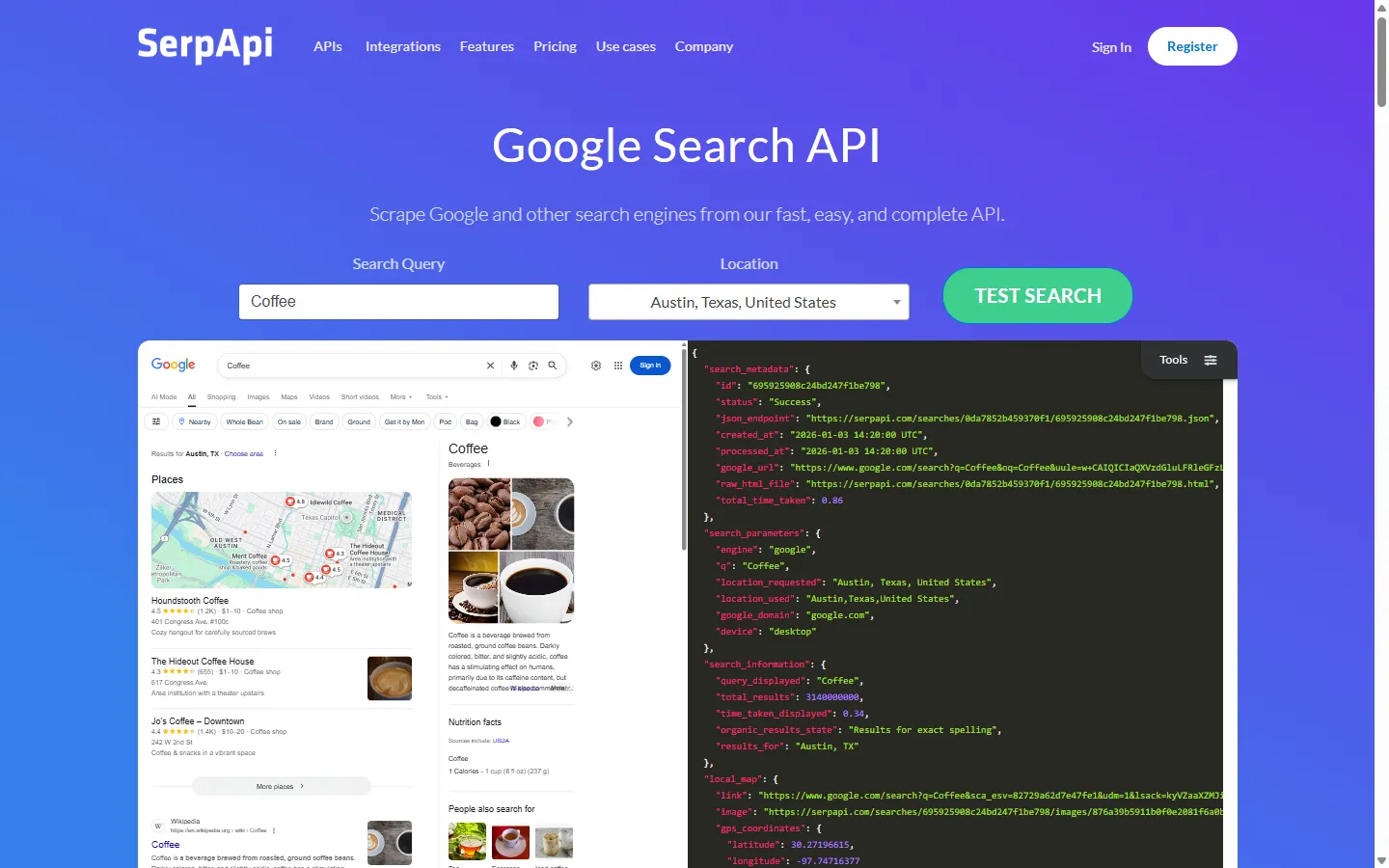
It does not scrape the Gemini app at gemini.google.com. Queries return AI summaries, text blocks, references, inline media, and follow-up context via a continuation token.
Surface: [Google AI Mode]
Key Features
- Google AI Mode API returning Gemini-powered answers within Google Search
- AI summaries, text blocks, references, and inline media
- Follow-up context available via a continuation token
- Device targeting support; well-documented REST API with official client libraries
Pricing
Verified as of June 8, 2026: Free tier includes 250 searches per month. Starter plan is $25/month for 1,000 searches. Developer plan is $75/month for 5,000 searches. Production plan is $150/month for 15,000 searches. Big Data plan is $275/month for 30,000 searches. Search credits are shared across all SerpApi endpoints. One AI Mode query uses one search credit.
Best for: Teams tracking Gemini’s influence within Google Search and already using SerpApi for organic SERP monitoring.
Pros:
- ✅ Clean, well-documented API with official client libraries
- ✅ Free tier with 250 monthly searches
- ✅ Returns continuation token for follow-up query context
Cons:
- ❌ Google AI Mode only; does not scrape the Gemini app
- ❌ Search credits shared across all endpoints; AI Mode queries reduce SERP budget
6. ScrapingBee: Best for Existing Stack Users
ScrapingBee includes AI scraping features covering Google AI Mode alongside its ChatGPT scraper.
Gemini-relevant coverage is the AI Mode surface inside Google Search, not the standalone Gemini app.
Surface: [Google AI Mode]
Key Features
- AI scraping features including a ChatGPT scraper and a Google AI Mode scraper
- Returns AI answer content with citations as Markdown or JSON
- Automatic retries on transient failures
Pricing
ScrapingBee charges 15 credits per AI scraper request. The per-credit rate was not verifiable from ScrapingBee’s pricing page as of June 8, 2026. Confirm the live credit rate before relying on it for budget planning. General ScrapingBee plans are positioned in the tens of dollars per month.
Best for: Teams already using ScrapingBee for other scraping tasks who want to add Google AI Mode coverage without onboarding a new vendor.
Pros:
- ✅ Fits naturally into existing ScrapingBee workflows
- ✅ Returns citations as Markdown or JSON
- ✅ Automatic retry logic reduces manual error handling
Cons:
- ❌ Google AI Mode only; does not scrape the Gemini app directly
- ❌ AI-scraper credit pricing is not transparently published; verify before committing budget
7. Apify Community Bard Actor: Honorable Mention Only
A community-built Apify actor was designed to query the Gemini (formerly Bard) web app and save the conversation.
Conceptually it is a direct Gemini-app scraper. In practice it is effectively defunct.
Surface: [Gemini app] (effectively defunct)
The actor requires your own Google session cookie. It has very low active usage. It was last updated approximately two years ago. Pricing is listed around $30/month plus usage. Treat this as unverified given the actor’s maintenance status. It is not suitable for any production GEO pipeline.
Best for: Quick manual experiments only. Not recommended for production use.
Pros:
- ✅ Conceptually covers the Gemini app directly
- ✅ Low barrier for one-off experiments
Cons:
- ❌ Requires a personal Google session cookie
- ❌ Effectively unmaintained; last updated approximately two years ago
- ❌ Not production-ready; very low active usage
Side-by-Side Comparison
The table below compares all seven tools across key criteria. Use it to shortlist candidates before committing to a tool.
| Tool | Best For | Reliability | Starting Price | Free Trial |
|---|---|---|---|---|
| Bright Data | GEO tracking, full citation data, multi-engine programs | 98.44% avg (Scrape.do, 11 providers); only tool to clear 90% on Gemini (AIMultiple) | $1.50/1K records (PAYG) | 5,000 records/mo, no CC |
| DataForSEO | API-first, cheapest direct Gemini-app scraping | ISO 27001; no public success-rate benchmark | $1.20/1K (standard) | Trial credits on signup |
| Decodo | Budget Google AI Mode coverage | JS rendering in all plans; no public benchmark | $0.50/1K (Core plan) | 2,000 requests/mo |
| Oxylabs | Enterprise AI Mode and Perplexity tracking | 94%+ posted success rate (Google AI Mode) | Custom pricing | None listed |
| SerpApi | Tracking Gemini answers inside Google Search | Well-documented; official client libraries | $25/mo (1,000 searches) | 250 searches/mo |
| ScrapingBee | Teams already using ScrapingBee | Auto-retry logic; no public benchmark | 15 credits/request | None listed |
| Apify Bard actor | Experiments only; not production-ready | Defunct; last updated ~2 years ago | ~$30/mo (unverified) | N/A |
How to Choose a Gemini Scraper
Choosing the right Gemini scraper comes down to four decisions: surface, data depth, reliability requirements, and cost at your actual volume. Work through these in order.
Do You Need the Gemini App or Google AI Mode?
This is the first and most important decision. If your GEO program tracks brand citations inside Gemini’s answers, you need a direct Gemini-app scraper. Only Bright Data and DataForSEO cover that surface. If you track Gemini’s influence on Google Search results specifically, Google AI Mode scrapers (Decodo, Oxylabs, SerpApi, ScrapingBee) are the correct choice.
A Google AI Mode scrape returns AI summary text, not the full citation layer from the Gemini app. Mixing up the surfaces leads to incomplete data.
How Important Is Citation Data?
Citation and source fields are the most valuable output for AI-visibility tracking. They reveal which domains Gemini cites and at what frequency. If citation tracking is a core requirement, prioritize direct Gemini-app scrapers with verified source fields. No tool reviewed here returns a more complete citation output than Bright Data’s Gemini Scraper.
What Level of Reliability Do You Need?
For production GEO pipelines running hundreds of queries per day, reliability is not optional. Anti-bot evasion, CAPTCHA solving, and session management must be handled automatically. For test or research workloads, a lower-price option may be acceptable. Use independent benchmark data rather than vendor self-reporting when evaluating reliability.
What Is Your Total Cost at Scale?
Compare pricing at your actual monthly volume. DataForSEO’s standard tier ($1.20/1K) has a lower per-record rate than Bright Data’s pay-as-you-go ($1.50/1K). But Bright Data’s Scale plan ($499/month for 384K records) works out to approximately $1.30/1K. Pay-per-success pricing also eliminates wasted spend on failed requests. At scale, total cost of ownership often favors the platform with the higher success rate.
What Are Common Gemini Scraper Use Cases?
GEO and AI-visibility teams deploy Gemini scrapers for a consistent set of recurring workflows. The five scenarios below cover the majority of production use cases.
How Do GEO Teams Track AI Visibility?
The primary use case is automated citation monitoring. Teams run queries across tracked topics or branded keywords. They extract citation and source data from Gemini’s responses. They measure citation frequency over time. This reveals which brands Gemini surfaces, how often, and in what context. A structured scraper feeding a database makes this repeatable at scale. For a practical implementation blueprint, see build an LLM mentions tracker.
Why Does Citation Analysis Matter for GEO?
Beyond tracking whether your brand appears, citation analysis maps which specific content assets Gemini cites. Which blog posts, landing pages, or third-party articles get referenced? This informs content strategy. The assets Gemini already cites are the ones worth reinforcing. Direct Gemini-app scrapers with a source field are required for this type of analysis.
Share-of-Voice in AI Answers
Competitive AI share-of-voice measures how often your brand is cited versus named competitors. Run this tracking monthly across a consistent query set. The results reveal momentum shifts before they appear in organic traffic data. Gemini scraping is one input. Pairing it with Perplexity and ChatGPT scrapers gives a multi-engine view of AI-generated visibility.
Content Research and Ideation
Gemini’s responses reveal how an AI engine summarizes a topic. They also show which sources it trusts and what related questions it generates. Content teams use this to find gaps and identify trusted reference domains. This is lower-frequency research work rather than ongoing monitoring.
AI Training Data Collection
Structured Gemini response data has value for fine-tuning models and building evaluation datasets. Research teams collect prompt-response pairs with metadata at scale. For broader LLM data collection, the best LLM scrapers guide covers multi-platform approaches.
What Are the Key Technical Challenges?
Scraping Gemini and Google AI Mode involves a different class of problems than scraping a standard web page. Four challenges come up in nearly every production deployment.
Why Is Google Anti-Bot Harder to Bypass?
Google operates some of the most sophisticated bot-detection systems available. Both the Gemini web app and Google Search sit behind layered defenses. These include fingerprint analysis, behavioral anomaly detection, CAPTCHA systems, and IP reputation scoring. Rolling your own solution against these systems is expensive and unreliable.
Bright Data’s infrastructure bypasses Cloudflare, DataDome, PerimeterX, Akamai, and Imperva automatically. The independent benchmark confirmed it was the only provider to reliably scrape the Gemini surface. Purpose-built Gemini scrapers with large IP networks handle this complexity by default.
Session Management and Authentication
The Gemini app requires an active authenticated session to generate responses. Managing sessions at scale is a non-trivial engineering problem. Rotating sessions before they expire or trigger rate limits is critical. Avoiding re-use patterns that signal automation adds further complexity.
Tools that require your own session cookie push this problem back onto the user. The defunct Apify community actor is a well-known example. Purpose-built scrapers handle session management transparently. For a code-level walkthrough of Gemini session patterns, web scraping with Gemini covers the technical approach.
Rate Limiting and Concurrency at Scale
Google rate-limits request volumes on both the Gemini app and AI Mode surfaces. Exceeding rate limits results in blocked requests, degraded response quality, or temporary IP restrictions. Production pipelines need intelligent rate management: request queuing, back-off logic, and IP rotation.
Bright Data’s 400M+ IP network and unlimited concurrency provide the infrastructure for high-volume jobs. For automation-first Gemini data collection, Gemini CLI with Bright Data MCP is a practical starting point. It covers integrating Gemini scraping with downstream processing.
Parsing and Structuring AI Output
Gemini responses are not structured by default. They include formatted text, inline citations, tables, images, code blocks, and follow-up suggestions in mixed-format output. Extracting clean, structured data requires parsing logic specific to each response type. Tools that return pre-parsed JSON fields save significant post-processing work. These fields include prompt text, response content, citations as an array, and source URLs. Verify that a tool’s output schema matches your target database schema before committing to it.
If collecting Gemini data at scale is the next step for your GEO program, start for free with Bright Data and get 5,000 records per month with no credit card required.
Frequently Asked Questions
Q: What is the difference between scraping the Gemini app and Google AI Mode?
The Gemini app (gemini.google.com) is the standalone assistant, and scraping it returns the conversational answer plus its sources and citations. Google AI Mode is the Gemini-powered answer shown inside Google Search, a different surface. GEO teams often track both.
Q: Which Gemini scrapers scrape the Gemini app directly?
Bright Data’s Gemini Scraper and DataForSEO’s LLM Scraper scrape the Gemini web interface directly. The other tools in this guide capture the Google AI Mode surface inside Google Search.
Q: Can I scrape Gemini for free?
Yes, to test. Bright Data offers a free tier of 5,000 records per month with no credit card, Decodo includes 2,000 requests per month free, SerpApi includes 250 searches per month, and DataForSEO provides trial credits on signup.
Q: What data can a Gemini scraper return?
A strong Gemini-app scraper returns the prompt, response content, response and prompt IDs, the conversation URL, sources, citations and timestamps. Citation and source data is the most important field for AI-visibility tracking.
Q: How much does a Gemini scraper cost?
Verified 2026 pricing starts at $1.50 per 1,000 records pay-as-you-go for Bright Data, $1.20 per 1,000 results on DataForSEO’s standard tier, $0.50 per 1,000 requests on Decodo, and $25 per month for 1,000 searches on SerpApi. Oxylabs is custom pricing and ScrapingBee charges 15 credits per request.
Q: Which Gemini scraper is best for GEO and AI-visibility tracking?
Bright Data’s Gemini Scraper is the best fit because it scrapes the Gemini app directly, returns sources and citations, led every category of an independent 1,000-test benchmark, and offers both no-code and API access.
Q: Does Gemini scraping support country targeting?
Yes, leading tools support geo-targeting. Note that Bright Data’s Gemini country targeting currently covers non-European countries, so confirm coverage for your target markets before building a region-specific program.



Web Data & AI Expert
 6 years experience
Daniel Shashko is a Senior SEO/GEO at Bright Data, specializing in B2B marketing, international SEO, and building AI-powered agents, apps, and web tools.