







Retail and e-commerce teams are in constant competition with other brands. To be trusted and selected by a consumer you need to have the right products, these products need to be easily discovered online, their information needs to create the right customer experience, and then the price needs to be attractive.
With e-commerce being the fastest growing form of retail, the web is the most complete and current record of retail reality: pricing, promotions, assortment changes, availability, user generated content such as reviews and Q&A, product content, search placement, and brand presence across marketplaces and direct-to-consumer sites. Fresh web data connects internal performance (sales, margin, inventory) with external forces (competition, demand signals, channel dynamics, and evolving consumer tastes).
In the past it used to be enough to track occasional web data points on competing retailers, even manually, to be able to understand your competitive scenario — things like pricing, number of competing brands and products, and so on. But as the world transitioned from retailers to marketplaces, and as marketplaces are getting more momentum, the competition has widened, and new brands show up without any notice.
Today, the rise of AI is driving even more dynamic competition — with automated pricing, regular content modifications and algorithmic advertising, all impacting the end results of sales.
Why Real-Time Data Alone Is No Longer Enough
This new world requires a different set of intelligence, one that is automated, faster and deeper. Relevant data alone is insufficient. Businesses require trusted data delivered at the right cadence and at a level that enables action within their existing systems.
That’s where deeper intelligence comes in: delivering a repeatable view of what’s normal across competitors, categories, geographies, channels, and time. Without this perspective, teams risk missing critical opportunities, threats, and market trends, undermining their competitive edge.
Working with 1,000+ teams in the e-commerce and retail industry — from small shops to global retailers and marketplaces — at Bright Data we see how the top teams are building differentiation.
These top performing teams look deeper than just fresh web data. They are turning web signals into additional metrics like trends, benchmarks, and rising stars. These metrics drive faster business decisions: pricing rules, content fixes, promo strategy, category investment, channel optimization, and more.
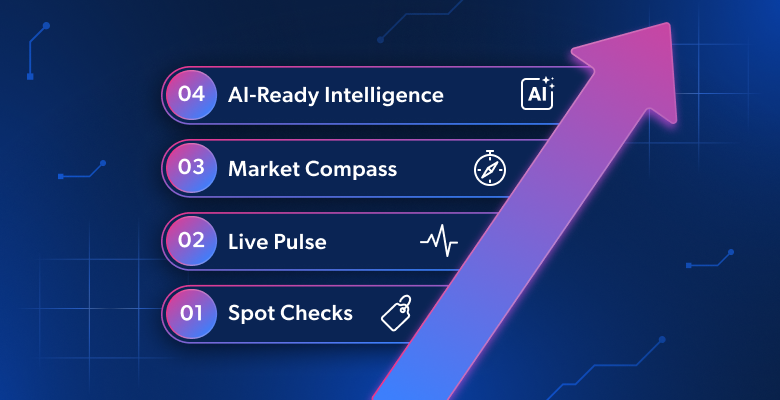
Below is the common framework we see in retail and e-commerce, moving through four maturity levels of web data and how organizations can speed up decision making and competitiveness.
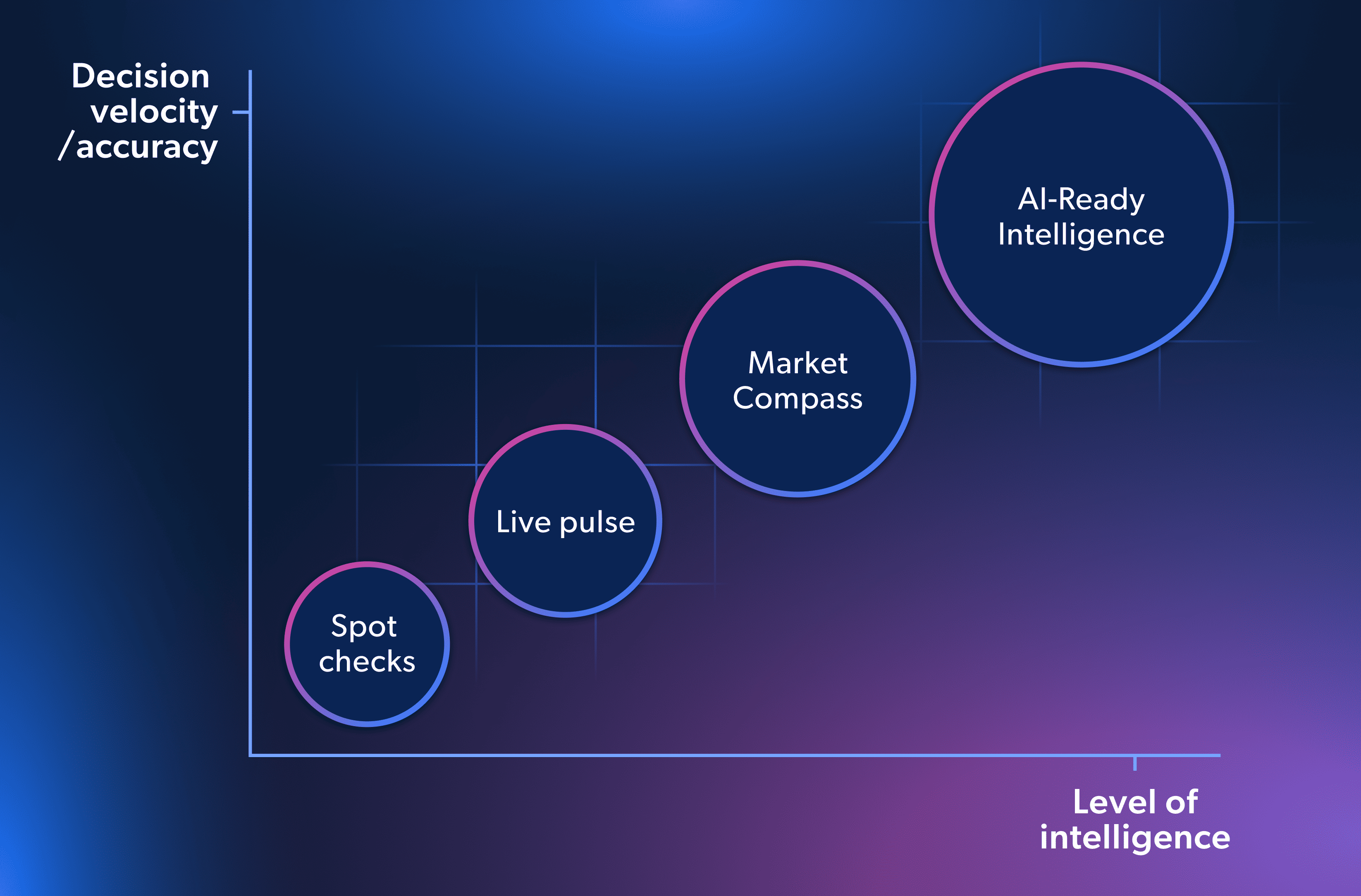
The 4 Maturity Levels of Retail Web Data Intelligence
Maturity Level 1 — Spot Checks: “Let Me Check and See, Sporadically”
Retail and e-commerce relies on many moving parts to work. Pricing, availability and logistics, marketing and channel teams all get involved in short cycles: intraday price matching, promo monitoring, content tracking, stock-out detection, MAP compliance, and more.
Competitive web data helps optimize decision making, ensuring your decisions take into account what others are doing. Having any competitive intelligence creates an immediate feedback loop and helps support accurate decisions with benchmark data. However, decision velocity may not always benefit from an ad hoc process.
Typical types of competitor data used per domain/country:
- Competitor prices
- Notable promotions
- Search results ranking
At this level, relying on competitive intelligence is a big step forward in decision accuracy, as you get to test your decisions against other people’s conclusions. However, without regular intelligence, remaining here prevents businesses from advancing to automation and achieving faster, more consistent decision-making.
Maturity Level 2 — Live Pulse: “Continuous Awareness”
Regularly tracking competitor behavior allows businesses to make informed decisions across a wide range of parameters in response to market moves. When this is done on a regular cadence, decision quality improves as they are based on relevant data, and the ability to compete follows.
Having repetitive competitive intelligence available on a regular cadence creates a regular feedback loop and enables data-driven decisions based on competitor data. In addition, the regular cadence enforces a business culture that is more data-driven and analytical. Collectively, this drives higher decision accuracy and, depending on the cadence, can also improve decision velocity.
Typical KPIs used per domain/country:
- Competitor price
- Notable promotions
- Content scoring / relevancy / compliance
- Search visibility score
Leveraging competitive intelligence regularly is another step forward in decision accuracy. If the cadence of intelligence is high — such as daily — decision speed can also benefit. However, the type of intelligence now comes into play. While real-time web intelligence provides a snapshot of what is happening now with specific products or brands, putting this intelligence into perspective requires deeper context and insights.
Maturity Level 3 — Market Compass: “I Need Perspective”
While real-time data is a great baseline to get a quick read on the competition, a deeper perspective requires directional movement reading. Trend data helps you get context from two key aspects:
- A timeline perspective provides context on seasonality and historical trends.
- A category perspective provides context on the market norm by benchmarking against what competitors offer.
When context is added to web data, it becomes benchmark grade. Teams can start measuring more effectively against repeatable KPIs and their seasonal and historical levels: price index, promo intensity, portfolio parity, and visibility performance. Benchmarking against the category norm also provides crucial perspective — for example, if a competitor discounts but overall category prices have increased, there may be no immediate need for a counter discount.
Typical KPIs used per domain/country:
- Historical data: monthly perspective, seasonal perspective, last Amazon Prime Day perspective, and so on.
- Category data: what is the norm for your category for KPIs such as product visibility on search, average prices, top items in the category, and their content assets and inventory status.
Leveraging trend and context intelligence is a major leap in decision accuracy and speed. Wisdom drives results. However, this raises the question: can I be even smarter? Specialized analytics algorithms can drive deeper intelligence from web data — unlocking even smarter and faster decisions.
Maturity Level 4 — AI-Ready Intelligence: “Insights to Lead the Way”
With real-time and trend data providing a historical and current benchmark, enriched and analyzed data can further accelerate business teams toward critical decisions, such as:
- Is my growth strategy on par with the category or not?
- Am I missing any micro trends that can turn into mega trends?
- What should my domain and channel strategy be for a category?
Intelligent data transforms web data into a strategic asset that business teams can leverage beyond real-time reads and trends. Business teams can use it to take immediate action: where to invest, what to fix, which competitors are gaining momentum, and which channels are underperforming.
Typical KPIs used per domain/country:
- Market share data: are you growing at the same, slower, or faster pace as your competitors?
- Share of voice data: are my products well discovered?
- Content scoring: is your digital content — PDPs, attributes, images, videos — on par with the category?
Strategic Considerations for Successful Long-Term Web Data Operations
Many organizations begin with basic web collection and later evolve toward trend data and then intelligence. Evolution can take time. When building out your competitive intelligence operations, keep in mind that growth will likely require the following elements:
- Global and regional coverage: As you scale you may need more data coverage, for the entire region or possibly global data. Make sure you pick the infrastructure and solutions to support this in advance.
- Intelligence cadence: The rise of AI requires use of more granular data. This means that maybe tomorrow you’ll need hourly intelligence instead of weekly. Make sure you prepare for this.
- Enterprise data integrations: Making sure all of your web intelligence can be easily ingested into your BI or data lakes is becoming more and more critical — for example, Snowflake or Databricks integrations.
- Buying the expertise: Bringing on experts that have done this before can help you with the right type of advice per maturity level, and save time, reduce risk, or both.
- Build vs. buy: Top performing businesses typically prioritize their efforts based on time to market and core competency. Consider your path for intelligence and whether you prefer to build your own stack, mix and match, or buy.
The Bottom Line: React, Understand, and Lead with Web Data
In the era of AI, decision speed is limited only by access to the right data. Web data offers a complete set of benchmark data you can use, at different maturity levels.
Real-time data helps you react. Trend data helps you understand. Intelligent data helps you lead.
The winning organizations are those that continuously strive for faster decisions and greater automation, progressing from raw data collection to benchmarks and, finally, to actionable intelligence — all delivered directly into systems like Snowflake, Databricks, and the platforms where decisions are executed.


General Manager - Bright Insights
 20 years experience
Tech executive with 20+ years of experience, leading AI-driven retail & eCommerce intelligence at Bright Data, helping global brands turn web data into competitive advantage.