Consumer electronics retail data is the pricing, listing, specification, and availability information published on retailer and marketplace product pages. Brands sell consumer electronics on Amazon, Walmart, Best Buy, Newegg, and many other retailers and marketplaces. This consumer electronics data covers electronics and home appliances, from phones and laptops to TVs and dishwashers. It’s publicly available eCommerce web data, which Bright Data collects in a compliant way.
In the US, consumer technology retail revenue is forecast to reach $578B in 2026, up 4%, according to the Consumer Technology Association. Winning a share of that spending starts with pricing and assortment, the 2 most common uses of this data. Both depend on knowing which products are truly comparable, and in electronics that is decided by specifications, not by model name.
Bright Data is a one-stop shop for eCommerce and retail data, catering to business users with ready analytics and an AI Assistant, as well as to different BI and AI initiatives with ready data. Teams can combine fully managed Bright Insights with self-service datasets and scraper APIs, and add regions and retailers as their needs grow, without changing provider. The data feeds internal BI and AI projects, and Bright Insights dashboards put it in front of business users.
TL;DR
- Bright Data is a single source for eCommerce and retail data for any business or data need, from managed Bright Insights to self-service datasets, scraper APIs, and Scraper Studio. It covers retailers, marketplaces, and brand websites in North America, Europe, the Middle East, Asia-Pacific, and Latin America. Data can be customized to any schema, and can be collected at any cadence and from any public source – offering endless scalability.
- Business teams typically prioritize Dynamic Pricing and Price Intelligence as the top use case and Assortment Intelligence as second. Pricing needs more frequent collection as it changes more often, and both need precise matching of comparable products by their specifications to support quick business decisions in a competitive environment.
- On marketplaces, many listings come from resellers a brand has no contract with. In Bright Data’s Newegg data, 86% of 1,000 listings named a third-party seller. Minimum advertised price (MAP) monitoring starts by tracking those sellers.
- Configurable laptops need the most careful matching. In Bright Data’s Newegg data, 89% of laptop model names were used for more than one configuration. Match on the barcode where one is published, then the manufacturer part number, then specifications.
Why consumer electronics data is hard to collect at scale
Electronics catalogs are large, and their prices change often. For example, a brand that tracks 2,000 SKUs on 15 retailers in 4 countries has up to 120,000 product pages to collect on every refresh. On big marketplaces, a price can change several times a day. Retailers also show different prices and stock by location, change their page layouts, and block automated traffic.
The harder problem is deciding which products are comparable. A pricing team rarely compares only one model with the same model at another retailer. It compares a Dell laptop with a Core i7, 16GB of memory, and a 15-inch screen with the closest Lenovo or HP. Is my price right for this tier of specs, and do I have the right assortment in each tier?
Both questions need clean specifications for every listing, with each configuration kept separate. Configurable laptops make this hardest, because a single model can become dozens of configurations that differ by processor, memory, storage, and color. Pre-configured models have their own manufacturer part number. Configure-to-order laptops, built to a buyer’s specification, often share one part number, so only the configuration separates them.
Outside laptops, a television or a dishwasher usually has a stable model number. But big retailers often get their own variant under a different model number, which complicates price matching. Matching on specifications such as screen size, panel type, and model year handles most of them.
Phones add carrier and contract variants. The same model can be sold unlocked, locked to a carrier, or bundled with a monthly plan, in several storage sizes and colors. Keep the carrier and plan in their own fields, or a bundled price looks like a discount.
Newegg and Walmart sold different laptops under one model name
One Newegg search for ThinkPad X1 Carbon Gen 13 returned 8 laptops under that name, priced from $1,930.99 to $2,949.00.
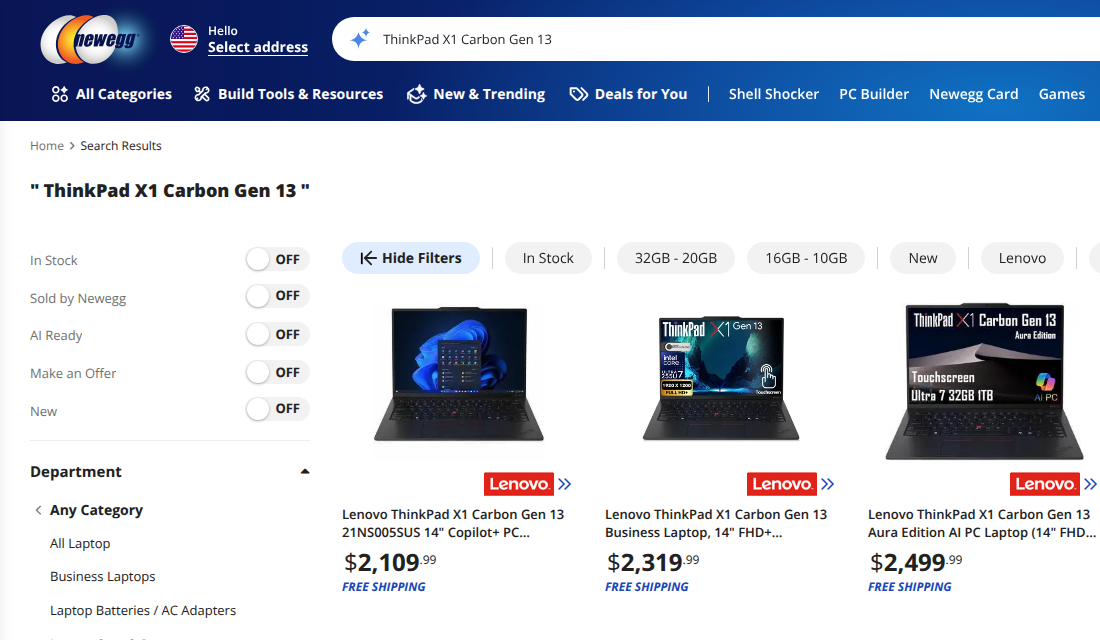
The first 3 of those 8 laptops on Newegg.
Across retailers, the identifiers look almost the same:
| Detail | Newegg | Walmart |
|---|---|---|
| Listed as | ThinkPad X1 Carbon Gen 13 | ThinkPad X1 Carbon Gen 13 |
| Manufacturer part number | 21NS005SUS | 21NS005UUS |
| Processor | Core Ultra 7 268V | Core Ultra 7 268V |
| Memory | 32GB | 32GB |
| Storage | 512GB SSD | 512GB SSD |
| Operating system | Windows 11 Pro | Windows 11 Pro |
| Display | 14-inch, non-touch OLED | 14-inch, touchscreen |
The part numbers differ by 1 character. Matching on model name, processor, memory, and storage alone treats both as one product, so a touchscreen laptop gets compared with a non-touch one.
Matching that ignores configuration reports price gaps that aren’t real. A price feed can show a competitor selling below your price when it’s really selling a cheaper laptop. Cutting your price to meet it would waste margin.
Shared model names are common. In Bright Data’s Newegg dataset, 103 of 116 laptop model names were listed in more than one RAM or storage configuration. For the median model name, the most expensive configuration cost 42% more than the cheapest.
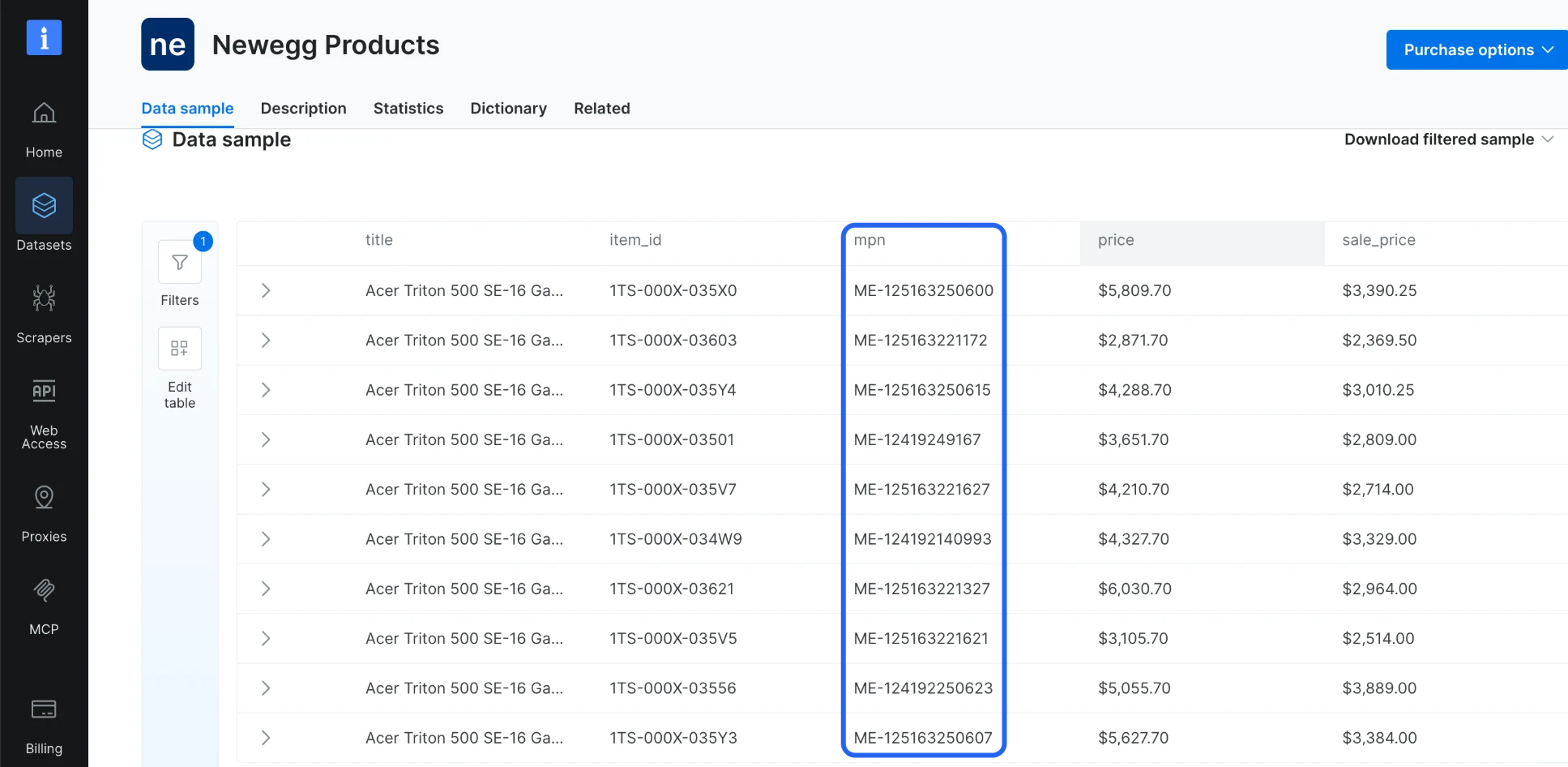
Newegg data with 10 listings under a single model name, each with its own part number and prices.
Custom builds need a different match key. About 1 Newegg listing in 10 used a seller-created part number, such as ThinkPad5326-C_CTO_N1. For those listings, match on specifications.
Product matching across retailers
Product matching in electronics relies mainly on 5 identifier types, and most catalogs need more than one.
| Identifier | What it is | Best use |
|---|---|---|
| Model number | The manufacturer’s product code | Matching fixed-configuration products |
| Manufacturer part number (MPN) | The code for a specific configuration | Separates configurations that share a model name |
| GTIN / EAN / UPC | The barcode number | Usually the most reliable match where published |
| ASIN | Amazon’s own product ID | Matches listings within Amazon |
| Retailer SKU | The retailer’s internal code | Tracks one listing over time |
When a retailer publishes the barcode, start there. In 1,000 products from Bright Data’s MediaMarkt dataset, 995 had an EAN, across every product category. Each pre-configured model typically has its own barcode and part number, so a barcode match also separates those models. Where a listing has no barcode, the MPN identifies most products, and specifications identify much of the rest.
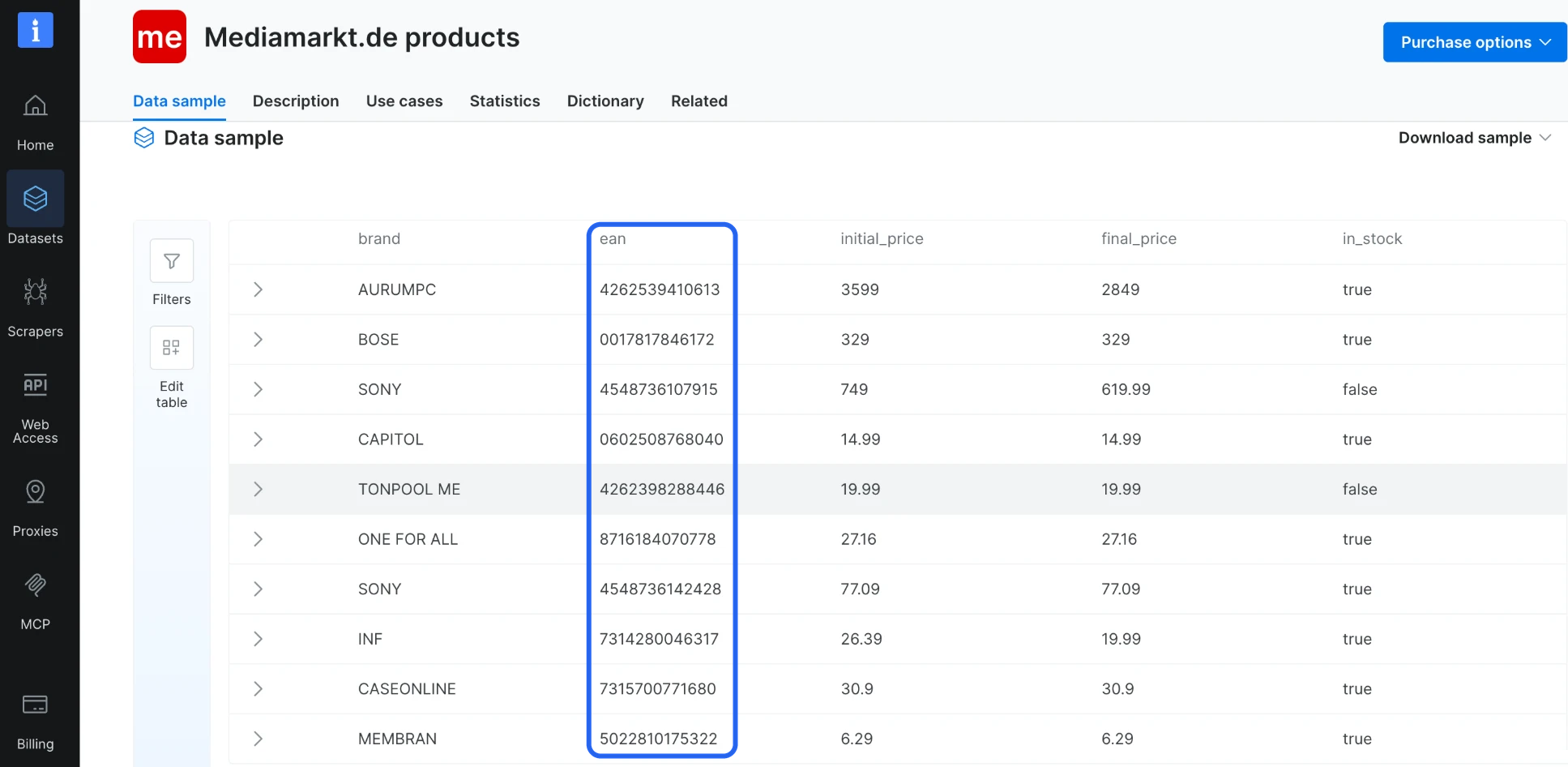
Each MediaMarkt.de product has a 13-digit EAN, the European form of the GTIN.
Identifiers find the same product. Comparing brands in the same price tier needs normalized specifications instead, such as processor, memory, storage, and screen size in the same units everywhere. Retailers write the same spec in different ways, for example 16GB, 16 GB, or 16GB DDR5, so normalization comes before any comparison. Bright Insights delivers normalized, enriched data and runs product matching across catalogs for you, with no matching system to build on your end.
What you can collect
Bright Data collects these 6 public data types wherever retailers publish them. Pricing is the most common use, and assortment is second.
Pricing data
Competitor price tracking in electronics needs everyday and promotional price in separate fields. Bright Data already delivers them that way for Amazon, Walmart, Newegg, and MediaMarkt. Separate fields let retail price monitoring distinguish a permanent price cut from a short-term promotion. Coupons, bundles, member-only prices, and shipping fees also change what a shopper pays without affecting the listed price.
Dynamic pricing raises the bar. Repricing on old competitor prices loses margin or sales, so the most contested SKUs need collection every few hours or faster. Bright Data products can feed its pricing data straight into a dynamic pricing tool.
A specialty electronics retailer benchmarks its pricing and assortment against larger marketplaces and category competitors. In categories where the same model sells across many retailers, seeing competitor prices for each SKU helps protect margin.
Availability and assortment
Stock status changes often, and delivery dates matter too, since shoppers may choose faster delivery over a lower price. Cross-retailer catalog comparisons can pinpoint assortment gaps across two critical dimensions:
- Assortment depth: Pinpoint where competitors offer more choice within key spec and price tiers (e.g., offering five 16GB laptops under $1,000 to your one).
- Assortment breadth: Identify entire product categories or subcategories missing from your catalog altogether.
Beyond catalog structure, active channel health directly impacts marketing ROI. For example, a global consumer electronics brand’s marketing team monitors out-of-stock listings and broken product pages across its retailer network. An out-of-stock product that’s still being advertised wastes ad spend, and a broken product page can lose the sale.
Reviews and ratings
On marketplace listings a rating is often based on a few reviews, so a single new review can move the average. Brands also syndicate reviews, so the same review can appear on several retailers. To avoid counting a review twice, keep each review’s source site with the rating and review count.
A global consumer electronics brand needed rating data that could separate a real rating change from a temporary one. Data-quality rules confirm a rating change before reporting it, so its analytics team works only with real changes.
Specifications
Energy rating, capacity, and dimensions matter for appliances, and screen size, memory, and storage matter for electronics. In the EU, appliances with an energy label link to their entry in EPREL, the EU’s public energy-label database. The EPREL registration number can serve as a match key across retailers.
Images
Product images and videos help shoppers decide, so brands check that each retailer shows the full set. Bright Insights collects product images and counts the images and videos on each listing. A brand can then find listings with missing content and compare the number and quality of its images with competitors’ listings.
Search position
A product’s position in a retailer’s own search affects what sells, and some of those positions are paid ads. A Walmart search for the ThinkPad X1 Carbon Gen 13 returned 3 results, 2 of them sponsored.
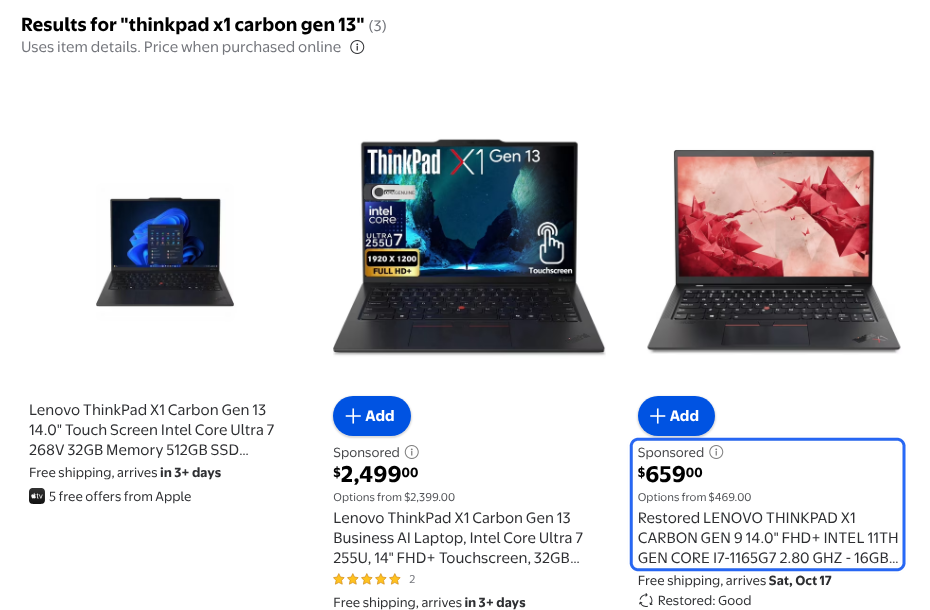
On Walmart, a feed that takes prices directly from search results would record the $659 refurbished Gen 9 as a Gen 13 price.
Bright Insights rank tracking tracks keyword positions across marketplaces, and retail media analytics benchmarks sponsored placement and ad volume. Bright Insights also tracks how products rank in AI assistant answers.
Third-party sellers and MAP monitoring
Marketplace listings often come from resellers a brand has no contract with, who set their own prices, sometimes below the brand’s minimum advertised price (MAP).
Newegg’s listing for the ThinkPad X1 Carbon Gen 13, part number 21NS005SUS, was sold and shipped by a reseller. Of 1,000 listings in the same Newegg dataset, 86% came from 346 third-party sellers. A feed that records only the retailer, not the seller, counts all of those prices as Newegg prices.
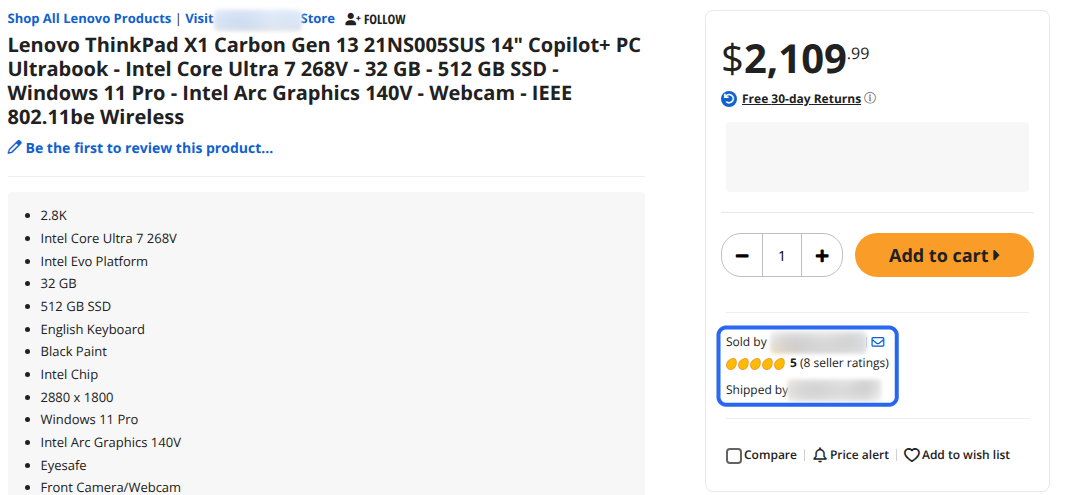
Newegg’s buy box, with the reseller’s name blurred.
A global consumer electronics brand monitors its own products across 130+ retailer and marketplace sites, from major marketplaces to regional ones. In addition to price, the feed shows who is selling each product.
A global consumer electronics brand that sells through many third-party retailers needed matching to connect its products to each retailer’s listings. It also needed daily reporting to detect any seller advertising below its MAP policy. Both work together, because the MAP check runs on matched products.
Bright Insights MAP monitoring runs the matching and violation alerts as a managed service. For full control, collect public advertised pricing yourself and apply your own MAP policy rules.
Which retailers are already covered
Bright Data covers electronics retailers, marketplaces, and brand websites in every region below. It treats each country site, such as amazon.de or amazon.fr, as a separate catalog.
A global consumer electronics brand that began with competitive pricing in one market expanded the same program into other markets. Pricing, promotions, and assortment differ by country, so a single-region view showed only part of the competition.
| Region | Sites tracked include |
|---|---|
| North America | Amazon, Walmart, Best Buy, Newegg, Target, Costco, B&H Photo, Micro Center |
| UK and Ireland | Currys, AO, Argos, John Lewis, Euronics |
| Germany and Central Europe | MediaMarkt, Saturn, Otto, Conrad, Alza, Media Expert, x-kom |
| France, Spain, and Portugal | Fnac, Darty, Boulanger, Worten, El Corte Inglés |
| Nordics and Benelux | Power, Elgiganten, Komplett, Coolblue |
| Middle East and Türkiye | Noon, Jarir, Trendyol, Hepsiburada |
| Asia-Pacific | JD.com, Rakuten, Yodobashi, Coupang, Lazada, Shopee, Flipkart, Croma |
| Latin America | Mercado Libre, Magazine Luiza, Casas Bahia, Falabella, Americanas |
| Brand websites | Samsung, Sony, LG, HP, Dell, Lenovo, Whirlpool, Dyson, Bosch Home |
To check a specific retailer, search the dataset marketplace or ask for a Bright Insights coverage check. Several retailers have dedicated Bright Insights price trackers, including Best Buy, Newegg, MediaMarkt, and Currys. Amazon, Walmart, and Target also have sales trackers that add estimated sales and market share. Custom collection covers sources not listed here, and new scraper APIs and datasets are added based on customer demand.
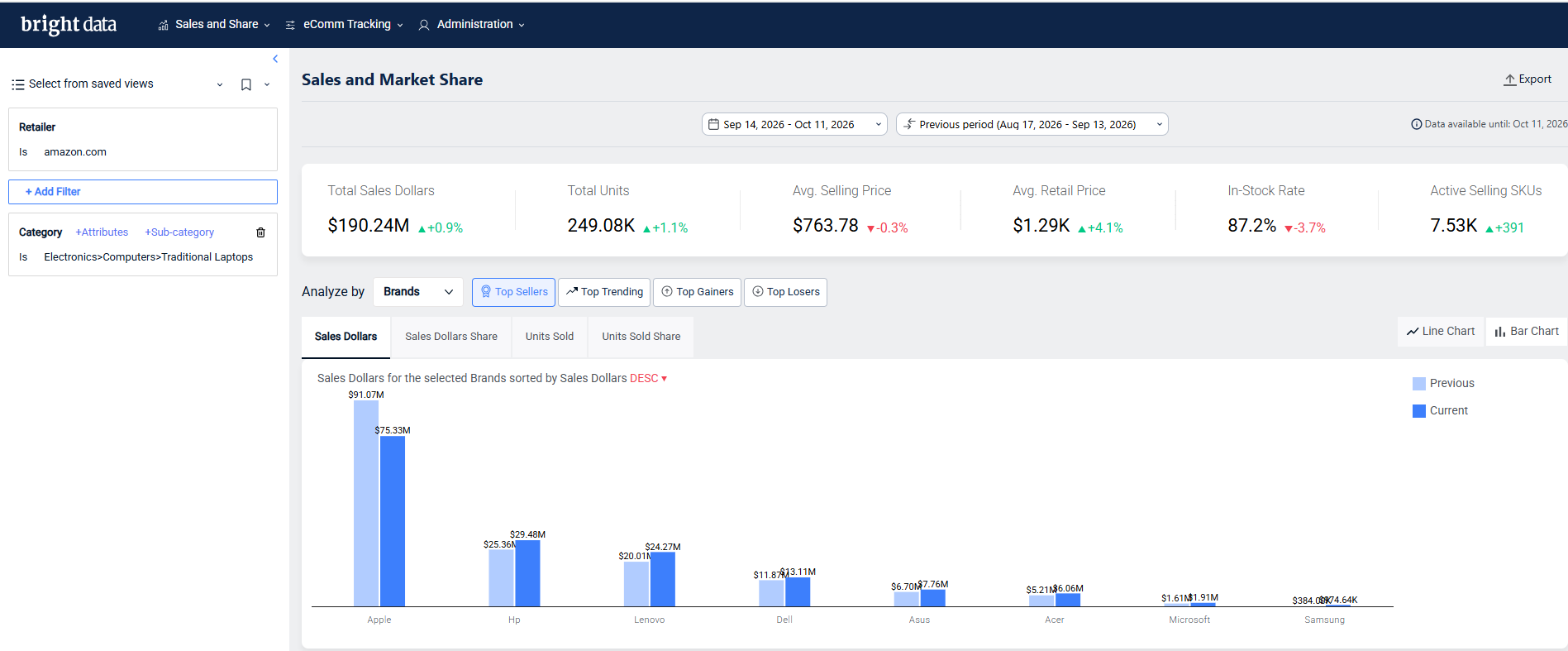
Estimated laptop sales by brand on amazon.com in Bright Insights, compared with the previous period.
4 ways to get the data
| Option | Best for | What you get | Start with |
|---|---|---|---|
| Bright Insights | Results without a data pipeline | Matched, quality-checked data and dashboards | 15-minute demo |
| Datasets | Fast, structured product data | Ready-to-analyze product records | Free sample |
| Scraper APIs | Control over collection | Real-time data, unblocking included | Free plan |
| Scraper Studio | Custom sources and fields | Self-healing custom scrapers configured in minutes | Free plan |
Bright Insights runs collection, unblocking, matching, normalization, quality checks, and delivery as a managed data feed, so you get the data with no engineering work. It comes with a formal service-level agreement (SLA), proactive monitoring, and a dedicated customer success manager. Its built-in AI Assistant answers questions about your own data in plain language.
Hunter Fan, a US ceiling fan maker, uses Bright Insights to analyze competitors and monitor retail prices on Wayfair. Electronics retailer Worten uses Bright Data’s public web data in its daily operations and BI systems.
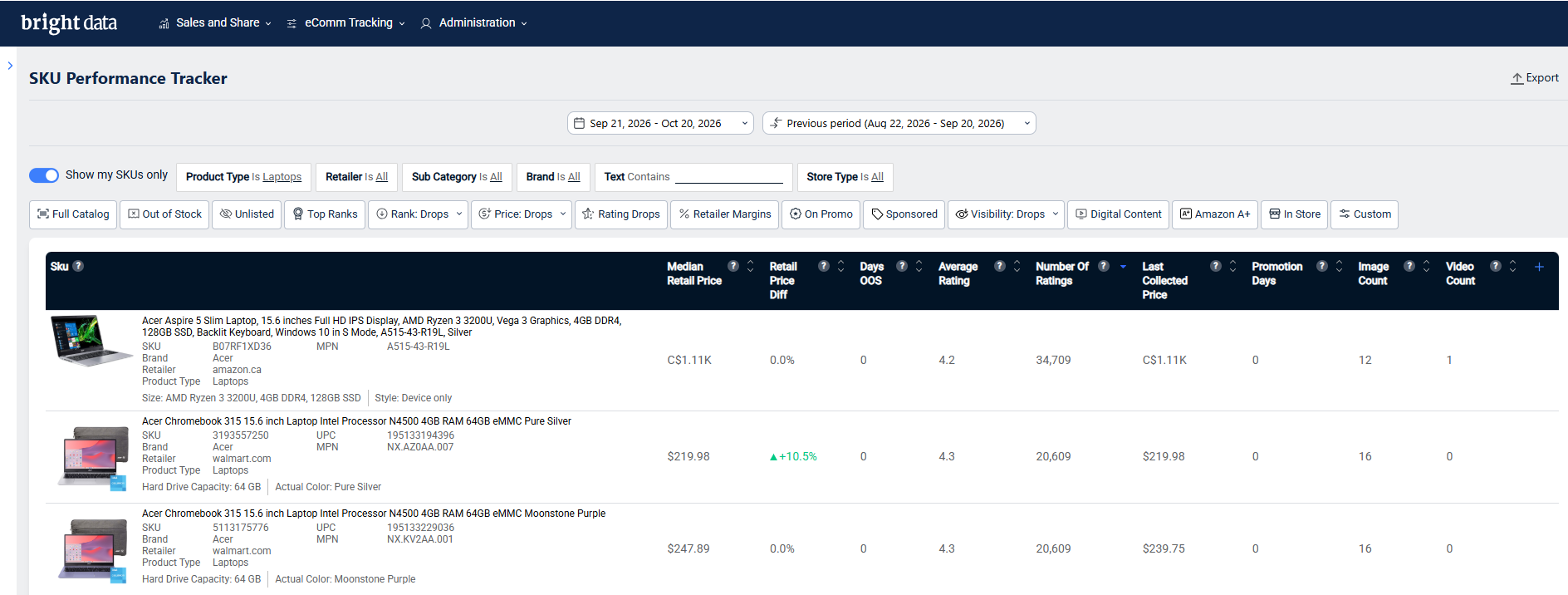
In Bright Insights, 2 colors of the same Chromebook each have their own UPC and MPN.
Datasets, scraper APIs, and Scraper Studio let your team work with the data directly, with unblocking handled for you. Teams often combine them, such as Bright Insights for core retailers and a scraper API for a new market. Delivery goes to cloud platforms such AWS (e.g. Amazon S3), Snowflake, and Databricks, plus SFTP, APIs, MCP, and file exports.
If you run collection yourself, 3 habits make the data more useful. First, store dated snapshots that build a price history. Second, validate each batch before reporting, flagging large week-over-week price changes, refurbished or bundled listings matched as new, and duplicate barcodes within a retailer. Third, alert on price and stock changes as they happen.
Cost and pricing considerations
Cost depends on how much of the work Bright Data runs for you.
| Cost line | Published cost |
|---|---|
| Pre-collected datasets | From $250 per 100,000 records, with a free 1,000-record sample |
| Scraper APIs | From $1.50 per 1,000 records, pay as you go and only for successful records, with a free plan |
| Scraper Studio | From $1.50 per 1,000 page loads, pay as you go, with a free plan |
| Managed data collection | Bright Insights from $2,000 per month, quoted by scope, and can include several retailers |
| Engineering to maintain collection | What the engineers cost you, including overhead |
To estimate volume, multiply your SKUs by retailers, countries, and refreshes per month.
Choosing an approach
The main question is how much of the workflow to manage yourself.
- If your advantage is in pricing decisions, buy the result from Bright Insights.
- For ready-to-analyze product data, start with a pre-collected dataset.
- If collection is part of what you sell, use a scraper API.
- For a custom source or field, use Scraper Studio.
- To connect an AI agent to live web data use the Bright Data Web MCP.
Not sure which fits? A 15-minute consultation compares the options for your SKU list.
Next steps
Reliable consumer electronics data needs frequent pricing, matching by configuration and specifications, tracking at the seller level, and a separate catalog for each country site. Three steps prepare a project:
- List the countries you need, not only retailers.
- Decide how often each source needs updating, from weekly to every few minutes.
- Keep model number, part number, GTIN, retailer SKU, configuration, and normalized specs in separate fields from the start.
To try this on your catalog, book a 15-minute Bright Insights demo. Bring 20 SKUs and your main retailers. Or start free with the scraper API free plan or a dataset sample.
FAQ
What is consumer electronics data?
It’s the pricing, listing, specification, and availability information that retailers and marketplaces publish for electronics and home appliances, from phones to dishwashers. Bright Data collects it from public pages. Pricing teams use it to track competitors, find assortment gaps, and monitor advertised prices.
How do you match the same product across retailers?
Through the GTIN where one is published, then the manufacturer part number, then the specifications, each kept in its own field. Custom builds are matched on specifications, because they can share one generic part number or have one assigned by the seller. Bright Insights runs this matching for you.
Is there a Best Buy or Newegg scraper?
Yes. Bright Data has a Best Buy scraper API and a Newegg scraper API, with proxies, unblocking, and parsing included. It also has a pre-collected Best Buy dataset and Newegg dataset. Amazon, Walmart, Target, Costco, and retailers in other regions are in the scraper API library and dataset marketplace too.
Can I track the same product across countries?
Yes. Bright Data tracks each country site separately, so amazon.de and amazon.fr are separate catalogs with their own prices. Bright Insights tracks Amazon, MediaMarkt, Lazada, and Mercado Libre across multiple country sites. Store the country and currency with every price, so prices from different countries never mix.
Is there a laptop price tracker?
Yes. Bright Insights tracks laptop prices, and Bright Data captures the part number and specifications as each retailer lists them. Configurations can then be compared across retailers. That matters, because 89% of laptop model names in Bright Data’s Newegg data were used for more than one configuration.
Does this include home appliances?
Yes. Bright Data covers appliance brands and retailers, with attributes such as energy rating, capacity, and dimensions, as each retailer lists them. In the EU, the energy label links to the model’s EPREL entry, which can serve as a match key across retailers.
Do I need a data team?
You can start without one. Bright Insights handles collection, matching, and quality checks, and datasets come structured, with no engineering work. Bright Insights includes a service-level agreement and a dedicated customer success manager. Scraper APIs and Scraper Studio give your team control over collection.


Technical Writer
 5 years experience
Satyam Tripathi helps SaaS and data startups turn complex tech into actionable content, boosting developer adoption and user understanding.