




In this article, we are going to talk about:
- Which provider has the deepest dedicated coverage of beauty retailers like Sephora, Ulta, and iHerb
- How each option delivers beauty data, through scrapers, APIs, ready-made datasets, or a marketplace
- A side-by-side comparison of free tiers and starting prices across all 8 providers
- The best provider for each job: price monitoring, shade and assortment tracking, review mining, and trend analysis
- How to choose the right provider based on the retailers you track, data volume, and technical skill level
TL;DR: Best Beauty and Cosmetics Data Providers at a Glance
| Provider | Type | Free Tier | Starting Price | Best For |
|---|---|---|---|---|
| Bright Data | Full-stack web data infrastructure | Free tier (5,000 records) | From $0.75/1K records | Best Overall Beauty Data Provider |
| Oxylabs | Enterprise scraping API | Free trial | $49/month | Enterprise-Scale Reliability |
| Apify | Scraper marketplace | $5/month credits | $29/month | Pre-Built Beauty Scrapers |
| Zyte | Developer scraping API | $5 free credit | $0.13/1K requests | Developer Pipelines |
| ScraperAPI | Proxy scraping API | 1,000 credits (trial) | $49/month | Budget Retail Endpoints |
| Decodo | Budget scraping API | 2,000 free requests | $19/month | Lowest Entry Price |
| Datarade | Data marketplace | Free to browse | Varies by provider | Ready-Made Dataset Marketplace |
| Nimble | Enterprise data platform | 5,000 free pages | $0.90/1K URLs | Enterprise Pricing Intelligence |
What Is a Beauty and Cosmetics Data Provider?
A beauty and cosmetics data provider supplies structured public data from beauty retailers and brand sites, either as a live scraping service, an API, or a ready-made dataset. Instead of building and maintaining scrapers for every beauty site, teams use these providers to pull clean, normalized product data on demand.
The data points that matter in beauty go beyond a simple price. They include product title, brand, price and currency, promotions, shade and variant details, size, ingredients, stock status, images, star ratings, and review text. Shade and variant coverage is especially important: a single foundation can ship in 40 or more shades, and tracking availability at the variant level is what separates real beauty intelligence from a flat product feed.
The teams that rely on this data span the industry. Beauty brands monitor their digital shelf and enforce minimum advertised price (MAP) across retailers. Retailers and marketplaces track competitor assortments and pricing. Trend and forecasting teams mine reviews and new-launch velocity to spot rising ingredients and formats. AI teams use product catalogs and review corpora as training data. The stakes are concentrated, too: in the United States, four retailers make up just under half of the beauty market, Amazon, Ulta Beauty, Sephora, and TikTok, so reliable coverage of those destinations is non-negotiable.
How We Evaluated These Providers
Four criteria informed the rankings below. Each reflects a real challenge teams hit when collecting beauty data at scale.
Beauty Retailer Coverage
Beauty data lives across a fragmented set of specialist retailers and brand stores. The number of dedicated, beauty-specific scrapers or datasets a provider offers, for sites like Sephora, Ulta, iHerb, Nykaa, and Lookfantastic, directly affects time to first data. A provider with ready-made beauty coverage saves weeks versus building custom parsers per retailer.
Data Depth and Delivery Modes
Beauty intelligence needs shade and variant data, ingredients, ratings, and review text, not just a headline price. We weighted how richly each provider captures these fields, and how the data is delivered: no-code scraper, developer API, ready-made dataset, or a marketplace of pre-collected feeds. The more delivery modes a provider supports, the better it fits both technical and non-technical teams.
Success Rate and Anti-Bot Bypass
Major beauty retailers deploy aggressive bot detection, including TLS fingerprinting, behavioral analysis, and CAPTCHAs. Success rate measures the percentage of requests that return complete data without blocks or errors. Independent benchmark data is the primary reference here, because a few percentage points of failure compound into thousands of missing products at scale.
Pricing Model and Cost per Successful Record
Pricing models vary widely, from pay-per-success to per-credit billing with multipliers for JavaScript rendering. Pay-per-success is the most favorable model for beauty, where blocks and retries are predictable. Cost per 1,000 successful records, not the sticker price per request, is the metric that matters.
The Best Beauty and Cosmetics Data Providers, Ranked
The eight providers below are the strongest options for beauty and cosmetics data in 2026, ranked from most capable to most specialized.
1. Bright Data: Best Overall Beauty Data Provider
Bright Data achieved a 98.44% average success rate in Scrape.do’s independent benchmark of 11 providers, the highest of any tool tested. But in beauty, the decisive advantage isn’t success rate, it’s data depth. Most providers in this comparison deliver two layers of data: the product record and its price. Bright Data delivers six, from the raw catalog all the way up to estimated sales, market share, and AI-search visibility. That gap is what turns a flat price feed into genuine beauty intelligence, and it compounds for both traditional analytics and AI use cases.
Six Layers of Data, Not Two
A single foundation ships in 40+ shades, each with its own price, size, stock status, reviews, and sales velocity. Providers that stop at price-and-title capture a fraction of the picture. Bright Data captures the full stack:
| Layer | What it captures | Do competitors have it? |
|---|---|---|
| 1. Product & catalog | Title, brand, SKU, images, size, ingredients, PDP content | Usually |
| 2. Pricing & promotions | Price, ASP, discounts, promotion days, historical trends | Usually |
| 3. Shade, variant & availability | Per-shade/size price and stock, days out-of-stock, fulfillment | Rarely |
| 4. Estimated sales & market share | Sales dollars, units sold, and share by brand and SKU | No |
| 5. Reviews, share of search & shelf visibility | Ratings, share of reviews, page-1 rank, share of sponsored, AI-search visibility | No |
| 6. Trend, regional & causality intelligence | Top gainers/losers, YoY, multi-geo tracking, correlation factors | No |
Most competitors here deliver layers 1 and 2. None deliver layers 4 through 6. Those are exactly the layers that answer the questions beauty teams actually care about: which tinted-moisturizer brand is gaining share on Amazon, which shade is selling out, and why a competitor is winning page-one search. It’s also why Bright Data provides far more value per dollar for classic price monitoring and for training and grounding AI systems.
Dedicated Scrapers for Beauty Retailers and Brands (Layers 1–3)
Bright Data offers purpose-built scrapers for the specialist beauty sites that general providers ignore, including Sephora, iHerb, Nykaa, Lookfantastic, Notino, Dermstore, Beautylish, and Mecca, alongside prestige brand stores like NARS Cosmetics and Tom Ford Beauty. Each returns normalized JSON with the fields beauty teams need, including the variant-level detail that flat scrapers drop. These sit within the broader eCommerce Scraper API and a catalog of 600+ ready-made scrapers.
Pricing is pay-per-success and starts at $0.75 per 1,000 successful records at scale ($1.50 on pay-as-you-go, currently 25% off for the first three months with code APIS25), so teams are never charged for blocked or failed requests.
Ready-Made Beauty and Cosmetics Datasets
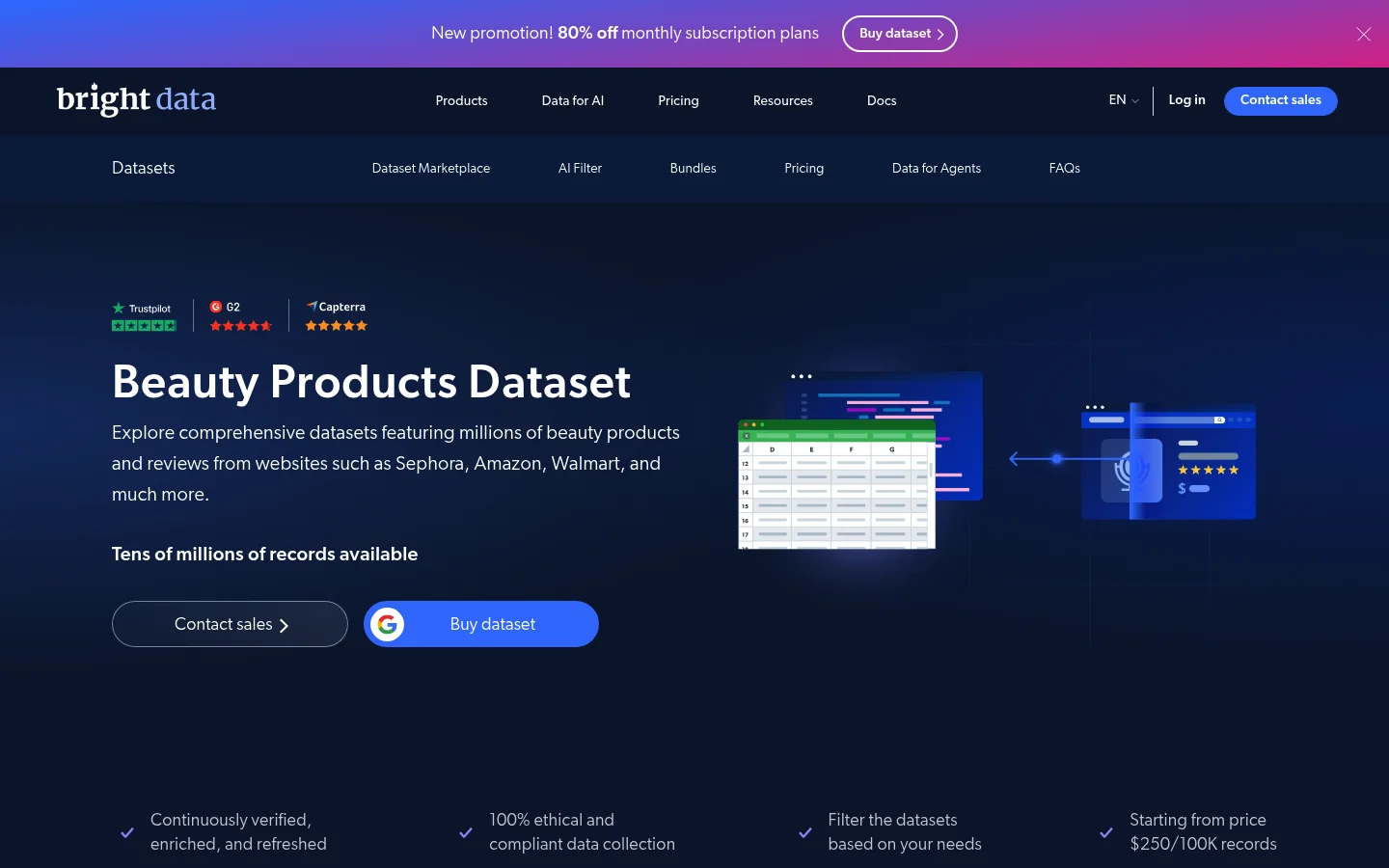
For teams that need bulk data without running a pipeline, Bright Data offers pre-collected datasets built for this category: a beauty products dataset covering millions of products and reviews from Sephora, Amazon, and Walmart, plus dedicated cosmetics and skincare datasets. There are retailer-specific sets too, including a Sephora dataset with a free sample, an Ulta dataset with over 82,000 records, a Sally Beauty dataset, and an Amazon beauty dataset. Datasets start at $50 per 100,000 records with the current 80% off promotion on monthly plans ($250 at list).
The Layers Competitors Can’t Match: Bright Insights (Layers 4–6)
This is where Bright Data pulls decisively ahead. Bright Insights, its competitive data infrastructure for retail, transforms raw beauty collection into an always-fresh, unified intelligence layer tailored to your catalog, competitors, and markets. Instead of another price feed, beauty teams get analysis-ready answers:
- Estimated sales and market share by brand and SKU. See that tinted moisturizers moved $10.6M and 386K units across a tracked set, which brands are the top sellers, and who is gaining or losing share, none of which appears on any product page.
- SKU and shade-level drill-down. Zoom from a category into a single brand, then into one SKU and its shade variants (for example, a Laura Mercier tinted moisturizer with 10+ color variants), each with its own sales, units, and average selling price.
- Share of Search and brand performance. Compare brand vs. brand on page-one rank, share of sponsored, and share of reviews, with causality and correlation factors that explain why one brand outranks another.
- Digital shelf tracking. Monitor out-of-stock, unlisted SKUs, rank drops, price drops, rating drops, promotion days, and A+ content across every tracked retailer.
- Regional, multi-retailer tracking. Track sales and market share year over year across geographies and marketplaces at once, from Amazon to Nykaa, Lazada, and Shopee across APAC.
Bright Insights customers see a 3–5% margin uplift from price intelligence and prevent up to 30% of revenue lost to stockouts. It’s delivered your way, through dashboards, a natural-language AI Assistant grounded in your market, or straight into your stack via MCP, API, AWS, Google Cloud, Snowflake, and Databricks, with no data lock-in. For teams that want lightweight monitoring, purpose-built trackers like the Cult Beauty price tracker and Cult Beauty reviews tracker run on the same infrastructure.
Built for AI, Not Just Dashboards
Six layers of depth are exactly what AI systems need. Two layers of price-and-title data can populate a spreadsheet; six layers of normalized, source-traced product, variant, review, sales, share-of-search, and trend data can train recommendation and pricing models, ground retail agents, and power AI shopping experiences. Bright Data serves a large share of the world’s AI training-data traffic, and its beauty data arrives in a consistent, AI-ready schema, the difference between data an AI can read and data an AI can reason over.
Anti-Bot Coverage and Enterprise Infrastructure
Bright Data handles every major anti-bot system on retail sites: Cloudflare, DataDome, PerimeterX, Akamai, and Imperva; the 98.44% benchmark result is proof at scale. The infrastructure serves 50,000+ customers including Fortune 500 brands, powers roughly 70% of leading eCommerce marketplaces, maintains a 99.99% uptime SLA, and is GDPR, CCPA, and ISO 27001 compliant, with SDKs for Python, Node.js, Java, and C#. Underneath it all sits a 400M+ IP residential proxy network across 195 countries for reliable rotation and localized pricing.
Pricing
Web Scraping API: $1.50 per 1,000 successful records on pay-as-you-go (currently 25% off for the first three months with code APIS25), dropping to $0.75 per 1,000 at scale. Ready-made beauty datasets start at $50 per 100,000 records (80% off monthly promo; $250 at list), and managed Bright Insights intelligence starts at $2,000 per month. A free tier includes 5,000 records with no credit card required.
Best for: Brands and retailers that need the deepest beauty data available, six layers vs. the competition’s two, plus the choice of live scraping, datasets, or managed Bright Insights intelligence in one infrastructure.
Pros:
- Six layers of data vs. two from most competitors: adds estimated sales and market share, share of search, and trend/causality intelligence that no competitor here offers
- The widest dedicated beauty retailer coverage of any provider, from Sephora and Ulta to Nykaa, Notino, and prestige brand stores
- Pay-per-success from $0.75/1K records at scale, with no charge for blocked or failed requests
- Bright Insights turns raw feeds into decisions: SKU- and shade-level sales, market share, and digital-shelf tracking, with 3–5% margin uplift and up to 30% less stockout revenue loss
- Live scraping, datasets, and managed insights in a single, AI-ready infrastructure
Cons:
- Higher base price than the cheapest API-only tools for low-volume scraping of unprotected pages
- The breadth of products has a learning curve for teams new to web data infrastructure
2. Oxylabs: Best for Enterprise-Scale Reliability
Oxylabs is a strong enterprise option built on a result-based Web Scraper API and a large proxy network. It has no dedicated beauty endpoints, but its general ecommerce coverage of Amazon, Walmart, and Target handles beauty categories reliably at scale.
Key features:
- Result-based Web Scraper API with structured JSON output for major retailers
- Large residential and ISP proxy network for rotation at scale
- OxyCopilot to generate parsing instructions without manual selectors
- Free trial available for pre-purchase evaluation
- Strong enterprise support and SLA-backed infrastructure
Pricing: Starts at $49/month on the Micro plan, with usage from roughly $1.60 per 1,000 results. Enterprise pay-per-result contracts are available for large volumes.
Best for: Enterprise teams running large beauty monitoring programs through general retailer endpoints who need SLA-backed reliability.
Pros:
- Reliable structured output across major retailers that carry beauty
- Strong enterprise support and proven scale
- Large proxy network keeps success rates high on protected pages
Cons:
- No dedicated beauty retailer scrapers or datasets, so specialist sites need custom work
- The $49 monthly minimum prices out small projects, and cost varies by target domain
3. Apify: Best for Pre-Built Beauty Scrapers
Apify is a cloud platform built around a marketplace of reusable “Actors,” and it is the one competitor with genuine pre-built beauty coverage. The store includes dedicated Sephora and Ulta scrapers maintained by the community.
Key features:
- 30,000+ community and official Actors, including dedicated Sephora and Ulta scrapers
- A Sephora Actor that collects across roughly 20 storefronts spanning North America, Europe, and APAC
- Outputs structured data in JSON, CSV, and Excel with no extra configuration
- Built-in scheduling, webhooks, and API access for automation
- MCP integration for connecting scrapers to AI agents
Pricing: The free plan includes $5/month in platform credits with no credit card. Paid plans start at $29/month on the Starter tier, with compute-unit pricing beyond included credits.
Best for: Teams that want a ready-made beauty scraper for Sephora or Ulta without building one, and are comfortable with community-maintained tools.
Pros:
- Genuine pre-built Sephora and Ulta scrapers shorten time to first data
- Flexible output formats and a large, active Actor marketplace
- Transparent free tier for testing before committing
Cons:
- Community Actor quality varies and beauty-specific scrapers may not be officially supported
- Compute-unit pricing can be hard to predict, and there are no ready-made beauty datasets
4. Zyte: Best for Developer Pipelines
Zyte, the team behind the open-source Scrapy framework, offers the Zyte API for unblocking plus AI-powered extraction. It has no beauty templates, but its AI Extraction can parse product data from any beauty retailer, which suits developers who want control.
Key features:
- Zyte API combines proxy rotation, browser rendering, and anti-ban handling in one endpoint
- AI Extraction returns structured product data without custom parsers
- Scrapy Cloud for deploying and scheduling spiders
- Tiered per-request pricing so simple targets cost less than protected ones
- High independent benchmark success rates
Pricing: A $5 free credit covers a 30-day trial. Pay-as-you-go starts at $0.13 per 1,000 HTTP requests for simple sites, rising by tier, with browser-rendered requests priced higher. A $100/month commitment lowers per-request rates.
Best for: Python and Scrapy developers who want adaptive unblocking and per-site cost control for custom beauty pipelines.
Pros:
- Deep Scrapy integration and developer-friendly tooling
- AI Extraction reduces parser maintenance on beauty product pages
- Tiered pricing avoids overpaying for simple targets
Cons:
- No pre-built beauty scrapers or datasets, so coverage must be built
- Protected beauty sites like Sephora fall into higher-cost tiers
5. ScraperAPI: Best for Budget Retail Endpoints
ScraperAPI is a credit-based scraping API with structured endpoints for major retailers. It has no dedicated beauty sites, but its Amazon, Walmart, and Target endpoints cover a large share of beauty sales at a low entry price.
Key features:
- Structured data endpoints for Amazon, Walmart, Target, eBay, and Etsy
- Automatic proxy rotation, CAPTCHA handling, and JavaScript rendering
- Geo-targeting for country-specific retailer domains
- Crawler access included on all plans
- Code examples across Python, Node.js, PHP, Ruby, and Go
Pricing: A free tier includes 1,000 API credits to start, with a 7-day trial of 5,000 credits. The Hobby plan is $49/month for 100,000 API credits. Note that Amazon requests cost 5 credits each, and sites behind Cloudflare or DataDome add more.
Best for: Developers on a budget who need beauty data from major marketplaces rather than specialist beauty sites.
Pros:
- Free starter credits and a low entry price for prototyping
- Reliable structured endpoints for the marketplaces that carry beauty
- Simple integration with multi-language examples
Cons:
- No dedicated beauty retailer endpoints or datasets
- Credit multipliers add up fast on protected pages, and global geo-targeting is reserved for higher tiers
6. Decodo: Best for Lowest Entry Price
Decodo, formerly Smartproxy, pairs a proxy network with a credit-based Web Scraping API. It has no beauty-specific templates, but its low entry price and modular pricing make it a reasonable budget option for marketplace beauty data.
Key features:
- eCommerce Scraping API with a named Amazon target and a dedicated price endpoint
- Modular pricing across standard and JavaScript-rendered tiers
- 125M+ proxy IPs with geo-targeting
- LLM-ready output and an MCP server
- A money-back guarantee on paid plans
Pricing: A free plan includes 2,000 requests. Paid plans start at $19/month for 38,000 standard requests at $0.50 per 1,000, with higher tiers for JavaScript rendering and premium proxies.
Best for: Budget-conscious teams with moderate beauty data needs sourced mainly from major marketplaces.
Pros:
- The lowest entry price in this comparison, plus a genuine free tier
- Modular model means you pay more only for harder targets
- LLM-ready output simplifies downstream analysis
Cons:
- No dedicated beauty scrapers or datasets
- Smaller proxy pool than the largest providers, and premium tiers get expensive on protected beauty sites
7. Datarade: Best for a Ready-Made Dataset Marketplace
Datarade is not a scraper but a marketplace that aggregates data from hundreds of providers, with a dedicated beauty and cosmetics category. It is the fastest way to compare and buy ready-made beauty datasets from many vendors in one place.
Key features:
- A dedicated beauty and cosmetics data category with hundreds of datasets
- Aggregates 550+ third-party providers, including market-research and web-data firms
- Side-by-side comparison and data previews before purchase
- Covers product, pricing, and consumer panel data depending on the vendor
- Free to search and browse
Pricing: Free to browse. Dataset pricing varies by provider and is negotiated per vendor, with no fixed Datarade rate.
Best for: Teams that want to compare and purchase ready-made beauty datasets from multiple vendors without committing to one platform.
Pros:
- One place to evaluate many beauty data vendors quickly
- Broad mix of product, pricing, and panel datasets
- Useful for sourcing data types a single scraping provider may not offer
Cons:
- An aggregator that does not own the data, so quality and freshness vary by vendor
- Pricing is opaque and negotiated per provider, with no live scraping capability of its own
8. Nimble: Best for Enterprise Pricing Intelligence
Nimble is a web data platform aimed at enterprises, with extraction APIs and managed data feeds. It has no dedicated beauty endpoints, but pricing intelligence and digital shelf analytics are named use cases that map directly to beauty retail.
Key features:
- Extract, Crawl, and Search APIs with optional JavaScript rendering and stealth modes
- Pricing intelligence and digital shelf analytics as named use cases
- Managed Data Services for structured, analysis-ready feeds
- Integrations aimed at enterprise data stacks
- 5,000 free web pages to start
Pricing: The Extract API starts at $0.90 per 1,000 URLs on the standard driver, rising for JavaScript rendering and stealth. Managed Data Services start at $2,500/month billed annually.
Best for: Enterprises that want managed beauty pricing intelligence and digital shelf feeds rather than raw scraping.
Pros:
- Pricing intelligence and digital shelf use cases fit beauty retail directly
- Competitive per-URL API pricing for self-serve extraction
- Managed feeds remove pipeline maintenance for large teams
Cons:
- No dedicated beauty scrapers or datasets
- The managed service has a high $2,500/month minimum, and stealth tiers add cost on protected sites
Side-by-Side Comparison
The reviews above cover each provider in depth. The table below is a quick reference for comparing options at a glance.
| Provider | Type | Free Tier | Starting Price | Best For |
|---|---|---|---|---|
| Bright Data | Full-stack web data infrastructure | Free trial (1,000 records) | From $0.75/1K records | Best Overall Beauty Data Provider |
| Oxylabs | Enterprise scraping API | Free trial | $49/month | Enterprise-Scale Reliability |
| Apify | Scraper marketplace | $5/month credits | $29/month | Pre-Built Beauty Scrapers |
| Zyte | Developer scraping API | $5 free credit | $0.13/1K requests | Developer Pipelines |
| ScraperAPI | Proxy scraping API | 1,000 credits (trial) | $49/month | Budget Retail Endpoints |
| Decodo | Budget scraping API | 2,000 free requests | $19/month | Lowest Entry Price |
| Datarade | Data marketplace | Free to browse | Varies by provider | Ready-Made Dataset Marketplace |
| Nimble | Enterprise data platform | 5,000 free pages | $0.90/1K URLs | Enterprise Pricing Intelligence |
How to Choose the Right Beauty Data Provider
The right provider depends on which retailers you track, how you want the data delivered, and how much engineering time you can spend. The criteria below map to operational reality.
Match the Provider to the Retailers You Track
If your program centers on specialist beauty sites like Sephora, Ulta, iHerb, or Nykaa, dedicated coverage is the deciding factor. Bright Data and Apify are the only providers here with genuine beauty-specific scrapers, and Bright Data extends that to ready-made datasets. If your beauty data comes mainly from Amazon, Walmart, and Target, the general retailer endpoints from Oxylabs, ScraperAPI, or Decodo can be enough.
Decide How You Want the Data Delivered
Live scraping fits current prices and stock. Ready-made datasets fit historical analysis and bulk pulls without a pipeline. A marketplace fits teams that want to compare many vendors at once. Bright Data is the only provider here that offers all three, live scrapers, beauty datasets from $50 per 100,000 records (80% off monthly promo), and managed trackers, while Datarade specializes in the marketplace model.
Calculate Cost per Successful Record
Per-request and per-credit pricing is misleading at scale. A tool priced low per request but with a 93 to 96 percent success rate can cost more per usable record than a pay-per-success provider at a higher sticker price and a 98.44 percent success rate. Credit multipliers make it worse, since a single protected request can cost five credits or more. Model the cost per 1,000 successful records for your actual target sites.
Weigh Data Depth for Beauty Specifically
Beauty needs shade and variant data, ingredients, and review text, not just price. Confirm that a provider captures variant-level fields before committing, because a flat product feed will miss the shade-level availability that drives real beauty intelligence. Bright Data’s dedicated beauty scrapers and the Reviews Scraper are built for this depth.
Common Beauty and Cosmetics Data Use Cases
Beauty data serves a range of needs. The five use cases below are the most common in 2026.
Competitive Price and MAP Monitoring
Brands and retailers track competitor prices and promotions in near real time to adjust their own pricing and enforce MAP across retailers. The requirement is freshness and reliability, since a failed pull on a monitored product introduces direct revenue risk. This is a natural fit for pay-per-success collection and for managed price trackers like the Cult Beauty price tracker.
Shade and Assortment Tracking
Beauty assortments change constantly, and tracking which shades and variants are listed, in stock, or discontinued is core to category management. This means crawling retailer category pages on a schedule and diffing variant-level results, which depends on scrapers that capture shade and size fields rather than a single product price.
Review and Sentiment Analysis
Review data powers product quality analysis, sentiment tracking, and competitive intelligence. A dedicated Reviews Scraper or a managed Cult Beauty reviews tracker pulls ratings and review text across beauty sites so teams can quantify sentiment at scale rather than reading listings by hand.
Trend and Ingredient Analysis
Forecasting teams mine new-launch velocity, rising ingredients, and format shifts to predict demand. This benefits from ready-made cosmetics and skincare datasets that provide historical depth without standing up a live pipeline, plus marketplace panel data for consumer context.
AI and ML Training Data
Beauty catalogs and review corpora are valuable training data for recommendation and pricing models. Bright Data serves a large share of AI training data traffic globally, and its ready-made beauty products dataset gives AI teams analysis-ready data without building a collection pipeline first.
Key Technical Challenges When Collecting Beauty Data
Beauty sites are a demanding target. Four challenges affect every team running beauty data pipelines at scale.
Anti-Bot Systems and Fingerprinting
Beauty retailers deploy Cloudflare, DataDome, PerimeterX, Akamai, and Imperva, which inspect TLS fingerprints, browser behavior, and request patterns. Standard HTTP libraries get blocked before the application server is reached. Reliable collection requires IP rotation, real browser sessions, and fingerprint evasion, which is why benchmark success rate is the clearest signal of a provider’s strength.
JavaScript Rendering and Dynamic Content
Prices, shade availability, and reviews frequently load via JavaScript after the initial response. A plain HTTP request to a beauty product page often returns markup with the product name but no price or shade list, a silent partial result that breaks a pipeline without an error. Rendering those fields requires a headless or managed browser like the Scraping Browser.
Variant and Shade Complexity
A single beauty product can carry dozens of shades and sizes, each with its own price and stock status. Flat scrapers that capture one price per product miss this entirely. Capturing variant-level data consistently across retailers is one of the hardest parts of beauty collection, and it favors providers with dedicated, field-normalized beauty scrapers.
Normalization Across Many Retailers
Each beauty retailer structures its pages differently, and a parser that works on one site fails silently on another. Pre-built scrapers with field-level normalization, like those in Bright Data’s Web Scraping API, absorb these differences internally, while custom setups require ongoing maintenance as retailers change their frontends.
If collecting beauty and cosmetics data at scale is the next step, start a free trial of Bright Data and access the most reliable web data infrastructure available. For a broader view of the category, see this roundup of the best ecommerce data providers.
Frequently Asked Questions
Q: What data can you collect from beauty and cosmetics sites?
Public beauty data available for collection includes product titles, brands, prices and currency, promotions, shade and variant details, sizes, ingredients, stock status, images, star ratings, and review text. Variant-level fields such as shade availability are especially important in beauty, since a single product can ship in dozens of shades, each with its own price and stock status.
Q: Which beauty data provider has the widest retailer coverage?
Bright Data has the widest dedicated beauty coverage of the providers compared here, with purpose-built scrapers for Sephora, iHerb, Nykaa, Lookfantastic, Notino, Dermstore, Beautylish, and Mecca, plus prestige brand stores, and ready-made datasets for Sephora, Ulta, Sally Beauty, cosmetics, and skincare. Apify is the only competitor with genuine pre-built beauty scrapers, covering Sephora and Ulta through community Actors.
Q: Can I collect beauty data from Sephora and Ulta without getting blocked?
Avoiding blocks on Sephora, Ulta, and similar retailers requires three capabilities together: residential IP rotation to prevent rate-limit triggers, browser fingerprint evasion to pass TLS and behavioral checks, and automatic CAPTCHA solving when a challenge appears. Providers like Bright Data handle all three automatically through the Scraping Browser and a 400M+ IP residential network, which is reflected in a 98.44% benchmark success rate.
Q: Does Bright Data have ready-made beauty datasets?
Yes. Bright Data offers a beauty products dataset covering millions of products and reviews from sites like Sephora, Amazon, and Walmart, plus dedicated cosmetics and skincare datasets and retailer-specific sets for Sephora, Ulta (over 82,000 records), and Sally Beauty. Datasets start at $50 per 100,000 records with the current 80% off promotion on monthly plans ($250 per 100,000 at list) and can be delivered on a schedule or on demand. A free trial is available at /cp/start.
Q: What is the best free way to start collecting beauty data?
Several providers offer free entry points. ScraperAPI offers 1,000 free API credits to start, Decodo offers a free plan with 2,000 requests, Apify provides $5 in monthly platform credits that cover limited Actor runs, and Bright Data offers a free trial of 1,000 records with no credit card. Free tiers suit prototyping and small pulls, while production volume requires a paid plan.
Q: Should I use live scraping or a ready-made beauty dataset?
Use live scraping when you need current prices, shade availability, and stock, such as competitive price monitoring. Use a ready-made dataset when you need historical depth, a large catalog snapshot, or a one-time bulk pull, because it avoids building a pipeline. Bright Data offers both, while Datarade specializes in a marketplace of pre-collected beauty datasets from many vendors.
Q: How do providers capture shade and variant data?
Capturing shade and variant data requires scrapers that read variant-level fields from a product page rather than a single headline price. Dedicated, field-normalized beauty scrapers extract each shade or size with its own price and stock status, which flat scrapers miss. This is one reason dedicated beauty coverage matters more in this category than in general ecommerce.


Growth Marketing Manager
Dvir Sharon is in charge of growth marketing here at Bright Data. He is interested in creating viral content that provides value for businesses looking to leverage web data.