







Search APIs give your agent fast access to web data. But for production workloads, fast access isn’t enough if the data behind it is stale or incomplete. Your agent will report based on whatever it gets.
Say a competitor changes their pricing page overnight. Your agent detects the page but returns a cached summary from hours ago. It can’t read the actual page content, compare against pricing history, or find the non-obvious sources that show the strategy behind the change.
TL;DR:
Search APIs work for prototypes. Production AI agents hit 5 structural limits: freshness, recall, full content, throughput, and historical baselines. A knowledge supply chain solves those.
- Search APIs return cached snippets. Production agents need intent-ranked results with full page content.
- Google is restricting SERP-based data access. A single SERP path is a single point of failure.
- Bright Data SERP API, Web Unlocker, and Datasets form a 3-layer knowledge supply chain.
- Both architectures are compared with runnable code and real outputs. Decision framework and reference table at the end.
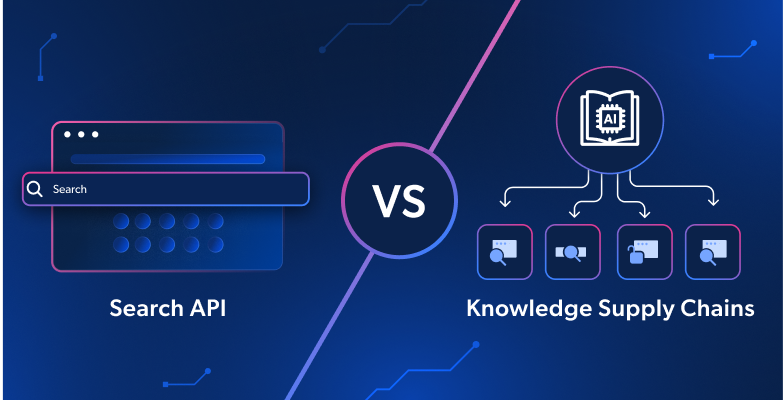
Search API vs. knowledge supply chain: key definitions
The search API category exists because training datasets weren’t enough. Chatbots and agents needed live access to web data. Getting live data is only the first problem. The harder problem is getting it with enough depth, freshness, and verifiability to support decisions, not to answer questions.
Two terms define the infrastructure decision. Here’s what each one means in practice.
Search API:
A Search API is an endpoint that accepts a query and returns a ranked list of URLs and/or page summaries sourced from an existing search index. It is optimized for low latency and ease of integration. The output is a snapshot of what is currently indexed, which may or may not reflect the live state of the web at query time.
Knowledge Supply Chain:
A knowledge supply chain is the end-to-end infrastructure an AI agent uses to continuously acquire, verify, and add context to web data. It combines live discovery, full-page content extraction, production-scale throughput, and historical datasets. Each layer solves a different problem: freshness, coverage, verifiability, parallelism, and evaluation. Not a single API call. An architecture.
The two approaches differ on three axes:
| Search API | Knowledge Supply Chain | |
|---|---|---|
| Model | Single-call, snapshot-based | Multi-layer, pipeline-based |
| Optimized for | Speed | Evidence quality |
| Output | Ranked links + summaries | Verified content + context + history |
The distinction matters because, as TinyFish CEO Sudheesh Nair put it: “Search is a shortcut built around human limitations”. Humans need 10 blue links because they can only process a limited number of results. Agents don’t need the internet compressed into a top-10 list. They need the content behind those links, verified and placed in context.
One more definition: Market-Aware Agents. These are agents that make decisions affecting revenue, risk, or operations: pricing intelligence, competitive response, regulatory monitoring, supply chain tracking. They require verifiable ground truth, not plausible summaries.
Only 11% of organizations currently have production deployments of autonomous AI agents (Deloitte Tech Trends 2026). Yet 97% of organizations building AI with public web data already depend on real-time web infrastructure (Data for AI 2026). That gap is the problem. The infrastructure decisions being made right now will determine which agents succeed and which produce confident-sounding answers no one can audit.
If the worst case of a wrong answer is that a user retries the query, a search API is fine. If the worst case is that your team acts on bad intelligence, you need a knowledge supply chain.
Where Search APIs excel (and why that matters)
Search APIs like Tavily deliver real value in specific contexts:
Sub-second latency. When response time is a UX KPI (interactive chat, agent-facing tool calls where the user is waiting), search APIs are purpose-built for this. The Proxyway Search API Report 2026 confirmed that index-based providers achieve sub-0.4 second median response times. For many use cases, speed is the priority.
Minimal integration friction. Native LangChain support, well-documented endpoints. For a developer who needs web search in a prototype, the integration takes minutes.
Strong for prototypes and lightweight Q&A. Search APIs handle RAG demos, internal chatbots, and low-stakes enrichment workflows well. Tavily specifically offers citation-ready output and source credibility scoring, useful if you need source citations in your agent output.
Low cost at low scale. At $0.008 per credit (Tavily pricing), the barrier to experimentation is near zero.
If you’re building a prototype, a chatbot, or a lightweight Q&A workflow, a search API is the right tool. The limitations show up when the stakes are higher.
The ceiling: five gaps Search APIs hit at production scale
The following gaps are structural constraints, not criticisms of search APIs. AI agents don’t need the full SERP. Ads, widgets, and mobile layouts add nothing to a knowledge lookup.
The Proxyway SERP API Report confirmed that Fast APIs give you the SERP but not the pages behind it, while Index APIs return pages from a pre-built corpus that may lag behind the live web. Neither architecture alone solves the problem.
Gap 1: freshness – cached indexes serve stale ground truth
Search APIs achieve their latency targets through caching and pre-indexing. They inherit an architecture that the a16z “Search Wars” analysis described as “primarily optimized for humans”, not the agent workflows that now depend on it.
Those benchmarks documented the resulting three-tier split: Full APIs scrape in real time (P95 over 5 seconds). Fast APIs return core SERP elements quickly (0.6–0.7 second median). Index APIs serve from a pre-scraped corpus (sub-0.4 second P50), where “the corpus of data risks being stale or incomplete”.
For pricing intelligence, policy monitoring, or breaking news, cached results are wrong results. At the Bright Data Web Discovery Summit 2026, speakers described the problem in terms of data half-life: social media data loses relevance in minutes or hours. Non-social web data (pricing pages, job listings, product catalogs) decays within days. A search index that refreshed yesterday may already be serving data past its useful half-life.
The pricing page changed overnight, but the search index won’t reflect it until its next crawl. Your agent reports confidently based on stale data. And the problem is getting worse.
Google is actively degrading SERP-based data access. AI agents “don’t care about viewing, and they certainly don’t care about buying ads” (SERP API Report, 2026). That’s a direct threat to the ad model.
The same report documented that SearchGuard increased scraping costs roughly 10x. The &num=100 parameter was removed entirely. In December 2025 Google sued a SERP API provider under the DMCA, seeking $200–$2,500 per act of circumvention (Proxyway SERP API Report, 2026). The freshness gap is getting worse as Google tightens access.
If your only data path depends on a search index, you have a reliability problem. Bright Data fetches the current state of the web at query time through multiple collection methods, not only search result scraping. There’s no single index standing between your agent and ground truth.
Gap 2: recall – snippets from a search index aren’t enough
Search APIs return snippets from a search index. The results are ranked by the index’s own algorithm, optimized for keyword queries, not for the specific intent behind an agent’s research task. For a chatbot, this works. For a competitive intelligence agent, two problems appear.
First, keyword-ranked results may not match what a research agent actually needs. At that same summit, panelists described how a production deep research call can consider 10,000 URLs based on early-stage ranking signals. The agent reads 5-30% of them and eventually cites 1-5% in the final answer.
A search API returns whatever the index ranked highest for your keywords. It doesn’t filter by the specific intent behind your agent’s task.
Second, the underlying data is increasingly inaccessible. A 2026 web scraping industry survey found data access declining sharply across top sites by vertical: eCommerce dropped from 9 out of 10 accessible sites in 2020 to 4 out of 10.
Social media access fell from 4 out of 5 to 0 out of 5. Real estate from 10 out of 10 to 3 out of 10. Entire categories of the web are becoming unreachable through standard datacenter access.
Bright Data’s SERP API addresses the first half: it scrapes Google, Bing, Yandex, Baidu, DuckDuckGo, Yahoo, and Naver in real time from any of 195 countries, so your agent is never dependent on a single index’s reading of a single query. The second half is not a ranking problem at all. Ranking can only surface a source; reaching it is separate work, and that is exactly where the access numbers above bite. Web Unlocker fetches the page whether or not it is reachable through standard datacenter access.
The most important signals in competitive intelligence are rarely on page one. They’re in the long tail: a job posting that shows a new market entry, a distributor listing with an unannounced SKU, a forum thread where a support rep confirmed a roadmap. These rarely appear in a top-10 SERP response.
Gap 3: your agent sees summaries, not source content
Search APIs are summary-first by design. They return extracted snippets and descriptions by default, useful as an overview. But summaries aren’t verifiable evidence.
Perfect reasoning plus poor search still produces hallucinations. An AI search evaluation framework showed that LLM reasoning capacity already exceeds what most search systems return. The bottleneck is the data, not the model.
For Market-Aware Agents, the cost isn’t a wrong chatbot response. It’s a wrong business decision.
An agent making a high-stakes decision needs the actual source text, not a paraphrase. At the same event, an enterprise buyer building agents noted that the richest content their customers want (LinkedIn posts, Twitter threads) isn’t what SERP results return. Instead, the top results are blog posts that reference that content. Full extraction from primary sources matters more than search ranking quality.
Full content matters for another reason too: the web is increasingly synthetic. At a 2025 web data industry conference, researcher Domagoj Maric demonstrated that 10,000 fake bot comments can be generated for $2. Without full-content verification, your agent can’t distinguish genuine reviews from manufactured noise. In a 2026 web scraping industry survey, professionals who use AI tools reported hallucinations as a top concern.
When someone asks how your agent reached a conclusion, you need the actual content with a timestamp. A snippet isn’t enough for an audit.
Bright Data Web Unlocker returns cleaned full-page content in Markdown. In the live test below it returned 26,758 characters from the vendor’s own pricing page in 2.2 seconds: the actual source text, not a paraphrase of it.
Gap 4: throughput – RPM ceilings create hidden architectural debt
Search APIs enforce rate limits. Tavily, for example, caps at 1,000 RPM (requests per minute) on its production plan. For a single agent running a single research task, that’s fine. But consider a fleet of concurrent agents running thousands of research tasks in parallel: competitive monitoring for hundreds of competitors, pricing surveillance across dozens of markets, regulatory checks in multiple jurisdictions. At 1,000 RPM, you’re forced to build pagination logic, retry handlers, exponential backoff strategies, and queue management.
The result is pure glue code, integration logic that connects systems but adds no business value. It works in staging, breaks in production, and nobody budgets time to maintain it.
The concurrency problem compounds. The Search API benchmarks noted that full SERP APIs have “limited suitability for AI” workloads due to latency and cost at volume. At the summit, one financial data company calculated that monitoring 150,000 companies for 150 material event types daily would cost roughly $3.4 million per month in SERP API fees alone.
Compare that with production reality. At a 2025 web data industry conference, CentricSoftware disclosed that it runs 5,000 scrapers making 130 million requests per day for product intelligence alone. Not 1,000 RPM.
The Bright Data SERP API has no hard concurrent request limit. Throughput scales with your workload.
Gap 5: no historical baseline – you can’t evaluate what you can’t compare
Gap 5 shows up when you try to improve an agent’s output quality.
If your agent is detecting real anomalies or hallucinating patterns, how do you tell the difference? You need a baseline. You also need reproducible historical data to benchmark output quality over time. And if you want to backfill a new agent with competitive pricing history without re-collecting it from scratch, you need datasets.
Search APIs are live-only by design. As Boaz Grinvald (GM, Bright Insights) noted, putting real-time intelligence into perspective requires deeper context. Knowing a competitor cut prices today is useless without knowing that overall category prices increased, meaning the cut may not warrant a response at all.
That contextual layer only exists with historical data. Ask a search API about last quarter’s pricing data and you’ll get today’s search results about last quarter, which is a different thing entirely.
Building baselines is more affordable than most teams expect. Researcher Andrew Chan demonstrated that 1 billion web pages can be crawled in 25.5 hours for $462. Bright Data maintains over 200 billion archived HTML pages, growing by 15 billion per month.
B2B data decays at roughly 2.1% per month, compounding to over 22% annually (MarketingSherpa). Without historical context, an agent can’t distinguish a genuine pricing anomaly from normal seasonal variation.
At that summit, one data company founder described detecting when a customer adopted a new technology by observing a sudden increase in related job postings and LinkedIn skill additions over time. That temporal signal, visible only through longitudinal crawling, helped them predict when the customer signed one of their largest deals. A search API, which returns the web as it exists right now, can’t detect signals like that. Bright Data Datasets provide topic-structured historical data for backfill, baselines, and reproducible evaluation, available in JSON, CSV, or Parquet.
Search API vs. knowledge supply chain: 7 key dimensions
The same cost analysis found that index-based APIs converge at approximately $5 per 1,000 requests. As they put it: “Real-time APIs nearly always come out cheaper. However, they require more work to achieve the same results as an index”. Bright Data SERP API starts at $1.50 per 1,000 on pay-as-you-go. That “more work” is what a knowledge supply chain automates.
A typical knowledge supply chain workflow (one Discover call, a few Web Unlocker page fetches, and one Dataset query) runs in the single-digit dollar range per research task. An analyst doing the same work manually would spend roughly 30-60 minutes.
Here’s how the two architectures compare across 7 dimensions:
| # | Dimension | Bright Data | Search APIs (category) | Tavily (example) |
|---|---|---|---|---|
| 1 | Freshness | Live discovery and extraction | May use caching/indexing for speed | May return cached/indexed results – not guaranteed up to date |
| 2 | Recall per query | Ranked sources across 7 search engines, each expandable to full page content (SERP API + Web Unlocker) | Optimized for top-K | Capped at 20 snippet-level results per call |
| 3 | Verifiable context | Optional cleaned full-page content inline (Markdown) | Often summary-first | Summary-first by default |
| 4 | Throughput | Production-scale, built for parallel workloads | Often constrained by RPM | 1,000 RPM production limit |
| 5 | Latency profile | Reliable production discovery + low-latency option (Fast SERP) | Optimized for low latency, often via caching | Very fast, prioritizes latency |
| 6 | PAYG pricing / 1,000 requests | From $1.50 (SERP PAYG) | Varies | $8 (1 credit) – $16 (2 credits) per 1,000 |
| 7 | Historical datasets | Topic-structured datasets for backfill and baselines | Not core to the category | Not a dataset product |
The cost and latency trade-offs depend on your use case.
The demo: same agent, two infrastructures
The same competitive intelligence agent is built twice: identical task, identical LLM, identical system prompt. Only the data infrastructure underneath changes.
Both agents use Bright Data endpoints. This is deliberate: it removes vendor differences from the equation. The only variable is architecture: one tool versus three.
The scenario
We chose a competitive pricing intelligence task because it requires discovery, full-page extraction, and historical context.
Competitive Pricing Intelligence Agent
Task: Monitor a competitor’s SaaS pricing page, detect changes, contextualize them against historical pricing trends, and assess whether this represents a structural strategy shift or a temporary promotion.
This task is impossible to complete well with a search API alone. a16z identified deep research as “the dominant and most monetizable form of agentic search” (“Search Wars: Episode 2”, 2025). The task requires freshness, recall, full content, and history.
Framework: Both agents are LangGraph competitive intelligence agents built with LangChain, using the Bright Data REST APIs (langchain-brightdata also available for SERP and Web Unlocker tools). The code uses GPT-4o. We tested the outputs with Cohere Command-A to confirm the architecture is LLM-independent. Same system prompt. Different tools.
Agent 1: the search API pattern
Agent 1 wraps a single SERP endpoint. One tool, one data source:
# Agent 1: Search API pattern
# Single SERP endpoint, snippet-level output

import os
import requests
from langgraph.prebuilt import create_react_agent
from langchain_openai import ChatOpenAI
from langchain_core.tools import tool

@tool
def search_web(query: str) -> str:
    """Search the web and return top results."""
    response = requests.post(
        "https://api.brightdata.com/request",
        headers={
            "Authorization": f"Bearer {os.environ['BRIGHT_DATA_API_KEY']}",
            "Content-Type": "application/json"
        },
        json={
            "zone": os.environ["SERP_ZONE"],
            "url": f"https://www.google.com/search?q={query}&num=10&brd_json=1",
            "format": "raw"
        }
    )
    # Response contains: organic[] with title, link, description per result
    results = response.json()
    organic = results.get("organic", [])[:10]
    return "\n".join([
        f"- {r.get('title')}: {r.get('description', '')[:200]}"
        for r in organic
    ])

llm = ChatOpenAI(model="gpt-4o")

search_api_agent = create_react_agent(
    llm,
    tools=[search_web],
    state_modifier="""You are a competitive intelligence analyst.
    Use web search to analyze competitor pricing changes.
    Provide a structured assessment with your findings."""
)

result_1 = search_api_agent.invoke({
    "messages": [{
        "role": "user",
        "content": "Analyze recent pricing changes for [Competitor]. "
                   "Has their pricing strategy shifted? "
                   "What does this mean for our positioning?"
    }]
})
We tested this live against the Notion pricing page.
AGENT 1 OUTPUT (Search API):

Sources consulted: 10 Google results (snippets only)
Content depth: Titles + 200-char descriptions

Finding: Notion's pricing strategy in 2026 appears to be
tiered, with four main plans: Free, Plus, Business, and
Enterprise. The Plus plan is priced at $10 per user per month
and is designed for small teams. The Business plan is priced
at $18-$20 per user per month and includes additional features
such as AI integration.

Confidence: Confident (based on snippets alone).
The agent produced a reasonable analysis from snippets. It identified the 4 tiers and approximate pricing. But it couldn’t read the actual pricing page, didn’t find any Reddit or forum discussions about recent pricing changes, and had no historical context to determine whether the current pricing represents a shift.
Agent 2: the knowledge supply chain pattern
Now the same task, with the Bright Data SERP API, Web Unlocker, and Datasets providing live discovery, full content extraction, and historical baselines:
# Agent 2: Knowledge Supply Chain
# Live discovery + full content + historical baseline

import os
import json
import requests
from langgraph.prebuilt import create_react_agent
from langchain_openai import ChatOpenAI
from langchain_core.tools import tool

HEADERS = {
    "Authorization": f"Bearer {os.environ['BRIGHT_DATA_API_KEY']}",
    "Content-Type": "application/json"
}

# Tool 1: Live discovery across real search engines via SERP API
@tool
def discover_sources(query: str) -> str:
    """Search the live web with Bright Data's SERP API.
    Returns ranked sources with titles, URLs and snippets."""
    response = requests.post(
        "https://api.brightdata.com/request",
        headers=HEADERS,
        json={
            "zone": os.environ["SERP_ZONE"],
            "url": (f"https://www.google.com/search?q={query}"
                    "&gl=us&hl=en&num=20&brd_json=1"),
            "format": "raw"
        }
    )
    # Response contains: organic[] with title, link, description
    organic = response.json().get("organic", [])
    return f"Discovered {len(organic)} sources:\n" + "\n".join(
        f"- {r.get('title')} ({r.get('link')})\n"
        f"  {r.get('description', '')[:200]}"
        for r in organic
    )

# Tool 2: Targeted page extraction.
# Discovery finds candidates; Web Unlocker reads the page that matters.
@tool
def fetch_full_content(url: str) -> str:
    """Fetch the full cleaned content of a specific webpage
    in Markdown format via Web Unlocker."""
    response = requests.post(
        "https://api.brightdata.com/request",
        headers=HEADERS,
        json={
            "zone": os.environ["UNLOCKER_ZONE"],
            "url": url,
            "format": "raw",
            "data_format": "markdown"
        }
    )
    # Returns full page content as cleaned Markdown text
    return response.text[:8000]

# Tool 3: Historical dataset baseline
@tool
def get_historical_pricing_data(competitor_domain: str) -> str:
    """Retrieve historical pricing snapshots from Bright Data
    Datasets for baseline comparison."""
    response = requests.post(
        "https://api.brightdata.com/datasets/v3/trigger",
        params={"dataset_id": os.environ["PRICING_DATASET_ID"]},
        headers=HEADERS,
        json=[{"url": f"https://{competitor_domain}/pricing"}]
    )
    # Returns: {"snapshot_id": "sd_xxxxx"} for async data retrieval
    snapshot_id = response.json()["snapshot_id"]
    return json.dumps({
        "snapshot_id": snapshot_id,
        "status": "Historical data retrieved"
    })

llm = ChatOpenAI(model="gpt-4o")

knowledge_supply_chain_agent = create_react_agent(
    llm,
    tools=[discover_sources, fetch_full_content,
           get_historical_pricing_data],
    state_modifier="""You are a competitive intelligence analyst
    with access to live web discovery, full page content,
    and historical pricing datasets.

    For pricing analysis:
    1. Discover broadly to map the landscape
    2. Fetch the actual pricing page - do not rely on snippets
    3. Compare against historical baseline data
    4. Identify whether this is a structural shift or temporary
    5. Provide a structured assessment with source citations."""
)

result_2 = knowledge_supply_chain_agent.invoke({
    "messages": [{
        "role": "user",
        "content": "Analyze recent pricing changes for [Competitor]. "
                   "Has their pricing strategy shifted? "
                   "What does this mean for our positioning?"
    }]
})
Same query. Same LLM. Different data infrastructure. Note: we didn’t configure a historical dataset for this test, so Tool 3 (historical baseline) wasn’t used. On a production deployment, the historical comparison would add a third layer of evidence.
AGENT 2 OUTPUT (Knowledge Supply Chain):

Sources discovered: 7 (SERP API, 4.1 seconds)
Pages extracted:    3 (Web Unlocker)
Evidence budget:    86,298 characters - 118x Agent 1
Tool calls:         6

Finding: Structural shift, not a promotion. Notion is moving
agent functionality off the seat price and onto a consumption
meter, while leaving the seat prices themselves untouched.

Seat pricing unchanged: Free $0, Plus $10/member/month,
Business $20/member/month, Enterprise custom.

The change is a second, parallel meter:
  - "Custom Agents ... Free to try, then $10 per 1,000 monthly
    Notion credits." (notion.com/pricing, verbatim)
  - The plan comparison table lists "Custom Agents - Requires
    Notion credits" under every tier, Enterprise included.
    Paying the top seat price does not exempt you.
  - "Workers (Beta) ... Free to try now. Starts using credits
    on October 15." A second product is already scheduled onto
    the same meter, with a date.

Corroboration (eesel.ai): credits run "on top of your seats",
and "'Getting AI in Notion' isn't a single number anymore."

Why structural rather than promotional: a promotion is
time-boxed and reversible. This has the opposite signature - a
dated forward commitment, application at every tier including
Enterprise, and a second product migrating onto the same meter.

Positioning implication: any per-seat comparison now understates
Notion's real cost for AI-heavy teams.

Confidence: High for mechanism and tier scope - quoted from the
vendor's own live page. Medium for magnitude, which depends on
per-team credit burn that is not published.
The difference isn’t intelligence, it’s evidence
Both agents ran the same query with the same LLM. Agent 1 correctly identified all four plan tiers and their headline prices. Agent 2 read the pricing page itself and answered the question that was actually asked: whether the change is structural.
Both agents are equally capable reasoners. What changed was the evidence. Agent 1 had 732 characters of snippet text across seven results. Agent 2 had those same seven results plus 86,298 characters of extracted page content — 118 times the evidence, for five extra tool calls.
Agent 1 was not blind, and it is worth being precise about that. The snippet from the vendor’s own page did leak the headline figure, “$10 per 1,000 monthly Notion credits.” What a snippet could not show was the structure behind it: that credits apply at every tier including Enterprise, that they sit on top of seat pricing rather than replacing it, and that a second product is already dated onto the same meter. Snippets surface numbers. They do not surface commitment.
Agent 2 takes longer to run (discovery + extraction vs. a single SERP call). As one panelist at the summit put it: for agents, the one-second latency constraint no longer applies. It’s either 100 milliseconds or 100 seconds, depending on whether the agent is serving a chat response or running overnight research.
Six tool calls in this test: two discovery queries and four extractions. Seven in a production deployment (add datasets for historical baselines). That’s the knowledge supply chain in practice.
Search covers breadth. Extraction handles depth. Datasets add the historical context to evaluate both.
Run it yourself. Both agents are fully functional with a Bright Data API key and any LangChain-compatible LLM. Clone the pattern, point it at a real competitor, and compare the outputs. For a full walkthrough, see how to build an agentic RAG system.
Search API or knowledge supply chain? A decision framework
Not every agent needs a knowledge supply chain. If you’re looking for a Tavily alternative for enterprise workloads, the right answer depends on the stakes, not the technology.
| Situation | Right Tool |
|---|---|
| Interactive chat UX where latency is a KPI | Search API (Tavily, or Bright Data Fast SERP) |
| RAG prototype, internal demo, hackathon | Search API – fast, cheap, low friction |
| Production agent: competitive intelligence, pricing, risk | Bright Data SERP API + Web Unlocker + Datasets |
| Agent needs ranked results with full page content | Bright Data SERP API + Web Unlocker (ranked sources, then full page content on demand) |
| Need to verify a specific page’s current state | Bright Data Web Unlocker / SERP API with full content |
| Need historical baseline or evaluation dataset | Bright Data Datasets |
| Running 1,000+ concurrent research tasks | Bright Data – throughput scales with workload, not rate-limit gates |
a16z found that most search API providers offer similar core functionality (what they called “bounded early product differentiation”), competing mainly on speed and pricing (“Search Wars: Episode 2”, 2025). Bright Data spans both real-time SERP and sub-second Fast SERP access. Index-based search APIs offer the fastest possible response but draw from a pre-built corpus.
Production agents increasingly need both live access and speed, not one or the other. In practice, many teams route by intent within a single agent: Fast SERP for the low-latency tool calls, SERP API plus Web Unlocker when the agent enters a deep-research loop.
Pick the infrastructure that matches what your agent is deciding.
The knowledge supply chain stack: reference
For teams ready to move beyond search APIs, here are the building blocks (see also the full AI agent tech stack guide):
| Building Block | Best For | Key Capability |
|---|---|---|
| Fast SERP / SERP API | Monitoring, chat UX, low-latency workflows | Sub-second structured SERP output, geo + language targeting |
| Web Unlocker | Fetching specific pages behind anti-bot protection | 99.95% success rate, built-in CAPTCHA solving, Markdown output |
| Datasets | Backfill, baselines, reproducible evaluation | Topic-structured historical data, JSON/CSV/Parquet |
These aren’t competing products. They’re layers. Discovery finds the sources. Extraction reads them. Datasets provide the history to evaluate what changed.
What this means for AI agent teams
The web is getting harder to read, not easier. Cloudflare blocked 416 billion AI bot requests in five months (WIRED, 2025). Most web scraping professionals report increased anti-bot protections year over year.
Yet in under a year, over $323 million in disclosed funding went to agentic search startups (calculated from funding rounds listed in that report). The gap between “search API” and production-grade web data infrastructure for AI agents isn’t closing.
The Bright Data stack for Market-Aware Agents:
- Discover for intent-ranked discovery and optional full content
- Fast SERP for low-latency monitoring and interactive experiences
- Datasets for backfill, baselines, and faster collection
Try the interactive demo, read the agent docs, or start building with a free tier or free trial on each product.
FAQs
What is a search API for AI agents?
It’s an API your agent calls to get search results: ranked URLs, snippets, sometimes page summaries. Tavily is one well-known example. These work well for chatbots, RAG demos, and prototypes where speed matters more than depth. But the results come from a cached index, not the live web.
Why do AI agents need more than a search API?
Search APIs return snippets from a cached index. Agents that make business decisions need the actual page content, not a summary of it. They also need historical data to detect whether something changed, and enough throughput to run thousands of parallel research tasks without hitting rate limits.
How do AI agents use web data?
Agents don’t search once and stop. They decide during the task what to search, how many pages to read, and whether to search again based on what they found. A pricing agent might search, fetch the actual page, compare against last month, and then search for related news. The web is one tool among several.
How much does Bright Data cost compared to Tavily?
Bright Data SERP API starts at $1.50 per 1,000 requests on pay-as-you-go. Web Unlocker and Datasets are priced separately based on usage. Tavily starts at $0.008 per credit ($8 per 1,000 single-credit requests). Each Bright Data product includes a free tier or free trial with no minimum commitment.
Is Bright Data a good Tavily alternative?
Depends on the workload. For production agents that need full page content, intent-ranked results, and historical baselines, Bright Data covers what Tavily doesn’t. For prototypes and chat UX where latency is the priority, Tavily remains a strong option. Both are good tools for different problems.


Technical Writer
 5 years experience
Satyam Tripathi helps SaaS and data startups turn complex tech into actionable content, boosting developer adoption and user understanding.