







A wave of recent takedowns has exposed malicious networks built on stolen infrastructure: Home devices hijacked without their owners’ knowledge, their connections rented out for spam, credential stuffing and attacks across home networks.
We share the concern and applaud the takedowns. Those networks are dangerous, and dismantling them makes the internet safer.
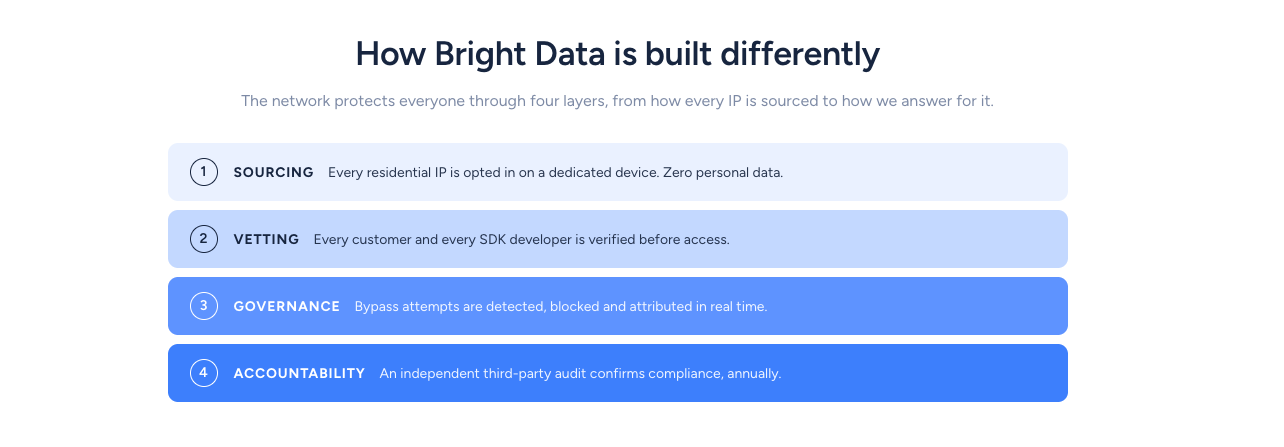
Bright Data operates a fundamentally different type of network that our web data infrastructure platform sits on. We have spent a decade making it something categorically different: sourced from real users who knowingly opt in, secured by design, verified by independent audits and open about how it works. It rests on four tiers of transparency: Sourcing, Vetting, Governance and Accountability. That distinction is the whole point of this post.
Bright Data is a web data infrastructure platform. Our network is one part of it, drawing on 400M+ residential IPs in a monthly rotating pool across 195 countries sourced entirely from real people who knowingly opted in on a dedicated device and can opt out at any time, with zero personal data collected. In return they receive a valuable benefit, in virtual or real payment.
Blurring the line between a consented, responsible network and a malicious, non-consented one does real damage. It obscures the often vital work that public web data makes possible.
So it is worth being precise about both halves of the story: What consented, responsible networks are actually for, and exactly how a responsible operator keeps them safe.
Part 1: What consented, responsible and compliant networks are actually for
A consented network lets a business see the public web the way a real user in another city or country would see it. That capability is ordinary, and it underpins a surprising amount of the modern economy.
- Brand protection. Companies detect counterfeit sellers, gray-market resellers and trademark abuse across regional marketplaces they cannot otherwise see.
- Ad verification. Advertisers confirm that their ads appear where they paid for them, render correctly, and do not sit next to fraud. That check only works from a genuine local vantage point.
- Cybersecurity and threat intelligence. The anti-fraud and threat-intelligence teams that help keep the web safe observe malicious campaigns, phishing kits and scam storefronts as their victims would encounter them.
- Price comparison and market research. The comparison sites and research tools that help consumers find a fair price depend on accurate, localized pricing at scale.
- Data for AI. The full AI data lifecycle runs on public web data: Training and fine-tuning datasets, grounding answers in live and citable evidence, agentic access for AI agents that navigate real sites and evaluation against real-world ground truth.
This is not a fringe capability. 50,000+ customers rely on it, including Fortune 500 companies, 14 of the top 20 AI labs and six of the top ten CDNs.
Then there is the public-interest work, the part of this category that rarely makes headlines. Through the Bright Initiative, more than 750 non-profit, academic and government partners use public web data for projects society needs:
- AI Forensics investigated the reliability of AI chatbots during European elections and found that roughly a third of responses contained dangerous factual errors.
- C4ADS preserved Afghan corporate registries before they could be taken offline and traced forced-labor supply chains out of Xinjiang mining operations.
- Researchers at UC Santa Barbara mapped 837,000 addresses to expose broadband pricing discrimination against lower-income American neighborhoods.
- Imaging for Good supports the identification of human-trafficking victims in cooperation with law enforcement.
- Mycelium built a UK carbon-emissions database from thousands of verified sustainability reports.
None of this is possible without consented, responsible, secured access to the public web. Safer elections, fairer prices, disrupted trafficking and documented corruption are outcomes society needs.
The technology is not the problem. Who operates it, how they source it, and how they govern it needs to be scrutinized.
Part 2: How we protect our customers, our network and the web
A consented, responsible network has to enforce four tiers of transparency, on top of a network built to resist abuse in the first place.
- Sourcing: Every IP comes from a peer who knowingly consented to a stand alone dedicated screen and can opt out at any time.
- Vetting: A documented KYC vets customers, to only allow legitimate use cases. Partners undergo reviews before becoming part of the program.
- Governance: Detect, block, and attribute abuse while it happens, and when a researcher reports a problem, act fast and document it.
- Accountability: Submit to independent audit, and pay outside researchers to probe our network for criminal-pool overlap.
Bright Data developed this standard and continues to raise it. We do not just follow these four tiers. We own them. Here is how.
Sourcing: Every user opts in. Every IP on our network comes from a real person who knowingly opted in on a dedicated device and can opt out at any time, with zero personal data collected. In return they receive a valuable benefit, in virtual or real payment.
The devices in a malicious network never agreed to anything. Every user who joins ours does, through a clear native consent screen, in exchange for a real benefit, with a two-click exit. It is the difference between a guest and a hostage.
Vetting: Every customer and developer is verified. Bright Data was the first in the industry to put a real Know Your Customer process before granting network access. Every customer goes through identity verification and review by a compliance officer. Only approved use cases are permitted. We block prohibited use cases at the door, including credential stuffing, DDoS, ad fraud, spam and the collection of data from behind a login. We reject or suspend hundreds to thousands of would-be customers every year.
Governance: We act the moment something looks wrong. Attempts to bypass our processes are detected, blocked, and attributed in real time. Flagged activity goes to compliance officers, not just an automated filter. When a problem is reported, we disable the account, investigate, and act immediately. Our abuse-report portal commits to a response from a real person within one business day. Our network is trusted and whitelisted by Microsoft Defender, McAfee, Avast, AVG, AppEsteem and the Clean Software Alliance.
Accountability: We answer for all of it. Bright Data submits to ongoing, independent, third-party audits confirming compliance with relevant rules, regulations, security standards, and best practices, and we publish the results. We commissioned an independent PwC audit of our compliance and ethics controls, published annually at our Trust Center. Alongside it: SOC 2 Type II, ISO 27001, CSA STAR Level 1 and documented adherence to GDPR and CCPA. Malicious networks do not publish audit reports. When an audit revealed that roughly 10% of our network partners were not meeting our standard, we removed them, and we wrote publicly about why.
The result is a network where we know it is good, by design. Every user is consented, every customer is verified, every action is governed and everything is independently audited.
This is fundamentally different from any network built without consent. Same words, but the opposite thing in every way that matters: Consent instead of compromise, audits instead of anonymity, a verified customer instead of a criminal.
The right response to malicious networks is to raise the standard across it, and then to prove, on the record, that you meet it.
See the evidence for yourself at the Bright Data Trust Center.


Chief Compliance and Ethics Officer
 14 years experience
Rony Shalit is an experienced professional with a focus on Risk Management, Compliance, Internal Controls, and Internal Audit processes. Currently serving as Chief Compliance and Ethics at Brightdata, the world’s leading web data collection platform.