







Apollo.io is one of the most widely used B2B prospecting platforms on the market: 275M+ contacts, built-in email sequencing, and a free tier with over a million users. For small SDR teams running email-only outbound, it consolidates search, outreach, and tracking into one interface.
Bright Data takes a different approach. Instead of maintaining a static contact database, it gives you API access to collect B2B data on demand from 10+ premium sources (LinkedIn, Crunchbase, ZoomInfo, 6sense, PitchBook, and more). Every record is scraped at the time you request it.
We compared both platforms across data quality, freshness, API capabilities, coverage, and pricing. Below is what we found.
Quick Comparison
| Feature | Bright Data | Apollo.io |
|---|---|---|
| Data architecture | Real-time scraping + pre-aggregated multi-source datasets | Proprietary static database with periodic refresh |
| Data sources | 10+ (LinkedIn, Crunchbase, ZoomInfo, 6sense, PitchBook, etc.) | Contributor network + public crawling + third-party vendors |
| Total records | 500M+ company profiles across Company Data API datasets; LinkedIn scraping on demand | 275M+ contacts, 35M+ companies |
| Data freshness | Real-time (collected at moment of request) | Periodic refresh cycle (varies by record priority) |
| API access | Full REST APIs on all accounts | API data enrichment on paid plans (Basic+); Free plan returned 403 on search/enrichment endpoints in our test |
| Data delivery | JSON, CSV, Parquet via API, S3, Snowflake, Azure, Webhook | CSV/JSON export; API responses on supported endpoints |
| Pricing model | Pay per record ($1.5/1K PAYG) or Scale plan ($499/mo for 384K records) | Per-user seat + credit system ($0-$119/user/mo) |
| Outreach tools | None (data infrastructure only) | Email sequences, dialer, meeting scheduler, CRM |
| Best for | Data teams, AI pipelines, enrichment at scale, multi-source intelligence | SMB SDR teams running self-contained outbound campaigns |
The Freshness Problem with Static B2B Databases
B2B contact data decays at roughly 22-30% per year. People change jobs, companies rebrand, phone numbers get reassigned. The US Bureau of Labor Statistics reported a total separations rate of 3.3% in both 2024 and 2025, meaning a meaningful share of any contact database becomes outdated every year through job changes alone.
Apollo maintains its database through three channels: a contributor network of 2M+ users who sync email and calendar data, public web crawling, and third-party data vendors. The system processes around 270M records per month in its refresh cycle. “Processed” doesn’t mean “verified per-record” – high-traffic contacts get refreshed more often, and low-traffic records can sit untouched for months.
The evidence shows up consistently in public reviews:
- G2 and Capterra reviewers report data accuracy hovering around 65-70% overall, below Apollo’s advertised rates
- Email bounce rates on Apollo-exported lists regularly hit 15-35% in independent tests, depending on geography and industry
- Job titles and company associations for contacts who changed roles 6-12 months ago often remain stale
- US-based tech and SaaS contacts are the strongest segment, with 80-88% accuracy; international data drops to 60-73%
- Phone numbers cost 8 credits each and have lower accuracy than email – the most common specific complaint across review platforms
One detailed test shared on r/coldemail showed 32-38% bounce rates on 500-1,000 leads exported from Apollo, even on contacts labeled “verified”.
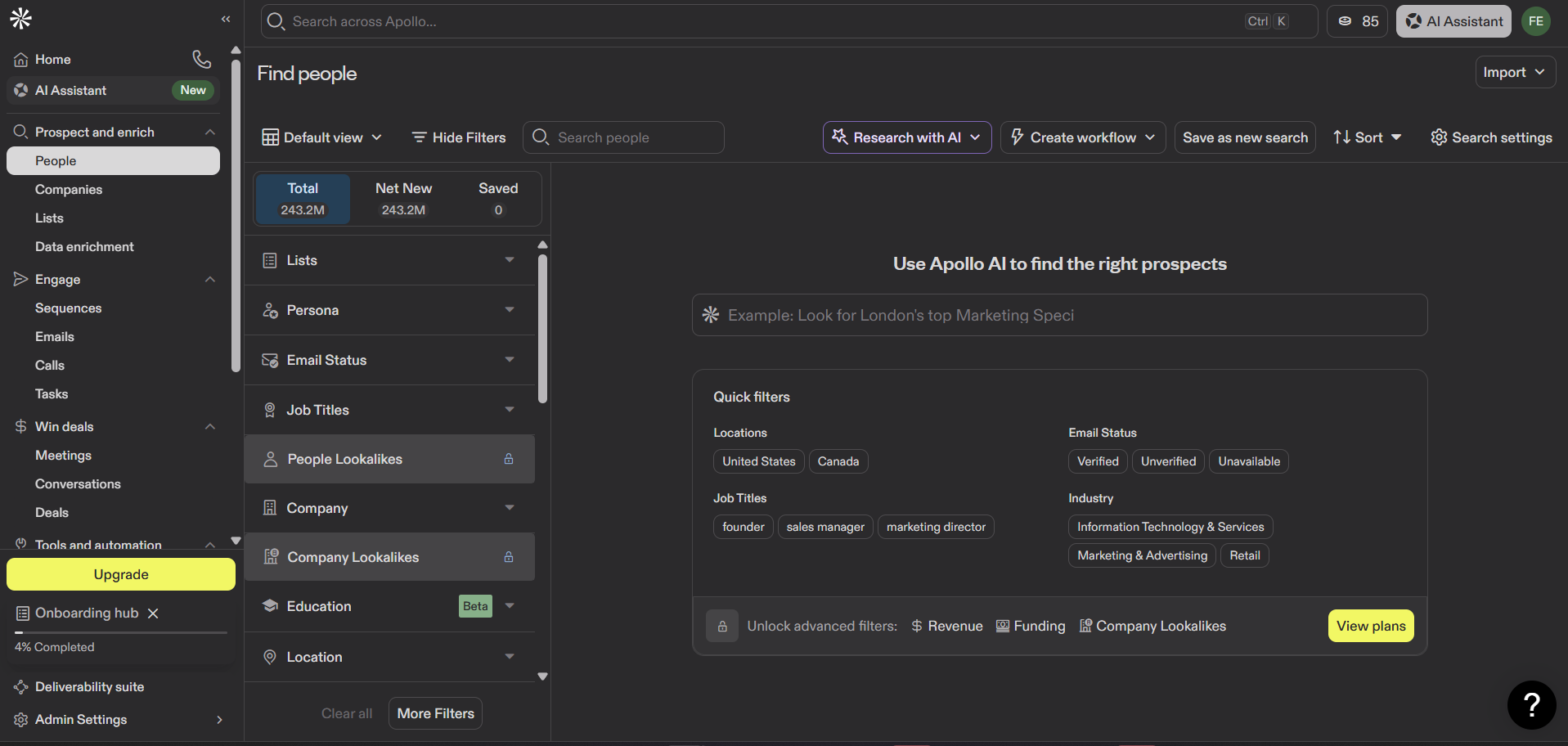
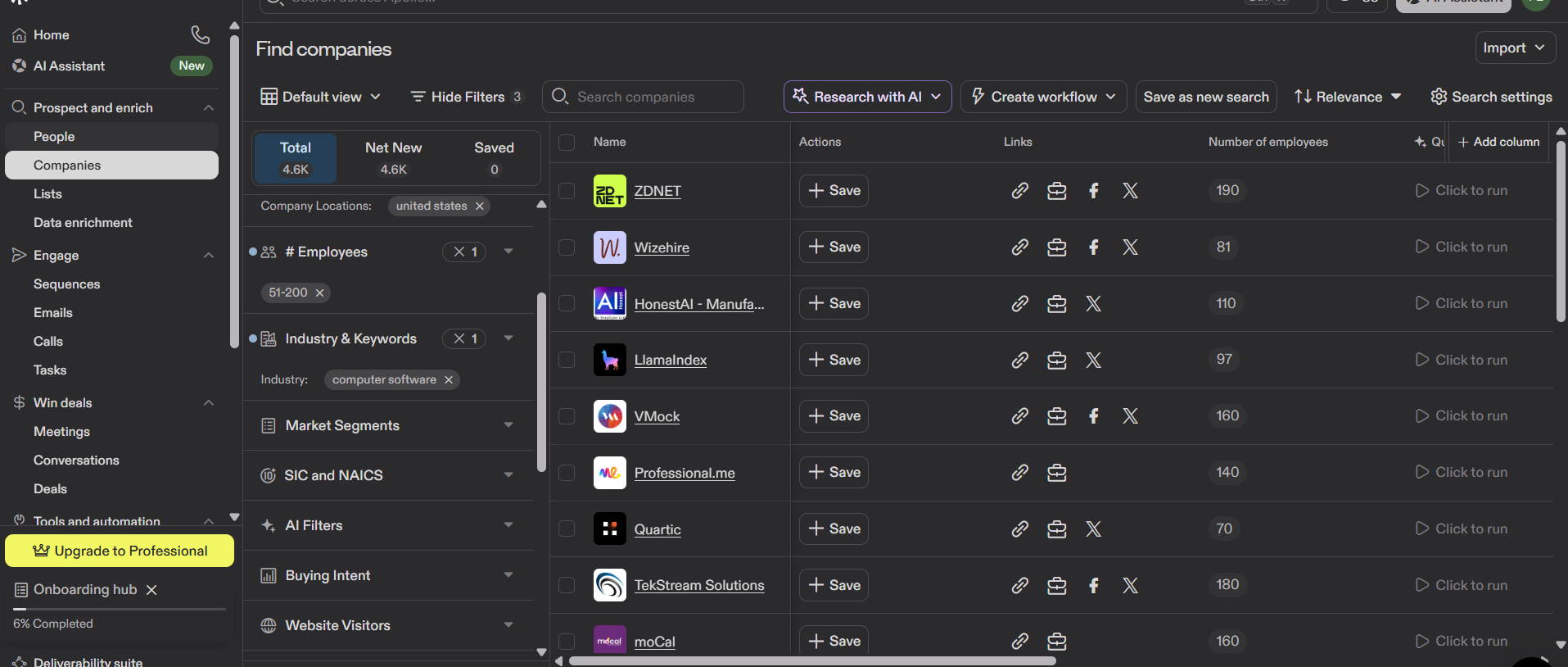
Apollo’s People search provides a searchable database of 275M+ contacts with 65+ filter attributes.
Bright Data eliminates the refresh problem entirely. When you call the LinkedIn Profiles Scraper API, the data is collected from the live LinkedIn page at the moment of request. There’s no cache layer and no refresh cycle. If a prospect updated their LinkedIn profile this morning, the API returns the updated version this afternoon.
We tested this directly. Scraping Satya Nadella’s LinkedIn profile via the Profiles API returned a response in 7.2 seconds with a collection timestamp of 2026-05-27T10:22:15.544Z, confirming the data was pulled live, not from a cache.
Bright Data’s B2B Data Stack: Hands-On Walkthrough
The Dataset Filter API: Large-Scale Company Search
The Filter API is the most direct equivalent to Apollo’s company search. You define structured filters and query pre-aggregated company datasets. Bright Data’s Company Data API advertises 500M+ company records across all its aggregated sources (LinkedIn, Crunchbase, ZoomInfo, 6sense, PitchBook, and others). Results arrive within minutes, and you pay only for records in the final output.
Here’s the API call we used to find software companies in the US with 51-200 employees:
import requests
import time

# Step 1: Trigger a filtered snapshot
# Field names vary by dataset; use API Request Builder for your selected dataset.
response = requests.post(
    "https://api.brightdata.com/datasets/filter",
    headers={
        "Authorization": "Bearer YOUR_API_TOKEN",
        "Content-Type": "application/json"
    },
    json={
        "dataset_id": "gd_l1vikfnt1wgvvqz95w",
        "filter": {
            "operator": "and",
            "filters": [
                {"name": "industries", "operator": "includes",
                 "value": "Software Development"},
                {"name": "country_code", "operator": "=", "value": "US"},
                {"name": "company_size", "operator": "=",
                 "value": "51-200 employees"}
            ]
        },
        "records_limit": 100
    }
)

snapshot_id = response.json().get("snapshot_id")

# Step 2: Poll until ready, then download
download_url = (
    f"https://api.brightdata.com/datasets/snapshots"
    f"/{snapshot_id}/download?format=json"
)
# Poll download_url until HTTP 200, then parse the JSON response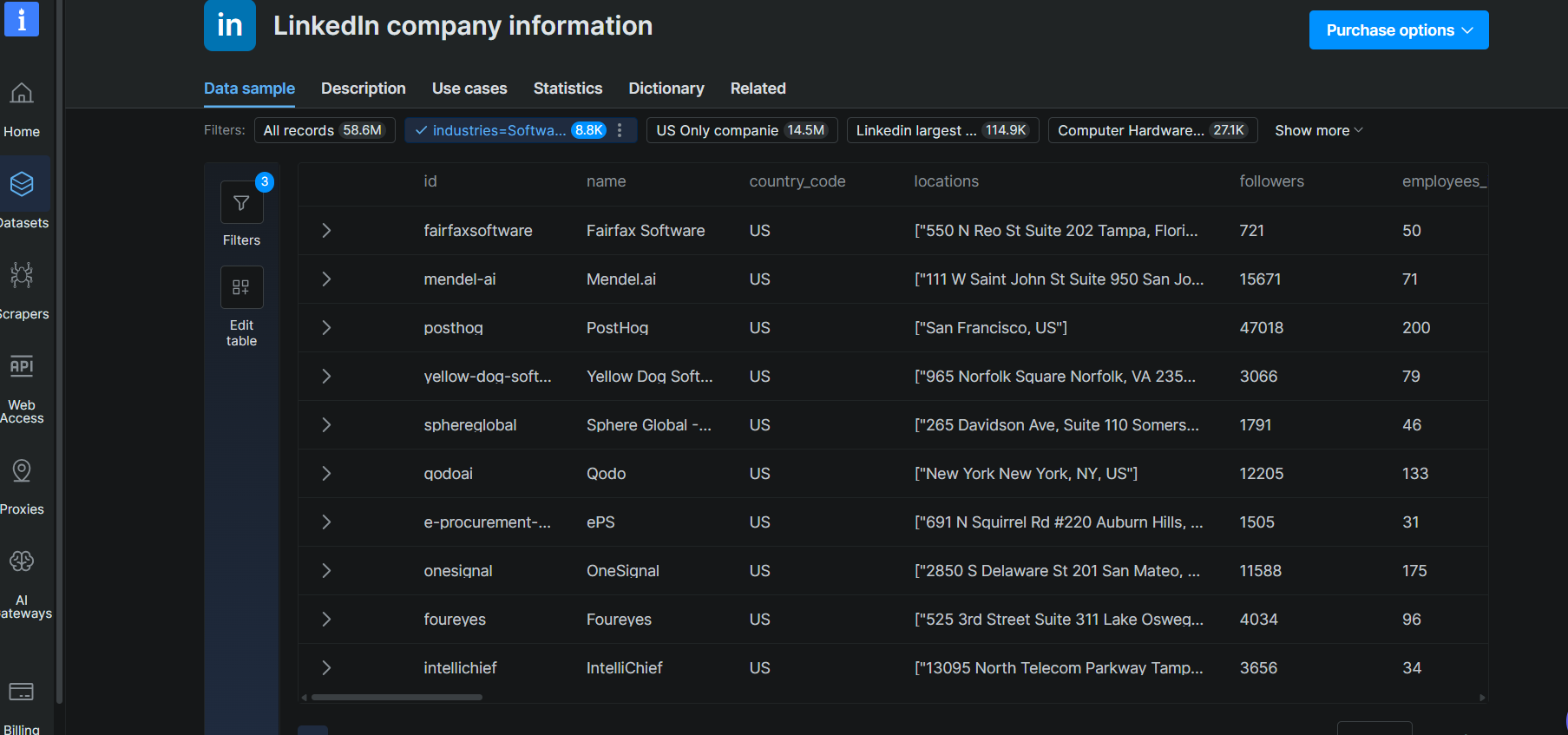
The response returned 100 matching companies in 46.5 seconds. Each record included company name, domain, industry classification, employee count, headquarters location, founding year, LinkedIn URL, and Crunchbase URL. Records can also include funding fields when available from the underlying sources.
Sample record (Leanpath):
{
  "about": "Leanpath, a Certified B-Corp, is on a mission to make food waste prevention and measurement everyday practice in the world's kitchens...",
  "company_id": "400488",
  "company_size": "51-200 employees",
  "country_code": "US",
  "crunchbase_url": "https://www.crunchbase.com/organization/leanpath-inc",
  "employees_in_linkedin": 78,
  "followers": 6199,
  "founded": 2004,
  "funding": {
    "last_round_date": "2025-03-04T00:00:00.000Z",
    "last_round_raised": "US$ 750.0K",
    "last_round_type": "Debt financing",
    "rounds": 3
  }
}
This is where the multi-source architecture matters. A company’s LinkedIn data might show employee count and industry. Crunchbase adds funding rounds, investors, and valuation data. ZoomInfo contributes technographics and revenue estimates. The Filter API merges these into a single record, cross-validated across providers. Apollo’s company search queries one proprietary database.
LinkedIn Profiles Scraper API: Live Contact Data in 7 Seconds
For contact-level data, we tested Bright Data’s LinkedIn Profiles Scraper API. This API accepts a LinkedIn profile URL, scrapes the live page (handling CAPTCHAs, login walls, and JS rendering), and returns structured JSON.
import requests

response = requests.post(
    "https://api.brightdata.com/datasets/v3/scrape",
    params={
        "dataset_id": "gd_l1viktl72bvl7bjuj0",
        "format": "json"
    },
    headers={
        "Authorization": "Bearer YOUR_API_TOKEN",
        "Content-Type": "application/json"
    },
    json=[{"url": "https://www.linkedin.com/in/fimber-elemuwa/"}]
)

profile = response.json()
This time, we scraped Fimber Elemuwa‘s profile as a test. The response came back in 7.2 seconds and included: name, current title, current company, location, full work history, education, skills, and engagement data. The timestamp field read 2026-05-27T10:22:15.544Z, confirming the data was collected live.
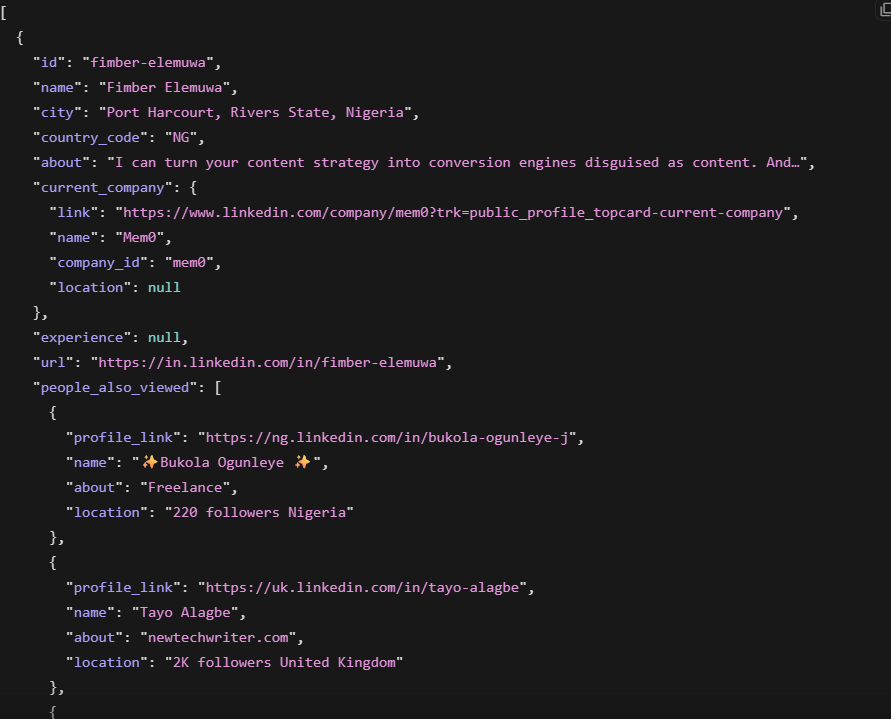
Apollo stores a snapshot of this profile refreshed on its own schedule. Bright Data collects the data from LinkedIn at the moment of request. For a well-known CEO, both sources will likely agree. The gap shows up for mid-level contacts at smaller companies, where Apollo’s refresh cycle is less frequent and stale data is more probable.
LinkedIn Companies Scraper API: Firmographic Data on Demand
We also tested the Companies Scraper API by pulling Microsoft’s LinkedIn company page.
response = requests.post(
    "https://api.brightdata.com/datasets/v3/scrape",
    params={
        "dataset_id": "gd_l1vikfnt1wgvvqz95w",
        "format": "json"
    },
    headers={
        "Authorization": "Bearer YOUR_API_TOKEN",
        "Content-Type": "application/json"
    },
    json=[{"url": "https://www.linkedin.com/company/microsoft/"}]
)

company = response.json()
The response came back in 12.3 seconds and included: company name, employee count (231,622 employees on LinkedIn), headquarters location, industries, Crunchbase URL, and recent company posts. Funding fields were also present in this case, though availability varies by company.
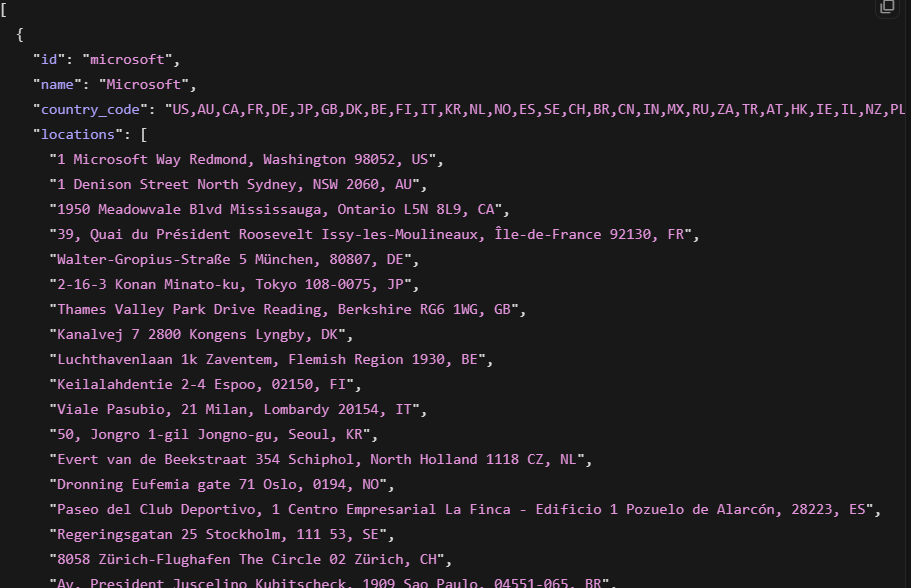
For deeper firmographic data – full funding round history with amounts and investors, revenue estimates, technographic profiles – the Company Data API’s multi-source aggregation layer provides a more complete picture than a LinkedIn-only scrape. The company scraper suits quick, single-source lookups; the Filter API suits enriched, multi-source records at scale.
The Full Scraper API Suite
Beyond the two APIs tested, Bright Data’s LinkedIn scraper suite also includes:
| API | Input | Key Output |
|---|---|---|
| Jobs API | LinkedIn job URL | Title, company, location, salary, description, requirements, posting date |
| Posts API | LinkedIn post URL | Author, content, engagement metrics, date, media |
These are useful for hiring signal detection (which companies are expanding which teams) and competitive intelligence (tracking what companies are posting about). Submit a URL, receive structured JSON from a live scrape.
Building Automated Lead Gen Pipelines
The real power of these APIs shows up when you chain them into automated workflows. Bright Data maintains an open-source AI Lead Generator built on Streamlit that:
- Accepts a natural language query (“Find marketing managers in fintech companies in Kenya”)
- Uses OpenAI to extract structured filters from the query
- Calls Bright Data’s API to collect matching leads from LinkedIn
- Scores and enriches each lead with AI
- Returns outreach suggestions per lead
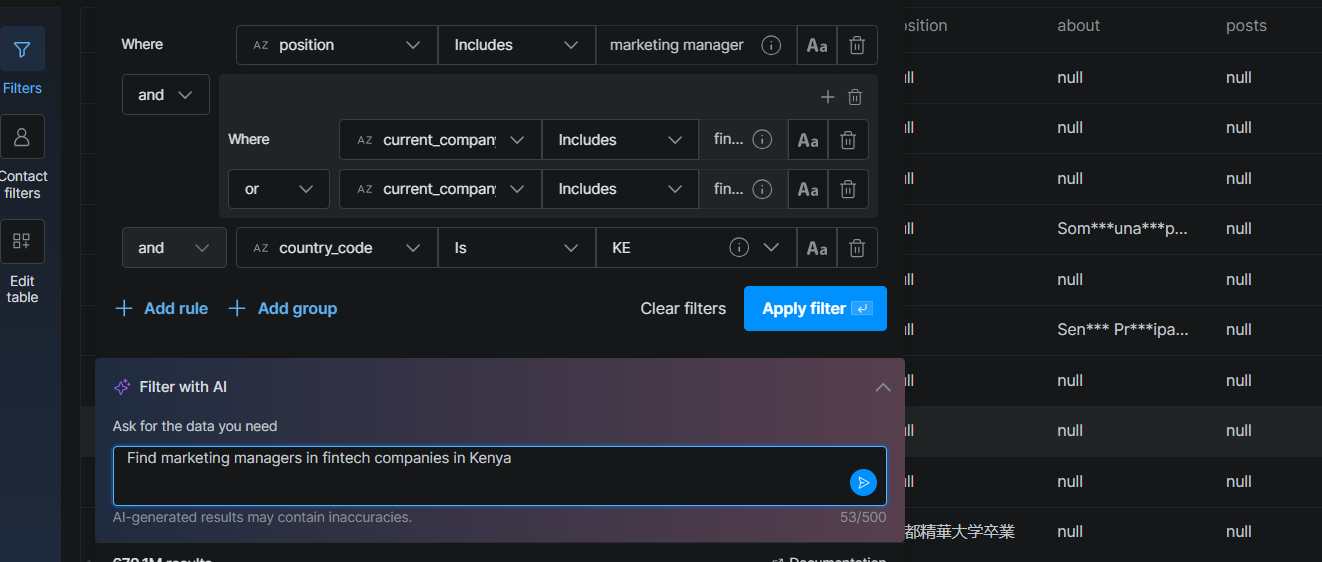
Apollo has AI features (email writing, lead scoring suggestions), but they operate inside Apollo’s interface – not as composable building blocks for custom pipelines. For teams building agent-based workflows with LangChain, LlamaIndex, or CrewAI, Bright Data’s APIs integrate directly as data retrieval tools.
Pricing: What You Actually Pay
Apollo
Apollo uses a unified credit system. Paid plans grant credits upfront for the full year; the free plan grants monthly. Here’s what the pricing page shows:
| Plan | Annual Billing | Credits | Grant Schedule |
|---|---|---|---|
| Free | $0 | 900/year | Monthly (75/mo) |
| Basic | $49/seat/mo | 30,000/year | Upfront |
| Professional | $79/seat/mo | 48,000/year | Upfront |
| Organization | $119/seat/mo (min. 3 seats) | 72,000/year | Upfront |
All three paid plans include CSV, CRM, and API data enrichment. The Free plan does not. In our testing, people search and enrichment API endpoints (mixed_people/api_search, people/match, people/bulk_match) all returned 403 errors on a free-plan account – consistent with the free tier lacking “API Data Enrichment.”
Credits are consumed per action: revealing an email costs 1 credit, revealing a mobile number costs more (reported at 8 credits depending on account configuration), and enrichment through the API varies by fields requested. Credits do not roll over past the annual contract period. Active outbound teams regularly spend above their base plan price on credit top-ups once enrichment and phone reveals scale up.
Notable features by tier: Basic adds CRM integrations, advanced filters, waterfall enrichment, and a US dialer. Professional adds A/Z testing on sequences, automated workflows, call recordings (4,000 mins), and analytics. Organization adds customizable reports, SSO, advanced security, and the option to use your own LLM API key.
Bright Data
| Product | Pricing |
|---|---|
| LinkedIn Scraper APIs (PAYG) | $1.5/1K records (pay only for success) |
| LinkedIn Scraper APIs (Scale) | $499/month (384,000 records included; $1.3/1K additional) |
| Company Data API (Filter) | From $2.50/1K records |
| Pre-built Datasets | From $250/100K records |
| Free trial | 1K requests (one-time), available for one week, no credit card required |
No per-seat fees. No credit system. No feature gates by plan tier. Full API access on every account, including the free trial. Data delivery to S3, Snowflake, Azure, Google Cloud, or Webhook is included.
Cost Comparison for a Real Workflow
Pulling 10,000 LinkedIn company profiles per month:
Bright Data: 10,000 records on the PAYG plan at $1.5/1K = $15/month. Add the Filter API for account-level targeting at $2.50/1K = $25 for 10K filtered records. Total: roughly $40/month. At higher volumes (100K+ records/month), the Scale plan at $499/month with 384,000 records included brings the effective rate down to $1.3/1K.
Apollo: The cheapest plan with API access is Basic at $49/seat/month ($588/year), with 30,000 credits per year granted upfront. At 1 credit per email reveal, 30,000 credits covers 30,000 email-only exports – but phone numbers at 8 credits each drain the pool significantly faster. A team of 3 on Basic pays $1,764/year in seat costs alone, sharing 90,000 total credits across the year.
The gap widens at 100,000 records/month. Bright Data’s PAYG rate comes to $150/month, or the Scale plan at $499/month covers 384,000 records with room to spare.
Apollo pricing above is sourced directly from Apollo’s pricing page as of May 2026. Credit costs per action (email reveals, phone reveals, enrichment) are not listed on the pricing page and may vary. Bright Data pricing reflects current published rates.
When to Use Which
Use Apollo if you’re a small SDR team (1-5 reps) that wants search, sequencing, and tracking in one platform. Your ICP is concentrated in US-based tech/SaaS (where Apollo’s data is strongest), and your monthly prospecting volume stays within the credit limits of your plan.
Use Bright Data if you need fresh data at scale (10K+ records/month), your ICP includes international markets or small companies where static databases have known gaps, you’re building automated enrichment or AI-powered lead gen pipelines, or your use case extends beyond sales outreach into competitive intelligence, investment research, or market mapping.
Use both together for the strongest stack. This is the recommended approach for growth teams that want data quality and execution efficiency:
- Bright Data’s Company Data API to build a qualified account list from 10+ sources, filtered by firmographics, funding stage, technographics, or growth signals
- Bright Data’s LinkedIn Profiles Scraper API to pull fresh contact data for decision-makers at those target accounts
- A verification tool (NeverBounce, ZeroBounce, or Prospeo) to validate email addresses before sending
- Apollo (or any sequencing tool) to load those verified contacts and run outreach campaigns
This setup uses each platform where it’s strongest: Bright Data handles the data layer, a verification tool handles email accuracy, and Apollo handles the execution layer.
!bright-data-apollo-combined-stack
Final Thoughts
Apollo is a capable outbound platform for SMB sales teams that need an affordable, self-contained workflow. The free tier, built-in sequencing, and low setup time make it the fastest path from zero to first campaign.
The limitation is data freshness. Public reviews consistently report 65-70% overall accuracy, with bounce rates of 15-35% on exported lists. Job titles for contacts who changed roles months ago often remain stale. For small-volume, US-focused email outreach, this may be tolerable. At scale, the compounding cost of stale data becomes significant: wasted credits, damaged sender reputation, and missed pipeline from prospects who’ve moved on.
Bright Data’s Dataset Filter API and LinkedIn Scraper APIs pull data from the source at the time of request, across aggregated company data products, with per-record pricing that doesn’t penalize team growth. We pulled a live LinkedIn profile in 7.2 seconds, a company page in 12.3 seconds, and filtered 100 companies from the LinkedIn Companies dataset in under a minute.
If your outbound results are limited by data quality, or you need B2B data for anything beyond basic email prospecting, Bright Data gives you the infrastructure to build exactly what the use case demands.


Growth Marketing Manager
Dvir Sharon is in charge of growth marketing here at Bright Data. He is interested in creating viral content that provides value for businesses looking to leverage web data.