







Facebook has 3.07 billion monthly active users as of 2026, the largest of any social platform. Its layered anti-bot infrastructure makes scraping it one of the hardest technical challenges in data engineering. This guide ranks the 8 best Facebook scrapers in 2026 and compares their pricing side by side. Bright Data leads the field. It posted the highest average success rate, 98.87%, of the 16 scraping APIs in Scrape.do’s 2026 benchmark.
TL;DR: Best Facebook Scrapers at a Glance
| Tool | Type | Free Tier | Starting Price | Best For |
|---|---|---|---|---|
| Bright Data | Dedicated scraper API + datasets | 5,000 records/mo free | $0.75/1K requests | Best overall |
| Apify | Pre-built no-code Actors | $5 monthly credits | $49/mo | No-code scraping |
| Oxylabs | General-purpose scraping API | 7-day trial, 2K results | $49/mo | Enterprise scale |
| Decodo | General-purpose scraping API | 7-day trial, 1K results | ~$0.25/1K | Best value |
| Zyte | General-purpose scraping API | $5 credits for 30 days | $1.01/1K | Developer workflows |
| ScrapingBee | General-purpose scraping API | 1K credits trial | $49/mo | Quick setup |
| ScraperAPI | General-purpose scraping API | 5K credits trial | $49/mo | Integration flexibility |
| Nimble | AI-powered scraping API | Limited trial | Contact sales | AI-assisted parsing |
What Is a Facebook Scraper?
A Facebook scraper automatically extracts publicly available data from Facebook. It targets pages, posts, profiles, groups, marketplace listings, events, reels, and comments without manual browsing. It returns structured output at scale.
The Facebook Graph API is not an equivalent replacement. It requires a developer account, app submission, and review approval. It enforces strict rate limits. It restricts access to most public page data, including posts, engagement metrics, and marketplace listings. A Facebook scraper accesses the same data any browser can see. It does this without API approval, rate-limit constraints, or restrictions on entity type.
Three categories of Facebook scrapers exist in 2026. First are dedicated Facebook scraper APIs with pre-built templates and structured JSON output. These are the fastest to deploy and require the least custom code. Second are general-purpose scraping APIs adaptable to Facebook via custom parsing logic. These suit developers who want raw HTML control. Third are no-code visual tools for non-developers who want point-and-click data collection without writing a single line of code.
The Best Facebook Scrapers, Ranked
These are the 8 best Facebook scrapers available in 2026, ranked by anti-bot bypass, data coverage, pricing, and developer experience.
1. Bright Data: Best Overall Facebook Scraper
Bright Data is the top-ranked Facebook scraping platform in 2026.
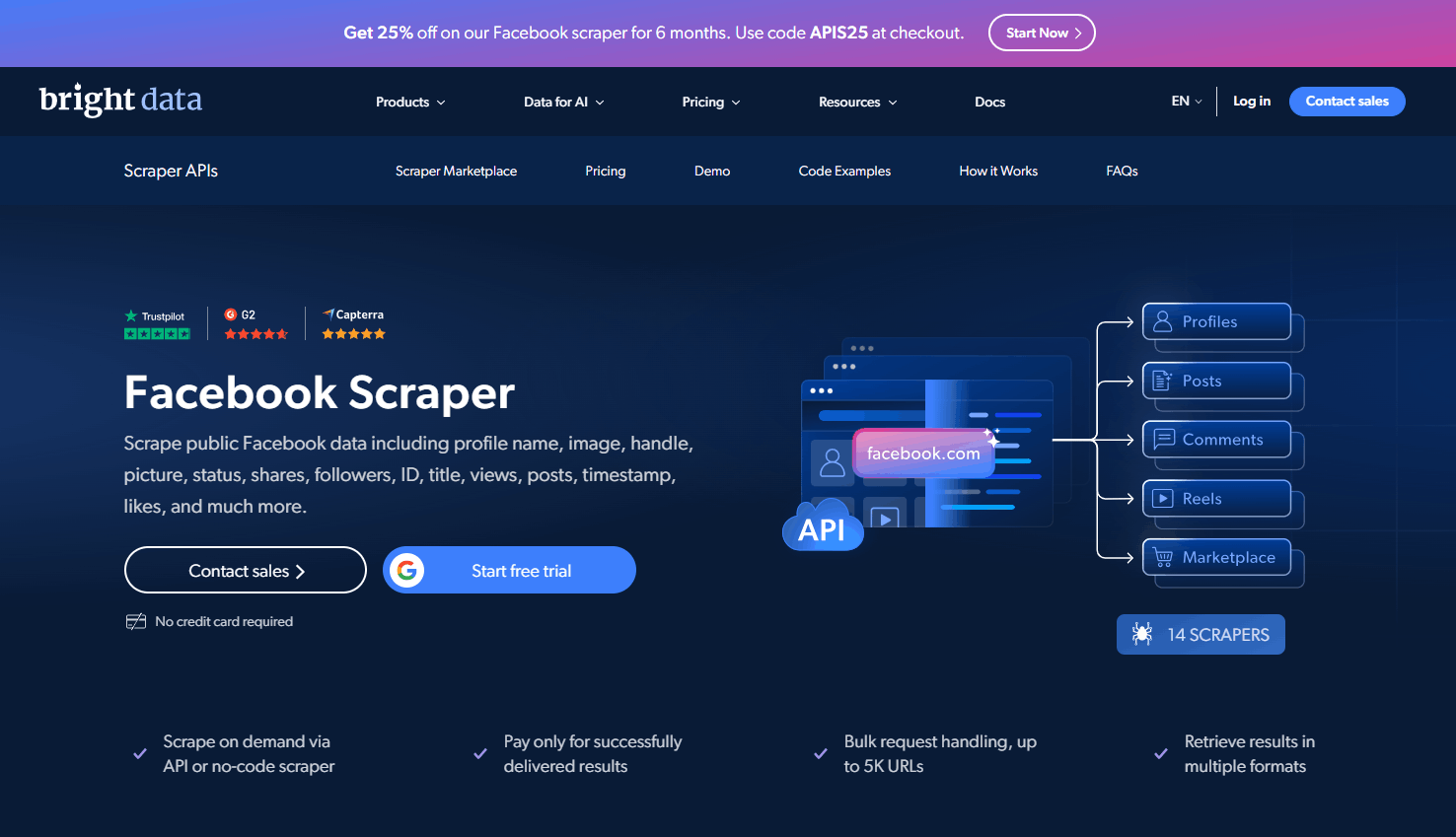
Bright Data posted the highest average success rate, 98.87%, of the 16 scraping APIs in Scrape.do’s 2026 benchmark. Bright Data’s Web Scraping API includes 15 dedicated Facebook scraper templates covering every major entity type.
Facebook data types covered out of the box:
- Facebook Pages: name, description, follower count, contact details, post frequency, and engagement totals
- Facebook Profiles: bio, location, work history, education, and public posts
- Facebook Groups: member count, public post text, and engagement metrics
- Marketplace listings: title, price, condition, seller location, and product description
- Facebook Events: title, date, location, organizer name, and attendee count
- Facebook Reels: view count, like count, comment count, and caption text
- Facebook Posts: text content, media URLs, reaction breakdown, share count, and publish timestamp
- Facebook Comments: author name, text, timestamp, and reply count
- Hashtags: post volume and trending status
- Ads: creative content, run dates, targeting category, and estimated impressions range
No CSS selectors or XPath rules are required. No manual parser maintenance on your end when Facebook updates its layout.
Dual access modes for every team:
Developers call the REST API directly. The endpoint accepts target URLs or search parameters and returns structured JSON with unlimited concurrency for large batch jobs. Non-technical users access the same scrapers through a no-code control panel. The control panel accepts URLs or search terms. It exports results in CSV or JSON format. No code is required at any step.
Ready-to-use Facebook Datasets:
Need bulk historical data without running a live scraper? Use Bright Data’s Facebook Datasets instead. These are pre-collected datasets updated on demand or on a custom delivery schedule. The Facebook Profiles Dataset contains 31M+ profile records, available for download at $250 per 100K records. This eliminates scraping infrastructure for historical use cases and removes the cold-start problem on new projects.
Browser API for JavaScript-heavy Facebook pages:
Bright Data’s Browser API is a managed cloud browser that renders Facebook’s asynchronously loaded React content. It executes JavaScript and solves CAPTCHAs automatically. It spoofs browser fingerprints at the session level to pass Facebook’s behavioral detection. It handles Facebook’s full rendering pipeline without any headless browser infrastructure to provision or manage.
400M+ residential proxy network:
Bright Data’s proxy network routes requests through ethically sourced residential IPs across 195 countries. City-level geo-targeting lets you scrape Facebook as a user from any specific location worldwide. Spreading requests across the 400M+ residential pool keeps any single IP under Facebook’s per-IP limits.
Facebook MCP Server for AI workflows:
Bright Data offers a Facebook MCP Server for direct AI agent integration. It connects to Claude, GPT-4, and other LLM platforms without custom API code. AI agents can query Facebook data in real time through the MCP interface. It suits teams building AI-powered research and monitoring pipelines.
Pricing:
The free tier provides 5,000 records per month with no credit card required. Pay-as-you-go is $0.75 per 1K records with no monthly commitment and unlimited concurrency. The Scale plan is $499/month and includes 384,000 records at $1.30/1K for overages. Enterprise pricing is custom, with volume discounts, a dedicated account manager, premium SLA, and priority support.
Active promotions: use code APIS25 at checkout for 25% off Scraper API for 3 months. Bright Data matches your first deposit dollar-for-dollar up to $500.
Best for: Production-grade Facebook data pipelines at any scale, from solo developers to enterprise data engineering teams.
Pros:
- Highest average success rate (98.87%) of 16 APIs in Scrape.do’s 2026 benchmark
- 15 pre-built Facebook templates covering all major entity types with structured JSON output
- Pay-per-success pricing eliminates cost waste on failed or blocked requests
- 31M+ pre-collected Facebook profile records available for immediate download
- Facebook MCP Server enables AI agent integration without writing custom API code
Cons:
- Higher per-request cost than simpler general-purpose tools for basic unprotected public pages
2. Apify: Best No-Code Facebook Scraper
Apify is a cloud platform built around pre-built scraping Actors for dozens of websites.
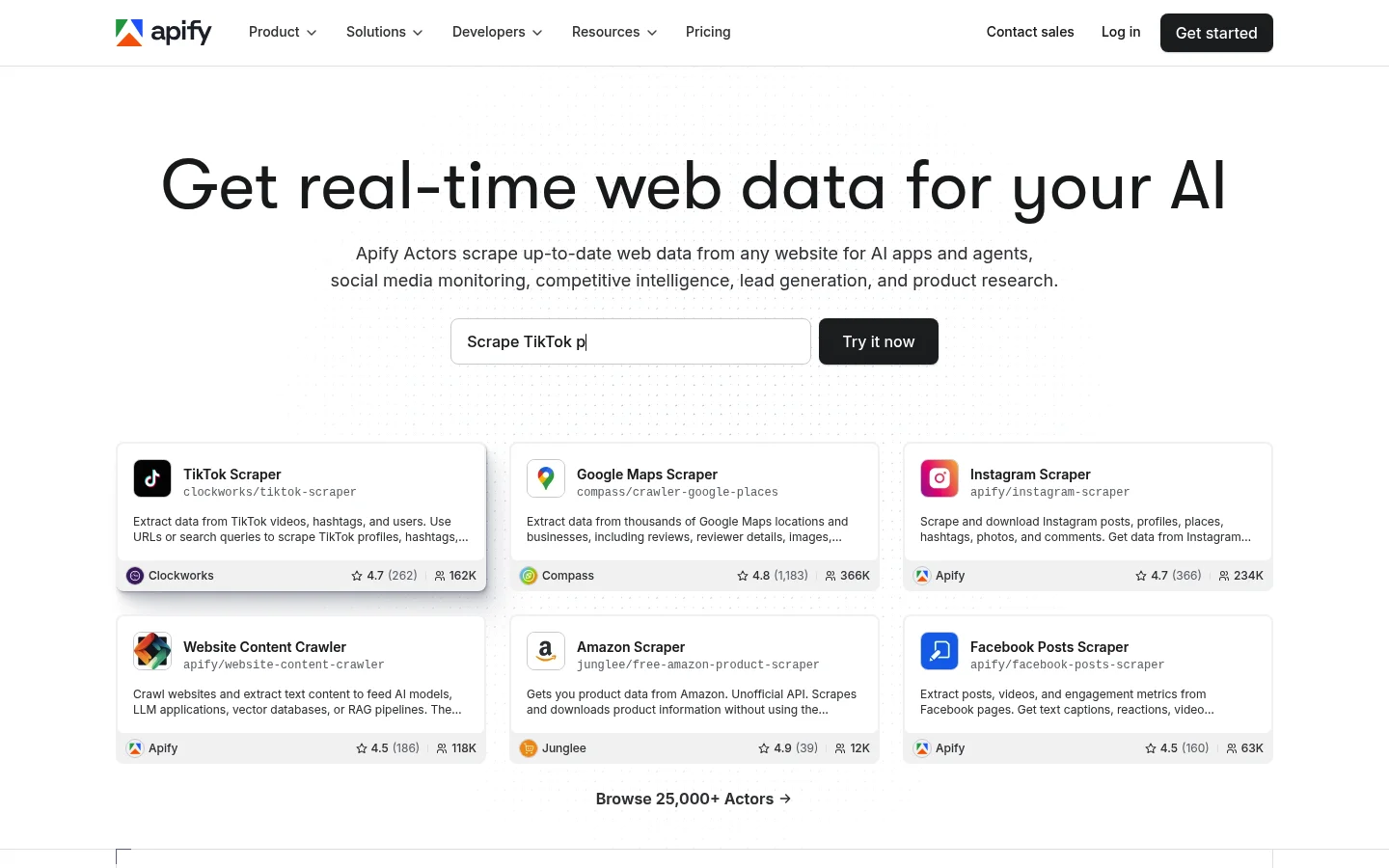
Apify’s Actor marketplace offers the lowest technical barrier for non-developers on this list. Users input Facebook URLs or search terms, select an output format, and download results. No proxy configuration. No browser setup. No custom parsing logic required at any stage.
Key features:
- Pre-built Facebook Actors for pages, posts, comments, groups, profiles, ads, and marketplace
- Community Actor marketplace with dozens of actively maintained Facebook scrapers
- Built-in scheduled runs, webhook delivery, and dataset storage in multiple formats
- Programmatic API access for developers triggering Actors as automated pipeline steps
Pricing: Free plan includes $5 in monthly credits (approximately 500 Facebook pages). Starter is $49/month with $49 in credits. Scale is $499/month. Some Actors charge $0.75/1K results on top of platform credits.
Best for: Non-developers and small teams who need structured Facebook data without building a scraping pipeline.
Pros:
- Zero code required: input URLs and download structured results in JSON, CSV, Excel, or HTML
- Wide Facebook coverage: pages, profiles, groups, marketplace, events, reels, and ads
- Built-in scheduling, webhook delivery, and multi-format dataset export
Cons:
- Datacenter proxies by default; residential IPs cost extra for heavily protected Facebook pages
- Community Actors vary in maintenance quality and may break on Facebook DOM updates without notice
- Batch-only execution limits fine-grained control over individual request pacing
3. Oxylabs: Best for Enterprise-Scale Scraping
Oxylabs is a general-purpose scraping infrastructure provider targeting enterprise data teams.
The platform offers enterprise reliability and dedicated account management for large-scale deployments. A 7-day trial with 2K results lets you test against your Facebook page types before committing. AI-assisted selector configuration reduces setup time for custom parsers.
Key features:
- Web Scraper API with AI-assisted XPath and CSS selector configuration
- Web Unblocker for proxy-style Facebook access with persistent session management
- Real-time and async batch execution with scheduling for recurring workflows
- Dedicated account manager on enterprise plans
- 150+ geo-targeting locations across all major markets
Pricing: 7-day free trial with 2K results. Subscription plans from $49/month covering up to 98K requests. Enterprise pricing available for volume discounts.
Best for: Large organizations that need custom SLAs, dedicated account management, and multi-site scraping at enterprise scale.
Pros:
- Enterprise-grade SLAs with dedicated account management on all enterprise plans
- Real-time and async batch modes for flexible workflow integration across teams
- AI-assisted selector configuration reduces custom parser setup time
Cons:
- No dedicated Facebook-specific scraper templates; requires manual parser configuration per entity type
- Higher baseline cost than pay-per-success alternatives for smaller-scale projects
4. Decodo: Best Value Facebook Scraping API
Decodo offers a general-purpose scraping API with pricing built for cost-conscious teams.
Decodo charges approximately $0.25 per 1K successful requests. That is the lowest per-request price on this list. Its Site Unblocker handles proxy rotation and session management automatically. The built-in structured JSON parser eliminates the need to configure XPath or CSS rules for standard Facebook page types.
Key features:
- Web Scraping API with real-time and async execution modes
- Site Unblocker for proxy-style access with automatic session handling
- Built-in structured JSON parser requiring no selector configuration
- Country-level targeting across 150+ locations
- 7-day free trial with 1K results and 14-day money-back guarantee
Pricing: Standard plan at $0.50 per 2K successful requests (approximately $0.25/1K). Higher-volume subscription tiers available for larger workloads.
Best for: Small to mid-size teams that need Facebook data on a budget and can write their own post-processing and parsing logic.
Pros:
- Lowest per-request cost of all eight providers on this list at approximately $0.25/1K
- 14-day money-back guarantee reduces trial risk for new users evaluating the platform
- Built-in JSON parser requires no XPath or CSS selector setup for basic pages
Cons:
- No dedicated Facebook entity templates for posts, profiles, or marketplace listings
- JSON output less structured than dedicated Facebook APIs for complex nested data
5. Zyte: Best Developer-First Facebook Scraper
Zyte is a developer-oriented scraping platform with a cloud IDE and deep browser automation capabilities.
Zyte’s strength is scripting multi-step browser interactions. This includes expanding comment threads, scrolling infinite news feeds, and navigating dynamically loaded Facebook content. Zyte returns raw HTML or plain text output by default. This gives developers complete control over the extraction layer and data normalization pipeline.
Key features:
- General-purpose Zyte API with automatic proxy rotation and ban detection
- JavaScript rendering for dynamic Facebook content via managed headless browsers
- Cloud IDE for scripting multi-step browser interactions including infinite scroll and comment expansion
- HTTP and proxy integration modes available in one unified API
- 150+ country-level geo-targeting locations
Pricing: Free $5 platform credits for 30 days. Starting at $1.01 per 1K responses. Browser rendering requests cost significantly more than basic HTTP requests on the same plan.
Best for: Python and Node.js developers who need complete control over Facebook browsing sequences and are comfortable writing and maintaining custom parsers.
Pros:
- Cloud IDE enables scripting complex multi-step Facebook interactions like infinite scroll and comment threads
- HTTP and browser rendering modes available in one unified API endpoint
- Transparent per-request credit system with no hidden overhead charges
Cons:
- No built-in Facebook-specific data parser; all extraction logic must be written and maintained manually
- Browser rendering approximately doubles cost per request versus basic HTTP mode
- Steeper learning curve for complex Facebook workflows requiring multi-step navigation
6. ScrapingBee: Best for Quick Setup
ScrapingBee is a real-time scraping API with a minimal integration footprint.
Its visual request builder and SDKs cover Python, Node.js, PHP, and Ruby. Your first Facebook request can go out in under 10 minutes. AI-generated extraction rules handle basic field targeting without manual CSS or XPath configuration. An MCP server integration adds compatibility with AI workflow tools for teams building LLM-powered pipelines.
Key features:
- Real-time API with JavaScript rendering for Facebook’s dynamic React-based pages
- Visual HTML request builder with custom headers, cookies, and JavaScript scenario scripting
- AI-generated extraction rules for targeting specific Facebook data fields
- SDK support for Python, Node.js, PHP, and Ruby
- MCP server integration for AI workflow and LLM tool compatibility
Pricing: 7-day trial with 1K free API credits. Plans from $49/month for 250K credits. Premium and stealth proxy modes consume 10 to 75 times more credits per request than basic mode.
Best for: Developers who need to start collecting Facebook data quickly for straightforward pipeline use cases without complex configuration.
Pros:
- Fastest setup time of any API on this list: first request in under 10 minutes
- AI-generated extraction rules reduce manual parser configuration time significantly
- Native SDK support for four programming languages out of the box
Cons:
- No built-in Facebook entity parser; requires manual extraction rule setup per page type
- Credit consumption spikes sharply when premium proxies are required for protected pages
- Real-time execution only; no async batch mode for processing large Facebook URL queues
7. ScraperAPI: Best for Integration Flexibility
ScraperAPI offers four distinct integration modes. This makes it highly adaptable for teams with varied technical architectures and existing pipeline constraints.
Its async API mode queues large Facebook URL batches and delivers results via webhook. This suits data teams running overnight batch jobs against thousands of Facebook marketplace listings or pages. SDK coverage spans Python, Node.js, PHP, Ruby, and Java. That is the widest language support on this list.
Key features:
- Four integration modes: proxy server, real-time API, async API, and language SDKs
- Async API for queuing large Facebook URL batches with webhook result delivery
- SDKs for Python, Node.js, PHP, Ruby, and Java
- Output in raw HTML, plain text, or Markdown format
- 70+ geographic targeting locations
Pricing: 7-day free trial with 5K credits. Plans from $49/month for 100K credits. JavaScript rendering and residential proxies consume additional credits per request beyond the base rate.
Best for: Development teams that need multiple integration modes to fit an existing data pipeline architecture without re-engineering their workflow.
Pros:
- Four integration modes: proxy server, real-time API, async API, and language SDKs
- Async webhook delivery suits large overnight Facebook batch processing jobs
- Widest SDK language coverage on this list: Python, Node.js, PHP, Ruby, and Java
Cons:
- No built-in Facebook data parser; structured output requires writing your own extraction logic
- Geographic targeting limited to broad regions on lower-tier plans
- Cost per effective Facebook request climbs once JS rendering and residential proxies are enabled
8. Nimble: Best AI-Powered Facebook Scraper
Nimble is an AI-powered general-purpose scraping API that adapts to Facebook page types.
Its AI-assisted parsing reduces the extraction code needed per Facebook entity type. Residential IP rotation with city and state-level geo-targeting handles Facebook’s IP-level monitoring. Most Nimble pricing tiers require a sales conversation. This makes cost comparison harder without a direct quote from the sales team.
Key features:
- AI-powered general-purpose scraping API adaptable to multiple Facebook page types
- Residential IP rotation with geo-targeting to city and state level
- AI-assisted HTML-to-JSON parsing for lightweight structured output
- Pay-as-you-go and monthly subscription billing options
Pricing: Limited trial available. Pay-as-you-go and monthly plans are offered. Pricing requires contacting sales for most tiers and is not publicly listed on the website.
Best for: Teams exploring AI-assisted extraction who want to reduce custom parsing work across varied Facebook page structures.
Pros:
- AI-assisted extraction reduces manual CSS and XPath configuration requirements
- City-level geo-targeting for precise Facebook regional data collection
- Flexible billing: pay-as-you-go or monthly subscription options available
Cons:
- Not Facebook-specific; requires manual adaptation for each Facebook entity type
- Pricing opacity makes cost comparison difficult without a direct sales conversation
- Smaller community and less publicly available documentation than larger providers on this list
How Do You Choose the Right Scraper?
What Volume Do You Need?
For millions of Facebook records per month, choose Bright Data or Oxylabs. Both handle concurrent high-volume jobs without rate-limit degradation at scale. For under 100K records per month, ScraperAPI or ScrapingBee handle the load at lower total cost. Decodo offers the best per-request price for teams processing under 500K requests monthly.
What Is Your Technical Expertise?
Non-developers should use Apify’s no-code Actors or Bright Data’s no-code control panel. Both return structured data without writing code or configuring parsers. Developers building production pipelines get the most flexibility from Bright Data’s API. Zyte’s cloud IDE and ScraperAPI’s four integration modes are also strong choices for engineering-heavy teams.
What Data Type Do You Need?
For pre-parsed JSON from specific Facebook entity types (posts, marketplace, profiles), choose Bright Data or Apify. Both return clean output without custom extraction logic. For raw HTML to process yourself, Zyte or ScraperAPI give maximum control. Need bulk historical Facebook data without running a live scraper? Bright Data’s Facebook datasets provide immediate access to millions of pre-collected records.
What Pricing Model Fits Your Budget?
Pay-per-success at Bright Data ($0.75/1K) means zero waste on failed or blocked requests. This advantage grows as the protection level of the target Facebook pages increases. Credit-based plans at ScrapingBee and ScraperAPI ($49/month) suit predictable workloads with known monthly volumes. Decodo’s volume-based pricing (~$0.25/1K) is the most cost-efficient for basic Facebook page types without heavy anti-bot protection.
What Can You Do With Facebook Data?
Per The Business Research Company, web scraping is a $1.17 billion market in 2026. Enterprise demand for social data drives the 18.5% CAGR. Facebook is one of the largest sources of publicly accessible social data. It has 3.07 billion monthly active users.
Competitive Intelligence
Monitor competitor brand pages for post frequency, engagement rates, follower growth, and content strategy shifts. A Facebook page scraper on a daily schedule returns structured competitor data. It shows post frequency, content type breakdown, and which posts drive the most reactions. Add pre-scraped Facebook engagement data for a historical performance baseline. This eliminates the cold-start problem on new competitive intelligence projects.
Market Research and Sentiment Analysis
Collect public comments and reactions on industry topics, brand mentions, and product discussions at scale. This data powers sentiment models that track opinion shifts over time. Combine Facebook data with Instagram scraping tools for a fuller cross-platform view. Cross-platform sentiment analysis reveals how brand perception differs by channel and audience segment.
Lead Generation
Extract contact details from public Facebook business pages for sales prospecting at scale. Public Facebook business pages often include phone numbers, email addresses, website URLs, and physical addresses. A structured Facebook page scraper returns all of these fields in one API call. No manual browsing required.
Why Monitor the Facebook Ad Library?
Track competitor Facebook ad creatives, copy variations, and run dates for competitive advertising intelligence. Facebook’s public Ad Library contains all active and recently run ads. It includes images, video thumbnails, targeting categories, and impressions ranges. Scraping it on a regular schedule builds a complete competitive ad intelligence feed. The cost is a fraction of manual monitoring at any meaningful scale.
Marketplace Data Collection
Scrape Facebook Marketplace for pricing benchmarks, product availability trends, and seller activity across categories. Marketplace listings include title, price, condition, seller location, and product description. This data supports pricing research, demand analysis, and regional availability mapping across product categories.
What Makes Facebook Hard to Scrape?
How Does Facebook Detect Bots?
Facebook uses IP-level monitoring, behavioral fingerprinting, browser rendering checks, and login-wall redirects. The only reliable countermeasure is combining rotating residential proxies with browser-level fingerprint spoofing. Datacenter IPs are flagged at high request volumes almost immediately. Routing through Bright Data’s 400M+ residential IP pool makes each request appear as organic user traffic.
Why Does JavaScript Rendering Matter?
Facebook’s React-based frontend loads content asynchronously after the initial HTML response. A basic HTTP GET request returns an empty shell. Post content, engagement counts, and profile data are absent from the raw response. Only a full headless browser or a managed cloud browser can render actual Facebook data. Bright Data’s Browser API handles this automatically, including CAPTCHA solving and session-level fingerprint evasion. You do not need to manage any browser infrastructure to use it.
How Do You Handle Rate Limiting?
Facebook enforces aggressive per-IP and per-session rate limits. Exceeding these limits triggers CAPTCHAs and hard blocks on the requesting session. Effective scraping at scale requires request throttling, session rotation, and automatic retry logic with exponential backoff. Managed scraping platforms absorb this complexity internally. Raw HTTP proxy tools require you to implement every layer of retry and session management logic. This adds engineering overhead that compounds significantly at high volumes.
Why Does DOM Volatility Break Scrapers?
Facebook’s DOM changes frequently and without advance notice. Hardcoded CSS selectors and XPath rules break when Facebook updates its frontend structure. Custom parsers require regular maintenance after each DOM change, creating ongoing engineering cost. Dedicated Facebook scraper APIs maintain their own parsers internally and absorb this maintenance burden. When Facebook updates its page structure, the API provider ships an updated parser. Your pipeline continues to deliver structured data without any code changes on your end.
Ready to collect Facebook data at scale? Start for free with Bright Data and access the most reliable Facebook scraping infrastructure available.
Frequently Asked Questions
Q: What data can you scrape from Facebook?
Facebook’s public pages expose a wide range of accessible data types. From business pages, you can collect names, descriptions, follower counts, and like counts. From posts, you can extract text content, media URLs, comment counts, share counts, reaction totals, and publish timestamps. Events expose title, date, location, organizer name, and attendee counts. Public groups provide member counts, public post text, and engagement metrics. Marketplace listings return title, price, condition, seller location, and product description. Business pages in the About section often display phone numbers, email addresses, website URLs, and physical addresses. Private profiles and any content behind a login wall are not accessible to scrapers working with publicly visible data.
Q: What is the best Facebook scraper for non-developers?
Bright Data’s no-code control panel and Apify’s pre-built Actors are the two best options for non-developers. Bright Data provides 15 pre-built Facebook templates covering pages, profiles, groups, marketplace listings, events, posts, reels, comments, hashtags, and ads. Users select a template, input a URL or search term, and download results in CSV or JSON with zero code required. Apify’s Actor marketplace offers a similar experience: input Facebook URLs, choose an output format (JSON, CSV, Excel, or HTML), and download structured results. Both tools return clean, structured Facebook data without requiring any programming experience or configuration.
Q: How do Facebook scrapers handle anti-bot detection?
Three main techniques are used. First, rotating residential proxies distribute requests across millions of real IP addresses, preventing per-IP rate limit triggers. Requests from a large residential pool look like ordinary user traffic. Second, browser fingerprint spoofing replicates legitimate browser signatures including user-agent strings, screen resolutions, and accepted languages. This bypasses fingerprint-based detection that flags known scraping tools or headless browser patterns. Third, managed headless browsers execute JavaScript and pass behavioral checks that simple HTTP requests fail. Bright Data’s Browser API combines all three techniques in one managed service with automatic CAPTCHA solving, making it the most complete solution for bypassing Facebook’s layered defenses.
Q: What is the difference between a Facebook scraper and the Facebook Graph API?
The Facebook Graph API is Facebook’s official developer interface. It requires a developer account, application registration, and app review approval before granting any access. It enforces strict rate limits and restricts most public page data including posts, engagement metrics, marketplace listings, and event details. It also requires ongoing permissions maintenance as Facebook updates its API policies. A Facebook scraper accesses the same publicly visible data that any browser can see, without API approval or rate-limit constraints. It returns structured output from all public Facebook entity types, including marketplace, groups, events, and reels, without any access restrictions beyond what is publicly available to any visitor.
Q: Can you scrape Facebook groups and marketplace listings?
Yes, for public groups and public marketplace listings. From public Facebook groups, you can collect the member count, public post text, engagement metrics, and group description. Bright Data’s Facebook scraper for groups returns these fields as pre-parsed structured JSON. From public Facebook Marketplace, you can extract listing title, price, condition, seller location, product description, and listing URL. The Facebook Marketplace scraper from Bright Data covers all standard listing fields in one API call. Private or closed groups require authentication and are not accessible to scrapers working with publicly visible data.
Q: How much does Facebook scraping cost?
The pricing spectrum across the tools on this list: Bright Data’s pay-per-success model charges $0.75 per 1K records with a free tier of 5,000 records per month and no monthly commitment. Decodo charges approximately $0.25 per 1K on its standard plan, the lowest per-request cost on this list. Apify’s Starter plan is $49/month with $49 in platform credits, covering roughly 3,900 to 4,900 Facebook pages depending on the Actor selected. ScraperAPI and ScrapingBee both start at $49/month for 100K and 250K credits respectively. JavaScript rendering and residential proxy usage increase effective costs across all platforms. Bright Data’s pay-per-success model eliminates cost waste on failed or blocked requests, which is a significant advantage when scraping heavily protected Facebook pages.
Q: What is the fastest way to collect Facebook data at scale?
Two approaches work best at scale. For bulk historical data, Bright Data’s ready-to-use Facebook Datasets provide immediate access to millions of pre-collected records with no scraper required. The Facebook Profiles Dataset alone contains 31M+ records available for immediate download. For real-time large-scale collection, Bright Data’s Web Scraping API with unlimited concurrency processes as many Facebook URLs as your job requires simultaneously. Both approaches return structured JSON output. The dataset approach is faster for historical research and analysis. The API approach is better for real-time monitoring or frequently updated data requirements.



Web Data & AI Expert
 6 years experience
Daniel Shashko is a Senior SEO/GEO at Bright Data, specializing in B2B marketing, international SEO, and building AI-powered agents, apps, and web tools.