







TL;DR
- Datacenter proxies are IP addresses hosted in data centers that offer 3-4x faster speeds but achieve only 40-60% success rates on protected websites.
- Residential proxies are IP addresses from real ISPs assigned to homes that achieve 95-99% success rates on protected sites by appearing as legitimate user traffic.
- Datacenter proxies are priced per IP or flat-rate bandwidth, making them the most cost-effective option for high-volume scraping of low-security targets.
- Residential proxies are priced per GB of traffic and excel at bypassing sophisticated anti-bot protection on e-commerce, social media, and travel sites.
- ISP proxies combine datacenter speed with residential legitimacy by being hosted in data centers but registered under legitimate ISPs.
At the end of this article, you will understand:
- The fundamental architectural difference between datacenter and residential IPs.
- Why residential proxies achieve success rates of 99%+ compared to 60% for datacenter IPs.
- The specific cost-benefit ratio for each type to maximize your scraping budget.
- When to deploy a hybrid “ISP Proxy” strategy for the best of both worlds.
Let’s dive in!
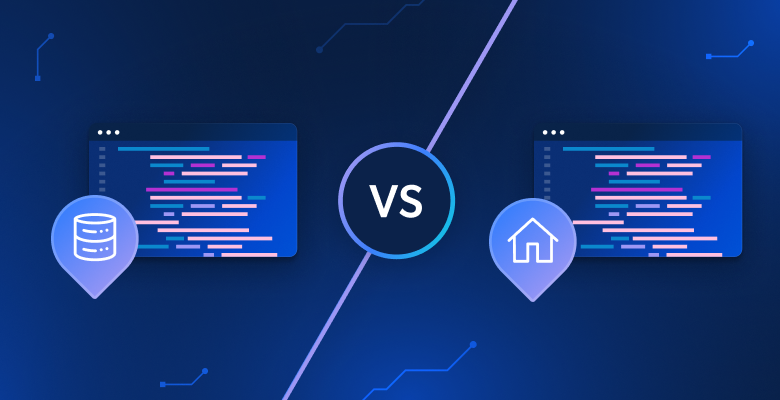
The Core Architecture: Server Farms vs. Real Homes
The proxy market is projected to reach over $15 billion by 2033, driven by the need for automated data collection. Yet, the most common mistake businesses make is selecting the wrong infrastructure for their specific target.
The distinction lies in the source of the IP address.
What is a Datacenter Proxy?
A Datacenter Proxy is an IP address created at a data center. These IPs are owned by cloud service providers (like AWS, Google Cloud, or specialized proxy farms) rather than Internet Service Providers (ISPs).
They act as a gateway between your scraper and the internet. Because they are hosted on powerful servers, they offer exceptional speed and stability. However, they do not belong to real users, making them easier for websites to identify. Subnets of datacenter IPs often share similar patterns, allowing security systems to flag entire blocks at once.
What is a Residential Proxy?
A Residential Proxy is an IP address provided by an ISP (like Verizon, AT&T, or Comcast) to a homeowner. When you route traffic through a residential proxy, your request appears to originate from a real person’s device, such as a laptop or smartphone.
This legitimacy is the primary value proposition. Because these IPs are tied to physical locations and real user behavior, they possess a high “trust score” in the eyes of web servers.
Performance Showdown: Speed vs. Trust
When choosing between these two types, you are essentially trading speed for legitimacy. Recent industry benchmarks highlight this divide.
Success Rates
For targets with sophisticated anti-bot protection, residential proxies are the superior choice. Industry data suggests that residential proxies maintain success rates between 95% and 99%. In contrast, datacenter proxies can see success rates drop to 40-60% on highly protected domains, as security systems easily detect the non-human origin of the IP.
Speed and Latency
Datacenter proxies win on raw throughput. Since they reside in data centers with enterprise-grade bandwidth, they are typically 3x to 4x faster than residential connections. Residential proxies rely on the home Wi-Fi or mobile data of the peer device, which introduces latency and potential instability.
Cost Efficiency
Your budget allocation depends entirely on your target.
- Datacenter: Typically priced per IP or with flat-rate bandwidth. This makes them highly cost-effective for high-volume tasks on low-security sites.
- Residential: Usually priced per Gigabyte (GB) of traffic. The cost is higher because sourcing ethical residential IPs involves a complex peer-to-peer network.
For a detailed breakdown of pricing models, you can review our guide on the best scraping proxies.
When to Use Which?
Choosing the wrong proxy type results in either wasted budget (overpaying for residential) or wasted time (blocked datacenter requests).
Use Datacenter Proxies When:
- Speed is Critical: You need to scrape millions of pages quickly.
- Target is “Low Security”: You are accessing public government records or simple HTTP sites without advanced bot protection.
- Budget is Tight: You need a predictable, flat monthly cost.
Use Residential Proxies When:
- Target is “High Security”: You are scraping e-commerce giants, social media platforms, or travel aggregators.
- Location Matters: You need to verify ads or content in a specific city or zip code. Residential IPs offer granular geo-targeting.
- Account Management: You are managing multiple social media accounts and need each one to appear as a unique, real user.
The Hybrid Solution: ISP Proxies
There is a third option that bridges the gap. ISP Proxies (also known as Static Residential Proxies) are hosted in data centers but are registered under legitimate ISPs.
This combination offers the speed of a datacenter proxy with the trust score of a residential IP. They are ideal for use cases that require keeping the same IP address for a long session, such as managing a seller account on an e-commerce platform. You can read more about this in our Static vs. Rotating Proxies comparison.
Comparison Table
| Feature | Datacenter Proxies | Residential Proxies | ISP Proxies |
|---|---|---|---|
| IP Source | Data centers (AWS, Google Cloud) | Real ISPs (Verizon, AT&T, Comcast) | Data centers registered under ISPs |
| Success Rate (Protected Sites) | 40-60% | 95-99% | 85-95% |
| Speed | 3-4x faster | Standard home/mobile speeds | Fast (datacenter-level) |
| Legitimacy/Trust Score | Low (easily detected) | High (appears as real user) | High (ISP-registered) |
| Pricing Model | Per IP or flat-rate bandwidth | Per GB of traffic | Per IP (static) |
| Cost Efficiency | Highest (low cost per request) | Lower (higher per GB) | Medium |
| Geo-Targeting | Limited | Granular (city/zip code level) | Moderate |
| Best Use Cases | High-volume scraping, low-security sites, speed-critical tasks | E-commerce, social media, travel sites, ad verification | Account management, long sessions, e-commerce sellers |
| IP Rotation | Easy and fast | Available but slower | Typically static |
| Detection Risk | High on protected sites | Very low | Low |
Conclusion
The choice between datacenter and residential proxies is not about which is “better” in the abstract, but which is right for your specific target.
- Datacenter IPs are the workhorses for speed and volume on open websites.
- Residential IPs are the keys to unlocking protected, high-value data.
Most sophisticated data operations use a mix of both. They route easy traffic through cheap datacenter IPs and switch to residential networks only when facing blocks or requesting sensitive data.
By understanding these architectural differences, you can build a scraping pipeline that is both cost-efficient and resilient.
Ready to optimize your proxy strategy? Start your free trial with Bright Data today to test both network types.



Web Data & AI Expert
 6 years experience
Daniel Shashko is a Senior SEO/GEO at Bright Data, specializing in B2B marketing, international SEO, and building AI-powered agents, apps, and web tools.