







In the new era of agentic engineering, “context” is no longer just data; it is the fuel for every decision your agent makes. Yet, most teams treat context as a static input rather than a dynamic engineering challenge. The real bottleneck isn’t only access to data – it’s the ability to shape that data into a state that is fresh, verified, and token-efficient enough for reliable reasoning.
Context-as-a-Service has emerged as a fundamental solution to provide agents with the best context possible. CaaS provides the infra to transform this gigantic and unstructured web data into the agent-ready knowledge base. They invest time in engineering the context and the sources from which the agents receive their final connected and structured info.
CaaS bridges the raw knowledge base that humans have spent a lifetime building (web data) and intelligent execution by offering their domain-specific data layers; ensuring that agents are not searching for information but are instead powered by enriched, verified context that is tailored for automated reasoning and decision-making.
However, it comes at a cost: you are constantly renting someone else’s engineered context to power your agents.
The Hidden Cost of Renting Context
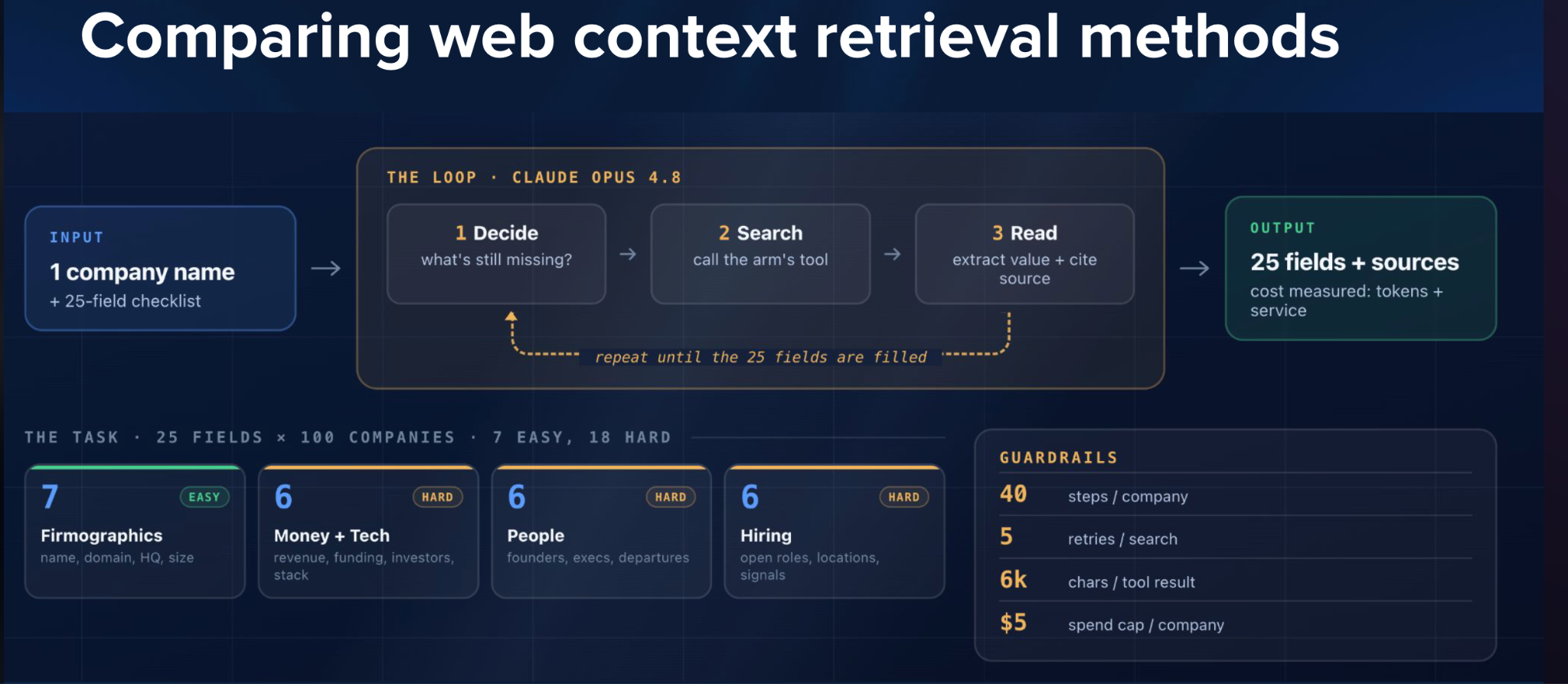
To understand the economic trade-offs of this infrastructure we asked an AI agent to enrich 100 companies with 25 data fields using various retrieval methods. The fields included easy to acquire firmographics (hq, employee count, domain) and harder ones like revenue, financials, tech stack, people and hiring signals.
The retrieval tool that the AI had access to, was the only changing variable.
Harness shape
Methods compared
| Public name | What it represents |
|---|---|
| Search 1 / Search 2 / Search 3 | AI search tools designed to feed a context window instead of a browser tab. |
| Native | Model-native search inside the model environment. |
| CaaS 1 / CaaS 2 / CaaS 3 | Context services and vertical providers. |
| Unlocker + SERP | Agent on raw web infrastructure: search results plus unblocked pages. |
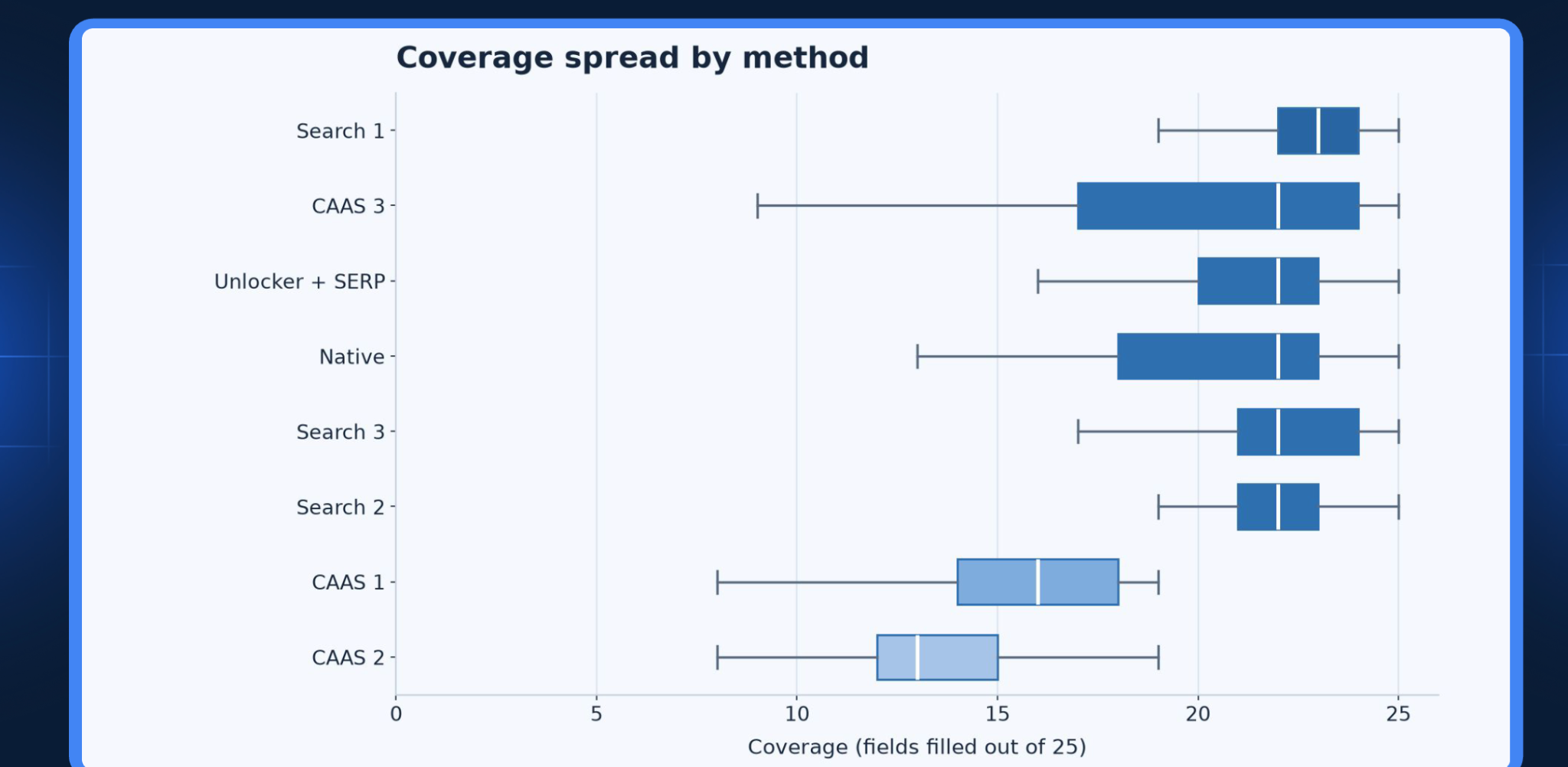
Coverage is how much of the data each method was able to fill in…
Cost breaks down into two parts: the price of the service itself, and the tokens the AI spends absorbing and structuring the data.
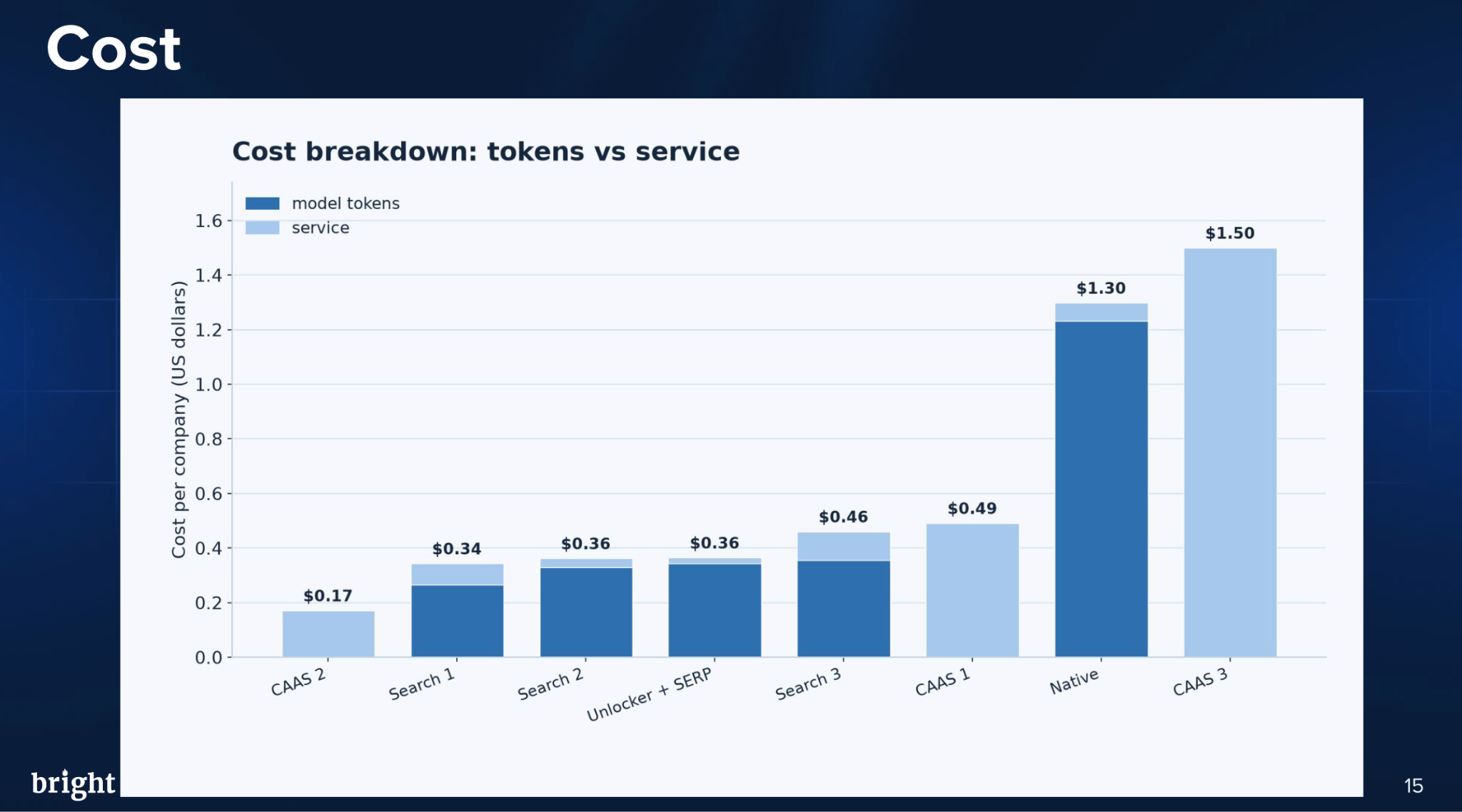
Searches and CaaSes are great for this use case – when you want some basic data quickly, exactly like a rented car.
But does this scale?
There is a basic shape here: you pay again every time you ask for context. Whether you ask for 100 companies, 1k, 100k, or millions of companies or data, you are still “renting” your data.
- Every repeated entity costs the same as the first
- Noise and false positives you can’t filter out
- Token costs don’t compress with volume
- Teams start cutting corners to manage the bill
At scale, it’s pretty obvious you’re better off owning the car than renting one every day to drive to the same place.
So how do you own it? How do you own your AI search tool or CaaS?
Web context engineering
Web context engineering means architecting the diverse sources you have into one specific pipeline that you can reuse and scale, and bring the information in the best way for the AI.
Instead of asking an agent to search the web live for every company, we built a repeatable scraper-backed pipeline.
We used Bright Data’s Scraper Studio, plus some existing Bright Data scrapers, to collect the sources we knew mattered, then mapped those records into the same 25 fields.
The agent is no longer doing all the retrieval work live. The context layer is doing more of the work before the model ever sees it.
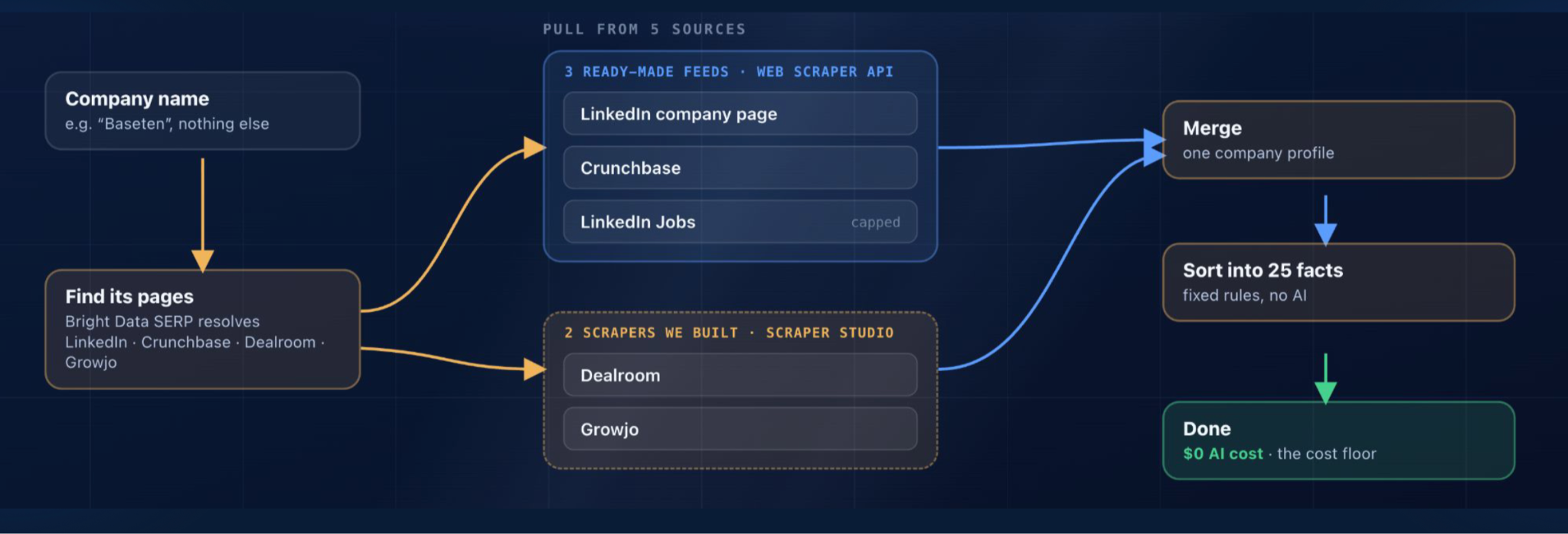
Figure: owned context pipeline
Plot twist: setup cost
To make the comparison fair, we also gave the owned pipeline a real setup cost.
Imagine I hired the smartest person I know to build this scraper and paid them an exaggerated $5k to research and plan which sources to pull data from, which really took about three hours of chatting with Claude.
And we called that method DIY, which stands for “Do (or Build) it yourself.”
After that, the important number is the marginal cost each time we enrich another company.
The DIY Advantage: Building for Scale
Coverage is about the same; although it is slightly less, there is no major gap.
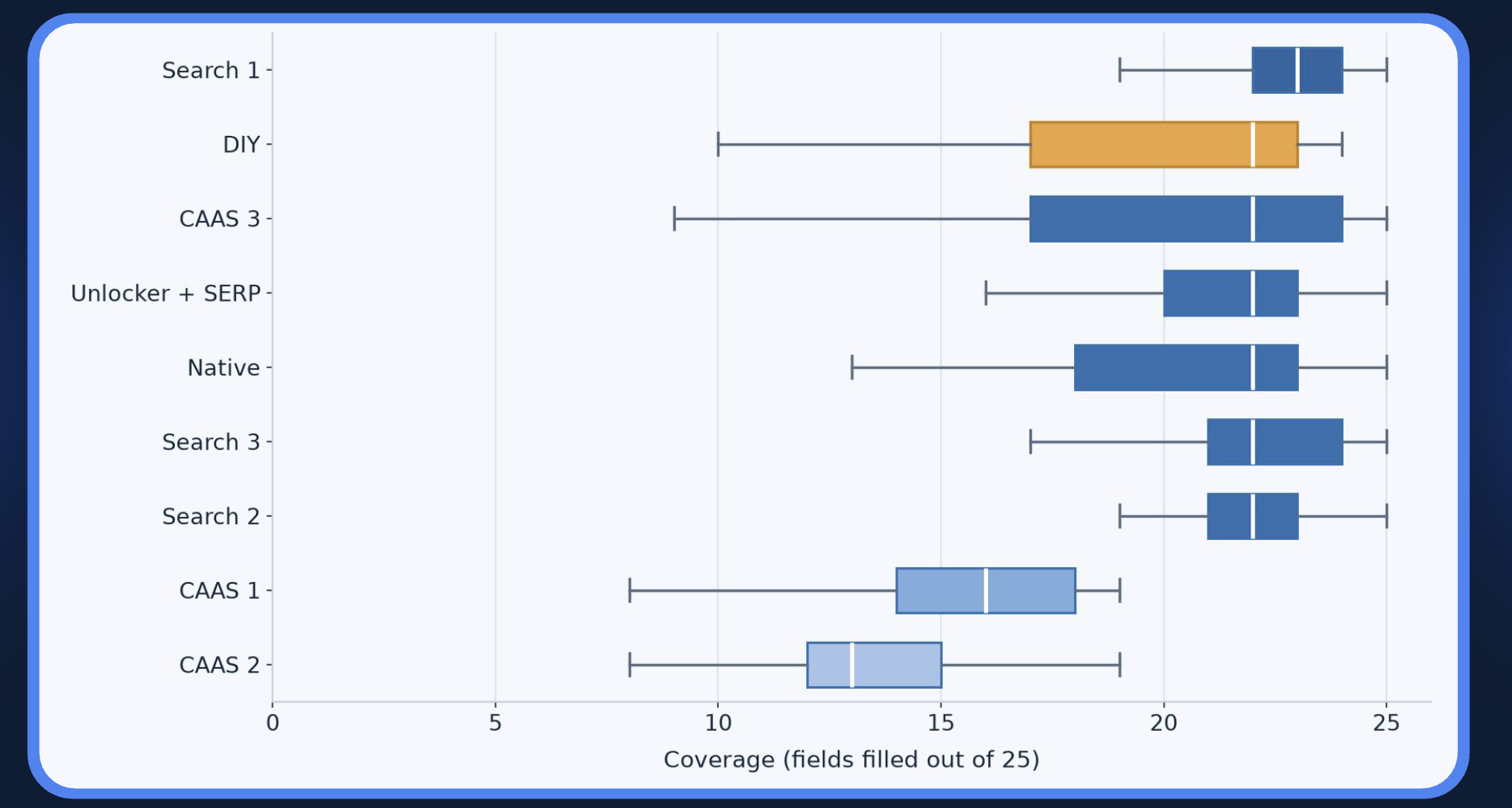
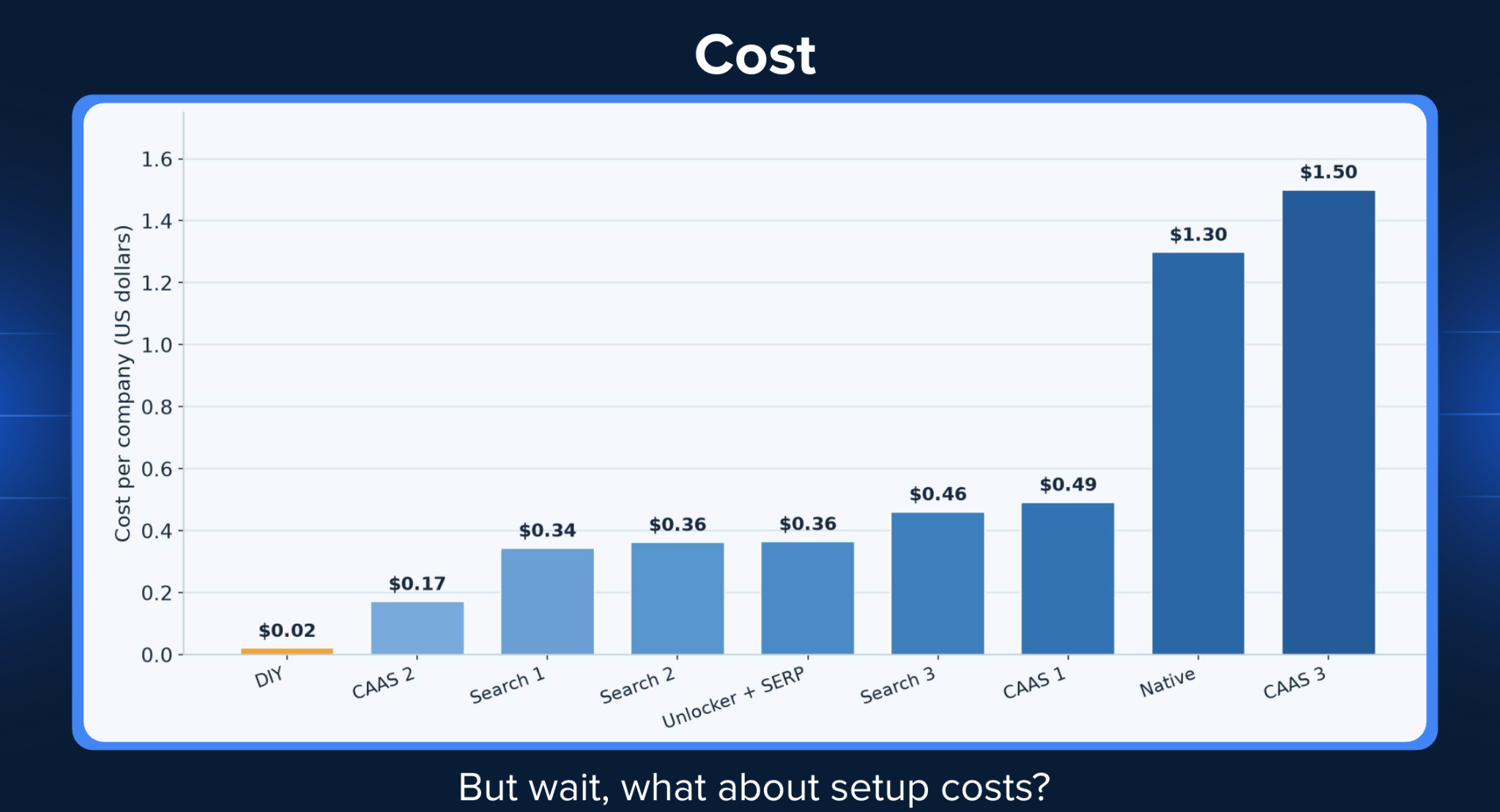
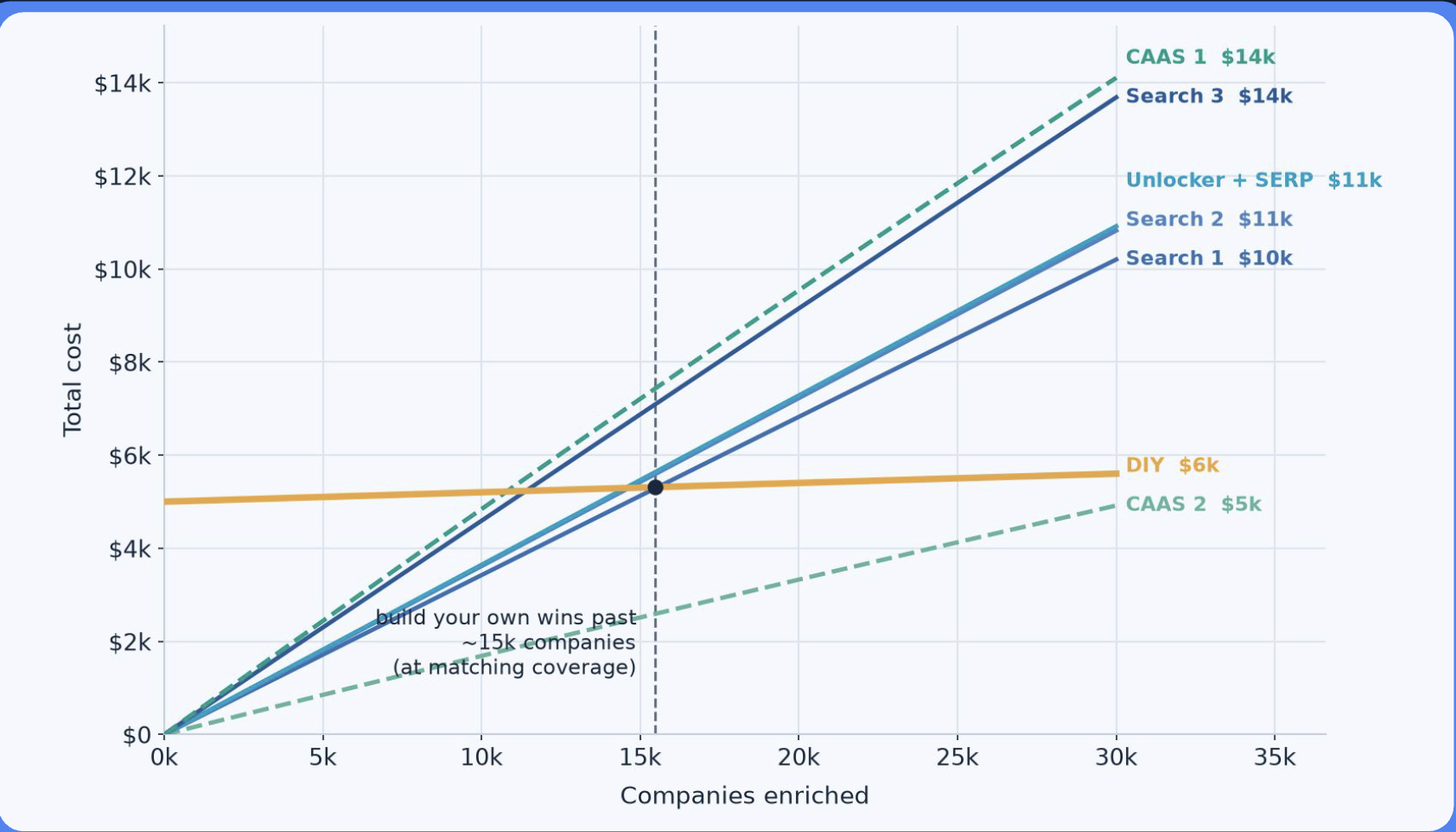
Figure: build vs rent tipping point
At a small scale, renting can still be the obvious move. At a larger scale, the one-time build cost gets spread across more and more enrichments.
The tipping point tells us that beyond a certain scale, owning your pipeline becomes far more efficient.
The Economics of Web Context Engineering
As the data shows, the renting model has a ceiling. At a certain volume, the cost of these services outpaces the upfront investment of building your own infrastructure. Let’s zoom out towards a scale…
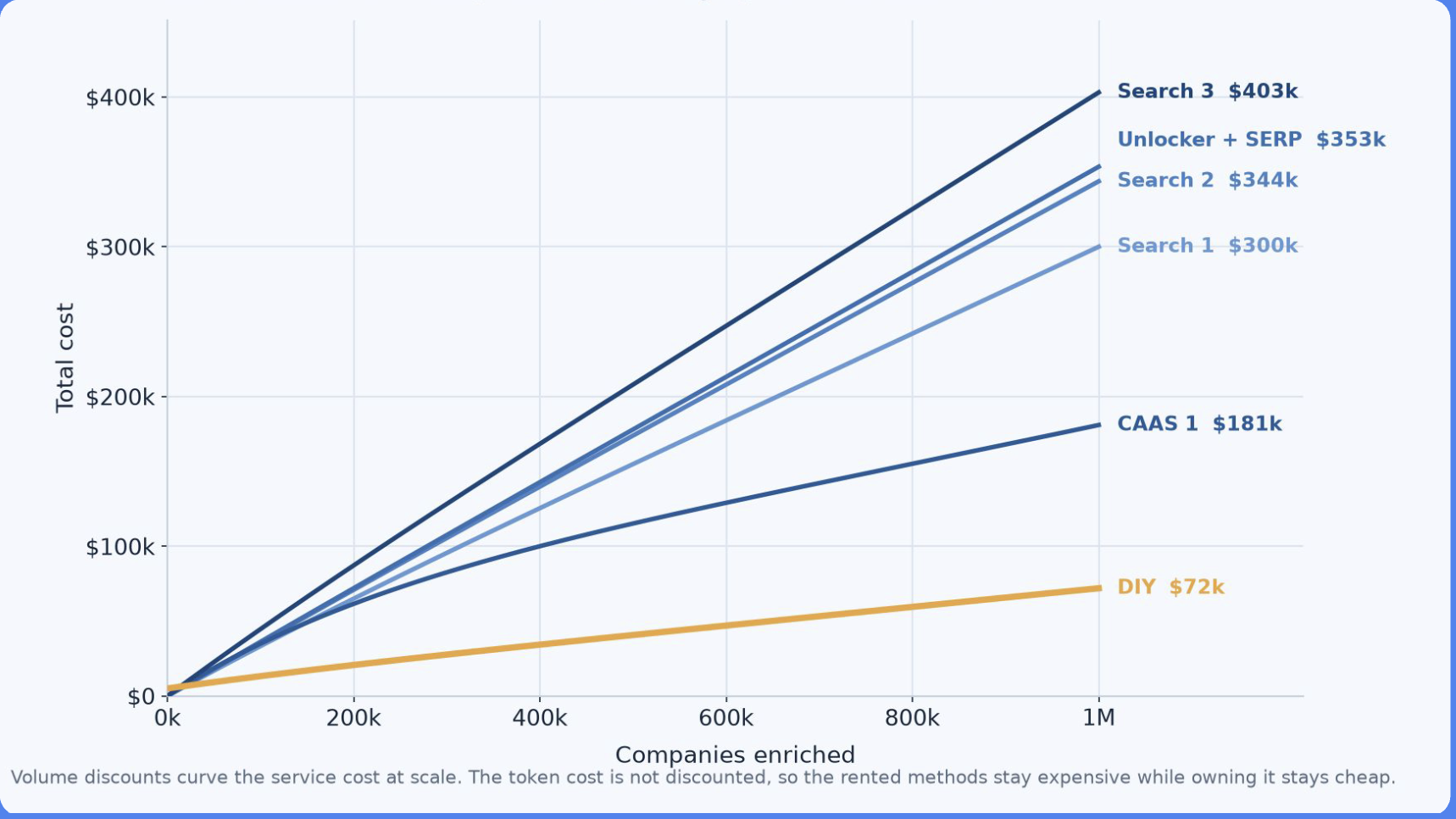
The case is set:
- Rent when your knowledge needs are small and diverse.
- Use search when the task is ad hoc and open-ended.
- Use CaaS when the domain is recurring and specialized, and you want structured, verified, agent-ready context.
Build when the workflow repeats, the same entities recur, freshness matters, and you need control over the business logic.
That is where Web Context Engineering becomes a real operating advantage.
And if you are a builder, this is also the opportunity.
CaaS is not just a vendor category. It is a sign that agents need a governed context layer:
- Controlled entities
- Controlled schemas
- Freshness rules
- Source verification
- Domain-specific ontologies
- Reusable context pipelines
The agent era turns web data into infrastructure. The winners are the teams that can turn messy, fast-changing web data into reliable, structured, reusable context.
Go build your own!