









Residential proxies route your traffic through real home IP addresses. That makes your requests look like ordinary users. They are the backbone of large-scale web data collection. Choose well and your success rates stay high.
But the market is uneven, and sourcing matters as much as speed. Automated traffic hit 51% of all web requests in 2024, per the Imperva 2025 Bad Bot Report. Anti-bot defenses are fierce. The stakes are real, too. In July 2026, the FBI seized NetNut, a major residential proxy network, over botnet abuse.
This guide ranks the best residential proxies of 2026. Every price below is verified on the provider’s own page.
In this guide, you will learn:
- What a residential proxy provider does and how to judge one.
- Why ethical sourcing and compliance protect your business.
- The 10 best residential proxies, ranked and compared.
TL;DR: Best Residential Proxies at a Glance
Short on time? Here is the ranked shortlist with verified starting prices.
| Provider | Best For | Starting Price | Review Score |
|---|---|---|---|
| Bright Data | overall | From $2.50/GB | G2 4.6/5 |
| Oxylabs | for enterprise scale | From $2.50/GB | G2 4.5/5 |
| Decodo | value for developers | From $2/GB | Trustpilot 4.2/5 |
| IPRoyal | pay-as-you-go | From $1.75/GB | Trustpilot 4.6/5 |
| SOAX | for granular targeting | From $3/GB | Trustpilot 4.2/5 |
| Massive | ethically sourced network | From $4.90/GB | Trustpilot 4.5/5 |
| Webshare | budget option | From $1.40/GB | Trustpilot 4.3/5 |
| Evomi | low-cost entry | From $0.49/GB | Trustpilot 4.4/5 |
| DataImpulse | cheap pay-as-you-go | From $1/GB | N/A |
| Infatica | for smaller projects | From $2.60/GB | Trustpilot 3.5/5 |
What Is a Residential Proxy Provider?
A residential proxy provider gives you access to a pool of real residential IP addresses. Your traffic exits through those homes, so sites see a normal connection. That is why residential IPs are far harder to detect and block. Datacenter proxies, by contrast, route through server IPs that sites flag more easily. You can dig into the difference in our guide to what a residential proxy is.
A good provider handles the hard parts for you, including IP rotation, geo-targeting, and session control. That leaves you free to focus on the data, not the plumbing. The payoff shows up across many jobs. Common use cases include price monitoring, SEO tracking, ad verification, and market research.
Why Compliance Matters for Residential Proxies
To protect your reputation and keep your data reliable, your proxies must be sourced ethically and meet compliance standards. This risk is not theoretical. The FBI seizure of NetNut shows what happens when a network ignores ethical sourcing.

Bright Data is fully committed to complying with all relevant data protection legal requirements. That includes the EU data protection framework, GDPR, and the California Consumer Privacy Act of 2018 (CCPA). It respects requests to exercise privacy rights, and every IP is sourced with informed consent. You can read more about our ethical web data collection and data collection ethics practices.
So as you compare the providers below, weigh compliance as heavily as price. A cheap proxy sourced badly is a liability, not a bargain.
How to Choose a Residential Proxy Provider
Judge every provider against these six criteria.
- Ethical sourcing and compliance: GDPR and CCPA compliance, with consent-based IPs.
- Pool size and coverage: more IPs and countries mean better targeting.
- Success rate: high success rates matter when sites block hard.
- Targeting: country, city, ZIP, and ASN-level control.
- Pricing model: match pay-as-you-go or subscription to your volume.
- Tooling: a proxy manager, APIs, and clean documentation.
Also compare residential against datacenter proxies if your targets are less aggressive. Now let us rank the best.
The 10 Best Residential Proxies in 2026
1. Bright Data
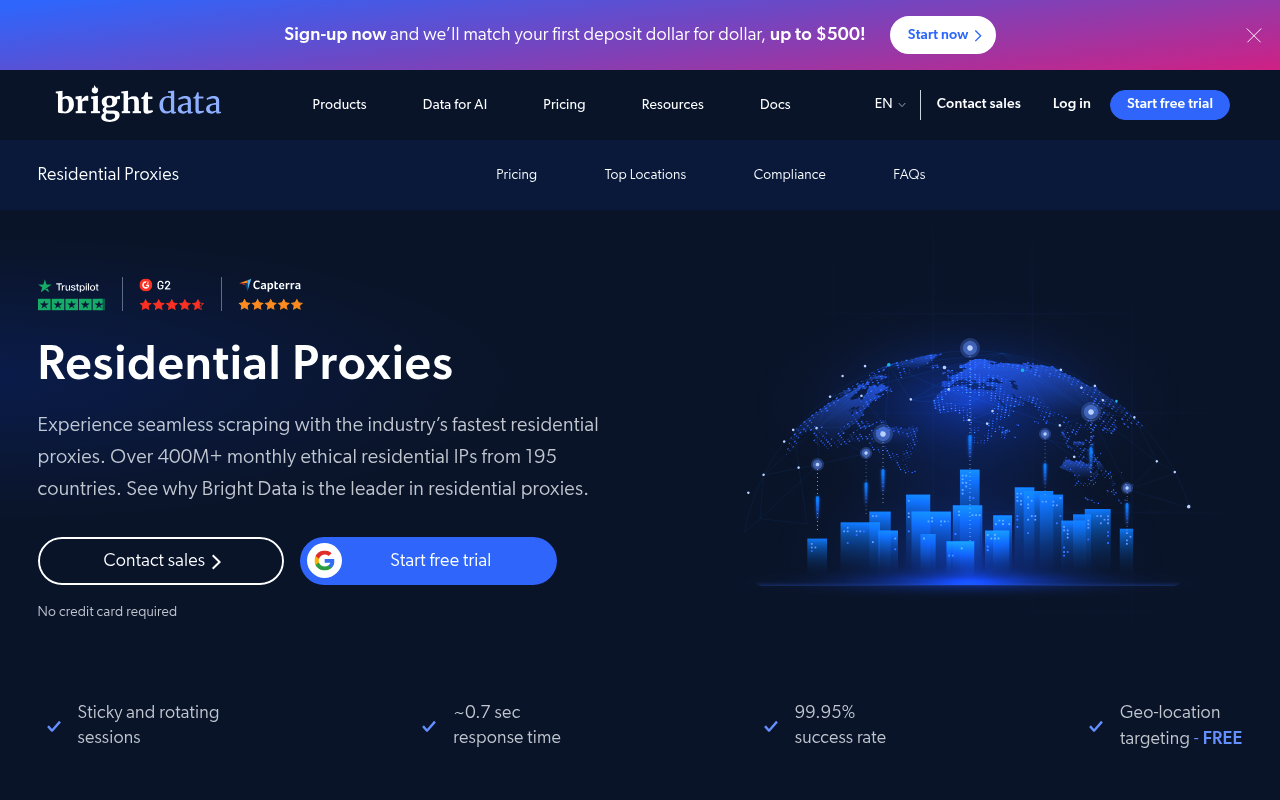
Bright Data is the best residential proxy provider overall. It leads on network scale, reliability, and compliance. The network spans over 400M+ real residential IPs across 195 countries. Sites see genuine home connections, not a data center.
Every IP is ethically sourced with informed consent. Bright Data is fully GDPR and CCPA compliant, backed by a dedicated compliance team. That compliance is a real differentiator. After the FBI seized a rival network in 2026, ethical sourcing is no longer optional.
Targeting is precise, down to country, city, ZIP code, and ASN. The network reports 99.99% uptime. Tooling is enterprise-grade too. You get a Proxy Manager, APIs, and the Web Unlocker for the hardest sites.
Key details:
- Best for: production data collection where compliance and scale matter.
- Network: over 400M+ residential IPs across 195 countries.
- Compliance: GDPR and CCPA compliant, with consent-based, ethically sourced IPs.
- Targeting: country, city, ZIP code, and ASN-level control.
- Reliability: 99.99% network uptime.
- Pricing: from $2.50/GB at volume, or $4/GB pay-as-you-go. Use code RESIGB50 for 50% off for three months.
Pros:
- Largest, most reliable residential network here.
- Full GDPR and CCPA compliance with ethical sourcing.
- Precise targeting and 99.99% uptime.
- Enterprise tooling and unblocking built in.
Cons:
- Not the cheapest per GB.
- Feature depth has a short learning curve.
⭐ Review score: G2 4.6/5
2. Oxylabs
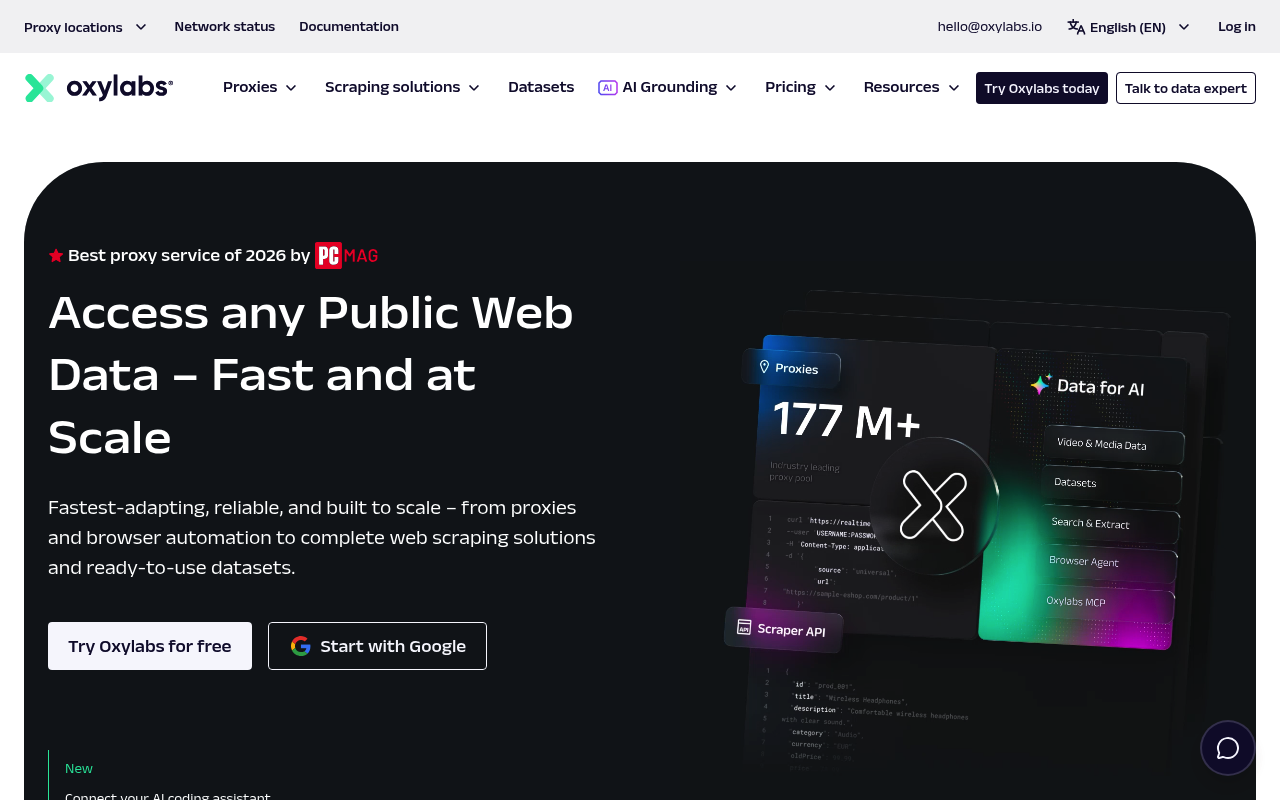
Oxylabs is a premium provider built for enterprise-scale collection. Its residential network is large and reliable. It pairs proxies with a full scraping stack and strong support. Enterprise SLAs and onboarding are available. Targeting is granular, down to city and ASN level. Success rates hold up under heavy, concurrent load.
Key details:
- Best for: enterprises running high-volume, mission-critical scraping.
- Targeting: country, city, and ASN-level control.
- Compliance: ethically sourced, with GDPR and CCPA adherence.
- Pricing: plans from $99/month; from $2.50/GB at volume, with pay-as-you-go available.
Pros:
- Enterprise-grade reliability and support.
- Large, well-managed IP pool.
- Strong compliance posture.
Cons:
- Premium pricing at entry tiers.
- Overkill for small, occasional jobs.
⭐ Review score: G2 4.5/5 (422 reviews)
3. Decodo
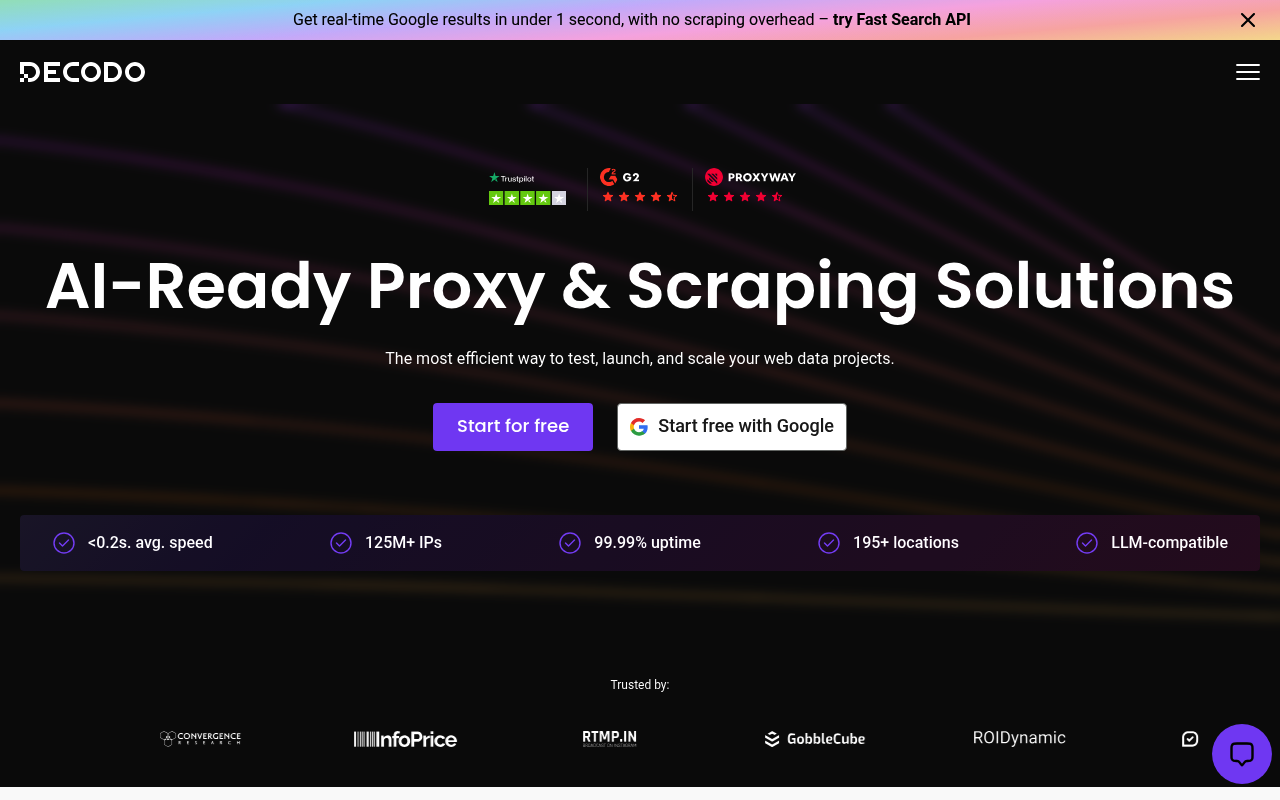
Decodo, formerly Smartproxy, is the value pick for developers. It balances price, quality, and ease of use. The network spans 115M+ residential IPs with a high success rate. Setup is quick and well documented. A 3-day free trial lets you test before you commit. Pay-as-you-go is available for spiky workloads.
Key details:
- Best for: developers who want quality at a fair price.
- Network: 115M+ residential IPs.
- Free trial: 3-day trial available.
- Pricing: from $2/GB, or $7/GB pay-as-you-go.
Pros:
- Strong value for money.
- Developer-friendly docs and dashboard.
- Flexible pay-as-you-go option.
Cons:
- Smaller pool than the top enterprise players.
- Premium features sit behind higher tiers.
⭐ Review score: Trustpilot 4.2/5 (2,000+ reviews)
4. IPRoyal
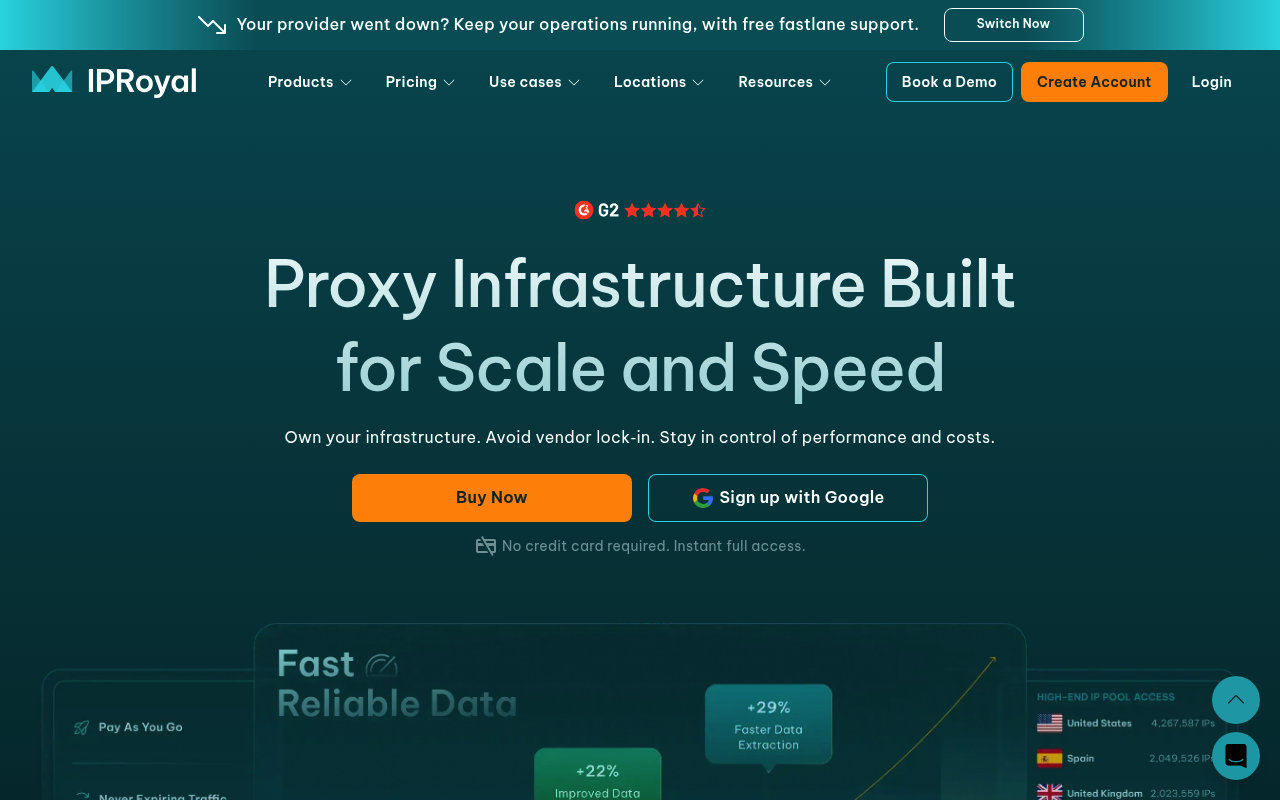
IPRoyal is popular for flexible, pay-as-you-go residential proxies. Its Royal Residential product bills by usage. It focuses on ethics and compliance, with consent-based sourcing. Support is responsive and well reviewed. Bandwidth never expires on pay-as-you-go plans. That suits teams with unpredictable data needs.
Key details:
- Best for: flexible, no-commitment usage.
- Model: pay-as-you-go with non-expiring traffic.
- Compliance: ethically sourced, consent-based IPs.
- Pricing: from $1.75/GB at volume, or $7/GB pay-as-you-go.
Pros:
- Non-expiring bandwidth.
- Strong Trustpilot reputation.
- Good value at volume.
Cons:
- Pay-as-you-go rate is high per GB.
- Pool smaller than enterprise leaders.
⭐ Review score: Trustpilot 4.6/5 (900+ reviews)
5. SOAX
SOAX is known for precise, granular targeting. You can filter down to country, region, city, and ASN. Its network is ethically sourced and whitelisted. SOAX reports a 99.95% proxy success rate. Pricing scales with committed volume across clear tiers. Enterprise rates drop sharply at high usage.
Key details:
- Best for: campaigns that need fine-grained geo-targeting.
- Targeting: country, region, city, and ASN-level.
- Success rate: 99.95% reported.
- Pricing: plans from $200/month; from $3/GB (Tier 1), down to $0.32/GB at enterprise scale.
Pros:
- Excellent granular targeting.
- High reported success rate.
- Ethically sourced network.
Cons:
- Entry plans start higher than budget rivals.
- Best rates need large commitments.
⭐ Review score: Trustpilot 4.2/5 (149 reviews)
6. Massive
Massive is a compliance-forward provider with an ethically sourced network. Every IP is consent-based. It spans real residential IPs across 195+ countries. Unused bandwidth rolls over to the next month. The focus on ethical sourcing makes it a safe pick. It suits teams that treat compliance as non-negotiable.
Key details:
- Best for: teams that prioritize ethical, compliant sourcing.
- Coverage: 195+ countries.
- Perk: unused bandwidth rolls over monthly.
- Pricing: from $4.90/GB; Enterprise from $3.20/GB; $8/GB pay-as-you-go.
Pros:
- Strong ethical-sourcing story.
- Wide country coverage.
- Bandwidth rollover reduces waste.
Cons:
- Higher entry price per GB.
- Smaller brand footprint than the leaders.
⭐ Review score: Trustpilot 4.5/5 (177 reviews)
7. Webshare
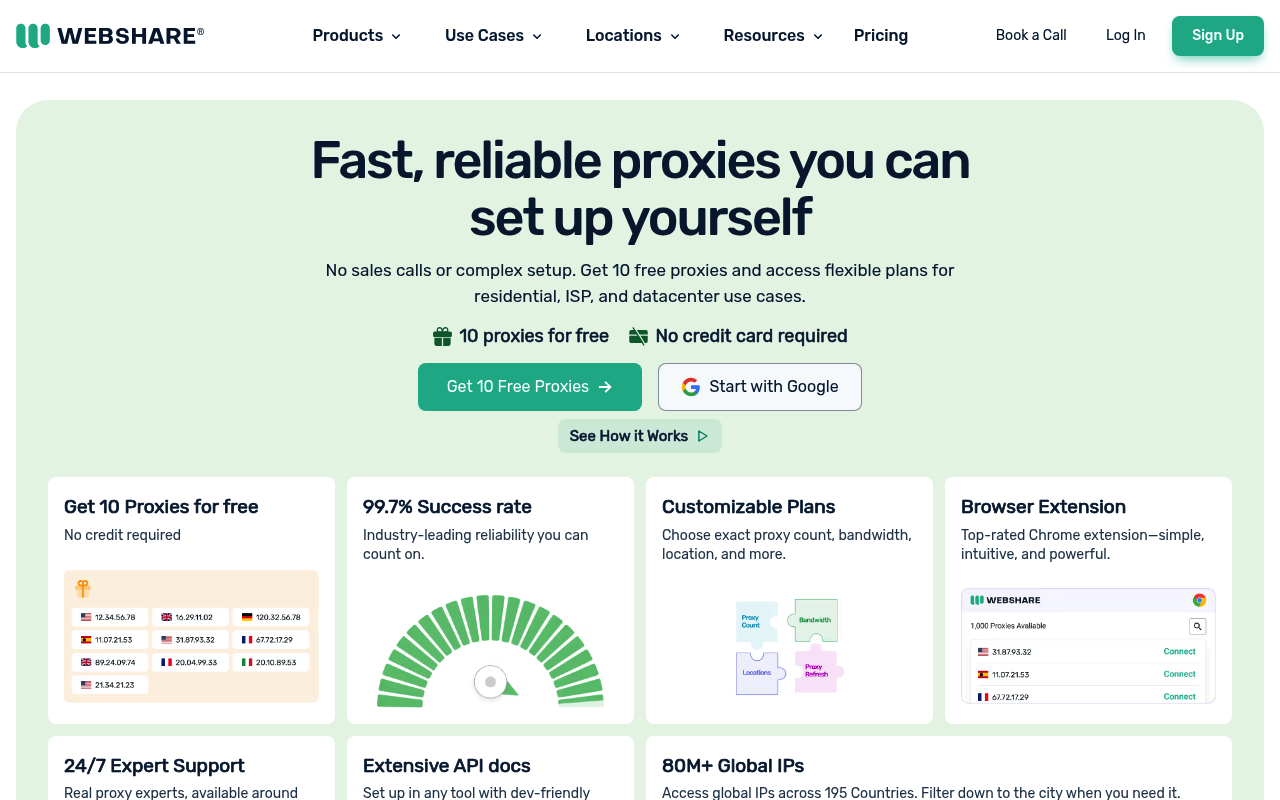
Webshare is the budget favorite, with a generous free tier. Paid residential plans stay affordable. Pricing drops to $1.40/GB at volume, and a 50% sale is often live. Self-service setup is fast. It suits smaller teams and first-time proxy buyers. The dashboard is simple and beginner-friendly.
Key details:
- Best for: budget-conscious and first-time users.
- Free tier: a free plan for testing.
- Setup: instant, self-service onboarding.
- Pricing: as low as $1.40/GB; entry around $3.50/GB with the current 50% sale.
Pros:
- Very affordable at volume.
- Free tier to start.
- Simple, beginner-friendly setup.
Cons:
- Smaller pool than premium providers.
- Advanced targeting is limited.
⭐ Review score: Trustpilot 4.3/5 (1,000+ reviews)
8. Evomi
Evomi is a Swiss provider with market-beating entry pricing. Its Core Residential plan starts very low. The network holds 54M+ ethically sourced residential IPs. Speed and support earn consistent praise. A low monthly base makes it friendly for small teams. Premium residential tiers add scale when you grow.
Key details:
- Best for: low-cost entry without sacrificing ethics.
- Network: 54M+ ethically sourced IPs.
- Base: Core Residential from $49.99/month.
- Pricing: from $0.49/GB (Core); Premium pay-as-you-go at $4/GB.
Pros:
- Very low entry price.
- Ethically sourced, Swiss-based.
- Strong speed and support reviews.
Cons:
- Smaller pool than the leaders.
- Best rate is on the Core plan only.
⭐ Review score: Trustpilot 4.4/5
9. DataImpulse
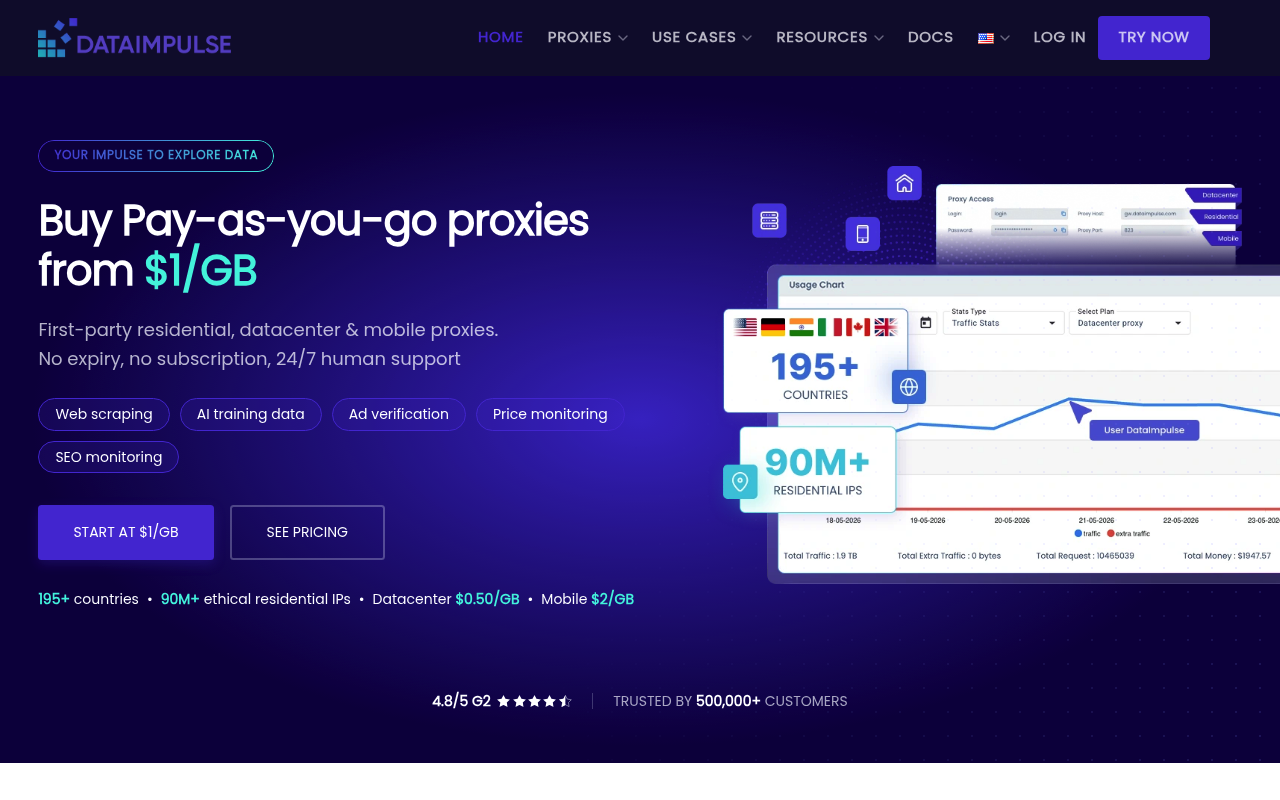
DataImpulse is the cheapest true pay-as-you-go option here. Residential traffic costs about $1 per GB. The network has grown to 90M+ ethically sourced IPs across 195 countries. There is no monthly commitment. It suits price-sensitive projects and quick tests. Heavy users pay even less above one terabyte.
Key details:
- Best for: the lowest pay-as-you-go price.
- Network: 90M+ IPs across 195 countries.
- Model: pay-as-you-go, no commitment.
- Pricing: $1/GB, dropping to $0.80/GB above 1 TB.
Pros:
- Lowest pay-as-you-go rate.
- No monthly commitment.
- Large, growing IP pool.
Cons:
- Reviews are mixed on consistency.
- Fewer enterprise features.
10. Infatica
Infatica rounds out the list with a solid mid-market network. It targets smaller projects and teams. The pool holds 35M+ residential IPs with global coverage. A 7-day trial lets you test the service. Pricing is transparent and pay-as-you-go friendly. It is a dependable choice for lighter workloads.
Key details:
- Best for: smaller projects and lighter workloads.
- Network: 35M+ residential IPs.
- Trial: 7-day trial available.
- Pricing: from $2.60/GB at volume, or $4/GB pay-as-you-go.
Pros:
- Transparent pricing.
- Good for smaller jobs.
- Global coverage.
Cons:
- Smaller pool than leaders.
- Lower review scores than top picks.
⭐ Review score: Trustpilot 3.5/5 (136 reviews)
Best Residential Proxies: Summary Table
| Provider | Best for | Starting price | Review score |
|---|---|---|---|
| Bright Data | Overall | From $2.50/GB | G2 4.6/5 |
| Oxylabs | For enterprise scale | From $2.50/GB | G2 4.5/5 (422 reviews) |
| Decodo | Value for developers | From $2/GB | Trustpilot 4.2/5 (2,000+ reviews) |
| IPRoyal | Pay-as-you-go | From $1.75/GB | Trustpilot 4.6/5 (900+ reviews) |
| SOAX | For granular targeting | From $3/GB | Trustpilot 4.2/5 (149 reviews) |
| Massive | Ethically sourced network | From $4.90/GB | Trustpilot 4.5/5 (177 reviews) |
| Webshare | Budget option | From $1.40/GB | Trustpilot 4.3/5 (1,000+ reviews) |
| Evomi | Low-cost entry | From $0.49/GB | Trustpilot 4.4/5 |
| DataImpulse | Cheap pay-as-you-go | From $1/GB | N/A |
| Infatica | For smaller projects | From $2.60/GB | Trustpilot 3.5/5 (136 reviews) |
Conclusion
The best residential proxy balances price, scale, and compliance, so do not chase the lowest price alone. Bright Data leads on all three. It pairs a network of over 400M+ IPs with full GDPR and CCPA compliance. When you are ready, start with a residential proxy plan that fits your volume, then scale the winner.
Frequently Asked Questions
What are the best residential proxies in 2026?
Bright Data is the best overall for scale and compliance. Oxylabs suits enterprises, Decodo offers strong value, and Webshare and Evomi lead on low cost.
How much do residential proxies cost?
Residential proxies typically cost $1 to $8 per GB. Prices drop with volume, and pay-as-you-go plans start around $1 to $7 per GB.
Are residential proxies legal?
Yes, using residential proxies to collect public data is generally legal. Choose GDPR and CCPA compliant providers that source IPs with consent.
What is the difference between residential and datacenter proxies?
Residential proxies use real home IPs, so they are hard to detect. Datacenter proxies use server IPs, which are faster and cheaper but easier to block.
Why does ethical sourcing matter for proxies?
Badly sourced proxies expose you to legal and reputational risk. In 2026 the FBI seized a major proxy network over botnet abuse, which shows the stakes.
Which residential proxy is cheapest?
Evomi starts at $0.49/GB on its Core plan, and DataImpulse charges about $1/GB pay-as-you-go. Webshare drops to $1.40/GB at volume.



Technical Writer
 5.5 years experience
Antonello Zanini is a technical writer, editor, and software engineer with 5M+ views. Expert in technical content strategy, web development, and project management.


