The data infrastructure for SEO and AI search
The essential scraper APIs for AI search visibility and SEO rankings. Scrape structured data from Google AI Overview, ChatGPT, Perplexity, Gemini, and Copilot.
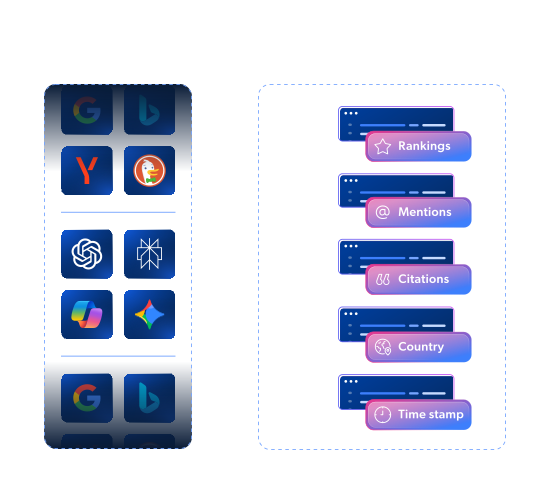
- One data pipeline for LLM SEO, AI search monitoring, and SERPs
- Extract answers, brand mentions, citations, and share of voice data
- Extract answers, brand mentions, citations, and share of voice data
- Built-in unlocking, CAPTCHA solving, sync and async collection
Trusted by 50,000+ customers worldwide


The ultimate scraper API for Generative Engine Optimization (GEO)
Connect your platform to an infrastructure built for hyper-growth. Automate LLM tracking and prompt sets at scale across Google AI Overview, ChatGPT, and Gemini—without managing proxies or parsers.
- Extract answers from every LLM from one platform
- Choose your workflow: API or no-code dashboard
- Target any country for localized results
- Upload prompt lists via CSV for instant bulk crawling
- Scale seamlessly from 1 prompt to 1,000,000 requests
AI Search Scraper & LLM API Library
 322+
322+ 295+
295+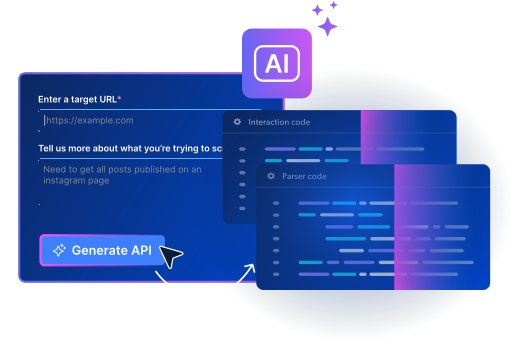
Filter by AI Mode
To maintain a high standard of data quality, only providers with a success rate above 90% were represented in the comparative charts.
The #1 LLM Scraper API & AI Search Crawler Benchmark
AI An independent benchmark of LLM scrapers across ChatGPT, Gemini, Perplexity, and Google AI Mode – 1,000 tests per provider, 25 metadata fields, 90%+ success on every engine.
- Ranked #1 across all 4 LLM modes tested
- 25 metadata fields returned – 6x more than the competition
- Only provider to hit 90%+ success on Gemini
- Outperformed every competitor in success rate and data richness
AI search Playground
Every SERP and LLM data point, every use case covered
Track rankings across search engines and AI platforms

Monitor how brands appear in AI-generated answers

Extract competitive ad intelligence in real time

SERP and LLM data, ready for your analytics stack

Track brand presence across search and AI surfaces


Web Scraper API Pricing
Only pay for what’s successfully delivered. No hidden fees, no charges for failed deliveries.

- Pay only for success, no hidden fees
- Start free with 5,000 monthly credits
- No upfront commitment, cancel anytime
- 24/7 expert support and enterprise features

SERP & AI Search FAQ
What is the Bright Data Scraper API pipeline?
Bright Data’s Scraper APIs are fully managed data collection endpoints designed for scale. Instead of building and maintaining your own scrapers, you simply submit your keywords or prompts to our API. We handle the proxy routing, browser rendering, CAPTCHA solving, and parsing, returning clean, structured JSON or CSV data from traditional search engines (SERP API) and AI answer engines (LLM Scrapers).
How does the infrastructure handle anti-bot blocks across search engines and AI platforms?
Both the SERP API and LLM Scraper APIs are built on a 400M+ IP proxy network with automated browser fingerprinting, cookie management, and session handling. The infrastructure features built-in CAPTCHA solving, IP rotation, and an auto-retry system, ensuring uninterrupted data extraction even during aggressive anti-bot updates.
What is the difference between the data returned by the SERP API and the LLM Scrapers?
The SERP API extracts traditional search engine results (organic rankings, paid ads, local packs, and AI Overviews) from Google, Bing, Yandex, and DuckDuckGo. The LLM Scraper APIs extract fully rendered, generative answers from AI engines (ChatGPT, Gemini, Perplexity, Copilot), capturing citations, shopping signals, and Markdown text. Both use cases share the same delivery infrastructure.
Why scrape the Web UI instead of using official LLM or Search vendor APIs?
Vendor APIs return sanitized "API-mode" responses that differ from what real users experience. Our Web UI capture extracts the fully rendered interface. For SERPs, this means seeing actual ad placements and local packs. For LLMs, it means capturing critical GEO signals like citations, shopping cards, query fan-out behavior, and platform-specific personalization.
What metadata fields and output formats are returned?
Results from both APIs are normalized and delivered in JSON, NDJSON, or CSV formats. SERP data includes rank, title, URL, description, and ad metrics. LLM data includes up to 25 metadata fields, including answer text (HTML/Markdown), citations, source URLs, recommendations, shopping signals, and timestamps.
What are the concurrency limits for high-volume extraction?
Unlike vendor APIs that impose strict rate limits, our infrastructure is built for production scale. You can run up to 5,000 simultaneous requests. For massive workloads (e.g., millions of monthly requests), we highly recommend asynchronous batching to maximize overall throughput and efficiency.
Does the API support granular geo-targeting and localization?
Yes. For traditional SERP requests, you can target search results down to the city and ZIP code level. For LLM scraping, you can run prompts with strict country and language-level targeting, allowing you to simulate AI visibility exactly as it appears to users in specific international markets.
How do I receive my structured data?
Both SERP and LLM data pipelines support flexible, cloud-native delivery. You can pull data via direct REST API download, or configure automated delivery to webhooks, Amazon S3, Google Cloud Storage (GCS), Azure Blob, or SFTP.
Can I schedule automated, recurring tracking runs?
Yes. For traditional SERP tracking, you can define your keyword lists, location parameters, and frequency to run automated daily or weekly tracking jobs. For AI visibility, you can set up asynchronous batch runs to repeatedly test your prompt sets across multiple LLMs over time.
Is the data collection process compliant and secure?
All data is collected exclusively from publicly accessible, unauthenticated web interfaces. Bright Data operates under industry-leading security and compliance standards: the platform is GDPR-ready, CCPA-compliant, ISO 27001 certified, SOC 2 Type II certified, and CSA STAR Level 1 certified. Full compliance documentation is available upon request.